Results by title
53 books match the query 'Secondary' and 2 start with h
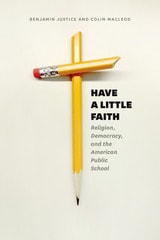
Have a Little Faith
Religion, Democracy, and the American Public SchoolBenjamin Justice and Colin Macleod
University of Chicago Press, 2016
It isn’t just in recent arguments over the teaching of intelligent design or reciting the pledge of allegiance that religion and education have butted heads: since their beginnings nearly two centuries ago, public schools have been embroiled in heated controversies over religion’s place in the education system of a pluralistic nation. In this book, Benjamin Justice and Colin Macleod take up this rich and significant history of conflict with renewed clarity and astonishing breadth. Moving from the American Revolution to the present—from the common schools of the nineteenth century to the charter schools of the twenty-first—they offer one of the most comprehensive assessments of religion and education in America that has ever been published.
From Bible readings and school prayer to teaching evolution and cultivating religious tolerance, Justice and Macleod consider the key issues and colorful characters that have shaped the way American schools have attempted to negotiate religious pluralism in a politically legitimate fashion. While schools and educational policies have not always advanced tolerance and understanding, Justice and Macleod point to the many efforts Americans have made to find a place for religion in public schools that both acknowledges the importance of faith to so many citizens and respects democratic ideals that insist upon a reasonable separation of church and state. Finally, they apply the lessons of history and political philosophy to an analysis of three critical areas of religious controversy in public education today: student-led religious observances in extracurricular activities, the tensions between freedom of expression and the need for inclusive environments, and the shift from democratic control of schools to loosely regulated charter and voucher programs.
Altogether Justice and Macleod show how the interpretation of educational history through the lens of contemporary democratic theory offers both a richer understanding of past disputes and new ways of addressing contemporary challenges.
[more]
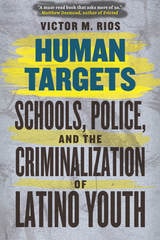
Human Targets
Schools, Police, and the Criminalization of Latino YouthVictor M. Rios
University of Chicago Press, 2017
At fifteen, Victor Rios found himself a human target—flat on his ass amid a hail of shotgun fire, desperate for money and a place on the street. Faced with the choice of escalating a drug turf war or eking out a living elsewhere, he turned to a teacher, who mentored him and helped him find a job at an auto shop. That job would alter the course of his whole life—putting him on the road to college and eventually a PhD. Now, Rios is a rising star, hailed for his work studying the lives of African American and Latino youth.
In Human Targets, Rios takes us to the streets of California, where we encounter young men who find themselves in much the same situation as fifteen-year-old Victor. We follow young gang members into schools, homes, community organizations, and detention facilities, watch them interact with police, grow up to become fathers, get jobs, get rap sheets—and in some cases get killed. What is it that sets apart young people like Rios who succeed and survive from the ones who don’t? Rios makes a powerful case that the traditional good kid/bad kid, street kid/decent kid dichotomy is much too simplistic, arguing instead that authorities and institutions help create these identities—and that they can play an instrumental role in providing young people with the resources for shifting between roles. In Rios’s account, to be a poor Latino youth is to be a human target—victimized and considered an enemy by others, viewed as a threat to law enforcement and schools, and burdened by stigma, disrepute, and punishment. That has to change.
This is not another sensationalistic account of gang bangers. Instead, the book is a powerful look at how authority figures succeed—and fail—at seeing the multi-faceted identities of at-risk youths, youths who succeed—and fail—at demonstrating to the system that they are ready to change their lives. In our post-Ferguson era, Human Targets is essential reading.
[more]