Results by title
279 books match the query 'Slavery' and 4 start with h

Harriet Jacobs
A PlayLydia R. Diamond
Northwestern University Press, 2010
Throughout her meteoric rise into the upper ranks of young playwrights, Lydia R. Diamond has boldly challenged assumptions about African American culture. In Harriet Jacobs, she turns one of the greatest of American slave narratives, Jacobs’ Incidents in the Life of a Slave Girl, into a penetrating, rousing work of theater.
Jacobs’ book—which was published in 1861 and only partially serialized in Horace Greely’s New York Tribune before it was deemed too graphic—chillingly exposed the sexual harassment and abuse of slave girls and women at the hands of their masters. Harriet Jabobs: A Play organically incorporates theatrical elements that extend the book’s enormous power. Through active scenes, piercing direct address, and slave narratives, Diamond is able to give new expression to the horrors and legacies of slavery. Diamond presents African American culture in all its richness—with slavery as a part of it, but not its defining aspect. Though harrowing, Harriet Jacobs addresses the necessary task of reenvisioning a difficult chapter in American history.
Jacobs’ book—which was published in 1861 and only partially serialized in Horace Greely’s New York Tribune before it was deemed too graphic—chillingly exposed the sexual harassment and abuse of slave girls and women at the hands of their masters. Harriet Jabobs: A Play organically incorporates theatrical elements that extend the book’s enormous power. Through active scenes, piercing direct address, and slave narratives, Diamond is able to give new expression to the horrors and legacies of slavery. Diamond presents African American culture in all its richness—with slavery as a part of it, but not its defining aspect. Though harrowing, Harriet Jacobs addresses the necessary task of reenvisioning a difficult chapter in American history.
[more]
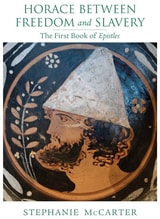
Horace between Freedom and Slavery
The First Book of <i>Epistles</i>Stephanie McCarter
University of Wisconsin Press, 2015
During the Roman transition from Republic to Empire in the first century B.C.E., the poet Horace found his own public success in the era of Emperor Augustus at odds with his desire for greater independence. In Horace between Freedom and Slavery, Stephanie McCarter offers new insights into Horace's complex presentation of freedom in the first book of his Epistles and connects it to his most enduring and celebrated moral exhortation, the golden mean.
She argues that, although Horace commences the Epistles with an uncompromising insistence on freedom, he ultimately adopts a middle course. She shows how Horace explores in the poems the application of moderate freedom first to philosophy, then to friendship, poetry, and place. Rather than rejecting philosophical masters, Horace draws freely on them without swearing permanent allegiance to any—a model for compromise that allows him to enjoy poetic
renown and friendships with the city's elite while maintaining a private sphere of freedom. This moderation and adaptability, McCarter contends, become the chief ethical lessons that Horace learns for himself and teaches to others. She reads Horace's reconfiguration of freedom as a political response to the transformations of the new imperial age.
[more]
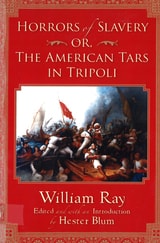
Horrors of Slavery
Or, The American Tars in TripoliBlum, Hester
Rutgers University Press, 2008
Barbary pirates in Africa targeted sailors for centuries, often taking slaves and demanding ransom in exchange. First published in 1808, Horrors of Slavery is the tale of one such sailor, captured during the United States's first military encounter with the Islamic world, the Tripolitan War. William Ray, along with three hundred crewmates, spent nineteen months in captivity after his ship, the Philadelphia, ran aground in the harbor of Tripoli. Imprisoned, Ray witnessed-and chronicled-many of the key moments of the military engagement. In addition to offering a compelling history of a little-known war, this book presents the valuable perspective of an ordinary seaman who was as concerned with the injustices of the U.S. Navy as he was with Barbary pirates.
Hester Blum's introduction situates Horrors of Slavery in its literary, historical, and political contexts, bringing to light a crucial episode in the early history of our country's relations with Islamic states.
A volume in the Subterranean Lives series, edited by Bradford Verter
[more]
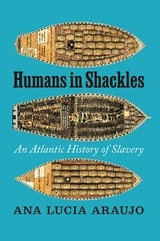
Humans in Shackles
An Atlantic History of SlaveryAna Lucia Araujo
University of Chicago Press, 2024
A sweeping narrative history of the Atlantic slave trade and slavery in the Americas.
During the era of the Atlantic slave trade, more than twelve million enslaved Africans were forcibly transported to the Americas in cramped, inhumane conditions. Many of them died on the way, and those who survived had to endure further suffering in the violent conditions that met them onshore. Covering more than three hundred years, Humans in Shackles grapples with this history by foregrounding the lived experience of enslaved people in tracing the long, complex history of slavery in the Americas.
Based on twenty years of research, this book not only serves as a comprehensive history; it also expands that history by providing a truly transnational account that emphasizes the central role of Brazil in the Atlantic slave trade. Additionally, it is deeply informed by African history and shows how African practices and traditions survived and persisted in the Americas among communities of enslaved people. Drawing on primary sources including travel accounts, pamphlets, newspaper articles, slave narratives, and visual sources such as artworks and artifacts, Araujo illuminates the social, cultural, and religious lives of enslaved people working in plantations and urban areas, building families and cultivating affective ties, congregating and re-creating their cultures, and organizing rebellions.
Humans in Shackles puts the lived experiences of enslaved peoples at the center of the story and investigates the heavy impact these atrocities have had on the current wealth disparity of the Americas and rampant anti-Black racism.
[more]