Results by title
165 books match the query 'Social sciences' and 5 start with h

Handbook of Latin American Studies, Vol. 73
Social SciencesKatherine D. McCann, Humanities Editor; Tracy North, Social Sciences Editor
University of Texas Press, 2019
"The one source that sets reference collections on Latin American studies apart from all other geographic areas of the world. . . . The Handbook has provided scholars interested in Latin America with a bibliographical source of a quality unavailable to scholars in most other branches of area studies." —Latin American Research Review
Beginning with Number 41 (1979), the University of Texas Press became the publisher of the most comprehensive annual bibliography in the field. Compiled by the Hispanic Division of the Library of Congress and annotated by a corps of more than 140 specialists in various disciplines, the Handbook alternates from year to year between social sciences and humanities.
The Handbook annotates works on Mexico, Central America, the Caribbean and the Guianas, Spanish South America, and Brazil, as well as materials covering Latin America as a whole. Most of the subsections are preceded by introductory essays that serve as biannual evaluations of the literature and research under way in specialized areas.
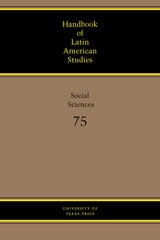
Handbook of Latin American Studies, Vol. 75
Social SciencesKatherine D. McCann
University of Texas Press, 2021
Beginning with Number 41 (1979), the University of Texas Press became the publisher of the most comprehensive annual bibliography in the field. Compiled by the Hispanic Division of the Library of Congress and annotated by a corps of more than 140 specialists in various disciplines, the Handbook alternates from year to year between social sciences and humanities.
The Handbook annotates works on Mexico, Central America, the Caribbean and the Guianas, Spanish South America, and Brazil, as well as materials covering Latin America as a whole. Most of the subsections are preceded by introductory essays that serve as biannual evaluations of the literature and research under way in specialized areas.

Handbook of Latin American Studies, Vol. 77
Social SciencesKatherine D. McCann
University of Texas Press, 2024
The Handbook annotates works on Mexico, Central America, the Caribbean and the Guianas, Spanish South America, and Brazil, as well as materials covering Latin America as a whole. Most of the subsections are preceded by introductory essays that serve as biannual evaluations of the literature and research underway in specialized areas. Subject categories for the Social Sciences editions include anthropology; geography; government and politics; international relations; political economy; and sociology.

Henri Lefebvre on Space
Architecture, Urban Research, and the Production of TheoryLukasz Stanek
University of Minnesota Press, 2010
Countering the prevailing view, which reduces Lefebvre’s theory of space to a projection of his philosophical positions, Stanek argues that Lefebvre’s work grew out of his concrete, empirical engagement with everyday practices of dwelling in postwar France and his exchanges with architects and planners. Stanek focuses on the interaction between architecture, urbanism, sociology, and philosophy that occurred in France in the 1960s and 1970s, which was marked by a shift in the processes of urbanization at all scales, from the neighborhood to the global level. Lefebvre’s thinking was central to this encounter, which informed both his theory of space and the concept of urbanization becoming global.
Stanek offers a deeper and clearer understanding of Lefebvre’s thought and its implications for the present day. At a time when cities are increasingly important to our political, spatial, and architectural world, this reassessment proposes a new empirical, and practical, interpretation of Lefebvre’s ideas on urbanism.

How French Moderns Think
The Lévy-Bruhl Family, From “Primitive Mentality” to Contemporary PandemicsFrédéric Keck
HAU, 2023
How French Moderns Think tells the story of the French sociological tradition through four generations of the Lévy-Bruhl family: Lucien, who founded the Institute of Ethnology at the University of Paris; his son Henri, who founded the Institute of Roman Law; his grandson Raymond, who took part in the creation of the National Institute of Statistics and Economic Studies; and his great-grandson Daniel, a vaccine specialist at the Institute of Public Health. This family history casts a new light on the philosophical debates about “primitive mentality” and the “savage mind.” By drawing on the expert knowledge inherent in this family genealogy, the articulation between the logical and the “pre-logical” is not a cognitive question but rather a problem of anticipating unpredictable events. By relating Lévy-Bruhl’s engagements from the Dreyfus Affair to the Minister of Armaments during the First World War, Keck narrates the confrontation of the socialist ideal of justice and truth with the French colonial experience and its transformations in global technologies preparing for pandemics.