231 books match the query 'Society' and 10 start with h

cover of Hard-Core Romance: "Fifty Shades of Grey," Best-Sellers, and Society

Hard-Core Romance

"Fifty Shades of Grey," Best-Sellers, and Society

Eva Illouz

University of Chicago Press, 2014
From its beginnings in Twilight fan-fiction to its record-breaking sales as an e-book and paperback, the story of the erotic romance novel Fifty Shades of Grey and its two sequels is both unusual and fascinating. Having sold over seventy million copies worldwide since 2011, E. L. James’s lurid series about a sexual ingénue and the powerful young entrepreneur who introduces her to BDSM sex has ingrained itself in our collective consciousness. But why have these particular novels—poorly written and formulaic as they are—become so popular, especially among women over thirty?
 
In this concise, engaging book, Eva Illouz subjects the Fifty Shades cultural phenomenon to the serious scrutiny it has been begging for. After placing the trilogy in the context of best-seller publishing, she delves into its remarkable appeal, seeking to understand the intense reading pleasure it provides and how that resonates with the structure of relationships between men and women today. Fifty Shades, Illouz argues, is a gothic romance adapted to modern times in which sexuality is both a source of division between men and women and a site to orchestrate their reconciliation. As for the novels’ notorious depictions of bondage, discipline, and sadomasochism, Illouz shows that these are as much a cultural fantasy as a sexual one, serving as a guide to a happier romantic life. The Fifty Shades trilogy merges romantic fantasy with self-help guide—two of the most popular genres for female readers.
 
Offering a provocative explanation for the success and popularity of the Fifty Shades of Grey novels, Hard-Core Romance is an insightful look at modern relationships and contemporary women’s literature.
[more]
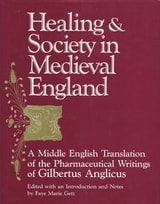
cover of Healing and Society in Medieval England: A Middle English Translation of the Pharmaceutical Writings of Gilbertus Anglicus

Healing and Society in Medieval England

A Middle English Translation of the Pharmaceutical Writings of Gilbertus Anglicus

Faye M. Getz

University of Wisconsin Press, 1991

Originally composed in Latin by Gilbertus Anglicus (Gilbert the Englishman), his Compendium of Medicine was a primary text of the medical revolution in thirteenth-century Europe. Composed mainly of medicinal recipes, it offered advice on diagnosis, medicinal preparation, and prognosis. In the fifteenth-century it was translated into Middle English to accommodate a widening audience for learning and medical “secrets.”
    Faye Marie Getz provides a critical edition of the Middle English text, with an extensive introduction to the learned, practical, and social components of medieval medicine and a summary of the text in modern English. Getz also draws on both the Latin and Middle English texts to create an extensive glossary of little-known Middle English pharmaceutical and medical vocabulary.

[more]
cover of Herman Schmalenbach on Society and Experience

Herman Schmalenbach on Society and Experience

Herman Schmalenbach

University of Chicago Press, 1977

Herman Schmalenbach (1885-1950), a friend of Husserl and a scholarly critic of Tönnies and Weber, carried on the tradition of Georg Simmel and ranks as one of the most important representatives of phenomenological society. However, because of historical and political circumstances, Schmalenbach's writings have received little attention either in his native Germany or abroad. Now Günther Lüschen and Gregory P. Stone have provided the first English translations of some of Schmalenbach's most important works. In their introductory essay to this collection, the editors appraise Schmalenbach as scholar, philosopher, and sociologist.
[more]
cover of Historic Zuni Architecture and Society: An Archaeological Application of Space Syntax

Historic Zuni Architecture and Society

An Archaeological Application of Space Syntax

T. J. Ferguson

University of Arizona Press, 1996

The historic architecture and settlements of the Zuni Indian Tribe in western New Mexico provide an unusual opportunity to investigate social change. In this monograph, the development of historic Zuni society is analyzed by delineating systematic links between the structure of Zuni society and the structure of architectural forms that the Zuni people built to facilitate their activities. Ferguson shows how the structure of open space within Zuni settlements was linked to defense. As long as the Zunis were subject to attack by Spaniards or Navajos, they built settlements that were difficult for outsiders to get into or move around in. As the need for defense waned, settlements became more open and accessible. He also shows how the internal spaces of traditional Zuni houses are oriented around the activities of the women--matriarchs of their families and clans. Federal housing projects tended to spatially isolate the activities of women from interaction with the rest of the household, thus instituting unexpected social change.

Historic Zuni Architecture and Society utilizes an interdisciplinary approach, analyzing archaeological data using method, theory, and techniques from the fields of architecture, planning, and ethnology. Archaeologists will find in the book an innovative application of space syntax to archaeological problems, and cultural anthropologists and others interested in the history of the Zuni Indians will value its observations about changes that are currently taking place in Zuni social organization.

[more]
cover of Historicizing the Enlightenment, Volume 1: Politics, Religion, Economy, and Society in Britain

Historicizing the Enlightenment, Volume 1

Politics, Religion, Economy, and Society in Britain

Michael McKeon

Bucknell University Press, 2023

The Enlightenment has been blamed for some of the most deadly developments of modern life: racism and white supremacy, imperialist oppression, capitalist exploitation, neoliberal economics, scientific positivism, totalitarian rule. These developments are thought to have grown from principles that are rooted in the soil of the Enlightenment: abstraction, reduction, objectification, quantification, division, universalization. Michael McKeon’s new book corrects this defective view by historicizing the Enlightenment--by showing that the Enlightenment has been abstracted from its history. From its past: critics have ignored that Enlightenment thought is a reaction against deadly traditions that precede it. From its present: the Enlightenment extended its reactive analysis of the past to its own present through self-analysis and self-criticism. From its future: much of what’s been blamed amounts to the failure of its posterity to sustain Enlightenment principles. To historicize the Enlightenment requires that we conjure what it was like to live through the emergence of concepts and practices that are now commonplace—society, privacy, the public, the market, experiment, secularity, representative democracy, human rights, social class, sex and gender, fiction, the aesthetic attitude. McKeon’s book argues the continuity of Enlightenment thought, its consistency and integrity across this broad range of conceptual domains. It also shows how the Enlightenment has shaped our views of both tradition and modernity, and the revisionary work that needs to be done in order to understand our place in the future. In the process, Historicizing the Enlightenment exemplifies a distinctive historiography and historical method.
 
Published by Bucknell University Press. Distributed worldwide by Rutgers University Press.

[more]
cover of History and Society in Central America

History and Society in Central America

By Edelberto Torres Rivas

University of Texas Press, 1993

First published in Chile in 1969 as Interpretación del desarrollo social centroamericano, this classic is now available in English. The first attempt at an integrated analysis of modern Central America's socioeconomic structure, Torres Rivas's work traces the social development of Central America from independence (1871) up to the 1960s.

Using a dependency framework, but not limited by it, Torres Rivas describes the various divisions of Central American society and their evolution within the liberal development model that has been so much a part of the past century of Central American economic history. The book is compelling in its explanation of the relationship between foreign and native elements in the social development of the region. Torres Rivas describes and analyzes the resulting long-term problems this development has posed for Central America. With a new chapter added for the English edition, History and Society in Central America remains vital for readers interested in the region.

[more]
cover of History of the Alps, 1500 - 1900: Environment, Development, and Society

History of the Alps, 1500 - 1900

Environment, Development, and Society

Jon Mathieu, translated by Matthew Vester

West Virginia University Press, 2009

In the 1700s, Jean-Jacques Rousseau celebrated the Alps as the quintessence of the triumph of nature over the “horrors” of civilization. Now available in English, History of the Alps, 1500-1900: Environment, Development, and Society provides a precise history of one of the greatest mountain range systems in the world. Jon Mathieu’s work disproves a number of commonly held notions about the Alps, positioning them as neither an inversion of lowland society nor a world apart with respect to Europe. Mathieu’s broad historical portrait addresses both the economic and sociopolitical—exploring the relationship between population levels, development, and the Alpine environment, as well as the complex links between agrarian structure, society, and the development of modern civilization. More detailed analysis examines the relationship between various agrarian structures and shifting political configurations, several aspects of family history between the late Middle Ages and the turn of the twentieth century, and exploration of the Savoy, Grisons, and Carinthia regions.

[more]
cover of Housing Design and Society in Amsterdam: Reconfiguring Urban Order and Identity, 1900-1920

Housing Design and Society in Amsterdam

Reconfiguring Urban Order and Identity, 1900-1920

Nancy Stieber

University of Chicago Press, 1998

Winner of the 1999 Spiro Kostof Book Award from the Society of Architectural
Historians.

During the early 1900s, Amsterdam developed an international reputation as an urban mecca when invigorating reforms gave rise to new residential neighborhoods encircling the city's dispirited nineteenth-century districts. This new housing, built primarily with government subsidy, not only was affordable but also met rigorous standards of urban planning and architectural design. Nancy Stieber explores the social and political developments that fostered this innovation in public housing.

Drawing on government records, professional journals, and polemical writings, Stieber examines how government supported large-scale housing projects, how architects like Berlage redefined their role as architects in service to society, and how the housing occupants were affected by public debates about working-class life, the cultural value of housing, and the role of art in society.

Stieber emphasizes the tensions involved in making architectural design a social practice while she demonstrates the success of this collective enterprise in bringing about effective social policy and aesthetic progress.



[more]
cover of How Does Law Matter?: Fundamental Issues in Law And Society

How Does Law Matter?

Fundamental Issues in Law And Society

Bryant G. Garth and Austin Sarat

Northwestern University Press, 1998

The question of how law matters has long been fundamental to the law and society field. Social science scholarship has repeatedly demonstrated that law matters less, or differently, than those who study only legal doctrine would have us believe. Yet research in this field depends on a belief in the relevance of law, no matter how often gaps are identified.

These essays show how law is relevant in both an "instrumental" and a "constitutive" sense, as a tool to accomplish particular purposes and as an important force in shaping the everyday worlds in which we live. Essays examine these issues by focusing on legal consciousness, the body, discrimination, and colonialism as well as on more traditional legal concerns such as juries and criminal justice.
[more]
cover of Human Geography: Society, Space, and Social Science

Human Geography

Society, Space, and Social Science

Derek Gregory

University of Minnesota Press, 1994

[more]