200 books match the query 'Sociology of Religion' and 3 start with h

cover of Heaven's Kitchen: Living Religion at God's Love We Deliver

Heaven's Kitchen

Living Religion at God's Love We Deliver

Courtney Bender

University of Chicago Press, 2003
How do people practice religion in their everyday lives? How do our daily encounters with people who hold different religious beliefs shape the way we understand our own moral and spiritual selves? In Heaven's Kitchen, Courtney Bender takes a highly original approach to answering these questions. For more than a year she worked in New York City as a volunteer for a nonprofit, nonreligious organization called God's Love We Deliver, helping to prepare home-cooked meals for people with AIDS. Paying close attention to what was said and not said, Bender traces how the volunteers gave voice to their moral positions and religious values. She also examines how they invested their conversations, and mundane activities such as cooking, with personal meaning that in turn affected how they saw their own spiritual lives. Filled with vibrant storytelling and rich theoretical insights, Heaven's Kitchen shows faith as a living practice, reshaping our understanding of the role of religion in contemporary American life.
[more]
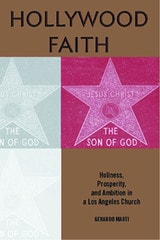
cover of Hollywood Faith: Holiness, Prosperity, and Ambition in a Los Angeles Church

Hollywood Faith

Holiness, Prosperity, and Ambition in a Los Angeles Church

Marti, Gerardo

Rutgers University Press, 2008

In Christianity, as with most religions, attaining holiness and a higher spirituality while simultaneously pursuing worldly ideals such as fame and fortune is nearly impossible. So how do people pursuing careers in Hollywood's entertainment industry maintain their religious devotion without sacrificing their career goals? For some, the answer lies just two miles south of the historic center of Hollywood, California, at the Oasis Christian Center.

In Hollywood Faith, Gerardo Marti shows how a multiracial evangelical congregation of 2,000 people accommodates itself to the entertainment industry and draws in many striving to succeed in this harsh and irreverent business. Oasis strategically sanctifies ambition and negotiates social change by promoting a new religious identity as "champion of life"-an identity that provides people who face difficult career choices and failed opportunities a sense of empowerment and endurance.

The first book to provide an in-depth look at religion among the "creative class," Hollywood Faith will fascinate those interested in the modern evangelical movement and anyone who wants to understand how religion adapts to social change.
[more]
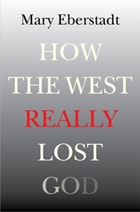
cover of How the West Really Lost God: A New Theory of Secularization

How the West Really Lost God

A New Theory of Secularization

Mary Eberstadt

Templeton Press, 2014

In this magisterial work, leading cultural critic Mary Eberstadt delivers an influential new theory about the decline of religion in the Western world. The conventional wisdom is that the West first experienced religious decline, followed by the decline of the family. Eberstadt turns this standard account on its head. Marshaling an impressive array of research, from fascinating historical data on family decline in pre-Revolutionary France to contemporary popular culture both in the United States and Europe, Eberstadt shows the reverse is also true: the undermining of the family has further undermined Christianity itself.
 
Drawing on sociology, history, demography, theology, literature, and many other sources, Eberstadt shows that family decline and religious decline have gone hand in hand in the Western world in a way that has not been understood before—that they are, as she puts it in a striking new image summarizing the book’s thesis, “the double helix of society, each dependent on the strength of the other for successful reproduction.”
 
In sobering final chapters, Eberstadt then lays out the enormous ramifications of the mutual demise of family and faith in the West. While it is fashionable in some circles to applaud the decline of both religion and the nuclear family, there are, as Eberstadt reveals, enormous social, economic, civic, and other costs attendant on both declines. Her conclusion considers this compelling question: whether the economic and demographic crisis now roiling Europe and spreading to America will have the unintentional result of reviving the family as the most viable alternative to the failed welfare state—fallout that could also lay the groundwork for a religious revival as well.
 
How the West Really Lost God is a startlingly original account of how secularization happens and a sweeping brief about why everyone should care. A book written for agnostics as well as believers, atheists as well as “none of the above,” it will permanently change the way every reader understands the two institutions that have hitherto undergirded Western civilization as we know it—family and faith—and the fundamental nature of the relationship between those two pillars of history.
 
[more]