Results by title
244 books match the query 'Study' and 11 start with h
Hamlet's Castle
The Study of Literature as a Social ExperienceBy Gordon Mills
University of Texas Press, 1976
Hamlet's Castle is both a theoretical and a practical examination of the interactions that take place in a literary classroom. The book traces the source of literature's power to the relationship between its illusional quality and its abstract meaning and relates these elements to the process by which a group, typically an academic class, forms a judgment about a literary work. In focusing on the importance of the exchange of ideas by readers, Gordon Mills reveals a new way of looking at literature as well as a different concept of the social function of the literary classroom and the possible application of this model to other human activities.
The three fundamental elements that constitute Mills's schema are the relationship between a reader and the illusional quality of literature, the relationship between a reader and the meaning of a text, and the concept of social experience within the environment of a text. The roles of illusion and meaning in a text are explored in detail and are associated with areas outside literature, including science and jurisprudence. There is an examination of the way in which decisions are forced by peers upon one another during discussion of a literary work-an exchange of opinion which is commonly a source of pleasure and insight, sought for its own sake. In the course of his study, Mills shows that the act of apprehending a literary structure resembles that of apprehending a social structure. From this relationship, he derives the social function of the literary classroom.
In combining a theoretical analysis with the practical objective of determining what value can be found in the study of literature by groups of people, Mills has produced a critical study of great significance. Hamlet's Castle will change concepts about the purpose of teaching literature, affect the way in which literature is taught, and become involved in the continuing discussion of the relationship of literary studies to other disciplines.
Hand Trembling, Frenzy Witchcraft, and Moth Madness
A Study of Navajo Seizure DisordersJerrold E. Levy
University of Arizona Press, 1987
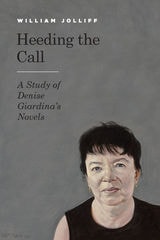
Heeding the Call
A Study of Denise Giardina's NovelsWilliam Jolliff
West Virginia University Press, 2020
In chapters devoted to each of Giardina’s novels, Jolliff attends to her uses of history, her formal techniques, and the central themes that make each work significant. What becomes clear is that while the author’s religious beliefs inform her fiction, she never offers easy answers. Her narratives consistently push her characters—and her readers—into more challenging and meaningful questions. Jolliff concludes by arguing that although Giardina’s initial fame has been tied to her significance as an Appalachian novelist, future studies must look beyond the regional to the deeply human questions her novels so persistently engage.
Heredity under the Microscope
Chromosomes and the Study of the Human GenomeSoraya de Chadarevian
University of Chicago Press, 2020
Telling this history in full for the first time, Soraya de Chadarevian argues that the often bewildering variety of observations made under the microscope were central to the study of human genetics. Making space for microscope-based practices alongside molecular approaches, de Chadarevian analyzes the close connections between genetics and an array of scientific, medical, ethical, legal, and policy concerns in the atomic age. By exploring the visual evidence provided by chromosome research in the context of postwar biology and medicine, Heredity under the Microscope sheds new light on the cultural history of the human genome.
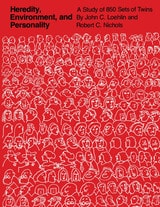
Heredity, Environment, and Personality
A Study of 850 Sets of TwinsBy John C. Loehlin and Robert C. Nichols
University of Texas Press, 1976
This volume reports on a study of 850 pairs of twins who were tested to determine the influence of heredity and environment on individual differences in personality, ability, and interests. It presents the background, research design, and procedures of the study, a complete tabulation of the test results, and the authors’ extensive analysis of their findings. Based on one of the largest studies of twin behavior conducted in the twentieth century, the book challenges a number of traditional beliefs about genetic and environmental contributions to personality development.
The subjects were chosen from participants in the National Merit Scholarship Qualifying Test of 1962 and were mailed a battery of personality and interest questionnaires. In addition, parents of the twins were sent questionnaires asking about the twins’ early experiences. A similar sample of nontwin students who had taken the merit exam provided a comparison group. The questions investigated included how twins are similar to or different from nontwins, how identical twins are similar to or different from fraternal twins, how the personalities and interests of twins reflect genetic factors, how the personalities and interests of twins reflect early environmental factors, and what implications these questions have for the general issue of how heredity and environment influence the development of psychological characteristics. In attempting to answer these questions, the authors shed light on the importance of both genes and environment and form the basis for different approaches in behavior genetic research.
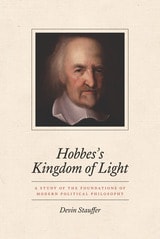
Hobbes's Kingdom of Light
A Study of the Foundations of Modern Political PhilosophyDevin Stauffer
University of Chicago Press, 2018
In Hobbes’s Kingdom of Light, Stauffer argues that Hobbes was engaged in a struggle on multiple fronts against forces, both philosophic and religious, that he thought had long distorted philosophy and destroyed the prospects of a lasting peace in politics. By exploring the twists and turns of Hobbes’s arguments, not only in his famous Leviathan but throughout his corpus, Stauffer uncovers the details of Hobbes’s critique of an older outlook, rooted in classical philosophy and Christian theology, and reveals the complexity of Hobbes’s war against the “Kingdom of Darkness.” He also describes the key features of the new outlook—the “Kingdom of Light”—that Hobbes sought to put in its place. Hobbes’s venture helped to prepare the way for the later emergence of modern liberalism and modern secularism. Hobbes’s Kingdom of Light is a wide-ranging and ambitious exploration of Hobbes’s thought.
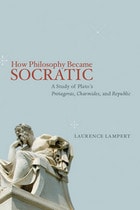
How Philosophy Became Socratic
A Study of Plato's "Protagoras," "Charmides," and "Republic"Laurence Lampert
University of Chicago Press, 2010
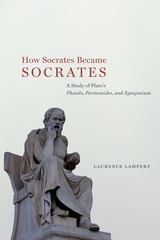
How Socrates Became Socrates
A Study of Plato’s “Phaedo,” “Parmenides,” and “Symposium”Laurence Lampert
University of Chicago Press, 2021
In addition to a careful and precise analysis of Plato’s Phaedo,Parmenides, and Symposium, Lampert shows that properly entwined, Plato’s three dialogues fuse to portray a young thinker entering philosophy’s true radical power. Lampert reveals why this radicality needed to be guarded and places this discussion within the greater scheme of the politics of philosophy.
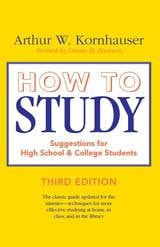
How to Study
Suggestions for High-School and College StudentsArthur W. Kornhauser
University of Chicago Press, 1993
*Mastering rather than just memorizing material
*Learning the secrets of mental preparation before tackling difficult assignments or exams
*Strengthening skills for better reading, note taking, and listening
*Improving use of time in the classroom, the library, and at home
It offers a wealth of advice, from the commonsensical ("Never begin study immediately after eating" and "Check every tendency to daydream") to the more psychological ("Use your knowledge by thinking, talking, and writing about the things you are learning").
Thoroughly revised and updated, this powerful little book can help any motivated and capable student work smarter, not just harder, from high school through college.
When he wrote How to Study Arthur W. Kornhauser (1896-1990) was associate professor of business psychology at the University of Chicago.

Human Nature and History
A Study of the Development of Liberal Political ThoughtRobert Denoon Cumming
University of Chicago Press, 1969
Human Nature and History, a monumental work in two volumes, is an attempt to analyze these relations. It is a work in meta-theory or the theory of political theory.
At the most general level, Cumming is concerned with the question of what is involved in the enterprise of political theory or political philosophy and how different conceptions of that enterprise have developed historically. More specifically, he is concerned with the format imposed on the historical development of political thought by Anglo-American liberalism, especially as represented by John Stuart Mill.
Since Cumming traces the development of political theory by reference to the relation between its subject-matter and other subject-matters, his study should be of interest to historians of thought and culture, as well as to political theorists and philosophers.

Human Relations in Interracial Housing
A Study of the Contact HypothesisDaniel M. Wilner, Rosabelle Price Walkley, and Stuart W. Cook
University of Minnesota Press, 1955
Human Relations in Interracial Housing was first published in 1955. Minnesota Archive Editions uses digital technology to make long-unavailable books once again accessible, and are published unaltered from the original University of Minnesota Press editions.
No phase of this country's domestic or foreign relations holds greater potential power for harmony or conflict than our racial attitudes. Yet there is probably no area of social relations in which we have had fewer facts and more assumptions on which to base our thinking and our efforts at constructive action. This sociopsychological study adds considerably to our knowledge of actual racial attitudes in the United States and some of the factors that affect them.
The study examines the racial attitudes of people living in public, interracial housing projects in four cities: Philadelphia, Pittsburgh, Hartford, and Springfield, Massachusetts. Based on interviews with more than 1000 white and Negro residents, it sought information that would help answer such questions as these: What is the effect of Negro-white residential proximity on race relations? Does living nearby reduce or intensify any already existing prejudices? What is the nature of the contacts that develop among members of the two races?
The findings show in great detail the effects of residential proximity and suggest the underlying reasons for the role that such proximity plays. They reveal, further, the effects of the contact experience itself and the perception of the social climate in the community regarding such contact.
The research forms an important sequel to the investigation reported in the book, Interracial Housing, by Deutsch and Collins, confirming some of the basic findings in the earlier study as well as providing new insights.
Psychologists, sociologists, social workers, housing officials, and community leaders will find solid evidence here on a subject that has been sparsely documented up to now.