Results by title
461 books match the query 'Teaching' and 11 start with h
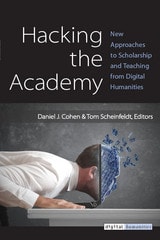
Hacking the Academy
New Approaches to Scholarship and Teaching from Digital HumanitiesDaniel J. Cohen and Tom Scheinfeldt, Editors
University of Michigan Press, 2013
On May 21, 2010, Daniel J. Cohen and Tom Scheinfeldt posted the following provocative questions online:
“Can an algorithm edit a journal? Can a library exist without books? Can students build and manage their own learning management platforms? Can a conference be held without a program? Can Twitter replace a scholarly society?”
As recently as the mid-2000s, questions like these would have been unthinkable. But today serious scholars are asking whether the institutions of the academy as they have existed for decades, even centuries, aren’t becoming obsolete. Every aspect of scholarly infrastructure is being questioned, and even more importantly, being hacked. Sympathetic scholars of traditionally disparate disciplines are canceling their association memberships and building their own networks on Facebook and Twitter. Journals are being compiled automatically from self-published blog posts. Newly minted PhDs are forgoing the tenure track for alternative academic careers that blur the lines between research, teaching, and service. Graduate students are looking beyond the categories of the traditional CV and building expansive professional identities and popular followings through social media. Educational technologists are “punking” established technology vendors by rolling out their own open source infrastructure.
Here, in Hacking the Academy, Daniel J. Cohen and Tom Scheinfeldt have gathered a sampling of the answers to their initial questions from scores of engaged academics who care deeply about higher education. These are the responses from a wide array of scholars, presenting their thoughts and approaches with a vibrant intensity, as they explore and contribute to ongoing efforts to rebuild scholarly infrastructure for a new millennium.

Handbook for In-Service Training in Human Services
William Crimando
Southern Illinois University Press, 1988
A practical "how-to" workbook that outlines a plan for the design and implementation of staff in-service training programs for human service agencies and facilities.
Crimando and Riggar have made every effort to guarantee the usefulness of this text to practitioners, instructors, and students. This is a working book designed to assist trainers as they acquire the knowledge and skills needed to provide thorough, systematic in-service training that will enhance human service endeavors.
The authors have organized the nineteen chapters into four parts that treat significant steps in the training-program design process. These include analyzing problems that require training solutions; developing a proposal; writing a plan of action for training; and evaluating a program. Each of the chapters combines text, examples, exercises, and supplementary readings to foster a full appreciation of the process involved. Even those topics frequently overlooked or disregarded are included: budgeting program time and financial resources, obtaining administrative commitment, and transferring and maintaining skills in the work setting.
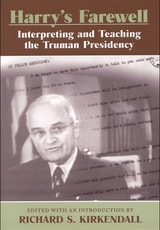
Harry's Farewell
Interpreting and Teaching the Truman PresidencyEdited & Intro by Richard S. Kirkendall
University of Missouri Press, 2004
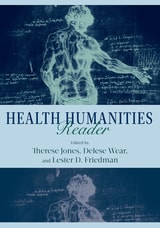
Health Humanities Reader
Jones, Therese
Rutgers University Press, 2014
In Health Humanities Reader, editors Therese Jones, Delese Wear, and Lester D. Friedman have assembled fifty-four leading scholars, educators, artists, and clinicians to survey the rich body of work that has already emerged from the field—and to imagine fresh approaches to the health humanities in these original essays. The collection’s contributors reflect the extraordinary diversity of the field, including scholars from the disciplines of disability studies, history, literature, nursing, religion, narrative medicine, philosophy, bioethics, medicine, and the social sciences.
With warmth and humor, critical acumen and ethical insight, Health Humanities Reader truly humanizes the field of medicine. Its accessible language and broad scope offers something for everyone from the experienced medical professional to a reader interested in health and illness.
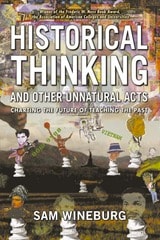
Historical Thinking
Sam Wineburg
Temple University Press, 2001
Although most of us think of history -- and learn it -- as a conglomeration of facts, dates, and key figures, for professional historians it is a way of knowing, a method for developing and understanding about the relationships of peoples and events in the past. A cognitive psychologist, Wineburg has been engaged in studying what is intrinsic to historical thinking, how it might be taught, and why most students still adhere to the "one damned thing after another" concept of history.
Whether he is comparing how students and historians interpret documentary evidence or analyzing children's drawings, Wineburg's essays offer "rough maps of how ordinary people think about the past and use it to understand the present." Arguing that we all absorb lessons about history in many settings -- in kitchen table conversations, at the movies, or on the world-wide web, for instance -- these essays acknowledge the role of collective memory in filtering what we learn in school and shaping our historical thinking.
History and Philosophy of the Humanities
An IntroductionMichiel Leezenberg
Amsterdam University Press, 2018
History and Philosophy of the Humanities
An IntroductionMichiel Leezenberg
Amsterdam University Press, 2019
'History and Philosophy of the Humanities: An Introduction' presents a reasoned overview of the conceptual and historical backgrounds of the humanities. In four sections, it discusses:
- the most influential views on scientific knowledge from Aristotle to Thomas Kuhn;
- the birth of the modern humanities and its relation to the natural and social sciences;
- the various methodological schools and conceptual issues in the humanities;
- several themes that set the agenda for current debates in the humanities: critiques of modernity; gender, sexuality and identity; and postcolonialism.
Thus, it provides students in the humanities with a comprehensive understanding of the backgrounds of their own discipline, its relation to other disciplines, and the state of the art of the humanities at large.
How Humans Learn
The Science and Stories behind Effective College TeachingJoshua R. Eyler
West Virginia University Press, 2018
Even on good days, teaching is a challenging profession. One way to make the job of college instructors easier, however, is to know more about the ways students learn. How Humans Learn aims to do just that by peering behind the curtain and surveying research in fields as diverse as developmental psychology, anthropology, and cognitive neuroscience for insight into the science behind learning.
The result is a story that ranges from investigations of the evolutionary record to studies of infants discovering the world for the first time, and from a look into how our brains respond to fear to a reckoning with the importance of gestures and language. Joshua R. Eyler identifies five broad themes running through recent scientific inquiry—curiosity, sociality, emotion, authenticity, and failure—devoting a chapter to each and providing practical takeaways for busy teachers. He also interviews and observes college instructors across the country, placing theoretical insight in dialogue with classroom experience.
How Myths about Language Affect Education
What Every Teacher Should KnowDavid Johnson
University of Michigan Press, 2013
How Myths about Language Affect Education: What Every Teacher Should Know clarifies some of the most common misconceptions about language, particularly those that affect teachers and the decisions they make when they teach English language learners. The chapters in this book address myths about language in general, about first and second language acquisition, about language and society, and about language and thinking. Each chapter concludes with activities for teachers that give examples, exercises, or simple questions that relate directly to teachers' everyday dealings with ELLs and language.
How Myths about Language Affect Education is not intended to be a complete introduction to linguistics; it does not contain information on phonetics or complex syntactic explanations, and technical jargon is kept to a minimum. The aim of this book is not to settle language issues but rather to highlight popular misconceptions and the ways that they influence debates regarding language and affect language policies in and out of the classroom.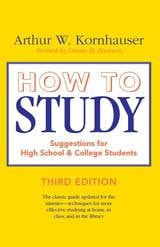
How to Study
Suggestions for High-School and College StudentsArthur W. Kornhauser
University of Chicago Press, 1993
*Mastering rather than just memorizing material
*Learning the secrets of mental preparation before tackling difficult assignments or exams
*Strengthening skills for better reading, note taking, and listening
*Improving use of time in the classroom, the library, and at home
It offers a wealth of advice, from the commonsensical ("Never begin study immediately after eating" and "Check every tendency to daydream") to the more psychological ("Use your knowledge by thinking, talking, and writing about the things you are learning").
Thoroughly revised and updated, this powerful little book can help any motivated and capable student work smarter, not just harder, from high school through college.
When he wrote How to Study Arthur W. Kornhauser (1896-1990) was associate professor of business psychology at the University of Chicago.
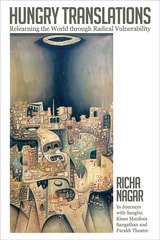
Hungry Translations
Relearning the World through Radical VulnerabilityRicha Nagar
University of Illinois Press, 2019