Results by title
56 books match the query 'Thought' and 4 start with h
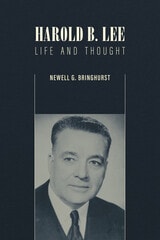
Harold B. Lee
Life and ThoughtNewell G. Bringhurst
Signature Books, 2021
While Harold B. Lee served as president of the Church of Jesus Christ of Latter-day Saints for a mere one and half-years—among the shortest tenure of any church leader—his impact on the modern LDS Church remains among the most profound. Lee implemented the Church Welfare Program, which provided relief to suffering church members during the 1930s Great Depression and continues to impact the lives of church members today. As a high-ranking general authority from 1941 to 1973, he championed other innovations, the most important being Correlation. Lee acted in response to the church’s record growth and increased diversity to consolidate and streamline churchwide instruction and administration. As a teacher/mentor, he promoted conservative church doctrine and practice, which influenced a generation of church leaders, including future presidents Spencer W. Kimball, Ezra Taft Benson, Howard W. Hunter, Gordon B. Hinckley, and Thomas S. Monson. Noted historian Newell G. Bringhurst succinctly narrates the major, defining events in Lee’s remarkable life, while highlighting Lee’s important, lasting contributions. This is the first volume in Signature’s new Brief Mormon Lives series.
[more]
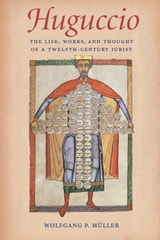
Huguccio
The Life, Works, and Thought of a Twelfth-Century JuristWolfgang Muller
Catholic University of America Press, 1994
Huguccio was an important lawyer of the medieval church, bishop of Ferrara, and one of the greatest representatives of twelfth-century scholasticism. In this book-length study of this influential figure, Wolfgang P. Müller provides a critical account of the biographical information on the man and his writings. He discusses the various aspects of Huguccio's career and thought as well as the manuscript tradition of some of his works. The author's scholarship rests on direct consultation and painstaking analysis of enormous quantities of manuscript material.
This book provides the point of departure for anyone wishing to study Huguccio first-hand. It will be worthy reading for students of medieval canon law and an essential addition to all libraries supporting research in medieval studies.
This book provides the point of departure for anyone wishing to study Huguccio first-hand. It will be worthy reading for students of medieval canon law and an essential addition to all libraries supporting research in medieval studies.
[more]
Humanism as Realism
Three Essays Concerning the Thought of Paul Elmer More and Irving BabbittLisa Fretschel
St. Augustine's Press, 2023
Originally published in Polish in 2019 by The Lethe Foundation, this book demonstrates the relevance and important of Paul Elmer More (1864–1937) and Irving Babbitt (1865–1933). Their collective legacy is one of responsible and truly thoughtful living. Their treatment of Humanists and their diagnosis of modernity is an important theme in this work, and the indication of the political consequences of humanism.
"This is a protreptic book. Its main goal is to encourage people to undertake independent studies or more generally, simply to think independently. If we want to think for ourselves, and not like preprogrammed humanoids, we can’t do so in a vacuum. We have to lean on something. In the Author’s view, the more than century-old writings of Paul Elmer More and Irving Babbitt are perfectly suited to the role of such a support for us, living in the here and now. They make it possible for us to dig ourselves out from underneath the heaps of opinions, “principles” or “theories” that allegedly can’t be rejected, that we’re obliged to follow, but that have a paralyzing and dumbing-down effect on us, making our lives from the
outset seems like the dream of a childish old man."
––Taken from the Preface by Pawel Armada
[more]
Humanist Poetics
Thought, Rhetoric, and Fiction in Sixteenth-Century EnglandArthur F. Kinney
University of Massachusetts Press, 1986
This important contribution to the study of English Renaissance culture redefines the humanist movement, employs humanist rhetoric in new ways, and argues that English fiction in the sixteenth century should be seen as a major genre with its own strategies for the imaginative artist. Arthur F. Kinney argues that the main purpose of Renaissance humanism was the cultivation and perfection of the individual and society by the use of rhetoric—by persuasion. Humanist poetics, then, is the poetics of rhetoric: the attempt to fashion the self or the reader by a fiction that employs rhetoric's means.
By tracing classical resources and the intertextuality of major English works from More's Utopia to Lodge's Rosalynde and Nashe's Unfortunate Traveller, Kinney not only locates basic Elizabethan habits of mind but also shows where the roots of the English novel may ultimately lie.
By tracing classical resources and the intertextuality of major English works from More's Utopia to Lodge's Rosalynde and Nashe's Unfortunate Traveller, Kinney not only locates basic Elizabethan habits of mind but also shows where the roots of the English novel may ultimately lie.
[more]