Results by title
67 books match the query 'War and society' and 5 start with h
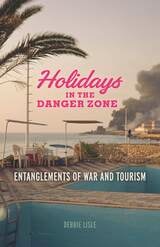
Holidays in the Danger Zone
Entanglements of War and TourismDebbie Lisle
University of Minnesota Press, 2016
Holidays in the Danger Zone exposes the mundane and everyday interactions between two seemingly opposed worlds: warfare and tourism. Debbie Lisle shows how a tourist sensibility shapes the behavior of soldiers in war—especially the experiences of Western military forces in “exotic” settings. This includes not only R&R but also how battlefields become landscapes of leisure and tourism. She further explores how a military sensibility shapes the development of tourism in the postwar context, from “Dark Tourism” (engaging with displays of conflict and atrocity) to exhibitions of conflict in museums and at memorial sites, as well as advertising, film, journals, guidebooks, blogs, and photography.
Focused on how war and tourism reinforce prevailing modes of domination, Holidays in the Danger Zone critically examines the long historical arc of the war–tourism nexus—from nineteenth-century imperialism to World War I and World War II, from the Cold War to globalization and the War on Terror.
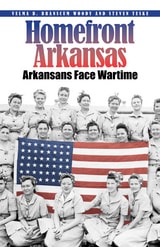
Homefront Arkansas
Arkansans Face Wartime Past and PresentVelma B. Branscum Woody
Butler Center for Arkansas Studies, 2009
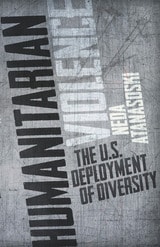
Humanitarian Violence
The U.S. Deployment of DiversityNeda Atanasoski
University of Minnesota Press, 2013
When is a war not a war? When it is undertaken in the name of democracy, against the forces of racism, sexism, and religious and political persecution? This is the new world of warfare that Neda Atanasoski observes in Humanitarian Violence, different in name from the old imperialism but not so different in kind. In particular, she considers U.S. militarism—humanitarian militarism—during the Vietnam War, the Soviet-Afghan War, and the 1990s wars of secession in the former Yugoslavia.
What this book brings to light—through novels, travel narratives, photojournalism, films, news media, and political rhetoric—is in fact a system of postsocialist imperialism based on humanitarian ethics. In the fiction of the United States as a multicultural haven, which morally underwrites the nation’s equally brutal waging of war and making of peace, parts of the world are subject to the violence of U.S. power because they are portrayed to be homogeneous and racially, religiously, and sexually intolerant—and thus permanently in need of reform. The entangled notions of humanity and atrocity that follow from such mediations of war and crisis have refigured conceptions of racial and religious freedom in the post–Cold War era. The resulting cultural narratives, Atanasoski suggests, tend to racialize ideological differences—whereas previous forms of imperialism racialized bodies. In place of the European racial imperialism, U.S. settler colonialism, and pre–civil rights racial constructions that associated racial difference with a devaluing of nonwhite bodies, Humanitarian Violence identifies an emerging discourse of race that focuses on ideological and cultural differences and makes postsocialist and Islamic nations the potential targets of U.S. disciplining violence.
Humanity's Ruins
Ethics, Feminism, and Genocidal HumanitarianismDanielle Bouchard
Duke University Press, 2025
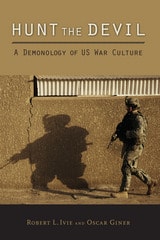
Hunt the Devil
A Demonology of US War CultureRobert L. Ivie and Oscar Giner
University of Alabama Press, 2015
Meticulously researched, documented, and argued, Hunt the Devil opens with contemporary images of the US’s global war on terror in the aftermath of 9/11. In five chapters devoted to the demonization of evildoers, witches, Indians, dictators, and Reds by American writers, in presidential rhetoric, and in popular culture, Ivie and Giner show how the use of demonization in the war on terror is only the most recent manifestation of a process that has recurred throughout American history.
In a sixth chapter, the authors introduce the archetype of the Trickster. Though not opposed to the Devil per se, the Trickster’s democratic impulses have often provided a corrective antidote to the corrosive and distorting effects of demonization. Invoking the framework of Carl Jung’s shadow aspect, Hunt the Devil offers the Trickster as a figure who can break the cycle of demonization and war.
The role of the mythic Devil in the American psyche has profound implications, not just for American diplomacy and the use of American arms in the world, but for the possibility of domestic peace within an increasingly diverse society. Hunt the Devil provides much of interest to readers and scholars in the fields of war, rhetorical studies, American Studies, US political culture, Jungian psychology, and mythography.