Results by title
272 books match the query 'Work' and 9 start with h
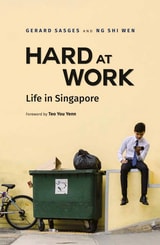
Hard at Work
Life in SingaporeGerard Sasges and Ng Shi Wen
National University of Singapore Press, 2019
Through first-person narratives based on detailed interviews, vividly augmented with color photographs, Hard at Work reminds us of the everyday labor that continually goes on around us, and that every job can reveal something interesting if we just look closely enough. It shows us too the ways inequalities of status and income are felt and internalized in this highly globalized society.
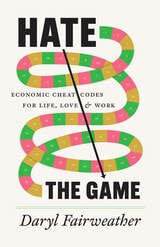
Hate the Game
Economic Cheat Codes for Life, Love, and WorkDaryl Fairweather
University of Chicago Press, 2025
Should I buy or rent? Do I ask for a promotion? Should I tell people I’m pregnant? What salary do I deserve? Should I just quit this job? Common anxieties about life are often grounded in economics. In an increasingly win-lose society, these economic decisions—where to work, where to live, even how to live—have a way of feeling fixed and mistakes terminal.
Daryl Fairweather is no stranger to these dynamics. As the first Black woman to receive an economics PhD from the famed University of Chicago, she saw firsthand how concepts of behavioral economics and game theory were deployed in the real world—and in her own life—to great effect. Hate the Game combines Fairweather’s elite knowledge of these principles with her singular voice in describing how they can be harnessed. Her great talent, unique among economists, is her ability to articulate economic trends in a way that is not just informative, but also accounts for life’s other anxieties.
In Hate the Game, Fairweather fixes her expertise and service on navigating the earliest economic inflection points of adult life: whether to go to college and for how long; partnering, having kids, both, or neither; getting, keeping, and changing jobs; and where to live and how to pay for it. She speaks in actionable terms about what the economy means for individual people, especially those who have the sneaking suspicion they’re losing out. Set against her own experiences and enriched with lessons from history, science, and pop culture, Fairweather instructs readers on how to use game theory and behavioral science to map out options and choose directions while offering readers a sense of control and agency in an economy where those things are increasingly rare.
Hate the Game
Economic Cheat Codes for Life, Love, and WorkDaryl Fairweather
University of Chicago Press, 2025
The secret insights of economics, translated for the rest of us.
Should I buy or rent? Do I ask for a promotion? Should I tell people I’m pregnant? What salary do I deserve? Should I just quit this job? Common anxieties about life are often grounded in economics. In an increasingly win-lose society, these economic decisions—where to work, where to live, even how to live—have a way of feeling fixed and mistakes terminal.
Daryl Fairweather is no stranger to these dynamics. As the first Black woman to receive an economics PhD from the famed University of Chicago, she saw firsthand how concepts of behavioral economics and game theory were deployed in the real world—and in her own life—to great effect. Hate the Game combines Fairweather’s elite knowledge of these principles with her singular voice in describing how they can be harnessed. Her great talent, unique among economists, is her ability to articulate economic trends in a way that is not just informative, but also accounts for life’s other anxieties.
In Hate the Game, Fairweather fixes her expertise and service on navigating the earliest economic inflection points of adult life: whether to go to college and for how long; partnering, having kids, both, or neither; getting, keeping, and changing jobs; and where to live and how to pay for it. She speaks in actionable terms about what the economy means for individual people, especially those who have the sneaking suspicion they’re losing out. Set against her own experiences and enriched with lessons from history, science, and pop culture, Fairweather instructs readers on how to use game theory and behavioral science to map out options and choose directions while offering readers a sense of control and agency in an economy where those things are increasingly rare.
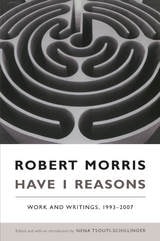
Have I Reasons
Work and Writings, 1993–2007Robert Morris
Duke University Press, 2008
The writings are arranged chronologically, beginning with “Indiana Street,” a vivid autobiographical account of the artist’s early years in Kansas City, Missouri. Have I Reasons includes reflections on Morris’s own site-specific installations; transcripts of seminars he conducted in conjunction with exhibitions; and the textual element of The Birthday Boy, the two-screen video-and-sound piece he installed at the Galleria dell’Accademia in Florence, Italy, on the occasion of the five hundredth anniversary of Michelangelo’s David. Essays range from original interpretations of Cézanne’s Mont Sainte-Victoire paintings and Jasper Johns’ early work to engagements with one of Morris’s most significant interlocutors, the philosopher Donald Davidson. Have I Reasons conveys not only Morris’s enduring deep interest in philosophy and issues of resemblance and representation but also his more recent turn toward directly addressing contemporary social and political issues such as corporate excess and preemptive belligerence.
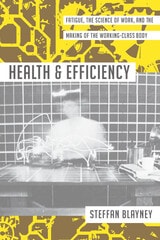
Health and Efficiency
Fatigue, the Science of Work, and the Making of the Working-Class BodySteffan Blayney
University of Massachusetts Press, 2022
A new model of health emerged in Britain between 1870 and 1939. Centered on the working body, organized around the concept of efficiency, and grounded in scientific understandings of human labor, scientists, politicians, and capitalists of the era believed that national economic productivity could be maximized by transforming the body of the worker into a machine. At the core of this approach was the conviction that worker productivity was intimately connected to worker health.
Under this new “science of work,” fatigue was seen as the ultimate pathology of the working-class body, reducing workers’ capacity to perform continued physical or mental labor. As Steffan Blayney shows, the equation between health and efficiency did not go unchallenged. While biomedical and psychological experts sought to render the body measurable, governable, and intelligible, ordinary men and women found ways to resist the logics of productivity and efficiency imposed on them, and to articulate alternative perspectives on work, health, and the body.
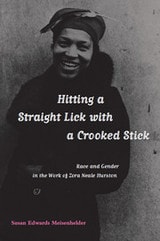
Hitting A Straight Lick with a Crooked Stick
Race and Gender in the Work of Zora Neale HurstonSusan E Meisenhelder
University of Alabama Press, 2001
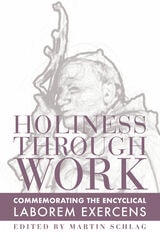
Holiness through Work
Commemorating the Encyclical Laborem ExercensMartin Schlag
St. Augustine's Press, 2022
This book is a timely contribution to the field of scholarship that focuses on Catholic Social Thought and is ideally suited for graduate studies and the reader interested in more serious questions in Christian theology.
Giulio Maspero, "The Bible and the Fathers of the Church on Work"
Patricia Ranft, "Work Theology in the High Middle Ages"
Angela Franks, "John Paul II's Metaphysics of Labor"
Deborah Savage, "Confronting a Technocratic Future: Women's Work and the Church's Social Vision"
Martin Schlag, "Contemplation at Work: A Theological Conversation Between John Paul II and Josemaría Escrivá"
Richard Turnbull, "Laborem Exercens: A Protestant Appreciation"
Michael Naughton, "Good Work: Insights from the Subjective Dimension of Work"
Christopher Michaelson, "Subjects and Objects in Meaningful Work"
Javier Ignacio Pinto Garay and Alvaro Pezoa Bissieres, "The Worker and the Transistor: The Dignity of Work and Business Ethics in Global Corporate Practices"
Gonzalo Flores-Castro Lingán, "The Real Work: Making the Encyclical Laborem Exercens Operational"
Geoffrey C. Friesen, "Laborem Exercens and the Subjective Dimension of Work in Economics and Finance"
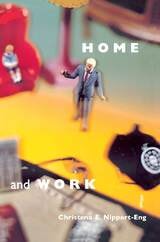
Home and Work
Negotiating Boundaries through Everyday LifeChristena E. Nippert-Eng
University of Chicago Press, 1996
Arguing that relationships between the two realms range from those that are highly "integrating" to those that are highly "segmenting," Nippert-Eng examines the ways people sculpt the boundaries between home and work. With remarkable sensitivity to the symbolic value of objects and actions, Nippert-Eng explores the meaning of clothing, wallets, lunches and vacations, and the places and ways in which we engage our family, friends, and co-workers. Commuting habits are also revealing, showing how we make the transition between home and work selves though ritualized behavior like hellos and goodbyes, the consumption of food, the way we dress, our choices of routes to and from work, and our listening, working, and sleeping habits during these journeys.
The ways each of us manages time, space, and people not only reflect but reinforce lives that are more "integrating" or "segmenting" at any given time. In clarifying what we take for granted, this book will leave you thinking in different ways about your life and work.
How We Die Now
Intimacy and the Work of DyingKarla Erickson
Temple University Press, 2013