Results by title
28167 books match the query 'History' and 906 start with h

Hounds of the Road
History of the Greyhound Bus CompanyCarlton Jackson
University of Wisconsin Press, 1984
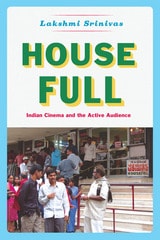
House Full
Indian Cinema and the Active AudienceLakshmi Srinivas
University of Chicago Press, 2016
With House Full, Lakshmi Srinivas takes readers deep into the moviegoing experience in India, showing us what it’s actually like to line up for a hot ticket and see a movie in a jam-packed theater with more than a thousand seats. Building her account on countless trips to the cinema and hundreds of hours of conversation with film audiences, fans, and industry insiders, Srinivas brings the moviegoing experience to life, revealing a kind of audience that, far from passively consuming the images on the screen, is actively engaged with them. People talk, shout, whistle, cheer; others sing along, mimic, or dance; at times audiences even bring some of the ritual practices of Hindu worship into the cinema, propitiating the stars onscreen with incense and camphor. The picture Srinivas paints of Indian filmgoing is immersive, fascinating, and deeply empathetic, giving us an unprecedented understanding of the audience’s lived experience—an aspect of Indian film studies that has been largely overlooked.
House Hold
A Memoir of PlaceAnn Peters
University of Wisconsin Press, 2013
More than a memoir of remembered landscapes, House Hold is also an expansive contemplation of America, a meditation on place and property, and an exploration of how literature shapes our thinking about the places we live. A gifted prose stylist, Peters seamlessly combines her love of buildings with her love of books. She wanders through the rooms of her past but also through what Henry James called “the house of fiction,” interweaving personal narrative with musings on James, Willa Cather, William Dean Howells, Paule Marshall, William Maxwell, and others. Peters reflects on the romance of pastoral retreat, the hazards of nostalgia, America’s history of expansion and land ownership, and the conflicted desires to put down roots and to hit the road. Throughout House Hold, she asks how places make us who we are.

House Money
A History of the American Mortgage MarketJonathan D. Rose and Kenneth Snowden
University of Chicago Press, 0
How the market that made the American Dream was made—and what that history tells us about its future and fluctuations.
When Americans poured into cities and suburbs during the twentieth century, they needed capital to build and own homes. The market that emerged did more than merely provide it: the American mortgage market became the consequential, if occasionally misunderstood, cornerstone of the US financial system.
House Money traces the history of the growth and occasional collapse of the American mortgage market over the last 150 years. Jonathan Rose and Kenneth Snowden show how three major housing-related crises (of the 1930s, 1980s, and 2000s) were not just cyclical events nor bubbles. Rather, they were episodes in a common pattern: shocks produced when the availability of capital in the market was eclipsed by the risk the market took on. Rose and Snowden chart the macro factors that produced these capital/risk asymmetries, showing that in all three crises, the macroeconomic trends—not just bubbles, not banker avarice—conspired to create a downturn despite federal and private safeguards. This illustrates Rose and Snowden’s core principle: housing markets can (and often, must) shoulder considerable risk. When the capital behind that risk evaporates, trouble becomes more likely.
Mining more than a century of economic history, Rose and Snowden show how the institutions and practices in the American mortgage market reflect the push-pulls of its past—both the private innovations and the government interventions. House Money reveals the great risk undertaken in service to American homeownership—and the perennial question of what happens when that risk goes wrong.

House Of Cards
Baseball Card Collecting and Popular CultureJohn Bloom
University of Minnesota Press, 1997
Explores the connection between baseball card collecting and nostalgia among men of the baby boom.
Baseball card collecting carries with it images of idealized boyhoods in the sprawling American suburbs of the postwar era. Yet in the past twenty years, it has grown from a pastime for children to a big-money pursuit taken seriously by adults. In A House of Cards, John Bloom uses interviews with collectors, dealers, and hobbyists as well as analysis of the baseball card industry and extensive firsthand observations to ask what this hobby tells us about nostalgia, work, play, masculinity, and race and gender relations among collectors.
Beginning in the late 1970s and into the early 1990s, baseball card collecting grew into a business that embodied traditional masculine values such as competition, savvy, and industry. In A House of Cards, Bloom interviews collectors who reveal ambivalence about the hobby’s emphasis on these values, often focusing on its alienating, lonely, and unfulfilling aspects. They express nostalgia for the ideal childhood world many middle-class white males experienced in the postwar years, when they perceived baseball card collecting as a form of play, not a moneymaking enterprise. Bloom links this nostalgia to anxieties about deindustrialization and the rise of the civil rights, feminist, and gay rights movements. He examines the gendered nature of swap meets as well as the views of masculinity expressed by the collectors: Is the purpose of baseball card collecting to form a community of adults to reminisce or to inculcate young men with traditional masculine values? Is it to establish “connectedness” or to make money? Are collectors striving to reinforce the dominant culture or question it through their attempts to create their own meaning out of what are, in fact, mass-produced commercial artifacts? Bloom provides a fascinating exploration of male fan culture, ultimately providing insight into the ways white men of the baby boom view themselves, masculinity, and the culture at large. [Excerpt:]“Collectors often decried how money had ruined their hobby, making it hard for them to form meaningful friendships through their cards. Money, however, made the hobby not only profitable but also more serious, more instrumental, and therefore more manly. The same collectors who complained about greed often bragged in the same interview about the value of their cards. Yet money, in turn, made the hobby less akin to child’s play and more like work: lonely, competitive, unfulfilling, and alienating.”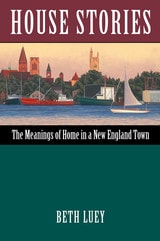
House Stories
The Meanings of Home in a New England TownBeth Luey
University of Massachusetts Press, 2017
Historic houses adorned with plaques populate New England like nowhere else in the country. These plaques note the construction year and original owner of the house, but they tell nothing about the rich lives of the people who lived there. In House Stories, Beth Luey takes readers on a virtual walking tour of several historic houses in Fairhaven, Massachusetts, a small New England coastal town, inviting us in to learn each house's secrets.
Through letters and diaries, church and business records, newspaper accounts, legal documents, and the recollections of neighbors who knew them, Luey introduces the diverse cast of historical characters who lived in these houses at various times from 1800 to the 2000s, including a Japanese castaway and his rescuer, a self-made millionaire, a seagoing adventurer, a religious pioneer, and an entrepreneurial immigrant. All of the houses are still standing and all but a lighthouse are still called home. In House Stories, Luey asks readers to join her as she considers the multiple meanings of “home” for these people and their families.

House and Street
The Domestic World of Servants and Masters in Nineteenth-Century Rio de JaneiroBy Sandra Lauderdale Graham
University of Texas Press, 1992
During the later half of the nineteenth century, a majority of Brazilian women worked, most as domestic servants, either slave or free. House and Street re-creates the working and personal lives of these women, drawing on a wealth of documentation from archival, court, and church records.
Lauderdale Graham traces the intricate and ambivalent relations that existed between masters and servants. She shows how for servants the house could be a place of protection—as well as oppression—while the street could be dangerous—but also more autonomous. She integrates her discoveries with larger events taking place in Rio de Janeiro during the period, including the epidemics of the 1850s, the abolition of slavery, the demolition of slums, and major improvements in sanitation during the first decade of the 1900s.
House of Grace, House of Blood
PoemsDenise Low
University of Arizona Press, 2024
In a personal poetic treatment of documents, oral tradition, and images, the author embodies the contradictions she unravels. From a haunting first-person perspective, Low’s formally inventive archival poetry combines prose and lyric, interweaving verse with historical voices in a dialogue with the source material. Each poem builds into a larger narrative on American genocide, the ways in which human loss corresponds to ecological destruction, and how intimate knowledge of the past can enact healing.
Ultimately, these poems not only reconstruct an important historical event, but they also put pressure on the gaps, silences, and violence of the archive. Low asks readers to question not only what is remembered, but how history is remembered—and who is forgotten from it. Reflecting on the injustice of the massacre, the Shawnee leader Tecumseh lamented that though “the Americans murdered all the men, women, and children, even as they prayed to Jesus . . . no American ever was punished, not one.” These poems challenge this attempted erasure.
House of Hits
The Story of Houston's Gold Star/SugarHill Recording StudiosBy Andy Bradley and Roger Wood
University of Texas Press, 2010
Founded in a working-class neighborhood in southeast Houston in 1941, Gold Star/SugarHill Recording Studios is a major independent studio that has produced a multitude of influential hit records in an astonishingly diverse range of genres. Its roster of recorded musicians includes Lightnin' Hopkins, George Jones, Willie Nelson, Bobby "Blue" Bland, Junior Parker, Clifton Chenier, Sir Douglas Quintet, 13th Floor Elevators, Freddy Fender, Kinky Friedman, Ray Benson, Guy Clark, Lucinda Williams, Beyoncé and Destiny's Child, and many, many more.
In House of Hits, Andy Bradley and Roger Wood chronicle the fascinating history of Gold Star/SugarHill, telling a story that effectively covers the postwar popular music industry. They describe how Houston's lack of zoning ordinances allowed founder Bill Quinn's house studio to grow into a large studio complex, just as SugarHill's willingness to transcend musical boundaries transformed it into of one of the most storied recording enterprises in America. The authors offer behind-the-scenes accounts of numerous hit recordings, spiced with anecdotes from studio insiders and musicians who recorded at SugarHill. Bradley and Wood also place significant emphasis on the role of technology in shaping the music and the evolution of the music business. They include in-depth biographies of regional stars and analysis of the various styles of music they represent, as well as a list of all of Gold Star/SugarHill's recordings that made the Billboard charts and extensive selected historical discographies of the studio's recordings.
House of Plenty
The Rise, Fall, and Revival of Luby's CafeteriasBy Carol Dawson and Carol Johnston
University of Texas Press, 2006
Violet Crown Award, Writers League of Texas, 2007
Citation, San Antonio Conservation Society, 2009
Scarred by the deaths of his mother and sisters and the failure of his father's business, a young man dreamed of making enough money to retire early and retreat into the secure world that his childhood tragedies had torn from him. But Harry Luby refused to be a robber baron. Turning totally against the tide of avaricious capitalism, he determined to make a fortune by doing good. Starting with that unlikely, even naive, ambition in 1911, Harry Luby founded a cafeteria empire that by the 1980s had revenues second only to McDonald's. So successfully did Luby and his heirs satisfy the tastes of America that Luby's became the country's largest cafeteria chain, creating more millionaires per capita among its employees than any other corporation of its size. Even more surprising, the company stayed true to Harry Luby's vision for eight decades, making money by treating its customers and employees exceptionally well.
Written with the sweep and drama of a novel, House of Plenty tells the engrossing story of Luby's founding and phenomenal growth, its long run as America's favorite family restaurant during the post-World War II decades, its financial failure during the greed-driven 1990s when non-family leadership jettisoned the company's proven business model, and its recent struggle back to solvency. Carol Dawson and Carol Johnston draw on insider stories and company records to recapture the forces that propelled the company to its greatest heights, including its unprecedented practices of allowing store managers to keep 40 percent of net profits and issuing stock to all employees, which allowed thousands of Luby's workers to achieve the American dream of honestly earned prosperity. The authors also plumb the depths of the Luby's drama, including a hushed-up theft that split the family for decades; the 1991 mass shooting at the Killeen Luby's, which splattered the company's good name across headlines nationwide; and the rapacious over-expansion that more than doubled the company's size in nine years (1987-1996), pushed it into bankruptcy, and drove president and CEO John Edward Curtis Jr. to violent suicide.
Disproving F. Scott Fitzgerald's adage that "there are no second acts in American lives," House of Plenty tells the epic story of an iconic American institution that has risen, fallen, and found redemption—with no curtain call in sight.

House, but No Garden
Apartment Living in Bombay's Suburbs, 1898-1964Nikhil Rao
University of Minnesota Press, 2013
Between the well-documented development of colonial Bombay and sprawling contemporary Mumbai, a profound shift in the city’s fabric occurred: the emergence of the first suburbs and their distinctive pattern of apartment living. In House, but No Garden Nikhil Rao considers this phenomenon and its significance for South Asian urban life. It is the first book to explore an organization of the middle-class neighborhood that became ubiquitous in the mid-twentieth-century city and that has spread throughout the subcontinent.
Rao examines how the challenge of converting lands from agrarian to urban use created new relations between the state, landholders, and other residents of the city. At the level of dwellings, apartment living in self-contained flats represented a novel form of urban life, one that expressed a compromise between the caste and class identities of suburban residents who are upper caste but belong to the lower-middle or middle class. Living in such a built environment, under the often conflicting imperatives of maintaining the exclusivity of caste and subcaste while assembling residential groupings large enough to be economically viable, led suburban residents to combine caste with class, type of work, and residence to forge new metacaste practices of community identity.
As it links the colonial and postcolonial city—both visually and analytically—Rao’s work traces the appearance of new spatial and cultural configurations in the middle decades of the twentieth century in Bombay. In doing so, it expands our understanding of how built environments and urban identities are constitutive of one another.
House/Garden/Nation
Space, Gender, and Ethnicity in Post-Colonial Latin American Literatures by WomenIleana Yamileth Rodriguez
Duke University Press, 1994
In House/Garden/Nation the narratives of five Centro-Caribbean writers illustrate these times of transition: Dulce María Loynáz, from colonial rule to independence in Cuba; Jean Rhys, from colony to commonwealth in Dominica; Simone Schwarz-Bart, from slave to free labor in Guadeloupe; Gioconda Belli, from oligarchic capitalism to social democratic socialism in Nicaragua; and Teresa de la Parra, from independence to modernity in Venezuela. Focusing on the nation as garden, hacienda, or plantation, Rodríguez shows us these writers debating the predicament of women under nation formation from within the confines of marriage and home.
In reading these post-colonial literatures by women facing the crisis of transition, this study highlights urgent questions of destitution, migration, exile, and inexperience, but also networks of value allotted to women: beauty, clothing, love. As a counterpoint on issues of legality, policy, and marriage, Rodriguez includes a chapter on male writers: José Eustacio Rivera, Omar Cabezas, and Romulo Gallegos. Her work presents a sobering picture of women at a crossroads, continually circumscribed by history and culture, writing their way.
Household Chores and Household Choices
Theorizing the Domestic Sphere in Historical ArchaeologyEdited by Kerri S. Barile and James C. Brandon
University of Alabama Press, 2004
Discusses the concepts of “home,” “house,” and “household” in past societies
Because archaeology seeks to understand past societies, the concepts of "home," "house," and "household" are important. Yet they can be the most elusive of ideas. Are they the space occupied by a nuclear family or by an extended one? Is it a built structure or the sum of its contents? Is it a shelter against the elements, a gendered space, or an ephemeral place tied to emotion? We somehow believe that the household is a basic unit of culture but have failed to develop a theory for understanding the diversity of households in the historic (and prehistoric) periods.
In an effort to clarify these questions, this volume examines a broad range of households—a Spanish colonial rancho along the Rio Grande, Andrew Jackson's Hermitage in Tennessee, plantations in South Carolina and the Bahamas, a Colorado coal camp, a frontier Arkansas farm, a Freedman's Town eventually swallowed by Dallas, and plantations across the South—to define and theorize domestic space. The essays devolve from many disciplines, but all approach households from an archaeological perspective, looking at landscape analysis, excavations, reanalyzed collections, or archival records. Together, the essays present a body of knowledge that takes the identification, analysis, and interpretation of households far beyond current conceptions.

Household Economy at Wall Ridge
A Fourteenth-Century Central Plains Farmstead in the Missouri ValleyEdited by Stephen C. Lensink, Joseph A. Tiffany, and Shirley J. Schermer
University of Utah Press, 2020
Household Economy at Wall Ridge tells the story of a Native American household that occupied a lodge on the eastern Plains border during the early 1300s AD. Contributors use cutting-edge methods and the site’s unparalleled archaeological record to shed light on the daily technological, subsistence, and dietary aspects of the occupants’ lives. This work represents the first comprehensive study of a prehistoric Central Plains household in over half a century.
The research covers archaeobotany, zooarchaeology, dating, ceramics, lithics, bone and shell tools, diet, climate, ecology, and more. The study of plant and animal usage from the lodge stands as a tour de force of analytical methods, including stable isotope data that permit the discovery of dietary items missed by traditional studies. Many of these items have never been reported before from Central Plains sites. The book firmly sets the site’s occupancy at AD 1305, with a margin of error of only a few years. This result, based on high-precision dating methods, exceeds in accuracy all previously dated Plains lodges and provides a temporal backdrop for evaluating household activities.
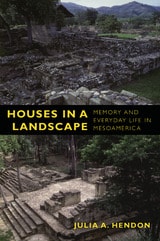
Houses in a Landscape
Memory and Everyday Life in MesoamericaJulia A. Hendon
Duke University Press, 2010
Hendon conducted research on three contemporaneous Native American civilizations that flourished from the seventh century through the eleventh CE: the Maya kingdom of Copan, the hilltop center of Cerro Palenque, and the dispersed settlement of the Cuyumapa valley. She analyzes domestic life in these societies, from cooking to crafting, as well as public and private ritual events including the ballgame. Combining her findings with a rich body of theory from anthropology, history, and geography, she explores how objects—the things people build, make, use, exchange, and discard—help people remember. In so doing, she demonstrates how everyday life becomes part of the social processes of remembering and forgetting, and how “memory communities” assert connections between the past and the present.
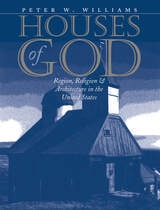
Houses of God
Region, Religion, and Architecture in the United StatesPeter W. Williams
University of Illinois Press, 1997
Housing Design and Society in Amsterdam
Reconfiguring Urban Order and Identity, 1900-1920Nancy Stieber
University of Chicago Press, 1998
Historians.
During the early 1900s, Amsterdam developed an international reputation as an urban mecca when invigorating reforms gave rise to new residential neighborhoods encircling the city's dispirited nineteenth-century districts. This new housing, built primarily with government subsidy, not only was affordable but also met rigorous standards of urban planning and architectural design. Nancy Stieber explores the social and political developments that fostered this innovation in public housing.
Drawing on government records, professional journals, and polemical writings, Stieber examines how government supported large-scale housing projects, how architects like Berlage redefined their role as architects in service to society, and how the housing occupants were affected by public debates about working-class life, the cultural value of housing, and the role of art in society.
Stieber emphasizes the tensions involved in making architectural design a social practice while she demonstrates the success of this collective enterprise in bringing about effective social policy and aesthetic progress.
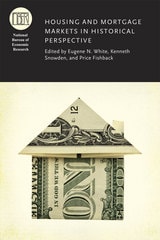
Housing and Mortgage Markets in Historical Perspective
Edited by Eugene N. White, Kenneth Snowden, and Price V. Fishback
University of Chicago Press, 2014
This volume begins to answer these questions, providing a much-needed context for understanding recent events by examining how historical housing and mortgage markets worked—and how they sometimes failed. Renowned economic historians Eugene N. White, Kenneth Snowden, and Price Fishback survey the foundational research on housing crises, comparing that of the 1930s to that of the early 2000s in order to authoritatively identify what contributed to each crisis. Later chapters explore notable historical experiences with mortgage securitization and the role that federal policy played in the surge in home ownership between 1940 and 1960. By providing a broad historical overview of housing and mortgage markets, the volume offers valuable new insights to inform future policy debates.
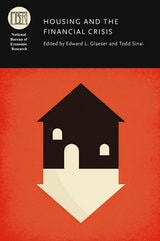
Housing and the Financial Crisis
Edited by Edward L. Glaeser and Todd Sinai
University of Chicago Press, 2013
Housing and the Financial Crisis looks at what happened to prices and construction both during and after the housing boom in different parts of the American housing market, accounting for why certain areas experienced less volatility than others. It then examines the causes of the boom and bust, including the availability of credit, the perceived risk reduction due to the securitization of mortgages, and the increase in lending from foreign sources. Finally, it examines a range of policies that might address some of the sources of recent instability.
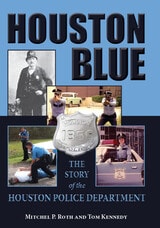
Houston Blue
The Story of the Houston Police DepartmentMitchel P. Roth
University of North Texas Press, 2012
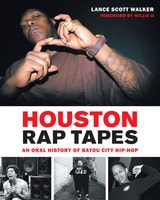
Houston Rap Tapes
An Oral History of Bayou City Hip-HopBy Lance Scott Walker, Foreword by Willie D
University of Texas Press, 2018
The neighborhoods of Fifth Ward, Fourth Ward, Third Ward, and the Southside of Houston, Texas, gave birth to Houston rap, a vibrant music scene that has produced globally recognized artists such as Geto Boys, DJ Screw, Pimp C and Bun B of UGK, Fat Pat, Big Moe, Z-Ro, Lil’ Troy, and Paul Wall. Lance Scott Walker and photographer Peter Beste spent a decade documenting Houston’s scene, interviewing and photographing the people—rappers, DJs, producers, promoters, record label owners—and places that give rap music from the Bayou City its distinctive character. Their collaboration produced the books Houston Rap and Houston Rap Tapes.
This second edition of Houston Rap Tapes amplifies the city’s hip-hop history through new interviews with Scarface, Slim Thug, Lez Moné, B L A C K I E, Lil’ Keke, and Sire Jukebox of the original Ghetto Boys. Walker groups the interviews into sections that track the different eras and movements in Houston rap, with new photographs and album art that reveal the evolution of the scene from the 1970s to today’s hip-hop generation. The interviews range from the specifics of making music to the passions, regrets, memories, and hopes that give it life. While offering a view from some of Houston’s most marginalized areas, these intimate conversations lay out universal struggles and feelings. As Willie D of Geto Boys writes in the foreword, “Houston Rap Tapes flows more like a bunch of fellows who haven’t seen each other for ages, hanging out on the block reminiscing, rather than a calculated literary guide to Houston’s history.”
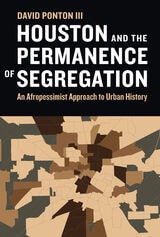
Houston and the Permanence of Segregation
An Afropessimist Approach to Urban HistoryDavid Ponton
University of Texas Press, 2024
2025 Most Significant Scholarly Book, Texas Institute of Letters
A history of racism and segregation in twentieth-century Houston and beyond.
Through the 1950s and beyond, the Supreme Court issued decisions that appeared to provide immediate civil rights protections to racial minorities as it relegated Jim Crow to the past. For black Houstonians who had been hoping and actively fighting for what they called a “raceless democracy,” these postwar decades were often seen as decades of promise. In Houston and the Permanence of Segregation, David Ponton argues that these were instead “decades of capture”: times in which people were captured and constrained by gender and race, by faith in the law, by antiblack violence, and even by the narrative structures of conventional histories. Bringing the insights of Black studies and Afropessimism to the field of urban history, Ponton explores how gender roles constrained thought in black freedom movements, how the “rule of law” compelled black Houstonians to view injustice as a sign of progress, and how antiblack terror undermined Houston’s narrative of itself as a “heavenly” place.
Today, Houston is one of the most racially diverse cities in the United States, and at the same time it remains one of the most starkly segregated. Ponton’s study demonstrates how and why segregation has become a permanent feature in our cities and offers powerful tools for imagining the world otherwise.
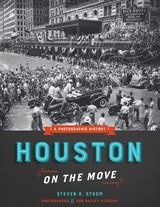
Houston on the Move
A Photographic HistoryBy Steven R. Strom, Photographs by Bob Bailey Studios
University of Texas Press, 2016
Houston completely transformed itself during the twentieth century, burgeoning from a regional hub into a world-class international powerhouse. This remarkable metamorphosis is captured in the Bob Bailey Studios Photographic Archive, an unparalleled visual record of Houston life from the 1930s to the early 1990s. Founded by the commercial photographer Bob Bailey in 1929, the Bailey Studios produced more than 500,000 photographs and fifty-two 16 mm films, making its archive the largest and most comprehensive collection of images ever taken in and around Houston. The Bob Bailey Studios Archive is now owned by the Dolph Briscoe Center for American History at the University of Texas at Austin.
Houston on the Move presents over two hundred of the Bailey archive’s most memorable and important photographs with extended captions that detail the photos’ subjects and the reasons for their significance. These images, most never before published, document everything from key events in Houston’s modern history—World War II; the Texas City Disaster; the building of the Astrodome; and the development of the Ship Channel, Medical Center, and Johnson Space Center—to nostalgic scenes of daily life. Bob Bailey’s expertly composed photographs reveal a great city in the making: a downtown striving to be the best, biggest, and tallest; birthday parties, snow days, celebrations, and rodeos; opulent department stores; Hollywood stars and political leaders; rapid industrial and commercial growth; and the inexorable march of the suburbs. An irresistible “remember that?” book for long-time Houstonians, Houston on the Move will also be an essential reference for historians, photographers, designers, and city planners.
Houston, We Have a Narrative
Why Science Needs StoryRandy Olson
University of Chicago Press, 2015
That’s a huge mistake, says Randy Olson: Hollywood has a lot to teach scientists about how to tell a story—and, ultimately, how to do science better. With Houston, We Have a Narrative, he lays out a stunningly simple method for turning the dull into the dramatic. Drawing on his unique background, which saw him leave his job as a working scientist to launch a career as a filmmaker, Olson first diagnoses the problem: When scientists tell us about their work, they pile one moment and one detail atop another moment and another detail—a stultifying procession of “and, and, and.” What we need instead is an understanding of the basic elements of story, the narrative structures that our brains are all but hardwired to look for—which Olson boils down, brilliantly, to “And, But, Therefore,” or ABT. At a stroke, the ABT approach introduces momentum (“And”), conflict (“But”), and resolution (“Therefore”)—the fundamental building blocks of story. As Olson has shown by leading countless workshops worldwide, when scientists’ eyes are opened to ABT, the effect is staggering: suddenly, they’re not just talking about their work—they’re telling stories about it. And audiences are captivated.
Written with an uncommon verve and enthusiasm, and built on principles that are applicable to fields far beyond science, Houston, We Have a Narrative has the power to transform the way science is understood and appreciated, and ultimately how it’s done.
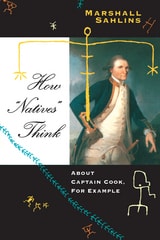
How "Natives" Think
About Captain Cook, For ExampleMarshall Sahlins
University of Chicago Press, 1995
In recent years, these questions have arisen in debates over the death and deification of Captain James Cook on Hawai'i Island in 1779. Did the Hawaiians truly receive Cook as a manifestation of their own god Lono? Or were they too pragmatic, too worldly-wise to accept the foreigner as a god? Moreover, can a "non-native" scholar give voice to a "native" point of view? In his 1992 book The Apotheosis of Captain Cook, Gananath Obeyesekere used this very issue to attack Sahlins's decades of scholarship on Hawaii. Accusing Sahlins of elementary mistakes of fact and logic, even of intentional distortion, Obeyesekere portrayed Sahlins as accepting a naive, enthnocentric idea of superiority of the white man over "natives"—Hawaiian and otherwise. Claiming that his own Sri Lankan heritage gave him privileged access to the Polynesian native perspective, Obeyesekere contended that Hawaiians were actually pragmatists too rational and sensible to mistake Cook for a god.
Curiously then, as Sahlins shows, Obeyesekere turns eighteenth-century Hawaiians into twentieth-century modern Europeans, living up to the highest Western standards of "practical rationality." By contrast, Western scholars are turned into classic custom-bound "natives", endlessly repeating their ancestral traditions of the White man's superiority by insisting Cook was taken for a god. But this inverted ethnocentrism can only be supported, as Sahlins demonstrates, through wholesale fabrications of Hawaiian ethnography and history—not to mention Obeyesekere's sustained misrepresentations of Sahlins's own work. And in the end, although he claims to be speaking on behalf of the "natives," Obeyesekere, by substituting a home-made "rationality" for Hawaiian culture, systematically eliminates the voices of Hawaiian people from their own history.
How "Natives" Think goes far beyond specialized debates about the alleged superiority of Western traditions. The culmination of Sahlins's ethnohistorical research on Hawaii, it is a reaffirmation for understanding difference.
How Alex Bloom Built Radical Democratic Secondary Education in Post-war London
Michael Fielding
University College London, 2026
The true story behind a school that pioneered progressive education in post-Second World War Britain and inspired the famous film To Sir, With Love.
Alex Bloom (1895–1955) was a remarkable school leader whose reputation in his lifetime extended far beyond the UK. Against all odds, in the bomb-damaged remains of London’s East End immediately after the Second World War, he established a school that championed equality, democracy, diversity, and creativity. That school—St George-in-the-East Secondary Modern on Cable Street—is known to many as the inspiration for the novel and film To Sir, With Love, but its significance for education goes far deeper. An explicit affirmation of Bloom’s progressive values and aspirations, it had no punishments or rewards, no prizes or failures, and no set curriculum. It became a beacon for radical democratic schooling, achieving an astonishing international reputation and a lasting legacy.
Based on primary research with former teachers and pupils of St George-in-the-East, How Alex Bloom Built Radical Democratic Secondary Education in Post-war London recounts the story of the school’s founding, pedagogy, and democratic inclusivity. Through the book’s own narrative, and in short contributions from some of today’s leading educators, it examines Bloom’s contemporary and subsequent influence on education in the UK and further afield. Most of all, this book reveals Bloom’s extraordinary dedication and commitment to his staff, his pupils, and their community, exemplifying the importance of engaging with the school’s contemporary realities.
How America Became Capitalist
Imperial Expansion and the Conquest of the WestJames Parisot
Pluto Press, 2019
Not so fast, says James Parisot. In How America Became Capitalist, he tells the little-known story of how our economic system came to be, and of the alternatives that were sidelined along the way. Capitalist elements were apparent from the first colonies of white settlers, but they were far from dominant, and they weren’t the driving factor in the advancement of colonies deeper into the continent. Even slavery, which was at the heart of both American capitalism and imperialism throughout much of the nation’s growth, was less a monolithic force than a series of complicated encounters that took different forms. Individual difference slowed the homogenization of capitalism as well, as transgender people, gays and lesbians, and people in interracial relationships all brought complexity to the market’s idea of the typical household.
At a moment when the long-term viability of capitalism is coming increasingly into question, How America Became Capitalist reminds us that the path to its dominance was never so smooth, nor so complete, as its champions would have us believe.
How America Met the Jews
Hasia R. Diner
SBL Press, 2017
Explore how American conditions and Jewish circumstances collided in the nineteenth and early twentieth centuries
In this new book award-winning author Hasia R. Diner explores the issues behind why European Jews overwhelmingly chose to move to the United States between the 1820s and 1920s. Unlike books that tend to romanticize American freedom as the force behind this period of migration or that tend to focus on Jewish contributions to America or that concentrate on how Jewish traditions of literacy and self-help made it possible for them to succeed, Diner instead focuses on aspects of American life and history that made it the preferred destination for 90 percent of European Jews.
Features:
- Examination of the realities of race, immigration, color, money, economic development, politics, and religion in America
- Exploration of an America agenda that sought out white immigrants to help stoke economic development and that valued religion as a force for morality

How Dark Is My Flower
Yosano Akiko and the Invention of Romantic LoveLeith Morton
University of Michigan Press, 2023
How Dark Is My Flower emphasizes the astonishing innovations in diction and style, not to mention content, in Akiko’s work that transformed the tanka genre from a hidebound and conservative mode of verse to something much more daring and modern. This book pays particular attention to poetry, particularly the tanka genre, in the evolution of modernism in Japanese literature and breaks new ground in the study of modern Japanese literature by examining the invention and evolution of the concept of romantic love.
How Difficult It Is to Be God
Shining Path’s Politics of War in Peru, 1980–1999Carlos Iván Degregori; Edited and with an introduction by Steve J. Stern; Translated by Nancy Appelbaum, Joanna Drzewieniecki, Héctor Flores, Eric Hershberg, Judy Rein, Steve J. Stern, and Kimberly Theidon
University of Wisconsin Press, 2012
In How Difficult It Is to Be God, Carlos Iván Degregori—the world’s leading expert on Shining Path and the intellectual architect for Peru’s highly regarded Truth and Reconciliation Commission—elucidates the movement’s dynamics. An anthropologist who witnessed Shining Path’s recruitment of militants in the 1970s, Degregori grounds his findings in deep research and fieldwork. He explains not only the ideology and culture of revolution among the insurgents, but also their capacity to extend their influence to university youths, Indian communities, and competing social and political movements.
Making Degregori’s most important work available to English-language readers for the first time, this translation includes a new introduction by historian Steve J. Stern, who analyzes the author’s achievement, why it matters, and the debates it sparked. For anyone interested in Peru and Latin America’s age of “dirty war,” or in the comparative study of revolutions, Maoism, and human rights, this book will provide arresting new insights.

How Economics Became a Mathematical Science
E. Roy Weintraub
Duke University Press, 2002
Whereas others have viewed economics as autonomous, Weintraub presents a different picture, one in which changes in mathematics—both within the body of knowledge that constitutes mathematics and in how it is thought of as a discipline and as a type of knowledge—have been intertwined with the evolution of economic thought. Weintraub begins his account with Cambridge University, the intellectual birthplace of modern economics, and examines specifically Alfred Marshall and the Mathematical Tripos examinations—tests in mathematics that were required of all who wished to study economics at Cambridge. He proceeds to interrogate the idea of a rigorous mathematical economics through the connections between particular mathematical economists and mathematicians in each of the decades of the first half of the twentieth century, and thus describes how the mathematical issues of formalism and axiomatization have shaped economics. Finally, How Economics Became a Mathematical Science reconstructs the career of the economist Sidney Weintraub, whose relationship to mathematics is viewed through his relationships with his mathematician brother, Hal, and his mathematician-economist son, the book’s author.
How Experiments End
Peter Galison
University of Chicago Press, 1987
"Anyone who is seriously concerned with understanding how research is done should read this. There have been many books on one or another part of its subject matter but few giving such insights into how the research is done and how the consensus of discovery is arrived at."—Frank Close, New Scientist
"[Galison] is to be congratulated on producing a masterpiece in the field."—Michael Redhead, Synthese
"How Experiments End is a major historical work on an exciting topic."—Andy Pickering, Isis
How Failed Attempts to Amend the Constitution Mobilize Political Change
Roger C. Hartley
Vanderbilt University Press, 2017
This book is a demonstration of how social reformers and politicians have used the amendment process to achieve favorable political results even as their proposed amendments have failed to be adopted. For example, the ERA "failed" in the sense that it was never ratified, but the mobilization to ratify the ERA helped build the feminist movement (and also sparked a countermobilization). Similarly, the Supreme Court's ban on compulsory school prayer led to a barrage of proposed amendments to reverse the Court. They failed to achieve the requisite two-thirds support from Congress, but nevertheless had an impact on the political landscape. The definition of the relationship between Congress and the President in the conduct of foreign policy can also be traced directly to failed efforts to amend the Constitution during the Cold War.
Roger Hartley examines familiar examples like the ERA, balanced budget amendment proposals, and pro-life attempts to overturn Roe v. Wade, but also takes the reader on a three-century tour of lesser-known amendments. He explains how often the mere threat of calling a constitutional convention (at which anything could happen) effected political change.
How French Moderns Think
The Lévy-Bruhl Family, From “Primitive Mentality” to Contemporary PandemicsFrédéric Keck
HAU, 2023
How French Moderns Think tells the story of the French sociological tradition through four generations of the Lévy-Bruhl family: Lucien, who founded the Institute of Ethnology at the University of Paris; his son Henri, who founded the Institute of Roman Law; his grandson Raymond, who took part in the creation of the National Institute of Statistics and Economic Studies; and his great-grandson Daniel, a vaccine specialist at the Institute of Public Health. This family history casts a new light on the philosophical debates about “primitive mentality” and the “savage mind.” By drawing on the expert knowledge inherent in this family genealogy, the articulation between the logical and the “pre-logical” is not a cognitive question but rather a problem of anticipating unpredictable events. By relating Lévy-Bruhl’s engagements from the Dreyfus Affair to the Minister of Armaments during the First World War, Keck narrates the confrontation of the socialist ideal of justice and truth with the French colonial experience and its transformations in global technologies preparing for pandemics.
How Green Were the Nazis?
Nature, Environment, and Nation in the Third ReichFranz-Josef Brüggemeier
Ohio University Press, 2005
How Happy to Call Oneself a Turk
Provincial Newspapers and the Negotiation of a Muslim National IdentityBy Gavin D. Brockett
University of Texas Press, 2011
The modern nation-state of Turkey was established in 1923, but when and how did its citizens begin to identify themselves as Turks? Mustafa Kemal Atatürk, Turkey's founding president, is almost universally credited with creating a Turkish national identity through his revolutionary program to "secularize" the former heartland of the Ottoman Empire. Yet, despite Turkey's status as the lone secular state in the Muslim Middle East, religion remains a powerful force in Turkish society, and the country today is governed by a democratically elected political party with a distinctly religious (Islamist) orientation.
In this history, Gavin D. Brockett takes a fresh look at the formation of Turkish national identity, focusing on the relationship between Islam and nationalism and the process through which a "religious national identity" emerged. Challenging the orthodoxy that Atatürk and the political elite imposed a sense of national identity from the top down, Brockett examines the social and political debates in provincial newspapers from around the country. He shows that the unprecedented expansion of print media in Turkey between 1945 and 1954, which followed the end of strict, single-party authoritarian government, created a forum in which ordinary people could inject popular religious identities into the new Turkish nationalism. Brockett makes a convincing case that it was this fruitful negotiation between secular nationalism and Islam—rather than the imposition of secularism alone—that created the modern Turkish national identity.
How Holocausts Happen
The United States in Central AmericaDouglas V. Porpora
Temple University Press, 1992
"History repeats itself, but it never repeats itself exactly," observes Douglas Porpora in this powerful indictment of U.S. intervention in Central America. Comparing the general public’s reaction to the Holocaust in Nazi Germany with American public opinion of U.S. participation in the genocidal policies of Nicaraguan counter-revolutionary forces, and the governments of Guatemala and El Salvador among others, Porpora demonstrates that moral indifference to the suffering of others was the common response. With reference to Hannah Arendt’s thesis of the banality of evil, he develops the concept of a "Holocaust-like event" and examines how even a democratic society can be capable of something on the order of a Holocaust.
Unlike other accounts of the Holocaust and genocide, this book focuses on the citizenry served or ruled by genocidal governments rather than on the governments themselves. Porpora argues that moral indifference and lack of interest in critical reflection are key factors that enable Holocaust-like events to happen And he characterizes American society as being typically indifferent to the fate of other people, uninformed, and anti-intellectual.
Porpora cites numerous horrifying examples of U.S.-backed Latin American government actions against their own peasants, Indians, and dissident factions. He offers finally a theory of public moral indifference and argues that although such indifference is socially created by government, the media, churches, and other institutions, we, the public, must ultimately take responsibility for it. How Holocausts Happen is at once a scholarly examination of the nature of genocide and a stinging indictment of American society.
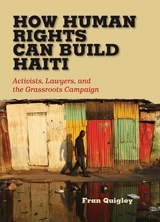
How Human Rights Can Build Haiti
Activists, Lawyers, and the Grassroots CampaignFran Quigley
Vanderbilt University Press, 2014
The only way to transform Haiti's dismal human rights legacy is through a bottom-up social movement, supported by local and international challenges to the status quo. That recipe for reform mirrors the strategy followed by Mario Joseph, Brian Concannon, and their clients and colleagues profiled in this book. Together, Joseph, Concannon, and their allies represent Haiti's best hope to escape the cycle of disaster, corruption, and violence that has characterized the country's two-hundred-year history. At the same time, their efforts are creating a template for a new and more effective human rights-focused strategy to turn around failed states and end global poverty.

How Knowledge Moves
Writing the Transnational History of Science and TechnologyEdited by John Krige
University of Chicago Press, 2019
This specialized knowledge is located at multiple sites and moves across borders via a dazzling array of channels, embedded in heads and hands, in artifacts, and in texts. In the United States, it shapes policies for visas, export controls, and nuclear weapons proliferation; in Algeria, it enhances the production of oranges by colonial settlers; in Vietnam, it facilitates the exploitation of a river delta. In India it transforms modes of agricultural production. It implants American values in Latin America. By concentrating on the conditions that allow for knowledge movement, these essays explore travel and exchange in face-to-face encounters and show how border-crossings mobilize extensive bureaucratic technologies.
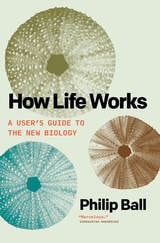
How Life Works
A User’s Guide to the New BiologyPhilip Ball
University of Chicago Press, 2023
“Ball’s marvelous book is both wide-ranging and deep. . . . I could not put it down.”—Siddhartha Mukherjee, author of The Song of the Cell and the Pulitzer Prize–winning The Emperor of All Maladies
A new, cutting-edge vision of biology that revises our understanding of what life itself is, how to enhance it, and what possibilities it offers.
Biology is undergoing a quiet but profound transformation. Several aspects of the standard picture of how life works—the idea of the genome as a blueprint, of genes as instructions for building an organism, of proteins as precisely tailored molecular machines, of cells as entities with fixed identities, and more—have been exposed as incomplete, misleading, or wrong.
In How Life Works, Philip Ball explores the new biology, revealing life to be a far richer, more ingenious affair than we had guessed. Ball explains that there is no unique place to look for an answer to this question: life is a system of many levels—genes, proteins, cells, tissues, and body modules such as the immune system and the nervous system—each with its own rules and principles. How Life Works explains how these levels operate, interface, and work together (most of the time).
With this knowledge come new possibilities. Today we can redesign and reconfigure living systems, tissues, and organisms. We can reprogram cells, for instance, to carry out new tasks and grow into structures not seen in the natural world. As we discover the conditions that dictate the forms into which cells organize themselves, our ability to guide and select the outcomes becomes ever more extraordinary. Some researchers believe that ultimately we will be able to regenerate limbs and organs, and perhaps even create new life forms that evolution has never imagined.
Incorporating the latest research and insights, How Life Works is a sweeping journey into this new frontier of the life sciences, a realm that will reshape our understanding of life as we know it.
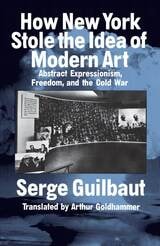
How New York Stole the Idea of Modern Art
Serge Guilbaut
University of Chicago Press, 1985
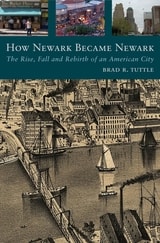
How Newark Became Newark
The Rise, Fall, and Rebirth of an American CityBrad R. Tuttle
Rutgers University Press, 2009
How Newark Became Newark is a fresh, unflinching popular history that spans the city's epic transformation from a tiny Puritan village into a manufacturing powerhouse, on to its desperate struggles in the twentieth century and beyond. After World War II, unrest mounted as the minority community was increasingly marginalized, leading to the wrenching civic disturbances of the 1960s. Though much of the city was crippled for years, How Newark Became Newark is also a story of survival and hope. Today, a real estate revival and growing population are signs that Newark is once again in ascendance.
How Oceans Become
Histories and Futures of the High Seas and Deep OceansThomas Brandt, Knut Ove Eliassen, Mats Ingulstad, Gard Paulsen
University of Chicago Press, 0
An anthology grounded in the idea that oceans are human realities, shaped by human interests, interactions, and technologies.
Historically and geographically diverse, oceans exist in the plural. Oceans become oceans through how they are represented, what resources they are deemed to hold, and the regulatory governance to which they are subjected. These are the three key components of “ocean making” this volume employs to shed light on the complex issues facing ocean governance today.
The anthology reaches back to the oceans of the early modern European expansion and up to the current concerns of anthropogenic changes and resource depletion. Chapters address activities and regulatory concerns regarding maritime transport, fisheries, deep-sea mining, wave energy, and whaling, and span from the southern oceans around Antarctica to the current shedding of the icy mantle of the Arctic Ocean. By drawing together scholars from a wide range of disciplines—including history, comparative literature, media studies, political science, law, and anthropology—How Oceans Become opens a multi-layered, interdisciplinary approach to studying the oceans’ entanglements with human cultures and societies.
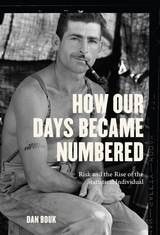
How Our Days Became Numbered
Risk and the Rise of the Statistical IndividualDan Bouk
University of Chicago Press, 2015
How Our Days Became Numbered tells a story of corporate culture remaking American culture--a story of intellectuals and professionals in and around insurance companies who reimagined Americans' lives through numbers and taught ordinary Americans to do the same. Making individuals statistical did not happen easily. Legislative battles raged over the propriety of discriminating by race or of smoothing away the effects of capitalism's fluctuations on individuals. Meanwhile, debates within companies set doctors against actuaries and agents, resulting in elaborate, secretive systems of surveillance and calculation.
Dan Bouk reveals how, in a little over half a century, insurers laid the groundwork for the much-quantified, risk-infused world that we live in today. To understand how the financial world shapes modern bodies, how risk assessments can perpetuate inequalities of race or sex, and how the quantification and claims of risk on each of us continue to grow, we must take seriously the history of those who view our lives as a series of probabilities to be managed.

How Philosophers Saved Myths
Allegorical Interpretation and Classical MythologyLuc Brisson
University of Chicago Press, 2004
How Philosophers Saved Myths also describes how, during the first years of the modern era, allegory followed a more religious path, which was to assume a larger role in Neoplatonism. Ultimately, Brisson explains how this embrace of myth was carried forward by Byzantine thinkers and artists throughout the Middle Ages and Renaissance; after the triumph of Chistianity, Brisson argues, myths no longer had to agree with just history and philosophy but the dogmas of the Church as well.
How Philosophy Became Socratic
A Study of Plato's "Protagoras," "Charmides," and "Republic"Laurence Lampert
University of Chicago Press, 2010
How Presidents Test Reality
Decisions on Vietnam, 1954 and 1965John P. Burke, Fred L. Greenstein, Larry Berman, and Richard Immerman
Russell Sage Foundation, 1991
Just as famines and plagues can provide opportunities for medical research, the unhappy course of United States relations with Vietnam is a prime source of evidence for students of American political institutions. How Presidents Test Reality draws on the record of American decision making about Vietnam to explore the capacity of top government executives and their advisers to engage in effective reality testing.
Authors Burke and Greenstein compare the Vietnam decisions of two presidents whose leadership styles and advisory systems diverged as sharply as any in the modern presidency. Faced with a common challenge—an incipient Communist take-over of Vietnam—presidents Eisenhower and Johnson engaged in intense debates with their aides and associates, some of whom favored intervention and some of whom opposed it. In the Dien Bien Phu Crisis of 1954, Eisenhower decided not to enter the conflict; in 1965, when it became evident that the regime in South Vietnam could not hold out much longer, Johnson intervened.
How Presidents Test Reality uses declassified records and interviews with participants to assess the adequacy of each president’s use of advice and information. This important book advances our historical understanding of the American involvement in Vietnam and illuminates the preconditions of effective presidential leadership in the modern world.
"An exceptionally thoughtful exercise in what ‘contemporary history’ ought to be. Illuminates the past in a way that suggests how we might deal with the present and the future." —John Lewis Gaddis
"Burke and Greenstein have written what amounts to an owner's manual for operating the National Security Council....This is a book Reagan's people could have used and George Bush ought to read." —Bob Schieffer, The Washington Monthly
How Reason Almost Lost Its Mind
The Strange Career of Cold War RationalityPaul Erickson, Judy L. Klein, Lorraine Daston, Rebecca Lemov, Thomas Sturm, and Michael D. Gordin
University of Chicago Press, 2013
How Revolutions Happen
Konstantin Sonin
University of Chicago Press, 0
From the Russian intellectual-in-exile Konstantin Sonin, a grand theory of when and how rapid political change happens—or doesn’t.
In 2015, economist Konstantin Sonin solidified his status as an enemy of the Russian state when he published an article predicting that Vladimir Putin’s presidency would produce the country’s third revolution by the middle of this century. Forced to flee the country, Sonin settled in Chicago. In the decade that followed, the Russian government continued to pursue him—placing him on their state wanted list, tracking his movements, and sentencing him in absentia to eight years in prison. Sonin’s research and political advocacy continued unabated. So did his writing.
Now, Sonin has completed his masterpiece: a revelatory and sweeping investigation of a timeless question—what makes a revolution? How Revolutions Happen pinpoints why they arise, why they don’t, and where they’re likely to occur next. Tracing examples of successful and failed examples from history—in China, France, Haiti, Ukraine—Sonin shows that revolutions don’t grow out of mere popular unrest; they happen when states cease to evolve. This argument extends well beyond why nations fail, considering also why nations almost fail and why other nations fail repeatedly. Drawing on both empirical evidence and his firsthand experience, he also argues that although revolutions are an important part of human societies, they are not inherently good or bad—or quick to end.
Wry, sweeping, and erudite, How Revolutions Happen recasts everything we think about political change. From one of the world’s foremost political economists, this book is a momentous cumulation of knowledge that allows us to fully understand what a revolution is, why they occurred in the past—and how to measure where they might be coming.
How Russia Learned to Write
Literature and the Imperial Table of RanksIrina Reyfman
University of Wisconsin Press, 2021
Irina Reyfman illuminates the surprisingly diverse effects of the Table of Ranks on writers, their work, and literary culture in Russia. From Sumarokov and Derzhavin in the eighteenth century through Pushkin, Gogol, Dostoevsky, and poets serving in the military in the nineteenth, state service affected the self-images of writers and the themes of their creative output. Reyfman also notes its effects on Russia’s atypical course in the professionalization and social status of literary work.