Results by title
5448 books match the query 'History and criticism' and 153 start with h
Heresy and the Ideal
On Contemporary PoetryDavid Baker
University of Arkansas Press, 2000
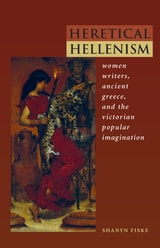
Heretical Hellenism
Women Writers, Ancient Greece, and the Victorian Popular ImaginationShanyn Fiske
Ohio University Press, 2008
The prevailing assumption regarding the Victorians’ relationship to ancient Greece is that Greek knowledge constituted an exclusive discourse within elite male domains. Heretical Hellenism: Women Writers, Ancient Greece, and the Victorian Popular Imagination challenges that theory and argues that while the information women received from popular sources was fragmentary and often fostered intellectual insecurities, it was precisely the ineffability of the Greek world refracted through popular sources and reconceived through new fields of study that appealed to women writers’ imaginations.
Examining underconsidered sources such as theater history and popular journals, Shanyn Fiske uncovers the many ways that women acquired knowledge of Greek literature, history, and philosophy without formal classical training. Through discussions of women writers such as Charlotte Brontë, George Eliot, and Jane Harrison, Heretical Hellenism demonstrates that women established the foundations of a heretical challenge to traditional humanist assumptions about the uniformity of classical knowledge and about women’s place in literary history.
Heretical Hellenism provides a historical rationale for a more expansive definition of classical knowledge and offers an interdisciplinary method for understanding the place of classics both in the nineteenth century and in our own time.
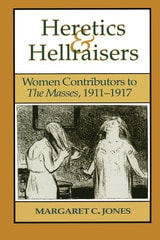
Heretics and Hellraisers
Women Contributors to The Masses, 1911-1917By Margaret C. Jones
University of Texas Press, 1993
The Masses was the most dynamic and influential left-wing magazine of the early twentieth century, a touchstone for understanding radical thought and social movements in the United States during that era. As a magazine that supported feminist issues, it played a crucial role in shaping public discourse about women's concerns. Women editors, fiction writers, poets, and activists like Mary Heaton Vorse, Louise Bryant, Adriana Spadoni, Elsie Clews Parsons, Inez Haynes Gillmore, and Helen Hull contributed as significantly to the magazine as better-known male figures.
In this major revisionist work, Margaret C. Jones calls for reexamination of the relevance of Masses feminism to that of the 1990s. She explores women contributors' perspectives on crucial issues: patriarchy, birth control, the labor movement, woman suffrage, pacifism, and ethnicity. The book includes numerous examples of the writings and visual art of Masses women and a series of biographical/bibliographical sketches designed to aid other researchers.
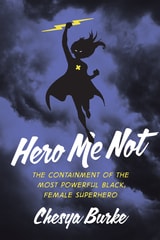
Hero Me Not
The Containment of the Most Powerful Black, Female SuperheroChesya Burke
Rutgers University Press, 2023
First introduced in the pages of X-Men, Storm is probably the most recognized Black female superhero. She is also one of the most powerful characters in the Marvel Universe, with abilities that allow her to control the weather itself. Yet that power is almost always deployed in the service of White characters, and Storm is rarely treated as an authority figure.
Hero Me Not offers an in-depth look at this fascinating yet often frustrating character through all her manifestations in comics, animation, and films. Chesya Burke examines the coding of Storm as racially “exotic,” an African woman who nonetheless has bright white hair and blue eyes and was portrayed onscreen by biracial actresses Halle Berry and Alexandra Shipp. She shows how Storm, created by White writers and artists, was an amalgam of various Black stereotypes, from the Mammy and the Jezebel to the Magical Negro, resulting in a new stereotype she terms the Negro Spiritual Woman.
With chapters focusing on the history, transmedia representation, and racial politics of Storm, Burke offers a very personal account of what it means to be a Black female comics fan searching popular culture for positive images of powerful women who look like you.
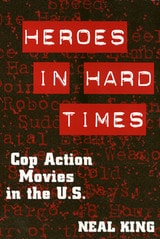
Heroes In Hard Times
Neal King
Temple University Press, 1999
King studies how, in the cop action genre, working-class police officers weigh in on such topics as racial justice, homosexuality, misogyny, unemployment, worker resistance, affirmative action, drug use, poverty, divorce, and the use of violence to deal with social problems. Facing their enemies with wisecracks and firepower, these men prove themselves at once complicitous in a system of violence and corruption and worthy to "blow away," with neither hesitation nor remorse, their -- society's -- menacing threats. The central male figures in these stories are heroes in their fight against criminals, but, as individuals, they fell undervalued by women, unappreciated by their bosses, and out of place in a society where fat cats and liberals have all the power. Such "hard times," King's study reveals, position them to simultaneously long for, disdain, and heroically -- if violently -- stake their frustrated claim to white male privilege.
Discussing such topics as white male guilt and the rage of the oppressed and examining such films as Lethal Weapon, Die Hard, and Silence of the Lambs, King's book notes the socially-charged roles given to American culture's fictional police heroes. The last artisan in a culture that has become increasingly corporate and bureaucratized, the movie cop is the last 'real man' in a world that has emasculated men and the last non-conforming patriot in a world that pays more attention to rules than what is morally right.
A book that shows how modern mythology makes sense of rampant corruption (and provides entertainment in its punishment), Heroes in Hard Times will educate and provoke those interested in American popular culture, film, and gender studies.

Heroes and Humanities
Detective Fiction and CultureRay B. Browne
University of Wisconsin Press, 1986
The present study of American, Australian, and Canadian detective fiction concerns literature which speaks in the ways of heroes and humanities about the human condition. All authors studied here, to one degree or another, demonstrate their concern with human society, some more strongly than others, but all with their eyes on the human situation and human existence. At times these studies lean toward the tragic in their outlook and development. In all instances they center on the humanistic.
Hewing to Experience
Essays and Reviews on Recent American Poetry and Poetics, Nature and CultureSherman Paul
University of Iowa Press, 1989
Hidden Hands
Working-Class Women and Victorian Social-Problem FictionPatricia E. Johnson
Ohio University Press, 2001
Tracing the Victorian crisis over the representation of working-class women to the 1842 Parliamentary bluebook on mines, with its controversial images of women at work, Hidden Hands argues that the female industrial worker became even more dangerous to represent than the prostitute or the male radical because she exposed crucial contradictions between the class and gender ideologies of the period and its economic realities.
Drawing on the recent work of feminist historians, Patricia Johnson lays the groundwork for a reinterpretation of Victorian social-problem fiction that highlights its treatment of issues that particularly affected working-class women: sexual harassment; the interconnections between domestic ideology and domestic violence; their relationships to male-dominated working-class movements such as Luddism, Chartism, and unionism; and their troubled connection to middle-class feminism.
Uncovering a series of images in Victorian fiction ranging from hot-tempered servants and sexually harassed factory girls to working-class homemakers pictured as beaten dogs, Hidden Hands demonstrates that representations of working-class women, however marginalized or incoherent, reveal the very contradictions they are constructed to hide and that the dynamics of these representations have broad implications both for other groups, such as middle-class women, and for the emergence of working-class women as writers themselves.
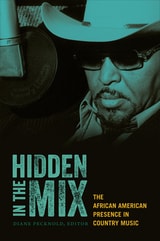
Hidden in the Mix
The African American Presence in Country MusicDiane Pecknold, ed.
Duke University Press, 2013
The contributors to Hidden in the Mix examine how country music became "white," how that fictive racialization has been maintained, and how African American artists and fans have used country music to elaborate their own identities. They investigate topics as diverse as the role of race in shaping old-time record catalogues, the transracial West of the hick-hopper Cowboy Troy, and the place of U.S. country music in postcolonial debates about race and resistance. Revealing how music mediates both the ideology and the lived experience of race, Hidden in the Mix challenges the status of country music as "the white man’s blues."
Contributors. Michael Awkward, Erika Brady, Barbara Ching, Adam Gussow, Patrick Huber, Charles Hughes, Jeffrey A. Keith, Kip Lornell, Diane Pecknold, David Sanjek, Tony Thomas, Jerry Wever

Hide and Seek
The Child between Psychoanalysis and FictionVirginia L. Blum
University of Illinois Press, 1995
Concentrating on the "go-between" function of the child in nineteenth- and twentieth-century American and British fiction, Virginia Blum shows how selected children in the works of L. P. Hartley, Charles Dickens, Henry James, and Vladimir Nabokov were actually fictional messengers who ultimately were unsuccessful at reconciling impasses in the adult world.
Throughout her book Blum draws on pop images of real and fictional children, ranging from the Baby Jessica case, in which the idea of "real" paternity and family bonds comes to the mythic fore, to the film Home Alone, in which the abandoned child becomes protector of his family's hearth and home. Hide and Seek raises provocative questions about the ways in which our culture fetishizes the idea of the child at the same time that we treat with comparative indifference the conditions under which many real children actually live.
"A work of striking originality and consistent intellectual honesty, forcing us into genuinely profound and darkly uncomfortable areas of speculation." -- James R. Kincaid, author of Child-Loving: The Erotic Child and Victorian
Culture
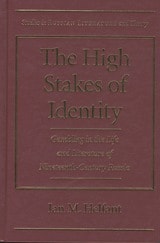
High Stakes of Identity
Gambling in the Life and Literature of Nineteenth-Century RussiaIan M. Helfant
Northwestern University Press, 2002
During the reigns of Alexander I and Nicholas I, Ian Helfant argues, gambling became an essential proving-ground and symbolic locus for noble identity in Russia--a way for the nobility to assert its values (fearlessness, disdain for money, implacable self-possession, deification of whim and will, and stylish performance) against nineteenth-century economics and bourgeois sentimentality. In <i>The High Stakes of Identity</i> Helfant's twin concerns are to analyze the structural components of the myth of the noble "beau joueur" and to show how gambling performances in society and in literature reciprocally reinforced, complicated, and eventually disintegrated its mystique.
Using a broad variety of sources--memoiristic, epistolary, journalistic, legal, fictional, theatrical--Helfant reconstructs both the prevalence and the particular codes of gambling's cultural system in the first few decades of the nineteenth century. These codes allow him to interpret the iconoclastic performances of truly legendary gamblers and to assess the importance and purpose of gambling in works ranging from Pushkin's "Queen of Spades" to Lermontov's "Masquerade." Throughout, Helfant gives voice to the rich variety of discourses, from tsarist laws to moralistic tracts, that came to bear on the culture of gambling in the 1830s and eventually led to its displacement as the key marker of nobility.
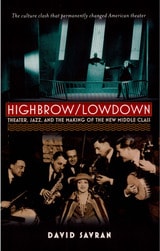
Highbrow/Lowdown
Theater, Jazz, and the Making of the New Middle ClassDavid Savran
University of Michigan Press, 2010

Higher Ground
From Utopianism to Realism in American Feminist Thought and TheorySally L. Kitch
University of Chicago Press, 2000
Drawing on the history of utopian thought, as well as on her own research on utopian communities, Kitch defines utopian thinking, explores the pitfalls of pursuing social change based on utopian ideas, and argues for a "higher ground" —a contrasting approach she calls realism. Replacing utopianism with realism helps to eliminate self-defeating notions in feminist theory, such as false generalization, idealization, and unnecessary dichotomies. Realistic thought, however, allows feminist theory to respond to changing circumstances, acknowledge sameness as well as difference, value the past and the present, and respect ideological give-and-take.
An important critique of feminist thought, Kitch concludes with a clear, exciting vision for a feminist future without utopia.
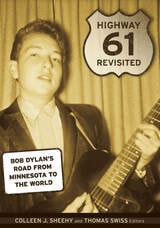
Highway 61 Revisited
Bob Dylan’s Road from Minnesota to the WorldColleen J. Sheehy
University of Minnesota Press, 2009
New essays consider Dylan’s latest work, his Minnesota roots, and his global reach
The young man from Hibbing released Highway 61 Revisited in 1965, and the rest, as they say, is history. Or is it? From his roots in Hibbing, to his rise as a cultural icon in New York, to his prominence on the worldwide stage, Colleen J. Sheehy and Thomas Swiss bring together the most eminent Dylan scholars at work today—as well as people from such far-reaching fields as labor history, African American studies, and Japanese studies—to assess Dylan’s career, influences, and his global impact on music and culture.
The Dylan effect has extended far beyond the United States in recent decades, and the essays here analyze his contribution to the people and cultures of the United Kingdom, Italy, and Japan. With a special focus on his Minnesota roots, including Greil Marcus’s spectacular tour of Dylan’s hometown, authors also take into account his most recent work and Martin Scorsese’s documentary No Direction Home.The first cultural and historical geography of his dramatic rise, storied career, and unmatched iconic status, Highway 61 Revisited maps the terrain of Bob Dylan’s music in the world.Contributors: John Barner, U of Georgia; Daphne Brooks, Princeton U; Court Carney, Stephen F. Austin State U; Alessandro Carrera, U of Houston; Michael Cherlin, U of Minnesota; Marilyn J. Chiat; Susan Clayton; Mick Cochrane, Canisius College; Thomas Crow, New York U; Kevin J. H. Dettmar, Pomona College, Carbondale; Sumanth Gopinath, U of Minnesota; Charles Hughes; C. P. Lee, U of Salford, Manchester, England; Alex Lubet, U of Minnesota; Greil Marcus, U of California, Berkeley; Aldon Lynn Nielsen, Pennsylvania State U; Roberto Polito, The New School; Robert Reginio, Frostburg State U; Heather Stur, U of Southern Mississippi; Mikiko Tachi, Chiba U, Japan; Gayle Wald, George Washington U; Anne Waldman, Naropa U; David Yaffe, Syracuse U.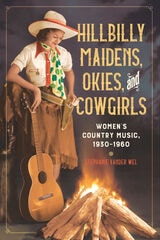
Hillbilly Maidens, Okies, and Cowgirls
Women's Country Music, 1930-1960Stephanie Vander Wel
University of Illinois Press, 2020
From the 1930s to the 1960s, the booming popularity of country music threw a spotlight on a new generation of innovative women artists. These individuals blazed trails as singers, musicians, and performers even as the industry hemmed in their potential popularity with labels like woman hillbilly, singing cowgirl, and honky-tonk angel.
Stephanie Vander Wel looks at the careers of artists like Patsy Montana, Rose Maddox, and Kitty Wells against the backdrop of country music's golden age. Analyzing recordings and appearances on radio, film, and television, she connects performances to real and imagined places and examines how the music sparked new ways for women listeners to imagine the open range, the honky-tonk, and the home. The music also captured the tensions felt by women facing geographic disruption and economic uncertainty. While classic songs and heartfelt performances might ease anxieties, the subject matter underlined women's ambivalent relationships to industrialism, middle-class security, and established notions of femininity.

Hints And Disguises
Marianne Moore ContemporariesCeleste Goodridge
University of Iowa Press, 1989
The first book-length exploration of Marianne Moore's prose focuses on her private and public critical exchanges with Wallace Stevens, Ezra Pound, William Carlos Williams, and T.S. Eliot. Drawing on previously unpublished material from the Moore Archive—correspondence, notebooks, manuscript notes, and books—Celeste Goodridge establishes Moore's central role as both poet-critic and prose stylist, providing a new perspective for considering Moore in relation to her contemporaries.
With clarity and elegance, Goodridge shows that Moore's most compelling critical judgments can best be recovered by examining the relationship between her private disclosures and her public pronouncements; her aesthetic of "hints and disguises" reveals a tension between what she felt free to voice and what she chose to veil.
In writing about these four poets, Moore made her greatest contribution to modernist criticism. With unusual perspicacity, she anticipated and defined many of the critical debates which still surround these writers' projects. Furthermore, Moore's critical exchanges indicated that her deepest alliances were with Stevens and Pound and not, as most have argued, with Williams and Eliot.
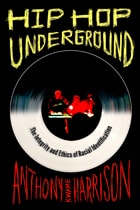
Hip Hop Underground
The Integrity and Ethics of Racial IdentificationAnthony Kwame Harrison
Temple University Press, 2009
Hip Hop Underground is a vivid ethnography of the author's observations and experiences in the multiracial world of the San Francisco underground hip hop scene. While Anthony Kwame Harrison interviewed area hip hop artists for this entertaining and informative book, he also performed as the emcee "Mad Squirrel." His immersion in the subculture provides him with unique insights into this dynamic and racially diverse but close-knit community.
Hip Hop Underground examines the changing nature of race among young Americans, and examines the issues of ethnic and racial identification, interaction, and understanding. Critiquing the notion that the Bay Area underground music scene is genuinely "colorblind," Harrison focuses on the issue of race to show how various ethnic groups engage hip hop in remarkably divergent ways—as a means to both claim subcultural legitimacy and establish their racial authenticity.
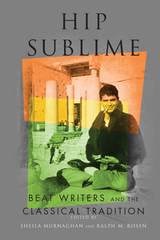
Hip Sublime
Beat Writers and the Classical TraditionEdited by Sheila Murnaghan and Ralph M. Rosen
The Ohio State University Press, 2018
In this volume, a diverse group of contributors explore for the first time the fascinating tensions and paradoxes that arose from interactions between these avant-garde writers and a literary tradition often seen as conservative and culturally hegemonic. With essays that cover the canonical Beat authors—such as Allen Ginsberg, Jack Kerouac, and William Burroughs—along with less well-known figures—including Kenneth Rexroth, Ed Sanders, and Diane di Prima—Hip Sublime: Beat Writers and the Classical Tradition brings long overdue attention to the Beat movement’s formative appropriation of the Greek and Latin classics.
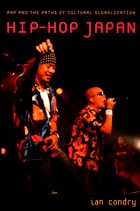
Hip-Hop Japan
Rap and the Paths of Cultural GlobalizationIan Condry
Duke University Press, 2006
Condry attended more than 120 hip-hop performances in clubs in and around Tokyo, sat in on dozens of studio recording sessions, and interviewed rappers, music company executives, music store owners, and journalists. Situating the voices of Japanese artists in the specific nightclubs where hip-hop is performed—what musicians and fans call the genba (actual site) of the scene—he draws attention to the collaborative, improvisatory character of cultural globalization. He contends that it was the pull of grassroots connections and individual performers rather than the push of big media corporations that initially energized and popularized hip-hop in Japan. Zeebra, DJ Krush, Crazy-A, Rhymester, and a host of other artists created Japanese rap, one performance at a time.

Hip-Hop in Africa
Prophets of the City and Dustyfoot PhilosophersMsia Kibona Clark
Ohio University Press, 2018
Throughout Africa, artists use hip-hop both to describe their lives and to create shared spaces for uncensored social commentary, feminist challenges to patriarchy, and resistance against state institutions, while at the same time engaging with the global hip-hop community. In Hip-Hop in Africa, Msia Kibona Clark examines some of Africa’s biggest hip-hop scenes and shows how hip-hop helps us understand specifically African narratives of social, political, and economic realities.
Clark looks at the use of hip-hop in protest, both as a means of articulating social problems and as a tool for mobilizing listeners around those problems. She also details the spread of hip-hop culture in Africa following its emergence in the United States, assessing the impact of urbanization and demographics on the spread of hip-hop culture.
Hip-Hop in Africa is a tribute to a genre and its artists as well as a timely examination that pushes the study of music and diaspora in critical new directions. Accessibly written by one of the foremost experts on African hip-hop, this book will easily find its place in the classroom.

Hired Pens
Professional Writers in America’s Golden Age of PrintRonald Weber
Ohio University Press, 1997
Just as mass-market magazines and cheap books have played important roles in the creation of an American identity, those skilled craftsmen (and women) whose careers are the subjects of Ronald Weber’s narrative profoundly influenced the outlook and strategies of the high-culture writers who are generally the focus of literary studies.
Hired Pens, a history of the writing profession in the United States, recognizes the place of independent writers who wrote for their livelihood from the 1830s and 1840s, with the first appearance of a broad-based print culture, to the 1960s.
Many realist authors began on this American Grub Street. Jack London turned out hackwork for any paying market he could find, while Scott Fitzgerald’s stories in slick magazines in the 1920s and early ’30s established his name as a writer.
From Edgar Allen Poe’s earliest forays into writing for pay to Sylvia Plath’s attempts to produce fiction for mass-circulation journals, Hired Pens documents without agenda the evolution of professional writing in all its permutations—travel accounts, sport, popular biography and history, genre and series fiction—and the culture it fed.
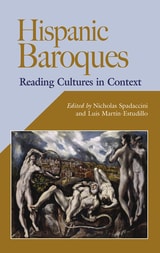
Hispanic Baroques
Reading Cultures in ContextNicholas Spadaccini
Vanderbilt University Press, 2005
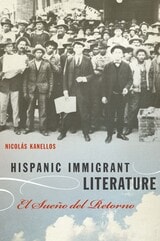
Hispanic Immigrant Literature
El Sueño del RetornoBy Nicolás Kanellos
University of Texas Press, 2011
Immigration has been one of the basic realities of life for Latino communities in the United States since the nineteenth century. It is one of the most important themes in Hispanic literature, and it has given rise to a specific type of literature while also defining what it means to be Hispanic in the United States. Immigrant literature uses predominantly the language of the homeland; it serves a population united by that language, irrespective of national origin; and it solidifies and furthers national identity. The literature of immigration reflects the reasons for emigrating, records—both orally and in writing—the trials and tribulations of immigration, and facilitates adjustment to the new society while maintaining links with the old society.
Based on an archive assembled over the past two decades by author Nicolás Kanellos's Recovering the U. S. Hispanic Literary Heritage project, this comprehensive study is one of the first to define this body of work. Written and recorded by people from Mexico, Cuba, Puerto Rico, the Caribbean, and Central and South America, the texts presented here reflect the dualities that have characterized the Hispanic immigrant experience in the United States since the mid-nineteenth century, set always against a longing for homeland.
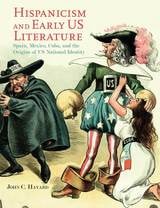
Hispanicism and Early US Literature
Spain, Mexico, Cuba, and the Origins of US National IdentityJohn C. Havard
University of Alabama Press, 2018
Revealing how Spain, Mexico, and Cuba helped shape the literary origins of American national identity.
In Hispanicism and Early US Literature, author John C. Havard posits that representations of Spain, Spanish America, Spanishness, and Spanish Americanness are integral elements in the evolution of early national and antebellum US literature. He argues that Spanish-speaking countries have long held a broad fascination for Americans and that stock narratives regarding these peoples were central to the period’s US literature.
Beginning with the work of eighteenth-century literary nationalists such as Joel Barlow, US literature has been drawn to reflect on Spain and Spanish America. Such reflection was often inspired by geopolitical conflicts such as US expansion into Spanish Louisiana and the US-Mexican War. Havard terms the discourse emerging from these reflections “Hispanicism.” This discourse was used to portray the dominant viewpoint of classical liberalism that propounded an American exceptionalism premised on the idea that Hispanophone peoples were comparatively lacking the capacity for self-determination, hence rationalizing imperialism. On the conservative side were warnings against progress through conquest.
Havard delves into selected works of early national and antebellum literature on Spain and Spanish America to illuminate US national identity. Poetry and novels by Joel Barlow, James Fenimore Cooper, and Herman Melville are mined to further his arguments regarding identity, liberalism, and conservatism. Understudied authors Mary Peabody Mann and José Antonio Saco are held up to contrast American and Cuban views on Hispanicism and Cuban annexation as well as to develop the focus on nationality and ideology via differences in views on liberalism.
More than just a work of literary criticism, there is a substantial amount of cultural and political history discussed. Havard’s use of archival sources such as political articles and personal correspondence elucidates not just literary genres and movements such as early national epic poetry, abolitionist fiction, and the American Renaissance, but also US prominent culture.
Hispanisms and Homosexualities
Sylvia Molloy and Robert Irwin, eds.
Duke University Press, 1998
In Hispanisms and Homosexualities, editors Sylvia Molloy and Robert Irwin bring together a group of essays that advance Hispanic studies and gay and lesbian studies by calling into question what is meant by the words Hispanic and homosexual. The fourteen contributors to this volume not only offer queer readings of Spanish and Latin American texts and performances, they also undermine a univocal sense of homosexual identities and practices. Taking on formations of national identity and sexuality; the politics of visibility and outing; the intersections of race, sexuality, and imperial discourse; the status of transvestism and posing; and a postmodern aesthetic of camp and kitsch, these essays from both established and emerging scholars provide a more complex and nuanced view of related issues involving nationality, ethnicity, and sexuality in the Hispanic world.
Hispanisms and Homosexualities offers the most sophisticated critical and theoretical work to date in Hispanic and queer studies. It will be an essential text for all those engaged with the complexities of ethnic, cultural, and sexual subjectivities.
Contributors. Daniel Balderston, Emilie Bergmann, Israel Burshatin, Brad Epps, Mary S. Gossy, Robert Irwin, Agnes I. Lugo-Ortiz, Sylvia Molloy, Oscar Montero, José Esteban Muñoz, José Quiroga, Rubén Ríos Avila, B. Sifuentes Jáuregui, Paul Julian Smith
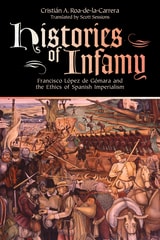
Histories of Infamy
Francisco López de Gómara and the Ethics of Spanish ImperialismCristián A. Roa-de-la-Carrera
University Press of Colorado, 2005
- Luis Fernando Restrepo, University of Arkansas
“In an eloquent and thorough exegesis, Roa-de-la-Carrera reveals how and why López de Gómara, having written the best of all possible books in exultation of Spanish imperialism, nevertheless failed to convince the readers of his time."
- Susan Schroeder, Tulane University
In Histories of Infamy, Cristián Roa-de-la-Carrera explores Francisco López de Gómara's (1511-ca.1559) attempt to ethically reconcile Spain's civilizing mission with the conquistadors' abuse and exploitation of Native peoples.
The most widely read account of the conquest in its time, Gómara's Historia general de las Indias y Conquista de México rationalized the conquistadors' crimes as unavoidable evils in the task of bringing "civilization" to the New World. Through an elaborate defense of Spanish imperialism, Gómara aimed to convince his readers of the merits of the conquest, regardless of the devastation it had wrought upon Spain's new subjects. Despite his efforts, Gómara's apologist text quickly fell into disrepute and became ammunition for Spain's critics. Evaluating the effectiveness of ideologies of colonization, Roa-de-la-Carrera's analysis will appeal to scholars in colonial studies and readers interested in the history of the Americas.
History Films, Women, and Freud's Uncanny
By Susan E. Linville
University of Texas Press, 2004
History films were a highly popular genre in the 1990s, as Hollywood looked back at significant and troubling episodes from World War II, the Cold War era, and the techno-war in the Persian Gulf. As filmmakers attempted to confront and manage intractable elements of the American past, such as the trauma of war and the legacy of racism, Susan Linville argues that a surprising casualty occurred—the erasure of relevant facets of contemporary women's history.
In this book, Linville offers a sustained critique of the history film and its reduction of women to figures of ambivalence or absence. Historicizing and adapting Freud's concept of the uncanny and its relationship to the maternal body as the first home, she offers theoretically sophisticated readings of the films Midnight Clear, Saving Private Ryan, The Thin Red Line, Nixon, Courage Under Fire, Lone Star, and Limbo. She also demonstrates that the uncanny is not only a source of anxiety but also potentially a progressive force for eroding nostalgic ideals of nation and gender. Linville concludes with a close reading of a recent 9/11 documentary, showing how the patterns and motifs of 1990s history films informed it and what that means for our future.
History Matters
Contemporary Poetry on the Margins of American CultureIra Sadoff
University of Iowa Press, 2009
Much of our most adventurous writing has occurred at history’s margins, simultaneously making use of and resisting tradition. By tracking key contemporary poets—including John Ashbery, Olena Kaltyiak Davis, Louise Glück, Czeslaw Milosz, Frank O’Hara, and C. K. Williams—as well as musing on jazz and other creative enterprises, Sadoff investigates the lively poetic art of those who have grappled with late twentieth-century attitudes about history, subjectivity, contingency, flux, and modernity. In plainspoken writing, he probes the question of the poet’s capacity to illuminate and universalize truth. Along the way, we are called to consider how and why art moves and transforms human beings.
History and Legend
Ideas and Images in the Ming Historical NovelsShelley Hsueh-lun Chang
University of Michigan Press, 1990
This combination of influences in the historical novels was especially significant during the Ming dynasty because of the rise of both urban culture of great refinement and diversity and a popularizing vernacular designed to promote learning among all people. These two exuberant movements came together in the historical novel to propagate the difficult and complex Official Histories of the governing elite, as well as to adapt unofficial histories and fictitious narratives, thus opening the way to the influence of the common people in literature.
This book is the first study of the novels from a historical standpoint. Combining traditional historical research with new source material of the historical novels and with analytical strategies, Chang creates a three-dimensional picture of the “historical world” of the Ming people. Chang compares issues of the dynastic cycle and political legitimacy of a regime, human ambitions and immortality, ethics in the relations between historical personages and legendary heroes, ideals of government and grandiose imperial institutions, and supernatural power and the justice of history that emerged from the historical novels with those in the Official Histories and Confucian canon.
History and Memory in the Two Souths
Recent Southern and Spanish American FictionDeborah Cohn
Vanderbilt University Press, 1999
First, Cohn proposes that Faulkner's appeal derives from Spanish American authors' perception of similarities between the South's history and the experiences of their own respective nations. She delineates historical experiences common to the South and Spanish America, including civil wars, defeat and dispossession, regional marginalization, and socio-economic hardship. She also suggests that Spanish American authors found in Faulkner a set of concerns with which they could identify and that, as a result, they were inspired to take up the stylistic innovations characteristic of his writing. The resulting assimilation and adaptation of Euro-American modernism through Faulkner has been an indispensable part of what is known as la nueva narrativa, "the new narrative," as well as of successive movements in Spanish American literature.
From another perspective, Cohn's book shows points of contact between works by other southern and Spanish American novelists without positing relations of influence. Specifically, after identifying common, recurrent themes in modern southern and Spanish American literature in general, Cohn reveals levels of a shared understanding of regional history in Faulkner and Mario Vargas Llosa, in Ralph Ellison and Isabel Allende, as well as in Katherine Anne Porter and Juan Rulfo. Her analyses compare and contrast these authors' shared attempts to provide correctives to official, mainstream historical discourse through alternate, parallel strategies for reconstructing, recording, and reclaiming the past.
In yoking together the South and Spanish America as neighboring spaces with similar personalities, Cohn advances a daring and controversial thesis that both narrows and enhances the frame of comparison between the literatures of the South and Spanish America.
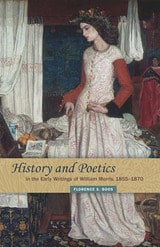
History and Poetics in the Early Writings of William Morris, 1855–1870
Florence S. Boos
The Ohio State University Press, 2015
Boos’s study is the first to utilize surviving original manuscripts, periodical publications, and poems unpublished during Morris’s lifetime. History and Poetics in the Early Writings of William Morris, 1855–1870traces Morris’s literary evolution through his juvenile poems; the essays, poems, and prose romances of the Oxford and CambridgeMagazine; the startlingly original verses of The Defence of Guenevere; and the ten years of experimentation that preceded his two best-known epics, The Life and Deathof Jason and The Earthly Paradise. This book explores the young poet’s successive efforts to find a balancing ethical framework through poetry—a framework that was at once a motivation for action and a template for authentic, shared popular art, one that reemerges forcefully in his later work.
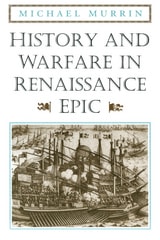
History and Warfare in Renaissance Epic
Michael Murrin
University of Chicago Press, 1994
Analyzing English, Italian, and Iberian epics published between 1483 and 1610, Murrin focuses on particular aspects of warfare (cavalry clashes, old and new style sieges, the tactical use of the gun, naval warfare) and the responses to them by authors from Malory to Milton. Throughout, Murrin traces a parallel development in the art of war and in the epic as it emerged from the romance.
Murrin demonstrates that with new technology and increasing levels of carnage, the practice of war gradually drifted from traditional epic modes. But before changes in warfare completely doomed the tradition in which the epic was rooted, this crisis provoked an unprecedented range of experiment which marks heroic narrative in the late Renaissance and ultimately led to the epic without war.
A much-needed introduction to the neglected subject of warfare in epic literature, this work is an uncommonly wide-ranging exercise in comparative criticism that will appeal to historians and students of literature alike.
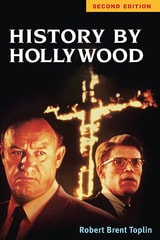
History by Hollywood, Second Edition
Robert Brent Toplin
University of Illinois Press, 2010
This newly updated edition of History by Hollywood explores the question of what happens to history when Hollywood filmmakers get their hands on it. With a fresh look at recent films and television productions such as Titanic, Pearl Harbor, The Patriot, and John Adams, Robert Brent Toplin examines how filmmakers have interpreted American history through their movies. Toplin discusses how writers, producers, and directors become involved in making historical films, what influences their interpretations of the past, and the responses they make to the controversies their works excite. With a realistic appreciation of the challenges filmmakers face, he effectively measures the strengths and weaknesses of Hollywood's presentation of history in the films Mississippi Burning, JFK, Sergeant York, Missing, Bonnie and Clyde, Patton, All the President's Men, and Norma Rae.

History of Nineteeth-Century Russian Literature
Volume I: The Romantic PeriodDmitrij Tschizewskij
Vanderbilt University Press, 1974
History, Historians, and Autobiography
Jeremy D. Popkin
University of Chicago Press, 2005
Drawing on the theoretical work of contemporary critics of autobiography and the philosophy of Paul Ricoeur, Popkin reads the autobiographical classics of Edward Gibbon and Henry Adams and the memoirs of contemporary historians such as Emmanuel Le Roy Ladurie, Peter Gay, Jill Ker Conway, and many others, he reveals the contributions historians' life stories make to our understanding of the human experience. Historians' autobiographies, he shows, reveal how scholars arrive at their vocations, the difficulties of writing about modern professional life, and the ways in which personal stories can add to our understanding of historical events such as war, political movements, and the traumas of the Holocaust.
An engrossing overview of the way historians view themselves and their profession, this work will be of interest to readers concerned with the ways in which we understand the past, as well as anyone interested in the art of life-writing.
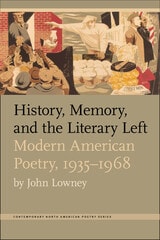
History, Memory, and the Literary Left
Modern American Poetry, 1935-1968John Lowney
University of Iowa Press, 2006
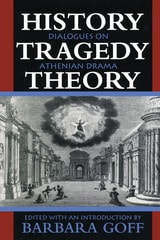
History, Tragedy, Theory
Dialogues on Athenian DramaEdited and with an introduction by Barbara Goff
University of Texas Press, 1995
Greek tragedy has held sway over the imagination of audiences for well over two millennia. This collection of essays on Athenian drama, the proceedings of a conference held at the University of Texas at Austin in 1992, demonstrates that Greek tragedy still retains its power to provoke debate and to engage the interest of specialists and non-classicists alike.
The book includes essays by seven of the foremost scholars of Greek drama—Helene Foley, Michelle Gellrich, Peter W. Rose, David Rosenbloom, Richard Seaford, Bernd Seidensticker, and Froma I. Zeitlin. These writers explore the work of all three great tragedians, Aeschylus, Sophocles, and Euripides, and approach them from a variety of perspectives on history and theory, including poststructuralism and Marxism. They investigate the possibilities for coordinating theoretically informed readings of tragedy with a renewed attention to the pressure of material history within those texts. The collection thus represents a response within classics to "New Historicism" and the debates it has generated within related literary disciplines.
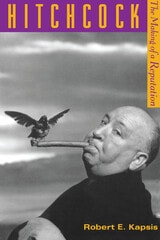
Hitchcock
The Making of a ReputationRobert E. Kapsis
University of Chicago Press, 1992
Through a close examination of Hitchcock's personal papers, scripts, production notes, publicity files, correspondence, and hundreds of British and American reviews, Robert Kapsis here traces Hitchcock's changing critical fortunes. Vertigo, for instance, was considered a flawed film when first released; today it is viewed by many as the signal achievement of a great director. According to Kapsis, this dramatic change occurred because the making of the Hitchcock legend was not solely dependent on the quality of his films. Rather, his elevation to artist was caused by a successful blending of self-promotion, sponsorship by prominent members of the film community, and, most important, changes in critical theory which for the first time allowed for the idea of director as auteur.
Kapsis also examines the careers of several other filmmakers who, like Hitchcock, have managed to cross the line that separates craftsman from artist, and shows how Hitchcock's legacy and reputation shed light on the way contemporary reputations are made. In a chapter about Brian De Palma, the most reknowned thriller director since Hitchcock, Kapsis explores how Hitchcock's legacy has affected contemporary work in—and criticism of—the thriller genre.
Filled with fascinating anecdotes and intriguing excerpts, and augmented by interviews with Hitchcock's associates, this thoroughly documented and engagingly written book will appeal to scholars and film enthusiasts alike.
"Required reading for Hitchcock scholars...scrupulously researched, invaluable material for those who continue to ask: what made the master tick?"—Anthony Perkins
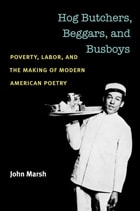
Hog Butchers, Beggars, and Busboys
Poverty, Labor, and the Making of Modern American PoetryJohn Marsh
University of Michigan Press, 2011
"Impressive—Marsh successfully rewrites the founding moment of American Modernist poetry."
---Mark Van Wienen, Northern Illinois University
"Cogently argued, instructive, and sensitive, Marsh’s revisionist reading opens new insights that will elicit lively comment and critical response."
---Douglas Wixson, University of Missouri–Rolla
Between 1909 and 1922, the genre of poetry was remade. Literary scholars have long debated why modern American poetry emerged when and how it did. While earlier poetry had rhymed, scanned, and dealt with conventional subjects such as love and nature, modern poetry looked and sounded very different and considered new areas of experience. Hog Butchers, Beggars, and Busboys: Poverty, Labor, and the Making of Modern American Poetry argues that this change was partially the result of modern poets writing into their verse what other poetry had suppressed: the gritty realities of modern life, including the problems of the poor and working class.
A closer look at the early works of the 20th century's best known poets (William Carlos Williams, T. S. Eliot, Edna St. Vincent Millay, Claude McKay, Langston Hughes, and Carl Sandburg) reveals the long-neglected role the labor problem—including sweatshops, strikes, unemployment, woman and child labor, and immigration---played in the formation of canonical modern American poetry. A revisionary history of literary modernism and exploration into how poets uniquely made the labor problem their own, this book will appeal to modernists in the fields of American and British literature as well as scholars in American studies and the growing field of working-class literature.
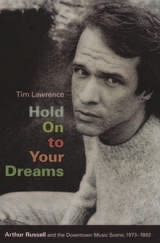
Hold On to Your Dreams
Arthur Russell and the Downtown Music Scene, 1973-1992Tim Lawrence
Duke University Press, 2009
Tim Lawrence traces Russell's odyssey from his hometown of Oskaloosa, Iowa, to countercultural San Francisco, and eventually to New York, where he lived from 1973 until his death from AIDS-related complications in 1992. Resisting definition while dreaming of commercial success, Russell wrote and performed new wave and disco as well as quirky rock, twisted folk, voice-cello dub, and hip-hop-inflected pop. “He was way ahead of other people in understanding that the walls between concert music and popular music and avant-garde music were illusory,” comments the composer Philip Glass. "He lived in a world in which those walls weren't there." Lawrence follows Russell across musical genres and through such vital downtown music spaces as the Kitchen, the Loft, the Gallery, the Paradise Garage, and the Experimental Intermedia Foundation. Along the way, he captures Russell's openness to sound, his commitment to collaboration, and his uncompromising idealism.
Hold-Outs
The Los Angeles Poetry Renaissance, 1948-1992Bill Mohr
University of Iowa Press, 2011
Hole in Our Soul
The Loss of Beauty and Meaning in American Popular MusicMartha Bayles
University of Chicago Press, 1996
Bayles defends the tough, affirmative spirit of Afro-American music against the strain of artistic modernism she calls 'perverse.' She describes how perverse modernism was grafted onto popular music in the late 1960s, and argues that the result has been a cult of brutality and obscenity that is profoundly anti-musical.
Unlike other recent critics of popular music, Bayles does not blame the problem on commerce. She argues that culture shapes the market and not the other way around. Finding censorship of popular music "both a practical and a constitutional impossibility," Bayles insists that "an informed shift in public tastes may be our only hope of reversing the current malignant mood."
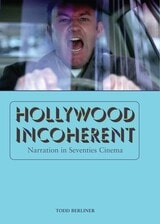
Hollywood Incoherent
Narration in Seventies CinemaBy Todd Berliner
University of Texas Press, 2010
In the 1970s, Hollywood experienced a creative surge, opening a new era in American cinema with films that challenged traditional modes of storytelling. Inspired by European and Asian art cinema as well as Hollywood's own history of narrative ingenuity, directors such as Martin Scorsese, Robert Altman, William Friedkin, Stanley Kubrick, Woody Allen, and Francis Ford Coppola undermined the harmony of traditional Hollywood cinema and created some of the best movies ever to come out of the American film industry. Critics have previously viewed these films as a response to the cultural and political upheavals of the 1970s, but until now no one has explored how the period's inventive narrative design represents one of the great artistic accomplishments of American cinema.
In Hollywood Incoherent, Todd Berliner offers the first thorough analysis of the narrative and stylistic innovations of seventies cinema and its influence on contemporary American filmmaking. He examines not just formally eccentric films—Nashville; Taxi Driver; A Clockwork Orange; The Godfather, Part II; and the films of John Cassavetes—but also mainstream commercial films, including The Exorcist, The Godfather, The French Connection, Willy Wonka and the Chocolate Factory, Dog Day Afternoon, Chinatown, The Bad News Bears, Patton, All the President's Men, Annie Hall, and many others. With persuasive revisionist analyses, Berliner demonstrates the centrality of this period to the history of Hollywood's formal development, showing how seventies films represent the key turning point between the storytelling modes of the studio era and those of modern American cinema.

Holocaust And Memory In The Global Age
Daniel Levy
Temple University Press, 2005
Originally published in Germany, The Holocaust and Memory in the Global Age examines the nature of collective memory in a globalized world, and how the memory of one particular event—the Holocaust—helped give rise to an emerging global consensus on human rights.
Daniel Levy and Natan Sznaider show how memories of the Holocaust have been de-contextualized from the original event and offer a framework for interpreting contemporary acts of injustice such as ethnic cleansing and genocide. Representations of mass atrocities in Bosnia and Kosovo during the 1990s resonated with iconographies of the Holocaust and played a significant role in the political and military interventions in the Balkans. Subsequently, these representations have had a crucial impact on the consolidation of international human rights and related issues of transitional justice, reparations, and restitution.
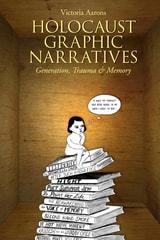
Holocaust Graphic Narratives
Generation, Trauma, and MemoryVictoria Aarons
Rutgers University Press, 2020
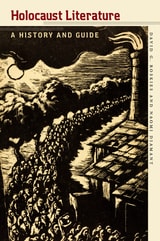
Holocaust Literature
A History and GuideDavid G. Roskies and Naomi Diamant
Brandeis University Press, 2013
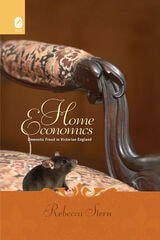
Home Economics
Domestic Fraud in Victorian EnglandRebecca Stern
The Ohio State University Press, 2008
In Home Economics: Domestic Fraud in Victorian England, Rebecca Stern establishes fraud as a basic component of the Victorian popular imagination, key to its intimate, as well as corporate, systems of exchange. Although Victorian England is famous for revering the domestic realm as a sphere separate from the market and its concerns, actual households were hardly isolated havens of fiscal safety and innocence. Rather, the Victorian home was inevitably a marketplace, a site of purchase, exchange, and employment in which men and women hired or worked as servants, contracted marriages, managed children, and obtained furniture, clothing, food, and labor. Alongside the multiplication of joint-stock corporations and the rise of a credit-based economy, which dramatically increased fraud in the Victorian money market, the threat of swindling affected both actual household commerce and popular conceptions of ostensibly private, more emotive forms of exchange. Working with diverse primary material, including literature, legal cases, newspaper columns, illustrations, ballads, and pamphlets, Stern argues that the climate of fraud permeated Victorian popular ideologies about social transactions. Beyond providing a history of cases and categories of domestic deceit, Home Economics illustrates the diverse means by which Victorian culture engaged with, refuted, celebrated, represented, and consumed swindling in familial and other household relationships.
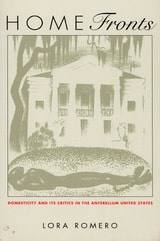
Home Fronts
Domesticity and Its Critics in the Antebellum United StatesLora Romero
Duke University Press, 1997
Romero remaps the literary landscape of the last century by looking at the operations of domesticity on the frontier as well as within the middle-class home and by reconsidering such crucial (if sometimes unexpected) sites for the workings of domesticity as social reform movements, African-American activism, and homosocial high culture. In the process, she indicts theories of the nineteenth century based on binarisms and rigidity while challenging models of power and resistance based on the idea that "culture" has the capacity to either free or enslave. Through readings of James Fenimore Cooper, Catherine Beecher, Harriet Beecher Stowe, Maria Stewart, and Nathaniel Hawthorne, Romero shows how the politics of culture reside in local formulations rather than in essential and ineluctable political structures.
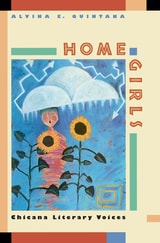
Home Girls
Chicana Literary VoicesAlvina E. Quintana
Temple University Press, 1996
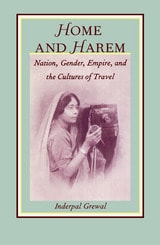
Home and Harem
Nation, Gender, Empire and the Cultures of TravelInderpal Grewal
Duke University Press, 1996
In her look at England, Grewal draws on nineteenth-century aesthetics, landscape art, and debates about women’s suffrage and working-class education to show how all social classes, not only the privileged, were educated and influenced by imperialist travel narratives. By examining diverse forms of Indian travel to the West and its colonies and focusing on forms of modernity offered by colonial notions of travel, she explores how Indian men and women adopted and appropriated aspects of European travel discourse, particularly the set of oppositions between self and other, East and West, home and abroad.
Rather than being simply comparative, Home and Harem is a transnational cultural study of the interaction of ideas between two cultures. Addressing theoretical and methodological developments across a wide range of fields, this highly interdisciplinary work will interest scholars in the fields of postcolonial and cultural studies, feminist studies, English literature, South Asian studies, and comparative literature.