Results by title
1993 books match the query 'Latin America' and 55 start with h
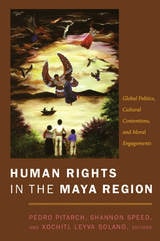
Human Rights in the Maya Region
Global Politics, Cultural Contentions, and Moral EngagementsPedro Pitarch, Shannon Speed, and Xochitl Leyva Solano, eds.
Duke University Press, 2008
The collection includes a reflection on the effects of truth-finding and documenting particular human rights abuses, a look at how Catholic social teaching validates the human rights claims advanced by indigenous members of a diocese in Chiapas, and several analyses of the limitations of human rights frameworks. A Mayan intellectual seeks to bring Mayan culture into dialogue with western feminist notions of women’s rights, while another contributor critiques the translation of the United Nations Declaration of Human Rights into Tzeltal, an indigenous language in Chiapas. Taken together, the essays reveal a broad array of rights-related practices and interpretations among the Mayan population, demonstrating that global-local-state interactions are complex and diverse even within a geographically limited area. So too are the goals of indigenous groups, which vary from social reconstruction and healing following years of violence to the creation of an indigenous autonomy that challenges the tenets of neoliberalism.
Contributors: Robert M. Carmack, Stener Ekern, Christine Kovic, Xochitl Leyva Solano, Julián López García, Irma Otzoy, Pedro Pitarch, Álvaro Reyes, Victoria Sanford, Rachel Sieder, Shannon Speed, Rodolfo Stavenhagen, David Stoll, Richard Ashby Wilson
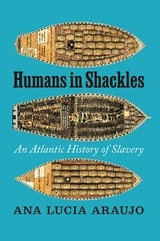
Humans in Shackles
An Atlantic History of SlaveryAna Lucia Araujo
University of Chicago Press, 2024
During the era of the Atlantic slave trade, more than twelve million enslaved Africans were forcibly transported to the Americas in cramped, inhumane conditions. Many of them died on the way, and those who survived had to endure further suffering in the violent conditions that met them onshore. Covering more than three hundred years, Humans in Shackles grapples with this history by foregrounding the lived experience of enslaved people in tracing the long, complex history of slavery in the Americas.
Based on twenty years of research, this book not only serves as a comprehensive history; it also expands that history by providing a truly transnational account that emphasizes the central role of Brazil in the Atlantic slave trade. Additionally, it is deeply informed by African history and shows how African practices and traditions survived and persisted in the Americas among communities of enslaved people. Drawing on primary sources including travel accounts, pamphlets, newspaper articles, slave narratives, and visual sources such as artworks and artifacts, Araujo illuminates the social, cultural, and religious lives of enslaved people working in plantations and urban areas, building families and cultivating affective ties, congregating and re-creating their cultures, and organizing rebellions.
Humans in Shackles puts the lived experiences of enslaved peoples at the center of the story and investigates the heavy impact these atrocities have had on the current wealth disparity of the Americas and rampant anti-Black racism.
Hybrid Cultures
Strategies for Entering and Leaving ModernityNestor Garcia Canclini
University of Minnesota Press, 1995
Hybrid Cultures
Strategies for Entering and Leaving ModernityNestor Garcia Canclini
University of Minnesota Press, 2005
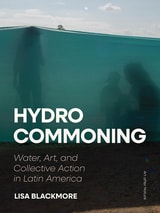
Hydrocommoning
Water, Art, and Collective Action in Latin AmericaLisa Blackmore
University of Minnesota Press, 2027
Reimagining watersheds as living hydrocommons through which artists and communities create more just and sustainable futures
Hydrocommoning explores how artists, activists, and curators coalesce around water in embodied efforts to contest entrenched and enduring forms of harm and degradation. Against the reduction of rivers, streams, and wetlands to mere resources to be managed, Hydrocommoning centers water as a living web of relations through which artists and communities forge creative means of reconnection by moving, weaving, pumping, eating, and listening.
By charting these aesthetic practices, Hydrocommoning shows how artists and organizers across Latin America oppose extractivism, unequal urbanization, ecological degradation, and the erasure of Indigenous water cultures. To cultivate widespread social attunement to vulnerable waters and raise the call for their defense and care, collectives in Brazil, Colombia, Guatemala, and Peru engage in communal meals, sound art, infrastructural interventions, and other practices that Lisa Blackmore theorizes as “hydrocommoning.”
Grounded in five years of experiential fieldwork, archival research, and curatorial projects in Latin America, Blackmore proposes a methodology to work with water as an analytical framework for collective action. Bridging the gap between theory, curating, and community-based practices, Hydrocommoning offers a promising vision of grassroots organizing that actively confronts some of today’s most urgent ecological threats.
Retail e-book files for this title are screen-reader friendly with images accompanied by short alt text and/or extended descriptions.