Results by title
2817 books match the query 'Nature' and 81 start with h
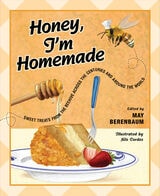
Honey, I'm Homemade
Sweet Treats from the Beehive across the Centuries and around the WorldEdited by May Berenbaum, Illustrated by Nils Cordes
University of Illinois Press, 2010
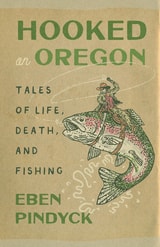
Hooked on Oregon
Tales of Life, Death, and FishingEben Pindyck
Oregon State University Press, 2027
Far from your average fishing book, Hooked on Oregon invites readers to visit unexpected places—behind prison walls, inside a bait factory, deep in a forbidden forest, up a mountain, and around a desert oasis—while introducing a troop of unforgettable fishing buddies. A German orphan adopted by an American war hero, a parolee busted for fishing without a license, and a Marine veteran, among others, help show what life looks like through the eyes of an inveterate angler.
Fishing stories in Oregon have never been greater than those told by Eben Pindyck. Whether casting a line on the Columbia River or visiting Herman the Sturgeon at the State Fair, there’s a real-life tale to capture the interest and fancy of anyone in search of a good story. These funny, honest, and elucidative essays take you to lakes, streams, and waterways throughout the state—and far beyond the anecdote about the one that got away.
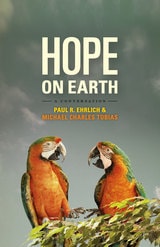
Hope on Earth
A ConversationPaul R. Ehrlich and Michael Charles Tobias
University of Chicago Press, 2014
Both Ehrlich and Tobias argue that we are on the verge of environmental catastrophe, as the human population continues to grow without restraint and without significant attempts to deal with overconsumption and the vast depletion of resources and climate problems it creates. Though their views are sympathetic, they differ in their approach and in some key moral stances, giving rise to a heated and engaging dialogue that opens up dozens of new avenues of exploration. They both believe that the impact of a human society on its environment is the direct result of its population size, and through their dialogue they break down the complex social problems that are wrapped up in this idea and attempts to overcome it, hitting firmly upon many controversial topics such as circumcision, religion, reproduction, abortion, animal rights, diet, and gun control. For Ehrlich and Tobias, ethics involve not only how we treat other people directly, but how we treat them and other organisms indirectly through our effects on the environment. University of California, Berkeley professor John Harte joins the duo for part of the conversation, and his substantial expertise on energy and climate change adds a crucial perspective to the discussion of the impact of population on global warming.
This engaging and timely book invites readers into an intimate conversation with some of the most eminent voices in science as they offer a powerful and approachable argument that the ethical and scientific issues involved in solving our environmental crisis are deeply intertwined, while offering us an optimistic way forward. Hope on Earth is indeed a conversation we should all be having.
Hormones, Brain, and Behavior
Edited by Carl Gans and David Crews
University of Chicago Press, 1992
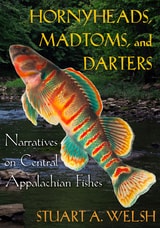
Hornyheads, Madtoms, and Darters
Narratives on Central Appalachian FishesStuart A. Welsh
Ohio University Press, 2023
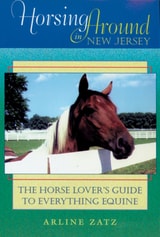
Horsing Around in New Jersey
The Horse Lover's Guide to Everything EquineZatz, Arline
Rutgers University Press, 2004
Arline Zatz has writtenthe first guidebook to everything equine in the Garden State: Horsing Around in New Jersey. This accessible, easy-to-use volume is essential reading for the novice who yearns to go horseback riding but doesn't know how or where to begin; for the experienced equestrian seeking new trails and campsites; for anyone wishing to attend an equestrian event; and for those seeking a job in the equestrian field, which already employs nearly 6,000 New Jerseyans. The industry generates more than 650 million dollars in annual revenue. Millions of people attend equine events in New Jersey each year. The U.S. Equestrian team makes its home there, and New Jersey's state animal is the horse.
Zatz tells readers--including those with disabilities--where they can take lessons, rent a horse, and prepare for riding. She includes safety and first aid tips. Horse history and breeds common to New Jersey are discussed, as are health concerns, including diseases, preventative medicine, and emergency care. The book showcases New Jersey's eighty-five equestrian trails and covers information on where to obtain riding permits and their accompanying rules and regulations. There is advice for both new horse owners and renters, including recommendations on tack and clothing, stable management, and horse adoption.
The book acquaints readers with year-round equine entertainment opportunities, and offers dozens of suggestions on where to watch or participate in sports on horseback. Zatz lists equine education programs for all ages, and outlines numerous employment opportunities within the equine industry. The book concludes with a glossary of common horse industry terminology, a listing of national equine associations and breed registries, equipment sources, and equine publications for further reading.
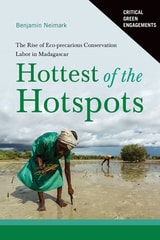
Hottest of the Hotspots
The Rise of Eco-precarious Conservation Labor in MadagascarBenjamin Neimark
University of Arizona Press, 2023
This book details the rollout of market conservation programs, including the finding of drugs from nature—or “bioprospecting”—biodiversity offsetting, and the selling of blue carbon credits from mangroves. It documents the tensions that exist at the local level, as many of these programs incorporate populations highly dependent on the same biodiversity now turned into global commodities for purposes of saving it. Proponents of market conservation mobilize groups of ecologically precarious workers, or the local “eco-precariat,” who do the hidden work of collecting and counting species, monitoring and enforcing the vital biodiversity used in everything from drug discovery to carbon sequestration and large mining company offsets.
Providing a voice for those community workers many times left out of environmental policy discussions, this volume proposes critiques that aim to build better conservation interventions with perspectives of the local eco-precariat.
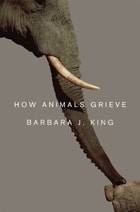
How Animals Grieve
Barbara J. King
University of Chicago Press, 2013
How Do We Think About Population in the Anthropocene?
Edited by Alison Bashford, Duncan Kelly, and David Nally
Prickly Paradigm Press, 2026
How do we think about population in the Anthropocene?
The “Great Acceleration” describes a set of interrelated human-driven transformations of Earth’s systems, including the eightfold population growth since 1800. Yet ideas about population in the epoch many call the Anthropocene sit uncomfortably in contemporary discussions.
How Do We Think About Population in the Anthropocene? brings together the world’s key thinkers in Anthropocene studies from a wide range of disciplines, including geology, geography, demography, history, political theory, and more. How do we think about population in the Anthropocene, or should we even think in terms of population at all? The twelve short essays in this pamphlet offer responses that reimagine how we think about economy, environment, consumption, reproduction, and extinction.
How Fast Can A Falcon Dive?
Fascinating Answers to Questions about Birds of PreyCapainolo, Peter
Rutgers University Press, 2010
From stories of red-tailed hawks making their homes on the ledges of Manhattan skyscrapers to their role in protecting California's vineyards from flocks of grape-loving starlings, How Fast Can a Falcon Dive? explores how these avian predators interact with people and with their environment.
How Green Were the Nazis?
Nature, Environment, and Nation in the Third ReichFranz-Josef Brüggemeier
Ohio University Press, 2005
How Is It Between Us?
Relational Ethics and Care for the WorldJarrett Zigon
HAU, 2024
In How Is It Between Us?, Jarrett Zigon puts anthropology and phenomenological hermeneutics in conversation to develop a new theory of relational ethics. This relational ethics takes place in the between, the interaction not just between people, but all existents. Importantly, this theory is utilized as a framework for considering some of today’s most pressing ethical concerns—for example, living in a condition of post-truth and worlds increasingly driven by algorithms and data extraction, various and competing calls for justice, and the ethical demands of the climate crisis. Written by one of the preeminent contributors to the anthropology of ethics, this is a ground-breaking book within that literature, developing a robust and systematic ethical theory to think through contemporary ethical problems.
How Long She'll Last in This World
Maria Melendez
University of Arizona Press, 2006
With this invocation, María Meléndez beckons us on a journey—an exotic expedition through life’s mysteries in search of the finer strands of experience. In a Latina voice laced with a naturalist’s sense of wonder, she weaves bold images reflecting a world threaded by unseen wounds, now laid before us with an unflinching love of life and an exquisite precision of language. Adopting multiple guises—field researcher, laboring mother, grief-stricken lover—Meléndez casts aside stereotypes and expectations to forge a new language steeped in life and landscape. Whether meditating on a controlled prairie burn or contemplating the turquoise cheek of a fathead minnow, she weaves words and memories into a rich tapestry that resonates with sensual detail and magnifies her sense of maternal wildness, urging us to “Love as much as you / can, don’t throw your heart / away to just one god.” In her paean to the Aztec deity Tonacacihuatl, mother of the gods, Meléndez muses that “How many spirits she’s twin to, and how long she’ll last in this world, / are secrets stashed in the rattle / of corn ears, in the coils / of venomous snakes.”
Through stunning images and stark realism, her poems embrace motherhood and vocation, love and grief, land and life, to bring new meaning to the natural world and how we experience it.
How Monkeys See the World
Inside the Mind of Another SpeciesDorothy L. Cheney and Robert M. Seyfarth
University of Chicago Press, 1990
"This reviewer had to be restrained from stopping people in the street to urge them to read it: They would learn something of the way science is done, something about how monkeys see their world, and something about themselves, the mental models they inhabit."—Roger Lewin, Washington Post Book World
"A fascinating intellectual odyssey and a superb summary of where science stands."—Geoffrey Cowley, Newsweek
"A once-in-the-history-of-science enterprise."—Duane M. Rumbaugh, Quarterly Review of Biology
How Nature Speaks
The Dynamics of the Human Ecological ConditionYrjö Haila and Chuck Dyke, eds.
Duke University Press, 2006
Exploring ways of conceiving the complexity and multiplicity of humans’ many interactive relationships with the environment, the contributors provide in-depth case studies of the interweaving of culture and nature in socio-historical processes. The case studies focus on the origin of environmental movements, the politicization of environmental issues in city politics, the development of a local energy production system, and the convergence of forest management practices toward a dominant scheme. They are supported by explorations of big-picture issues: recurring themes in studies of social and environmental dynamics, the difficulties of deliberative democracy, and the potential gains for socio-ecological research offered by developmental systems theory and Pierre Bourdieu’s theory of intentionality.
How Nature Speaks includes a helpful primer, “On Thinking Dynamically about the Human Ecological Condition,” which explains the basic principles of complexity and nonlinear thinking.
Contributors. Chuck Dyke, Yrjö Haila, Ari Jokinen, Ville Lähde, Markus Laine, Iordanis Marcoulatos, John O’Neill, Susan Oyama, Taru Peltola, Lasse Peltonen, John Shotter, Peter Taylor
How Primates Eat
A Synthesis of Nutritional Ecology across a Mammal OrderEdited by Joanna E. Lambert, Margaret A. H. Bryer, and Jessica M. Rothman
University of Chicago Press, 2024
What do we mean when we say that a diet is nutritious? Why can some animals get all the energy they need from eating leaves while others would perish on such a diet? Why don’t mountain gorillas eat fruit all day as chimpanzees do? Answers to these questions about food and feeding are among the many tasty morsels that emerge from this authoritative book. Informed by the latest scientific tools and millions of hours of field and laboratory work on species across the primate order and around the globe, this volume is an exhaustive synthesis of our understanding of what, why, and how primates eat. State-of-the-art information presented at physiological, behavioral, ecological, and evolutionary scales will serve as a road map for graduate students, researchers, and practitioners as they work toward a holistic understanding of life as a primate and the urgent conservation consequences of diet and food availability in a changing world.
How To Identify Plants
H. D. Harrington
Ohio University Press, 1957
First issued in 1957 by Swallow Press, this classic guide to the art of plant identification is now familiar to an entire generation of students. Harrington who was Professor of Botany and Curator of the Herbarium at Colorado State University, gives step-by-step instructions and definitions to help readers recognize and classify plants. The new printing has been reset and reformatted, and L.W. Durrell’s drawings and glossary—more than 500 images—have been digitally enhanced for clarity.
How Trees Die
The Past, Present, and Future of our ForestsJeff Gillman
Westholme Publishing, 2009
Trees have been essential to the success of human beings, providing food, shelter, warmth, transportation, and products (consider the paper you are holding). Trees are also necessary for a healthy atmosphere, literally connecting the earth with the sky. Once in wild abundance— the entire eastern North America was a gigantic forest—they have receded as we have clearcut the landscape in favor of building cities and farms, using up and abusing our forests in the process. Over the centuries, we have trained food trees, such as peach and apple trees, to produce more and better fruit at the expense of their lives. As Jeff Gillman, a specialist in the production and care of trees, explains in his acclaimed work, How Trees Die: The Past, Present, and Future of Our Forests, the death of a tree is as important to understanding our environment as how it lives. While not as readily apparent as other forms of domestication, our ancient and intimate relationship with trees has caused their lives to be inseparably entwined with ours. The environment we have created—what we put into the air and into the water, and how we change the land through farming, construction, irrigation, and highways—affects the world’s entire population of trees, while the lives of the trees under our direct care in farms, orchards, or along a city boulevard depend almost entirely on our actions. Taking the reader on a fascinating journey through time and place, the author explains how we kill trees, often for profit, but also unintentionally with kindness through overwatering or overmulching, and sometimes simply by our movements around the globe, carrying foreign insects or disease. No matter how a tree’s life ends, though, understanding the reason is essential to understanding the future of our environment.
How We See the Sky
A Naked-Eye Tour of Day and NightThomas Hockey
University of Chicago Press, 2002
Gazing up at the heavens from our backyards or a nearby field, most of us see an undifferentiated mess of stars—if, that is, we can see anything at all through the glow of light pollution. Today’s casual observer knows far less about the sky than did our ancestors, who depended on the sun and the moon to tell them the time and on the stars to guide them through the seas. Nowadays, we don’t need the sky, which is good, because we’ve made it far less accessible, hiding it behind the skyscrapers and the excessive artificial light of our cities.
How We See the Sky gives us back our knowledge of the sky, offering a fascinating overview of what can be seen there without the aid of a telescope. Thomas Hockey begins by scanning the horizon, explaining how the visible universe rotates through this horizon as night turns to day and season to season. Subsequent chapters explore the sun’s and moon’s respective motions through the celestial globe, as well as the appearance of solstices, eclipses, and planets, and how these are accounted for in different kinds of calendars. In every chapter, Hockey introduces the common vocabulary of today’s astronomers, uses examples past and present to explain them, and provides conceptual tools to help newcomers understand the topics he discusses.
Packed with illustrations and enlivened by historical anecdotes and literary references, How We See the Sky reacquaints us with the wonders to be found in our own backyards.
How the Earth Feels
Geological Fantasy in the Nineteenth-Century United StatesDana Luciano
Duke University Press, 2024
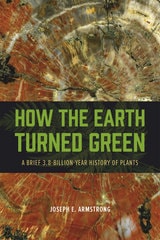
How the Earth Turned Green
A Brief 3.8-Billion-Year History of PlantsJoseph E. Armstrong
University of Chicago Press, 2014
Using an evolutionary framework, How the Earth Turned Green addresses questions such as: Should all green organisms be considered plants? Why do these organisms look the way they do? How are they related to one another and to other chlorophyll-free organisms? How do they reproduce? How have they changed and diversified over time? And how has the presence of green organisms changed the Earth’s ecosystems? More engaging than a traditional textbook and displaying an astonishing breadth, How the Earth Turned Green will both delight and enlighten embryonic botanists and any student interested in the evolutionary history of plants.
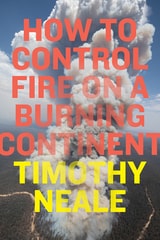
How to Control Fire on a Burning Continent
Timothy Neale
Duke University Press, 2026
Each year, Australia faces increasingly unprecedented wildfires, marked both by their scale and by the intense public disagreements about their political, cultural, and ecological causes. How to Control Fire on a Burning Continent is a critical and ethnographic exploration of wildfire management in Australia and the technoscientific systems of control that shape its current and future possibilities. Timothy Neale observes how two seemingly opposing forces—an entrenched sense of crisis and widespread normalization—combine to form an apparatus of institutional fire management that increasingly centers technical control and militarization. While sympathetic to the double binds many fire management professionals find themselves in, Neale ties contemporary wildfire problems to ongoing colonization and Indigenous dispossession, exploring Indigenous-led land management and cultural burning as a practical assertion of sovereignty. Through dialogue and collaboration with professional fire managers and Indigenous environmental stewards, Neale calls for a collective movement beyond control thinking by fostering new alliances and modes of coping with, rather than commanding, our flammable world.

How to Identify Grasses and Grasslike Plants
Sedges and RushesH. D. Harrington
Ohio University Press, 1977
There is no easy way to identify grasses. And no one understands this better than H.D. Harrington, who observed thousands of students struggle and learn. His clear, concise, and well-organized guide will continue to be a basic and essential text for use in the classroom or in the field. The book contains over 500 drawings and an illustrated glossary.
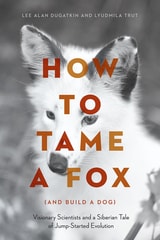
How to Tame a Fox (and Build a Dog)
Visionary Scientists and a Siberian Tale of Jump-Started EvolutionLee Alan Dugatkin and Lyudmila Trut
University of Chicago Press, 2017
Most accounts of the natural evolution of wolves place it over a span of about 15,000 years, but within a decade, Belyaev and Trut’s fox breeding experiments had resulted in puppy-like foxes with floppy ears, piebald spots, and curly tails. Along with these physical changes came genetic and behavioral changes, as well. The foxes were bred using selection criteria for tameness, and with each generation, they became increasingly interested in human companionship. Trut has been there the whole time, and has been the lead scientist on this work since Belyaev’s death in 1985, and with Lee Dugatkin, biologist and science writer, she tells the story of the adventure, science, politics, and love behind it all. In How to Tame a Fox, Dugatkin and Trut take us inside this path-breaking experiment in the midst of the brutal winters of Siberia to reveal how scientific history is made and continues to be made today.
To date, fifty-six generations of foxes have been domesticated, and we continue to learn significant lessons from them about the genetic and behavioral evolution of domesticated animals. How to Tame a Fox offers an incredible tale of scientists at work, while also celebrating the deep attachments that have brought humans and animals together throughout time.
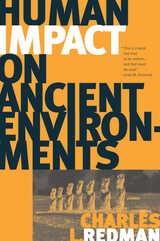
Human Impact on Ancient Environments
Charles L. Redman
University of Arizona Press, 1999
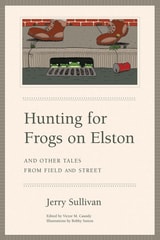
Hunting for Frogs on Elston, and Other Tales from Field & Street
Jerry Sullivan
University of Chicago Press, 2004
Published in association with the Chicago Wilderness coalition, Hunting for Frogs on Elston comprehensively chronicles Chicagoland's unique urban ecology, from its indigenous prairie and oft-delayed seasons to its urban coyotes and passenger pigeons. In witty, informed prose, Sullivan evokes his adventures netting dog-faced butterflies, hunting rattlesnakes, and watching fireflies mate. Inspired by regional flora and fauna, Sullivan ventures throughout the metropolis and its environs in search of sludge worms, gyrfalcons, and wild onions. In reporting his findings to otherwise oblivious urbanites, Sullivan endeavors to make "alienated, atomized, postmodern people feel at home, connected to something beyond ourselves."
In the sprawling Chicagoland region, where an urban ecosystem teeming with remarkable life evolves between skyscrapers and train tracks, no writer chronicled the delicate balance of nature and industry more vividly than Jerry Sullivan. An homage to the urban ecology Sullivan loved so dearly, Hunting for Frogs on Elston is his fitting legacy as well as a lasting gift to the urban naturalist in us all.
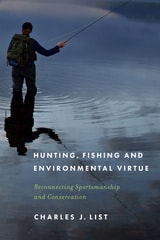
Hunting, Fishing, and Environmental Virtue
Reconnecting Sportsmanship and ConservationCharles J. List
Oregon State University Press, 2013
In his argument, List examines the connection between certain activities and the development of virtue in the classical sources, such as Aristotle and Plato. He then explores the work of Aldo Leopold, identifying three key environmental virtues that field sports instill in practitioners in the kind of conservation advocated by Leopold and others.
After reviewing several powerful philosophical objections to his viewpoint, List considers the future of environmental sportsmanship. He suggests that, in order to incorporate a revived connection between field sports and environmental virtue, the practice of hunting and angling must undergo changes, including shifts that would impact hunter education, civic engagement, the role of firearms, our understanding of “game” animals, and alliances with other sorts of outdoor recreation.
Hunting, Fishing, and Environmental Virtue will appeal to academics interested in the ethical issues surrounding hunting and fishing, professionals in wildlife management, and hunters and anglers interested in conservation.
Hybrid Ecologies
Edited by Susanne Witzgall, Marietta Kesting, Maria Muhle, and Jenny Nachtigall
Diaphanes, 2021
The notion of ecology not only figures centrally in current debates around climate change, but also traverses contemporary discourses in the arts, the humanities, and the social and techno sciences. In this present form, ecology refers to the multilayered and multidimensional nexus of living processes and technological and media practices—that is, to the complex relations of human and nonhuman agents. Hybrid Ecologies understands ecology as an ambivalent notion, whose very broadness simultaneously opens up new fields of action and raises provocative questions, not least concerning its genealogy. This interdisciplinary volume explores the political and social effects of rethinking community in ecological terms, with a particular emphasis on what the contemporary notion of ecology might mean for artistic and design practices. The result of the fifth annual program of the cx centre for interdisciplinary studies, which was conceived in cooperation with the Chair of Philosophy | Aesthetic Theory at the Academy of Fine Arts in Munich, Hybrid Ecologies is a timely and thought-provoking study of one of the most important themes of our time.
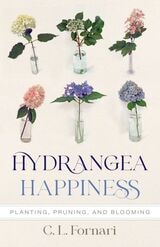
Hydrangea Happiness
Planting, Pruning, and BloomingC. L. Fornari
Brandeis University Press, 2026
A comprehensive, easy-to-use, illustrated guide to hydrangeas for novice gardeners and experienced horticulturists.
With large, long-lasting flowers that range from showy pinks to heartbreaking shades of blue, hydrangeas are captivating, popular plants. Yet gardeners often find themselves flummoxed by the challenge of understanding and growing the many varieties of these shrubs.
Writer, radio host, and gardening consultant C. L. Fornari (also known as The Garden Lady) simplifies the cultivation and care of the six most popular species of hydrangeas in this practical, clear, and accessible guide. Hydrangea Happiness explains the difference between varietals and tells how and where they can successfully grow in assorted soils and conditions throughout the United States. In addition to sharing essential information, Fornari addresses myths and misinformation and fields questions about cultivating these popular plants. Punctuated with catchy rhymes and beautiful photographs, this book makes the road to Hydrangea Happiness easy, successful, and fun.
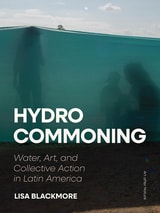
Hydrocommoning
Water, Art, and Collective Action in Latin AmericaLisa Blackmore
University of Minnesota Press, 2027
Reimagining watersheds as living hydrocommons through which artists and communities create more just and sustainable futures
Hydrocommoning explores how artists, activists, and curators coalesce around water in embodied efforts to contest entrenched and enduring forms of harm and degradation. Against the reduction of rivers, streams, and wetlands to mere resources to be managed, Hydrocommoning centers water as a living web of relations through which artists and communities forge creative means of reconnection by moving, weaving, pumping, eating, and listening.
By charting these aesthetic practices, Hydrocommoning shows how artists and organizers across Latin America oppose extractivism, unequal urbanization, ecological degradation, and the erasure of Indigenous water cultures. To cultivate widespread social attunement to vulnerable waters and raise the call for their defense and care, collectives in Brazil, Colombia, Guatemala, and Peru engage in communal meals, sound art, infrastructural interventions, and other practices that Lisa Blackmore theorizes as “hydrocommoning.”
Grounded in five years of experiential fieldwork, archival research, and curatorial projects in Latin America, Blackmore proposes a methodology to work with water as an analytical framework for collective action. Bridging the gap between theory, curating, and community-based practices, Hydrocommoning offers a promising vision of grassroots organizing that actively confronts some of today’s most urgent ecological threats.
Retail e-book files for this title are screen-reader friendly with images accompanied by short alt text and/or extended descriptions.
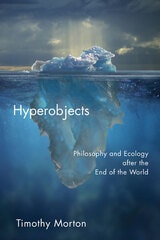
Hyperobjects
Philosophy and Ecology after the End of the WorldTimothy Morton
University of Minnesota Press, 2013
Having set global warming in irreversible motion, we are facing the possibility of ecological catastrophe. But the environmental emergency is also a crisis for our philosophical habits of thought, confronting us with a problem that seems to defy not only our control but also our understanding. Global warming is perhaps the most dramatic example of what Timothy Morton calls “hyperobjects”—entities of such vast temporal and spatial dimensions that they defeat traditional ideas about what a thing is in the first place. In this book, Morton explains what hyperobjects are and their impact on how we think, how we coexist with one another and with nonhumans, and how we experience our politics, ethics, and art.
Moving fluidly between philosophy, science, literature, visual and conceptual art, and popular culture, the book argues that hyperobjects show that the end of the world has already occurred in the sense that concepts such as world, nature, and even environment are no longer a meaningful horizon against which human events take place. Instead of inhabiting a world, we find ourselves inside a number of hyperobjects, such as climate, nuclear weapons, evolution, or relativity. Such objects put unbearable strains on our normal ways of reasoning.
Insisting that we have to reinvent how we think to even begin to comprehend the world we now live in, Hyperobjects takes the first steps, outlining a genuinely postmodern ecological approach to thought and action.