4743 books match the query 'Religion' and 176 start with h

cover of Heresy in the Heartland: The Controversy at The University of Dayton, 1960-67

Heresy in the Heartland

The Controversy at The University of Dayton, 1960-67

Mary Jude Brown

Catholic University of America Press, 2022

Heresy in the Heartland is a narrative case study of the 'Heresy' Affair at the University of Dayton, a series of events predominantly in the philosophy department that occurred when tensions between the Thomists and proponents of new philosophies reached crisis stage in fall 1966. The controversy culminated in a letter written by a lay assistant professor to the Cincinnati archbishop, Karl J. Alter. In the letter, the professor cited a number of instances where “erroneous teachings” were “endorsed” or “openly advocated” by four lay faculty members. Concerned about the pastoral impact on the University of Dayton community, the professor asked the archbishop to conduct an investigation. How the University weathered this controversy, the second of three major controversies to hit Catholic higher education within three years (St. John’s University, University of Dayton and the Curran affair at Catholic University of America), is of interest to faculty and administrators in Catholic higher education who continue to struggle with defining what it means to be a “Catholic” university, with the relationship of Catholic universities to the Church at large and the hierarchy in particular, and with Church teachings that conflict with the culture we live in such as immigration, the environment and sexual ethics. The story is told in chronological order by the participants in the controversy - faculty, administrators, students and clergy - using the words of those involved. Heresy in the Heartland concludes with a synopsis of what happened at the University of Dayton and draws some lessons for the future of Catholic higher education.
[more]
cover of Heretical Fictions: Religion in the Literature of Mark Twain

Heretical Fictions

Religion in the Literature of Mark Twain

LAWRENCE I. BERKOVE

University of Iowa Press, 2010

Challenging the prevailing belief that Mark Twain’s position on religion hovered somewhere between skepticism and outright heresy, Lawrence Berkove and Joseph Csicsila marshal biographical details of Twain’s life alongside close readings of his work to explore the religious faith of America’s most beloved writer and humorist. They conclude not only that religion was an important factor in Twain’s life but also that the popular conception of Twain as agnostic, atheist, or apostate is simply wrong.  

Heretical Fictions is the first full-length study to assess the importance of Twain’s heretical Calvinism as the foundation of his major works, bringing to light important thematic ties that connect the author’s early work to his high period and from there to his late work. Berkove and Csicsila set forth the main elements of Twain’s “countertheological” interpretation of Calvinism and analyze in detail the way it shapes five of his major books—Roughing It, The Adventures of Tom Sawyer, Adventures of Huckleberry Finn, A Connecticut Yankee in King Arthur's Court, and No. 44, The Mysterious Stranger—as well as some of his major short stories. The result is a ground-breaking and unconventional portrait of a seminal figure in American letters.

[more]
cover of Herman Melville's Ship of State

Herman Melville's Ship of State

will morrisey

St. Augustine's Press, 2020

William Morrisey unravels Melville’s “loomings” of the great whale, showing them to be important threads of politics and theories of governance. The Young America of Melville’s day valorized popular sovereignty such that moral law suppressed by the majority rule was bringing America to state of being that could only then be ruled by the mightiest of the mighty––the great Leviathan, who reigns in the boundless chaotic sea separated from “stable land.” The force of the created world and the necessary ordering achieved through conquest are dominating themes of Melville’s great tale, but as Morrisey observes approaching the great whale, ruler of the untamable seas, is for captain (ruler) an opportunity to destroy it. But for the sailor (the ruled) being close to the white whale is a moment for understanding, and in turn of being understood. Yet in what sense is being seen, for human beings of moral bearings, not also an impulse to self-impose? “The modern Ishmael wants to see, not to kill, perhaps to be seen, and surely not to be killed. Americans too need to come to terms with the white whale, if they are to perceive reality as it is without bringing destruction upon themselves.” Is Melville proposing an utterly new philosophy of ruler and ruled, of a proper gauge of the immeasurable chaos that is nature?

“Does Melville also intend to be a founder in the ‘New World’?” Morrisey’s study is a compelling look at the early political moments of a new nation, but one that at the time perceived itself as already aging and maturing in the process of political voyage and adventure. Dangers lie ahead, Melville seems to warn, and in his disenchantment of the vigor of the Young America he once endorsed he tells the story of what really happens when democracy is idealized and the surrounding waters of chaos are thereby veiled; and yet also of what happens when one would seek to command the chaos only to transform into the unpredictably destructive prey he pursues, especially under the guise of moral outrage. 

Melville, like Ishmael, urges a new vision of both God and nature, and challenges the notion of rule in all its expressions. Americans, the people of the New World, are invited to be unafraid, but also careful. In wandering as on the open waters one wonders, beyond civic boundaries and conventions, and in that wonder one may finally come face to face with what is good and grand––but in beholding the great white whale, can one resist the urge to conquest, now that he is likewise by the leviathan beholden? Is the rule of man and the coronation of a specific dialectic of power an untenable victory, given that “‘Nature is nobody’s ally’: it wounds or kills any person or nation that violates it, impartially”? 

Morrisey writes with lucidity and weaves together elements of history, literature, politics and perhaps his own affinity for Ishmael’s passenger spirit to reveal just how broad and boundless of a narrative Melville’s Moby Dick truly is.
[more]
cover of Hermann Cohen: Writings on Neo-Kantianism and Jewish Philosophy

Hermann Cohen

Writings on Neo-Kantianism and Jewish Philosophy

Edited by Samuel Moyn and Robert Schine

Brandeis University Press, 2021

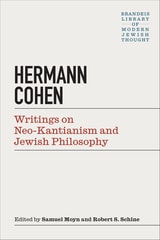
Hermann Cohen (1842–1918) was among the most accomplished Jewish philosophers of modern times—if not the single most significant. But his work has not yet received the attention it deserves. This newly translated collection of his writings—most of which are appearing in English for the first time—illuminates his achievements for student readers and rectifies lapses in his intellectual reception by prior generations. It presents chapters from Cohen’s Ethics of Pure Will, conflicting interpretations of Cohen by Franz Rosenzweig and Alexander Altmann, and finally the eulogy to Cohen delivered at graveside by Ernst Cassirer. Containing full annotations and selections that concentrate both on the philosophical core of Cohen’s writings and the politics of interpretation of his work at the time of his death and after, Hermann Cohen truly brings to light all of Cohen’s accomplishments.   
[more]
cover of Hexameron, Paradise, and Cain and Abel

Hexameron, Paradise, and Cain and Abel

Saint Ambrose

Catholic University of America Press, 1961
No description available
[more]
cover of Hidden Critique of Solomon in the Hebrew Bible

Hidden Critique of Solomon in the Hebrew Bible

Pekka Särkiö

SBL Press, 2025
The period of Israel’s united kingdom under King Solomon is portrayed in 1 Kings 3–11 as ideal in order to arouse hope for the restoration of Israelite kingship. Conversely, postexilic writers were faced with traditions that blamed the division of the united kingdom on Solomon’s sins. Pekka Särkiö explores how the writers of the Hebrew Bible used scribal tools and creativity to weave these disparate perspectives together with a subtle, hidden critique that stretches through the Torah, Prophets, and Writings. This in-depth study reveals the expressions, themes, and structures that evoke Solomon’s foreign wives, his excessive wealth, his respect for other gods, his pride, and his elevation to a venerated character. The resulting texts allow the coexistence of hope for the future and the concerns of northern survivors who blamed Solomon for the exile and the divided kingdom.
[more]
cover of Hidden Histories: Faith and Black Lesbian Leadership

Hidden Histories

Faith and Black Lesbian Leadership

Monique Moultrie

Duke University Press, 2023
In Hidden Histories, Monique Moultrie collects oral histories of Black lesbian religious leaders in the United States to show how their authenticity, social justice awareness, spirituality, and collaborative leadership make them models of womanist ethical leadership. By examining their life histories, Moultrie frames queer storytelling as an ethical act of resistance to the racism, sexism, and heterosexism these women experience. She outlines these women’s collaborative, intergenerational, and leadership styles, and their concerns for the greater good and holistic well-being of humanity and the earth. She also demonstrates how their ethos of social justice activism extends beyond LGBTQ and racialized communities and provides other models of religious and community leadership. Addressing the invisibility of Black lesbian religious leaders in scholarship and public discourse, Moultrie revises modern understandings of how race, gender, and sexual identities interact with religious practice and organization in the twenty-first century.
[more]
cover of Hidden Truths from Eden: Esoteric Readings of Genesis 1-3

Hidden Truths from Eden

Esoteric Readings of Genesis 1-3

Caroline Vander Stichele

SBL Press, 2014

Examine a rich history of spiritual interpretations from antiquity to the present

Since the sixteenth century CE, the field of biblical studies has focused on the literal meaning of texts. This collection seeks to rectify this oversight by integrating the study of esoteric readings into academic discourse. Case studies focusing on the first three chapters of Genesis cover different periods and methods from early Christian discourse through zoharic, kabbalistic and alchemical literature to modern and post-postmodern approaches.

Features:

  • Discussions, comparisons, and analyses of esoteric appropriations of Genesis 1–3
  • Essays on creation myths, gender, fate and free will, the concepts of knowledge, wisdom, and gnosis
  • Repsonses to papers that provide a range of view points

[more]
cover of Hiding

Hiding

Mark C. Taylor

University of Chicago Press, 1997

The age of information, media, and virtuality is transforming every aspect of human experience. Questions that have long haunted the philosophical imagination are becoming urgent practical concerns: Where does the natural end and the artificial begin? Is there a difference between the material and the immaterial? In his new work, Mark C. Taylor extends his ongoing investigation of postmodern worlds by critically examining a wide range of contemporary cultural practices.

Nothing defines postmodernism so well as its refusal of depth, its emphasis on appearance and spectacle, its tendency to collapse a three-dimensional world in which image and reality are distinct into a two-dimensional world in which they merge. The postmodern world, Taylor argues, is a world of surfaces, and the postmodern condition is one of profound superficiality.

For many cultural commentators, postmodernism's inescapable play of surfaces is cause for despair. Taylor, on the other hand, shows that the disappearance of depth in postmodern culture is actually a liberation repleat with creative possibilities. Taylor introduces readers to a popular culture in which detectives—the postmodern heroes of Paul Auster and Dennis Potter—lift surfaces only to find more surfaces, and in which fashion advertising plays transparency against hiding. Taylor looks at the contemporary preoccupation with body piercing and tattooing, and asks whether these practices actually reveal or conceal. Phrenology and skin diseases, the "religious" architecture of Las Vegas, the limitless spread of computer networks—all are brought within the scope of Taylor's brilliant analysis. Postmodernism, he shows, has given us a new sense of the superficial, one in which the issue is not the absence of meaning but its uncontrollable, ecstatic proliferation.

Embodying the very tendencies it analyzes, Hiding is unique. Conceived and developed with well-known designers Michael Rock and Susan Sellars, this work transgresses the boundary that customarily separates graphic design from the story within a text. The product of nearly three decades of reflection and writing, Hiding opens a window on contemporary culture. To follow the remarkable course Taylor charts is to see both our present and past differently and to encounter a future as disorienting as it is alluring.
[more]
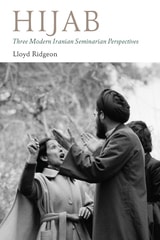
cover of Hijab: Three Modern Iranian Seminarian Perspectives

Hijab

Three Modern Iranian Seminarian Perspectives

Lloyd Ridgeon

Gingko, 2021

This book provides an overview of the range of seminarian thinking in Iran on the controversial topic of the hijab. During the modern period, Iran has suffered a great deal of conflict and confusion caused by the impact of Western views on the hijab in the 19th century, Riza Shah Pahlavi’s 1936 decree banning Islamic head coverings, and the imposition of the veil in the wake of the Islamic Revolution in 1979.

Ḥijāb addresses the differences of opinion among seminarians on the hijab in the Islamic Republic of Iran, focusing on three representative thinkers: Murtaza Mutahhari who held veiling to be compulsory, Ahmad Qabil who argued for the desirability of the hijab, and Muhsin Kadivar who considers it neither necessary nor desirable. In the first chapter, the views of these three scholars are contextualized within the framework known as ‘new religious thinking’ among the seminarians. Comprehending the hermeneutics of this new religious thinking is key to appreciating how and why the younger generation of scholars have offered divergent judgements about the hijab. Following the first chapter, the book is divided into three parallel sections, each devoted to one of the three seminarians. These present a chronological approach, and each scholar’s position on the hijab is assessed with reference to historical specificity and their own general jurisprudential perspective. Extensive examples of the writings of the three scholars on the hijab are also provided.

 
[more]
cover of Hillel at Michigan, 1926/27-1945: Struggles of Jewish Identity in a Pivotal Era

Hillel at Michigan, 1926/27-1945

Struggles of Jewish Identity in a Pivotal Era

Andrei S. Markovits and Kenneth Garner

Michigan Publishing Services, 2016

This book provides the very first in-depth analysis of the founding decades of a major Hillel chapter in the United States. Hillel at the University of Michigan was founded in 1926 as the fourth such chapter in the United States following its establishment at three other public universities in the Midwest: Illinois (1923); Wisconsin (1924); Ohio State (1925).
 
The study analyzes Hillel's challenges as a big-tent, catch-all institution trying to represent all Jewish students on campus regardless of their religious orientation, cultural preferences, and ideological predilections. It looks at Hillel's interactions with the then powerful Jewish fraternities and sororities that provided the main locus of Jewish life on campus at the time, as well as its relations with the University's leadership and many of its cultural and political constituencies. Most of these activities occurred at a time when anti-Semitism was rife in the United States, particularly in the larger Detroit area, home to Henry Ford and Father Charles Edward Coughlin.

[more]
cover of Himalayan Dialogue: Tibetan Lamas & Gurung Shamans In Nepal

Himalayan Dialogue

Tibetan Lamas & Gurung Shamans In Nepal

Stan Royal Mumford

University of Wisconsin Press, 1989

In the mountain valleys of Nepal, Tibetan communities have long been established through migrations from the North. Because of these migrations over the last few centuries, Tibetan lamaism, as one of the world’s great ritual traditions, can be studied in the Himalayas as a process that emerges through dialogue with the more ancient shamanic tradition which it confronts and criticizes.
    Here for the first time is a thorough anthropological study of Tibetan lamaism combining textual analysis with richly contextualized ethnographic data. The rites studied are of the Nyingma Tibetan Buddhist tradition. In contrast to the textual analyses that have viewed the culture as a finished entity, here we see an unbounded ritual process with unfinished interpretations.
    Mumford’s focus is on the “dialogue” taking place between the lamaist and the shamanic regimes, as a historic development occurring between different cultural layers. The study powerfully demonstrates that interrelationships between subsystems within a given cultural matrix over time are critical to an understanding of religion as a cultural process.
[more]
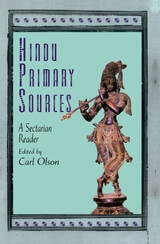
cover of Hindu Primary Sources: A Sectarian Reader

Hindu Primary Sources

A Sectarian Reader

Olson, Carl

Rutgers University Press, 2007

Bringing together texts from a variety of sectarian traditions, this reader provides the broadest selection of primary source Hindu literature available to date.

The volume is divided into two major parts. The first section presents selections that explore major themes in classical Sanskrit traditions, including those in the Vedic, Upanisadic, and Dharma literatures, as well as the classical philosophical-religious schools. The second part includes selections that highlight the sectarian and devotional movements related to major deities such as Vishnu, Shiva, Krishna, Rama, Sant, Tantra, and the goddess figures.

In addition to a general introductory chapter on Indian literature, each major section is introduced by an essay that places the selections within the context of Hindu history. This comprehensive reader stands on its own as an indispensable anthology of original textual sources for courses in Hinduism, while also serving as a companion volume to the text The Many Colors of Hinduism: A Thematic-Historical Introduction.
[more]
cover of Hindutva as Political Monotheism

Hindutva as Political Monotheism

Anustup Basu

Duke University Press, 2020
In Hindutva as Political Monotheism, Anustup Basu offers a genealogical study of Hindutva—Hindu right-wing nationalism—to illustrate the significance of Western anthropology and political theory to the idea of India as a Hindu nation. Connecting Nazi jurist Carl Schmitt's notion of political theology to traditional theorems of Hindu sovereignty and nationhood, Basu demonstrates how Western and Indian theorists subsumed a vast array of polytheistic, pantheistic, and henotheistic cults featuring millions of gods into a singular edifice of faith. Basu exposes the purported “Hindu Nation” as itself an orientalist vision by analyzing three crucial moments: European anthropologists’ and Indian intellectuals’ invention of a unified Hinduism during the long nineteenth century; Indian ideologues’ adoption of ethnoreligious nationalism in pursuit of a single Hindu way of life in the twentieth century; and the transformations of this project in the era of finance capital, Bollywood, and new media. Arguing that Hindutva aligns with Enlightenment notions of nationalism, Basu foregrounds its significance not just to Narendra Modi's right-wing, anti-Muslim government but also to mainstream Indian nationalism and its credo of secularism and tolerance.
[more]
cover of Hispanic Methodists, Presbyterians, and Baptists in Texas

Hispanic Methodists, Presbyterians, and Baptists in Texas

By Paul Barton

University of Texas Press, 2006

The question of how one can be both Hispanic and Protestant has perplexed Mexican Americans in Texas ever since Anglo-American Protestants began converting their Mexican Catholic neighbors early in the nineteenth century. Mexican-American Protestants have faced the double challenge of being a religious minority within the larger Mexican-American community and a cultural minority within their Protestant denominations. As they have negotiated and sought to reconcile these two worlds over nearly two centuries, los Protestantes have melded Anglo-American Protestantism with Mexican-American culture to create a truly indigenous, authentic, and empowering faith tradition in the Mexican-American community.

This book presents the first comparative history of Hispanic Methodists, Presbyterians, and Baptists in Texas. Covering a broad sweep from the 1830s to the 1990s, Paul Barton examines how Mexican-American Protestant identities have formed and evolved as los Protestantes interacted with their two very different communities in the barrio and in the Protestant church. He looks at historical trends and events that affected Mexican-American Protestant identity at different periods and discusses why and how shifts in los Protestantes' sense of identity occurred. His research highlights the fact that while Protestantism has traditionally served to assimilate Mexican Americans into the dominant U.S. society, it has also been transformed into a vehicle for expressing and transmitting Hispanic culture and heritage by its Mexican-American adherents.

[more]
cover of Historic Sites and Markers along the Mormon and Other Great Western Trails

Historic Sites and Markers along the Mormon and Other Great Western Trails

Stanley B. Kimball

University of Illinois Press, 1988

Historic Sites and Markers
  is an indispensable guide for travelers who wish to retrace the various frontier
  routes taken by the Mormons and other pioneers in their treks westward. Traversing
  fifteen states from New York to California, Stanley Kimball presents some of
  America's most famous trails--the Mormon, the Oregon-California, the Santa Fe,
  the Overland, and many others--and describes important points of interest, including
  forts, trail centers, and museums.
"An important contribution
  to the history of the West and perhaps the most comprehensive mile-by-mile guide
  to trail markers and historical sites ever prepared."
  -- Brigham D. Madsen, author of The Shoshoni Frontier and the Bear
  River Massacre

 
[more]
cover of Historical Archaeology and the Latter-day Saint Past

Historical Archaeology and the Latter-day Saint Past

Benjamin C. Pykles

Utah State University Press, 2025

Historical Archaeology and the Latter-day Saint Past reviews the history of archaeological investigations at sites connected to the Latter-day Saints and examines the ways archaeology has contributed to the understanding of that past. Examples from various sites, where over time archaeologists have utilized a wide range of methods, illustrate the potential of historical archaeology to confirm, complete, correct, and sometimes confuse understandings of the Latter-day Saints.

The Arrington Lecture series, established in honor of one of the twentieth-century American West’s most distinguished historians, Leonard Arrington, has become a leading forum for prominent scholars to address topics related to Latter-day Saint history. Utah State University hosts the Leonard J. Arrington Mormon History Lecture Series through the Merrill-Cazier Library’s Special Collections and Archives.
 
[more]
cover of Historical Linguistics and Biblical Hebrew: Steps Toward an Integrated Approach

Historical Linguistics and Biblical Hebrew

Steps Toward an Integrated Approach

Robert Rezetko

SBL Press, 2014

A philologically robust approach to the history of ancient Hebrew

In this book the authors work toward constructing an approach to the history of ancient Hebrew that overcomes the chasm of academic specialization. The authors illustrate how cross-textual variable analysis and variation analysis advance research on Biblical Hebrew and correct theories based on extra-linguistic assumptions, intuitions, and ideologies by focusing on variation of forms/uses in the Masoretic text and variation between the Masoretic text and other textual traditions.

Features:

  • A unique approach that examines the nature of the sources and the description of their language together
  • Extensive bibliography for further research
  • Tables of linguistic variables and parallels
[more]
cover of Historical Metaphors and Mythical Realities: Structure in the Early History of the Sandwich Islands Kingdom

Historical Metaphors and Mythical Realities

Structure in the Early History of the Sandwich Islands Kingdom

Marshall D. Sahlins

University of Michigan Press, 1981

Hawaiian culture as it met foreign traders and settlers is the context for Sahlins's structuralist methodology of historical interpretation

[more]
cover of Historical Roots of the Old Testament (1200-63 BCE)

Historical Roots of the Old Testament (1200-63 BCE)

Richard D. Nelson

SBL Press, 2014

A thorough overview of the history of ancient Israel for research and classroom use

Richard D. Nelson charts the beginning of the Iron Age and the emergence of Israel and its literature, including the kingdoms of Israel and Judah, the downfall of Israel, Judah in the Assyrian and Babylonian periods, Yehud and Persia, and the Hellenistic period. Each chapter provides a summary of the period under consideration, a historical reconstruction of the period, based on biblical and extrabiblical evidence; a critical study of the biblical literature deriving from or associated with the period, and theological conclusions that readers may draw from the relevant biblical texts.

Features:

  • Balanced coverage of controversial topics
  • Extensive bibliographies at the beginning of each chapter
  • Lists of rulers and key dates for reference and classroom use

[more]
cover of Historicity of Nature: Essays on Science and Theology

Historicity of Nature

Essays on Science and Theology

Wolfhart Pannenberg

Templeton Press, 2008

Known as one of the most outstanding theologians of the twentieth century, Wolfhart Pannenberg is also considered a great interdisciplinary thinker. Now, essays and articles on science and theology that are central to understanding Pannenberg's theories have been collected into one volume.

Niels Henrik Gregersen, a former student of Pannenberg and now professor of systematic theology at Copenhagen University, has compiled the writings in four sections: Methodology, Creation and Nature's Historicity, Religion and Anthropology, and Meaning and Metaphysics. Included in this volume are:

•Translations of Pannenberg's principled argument for the consonance between science and religion, including contingency and laws of nature, field theories and space-time, and divine action
•Translations of Pannenberg's theory of theology as a rational hypothetical science, including his discussions with leading British and American scholars such as A. N. Whitehead, John Cobb, and Langdon Gilkey
•Previously unpublished articles on the problems between science and theology in the course of modern history, explaining why chance may be more important for theology than design
•Translations of seminal articles that articulate Pannenberg's understanding of the role of religion in human nature
•One of the few theological articles on aggression as a psychological and social phenomenon

With this collection, the essays of this important contemporary theologian and his illuminating views are presented in one convenient volume.

[more]
cover of History of Ancient Israel

History of Ancient Israel

Christian Frevel

SBL Press, 2023

This English translation of the second edition of Christian Frevel’s essential textbook Geschichte Israels (Kohlhammer, 2018) covers the history of Israel from its beginnings until the Bar Kokhba revolt (132–135 CE). Frevel draws on archaeological evidence, inscriptions and monuments, as well as the Bible to sketch a picture of the history of ancient Israel within the context of the southern Levant that is sometimes familiar but often fresh and unexpected. Frevel has updated the second German edition with the most recent research of archaeologists and biblical scholars, including those based in Europe. Tables of rulers, a glossary, a timeline of the ancient Near East, and resources arranged by subject make this book an accessible, essential textbook for students and scholars alike.
[more]
cover of History of Biblical Interpretation, Volume 1: From the Old Testament to Origen

History of Biblical Interpretation, Volume 1

From the Old Testament to Origen

Henning Graf Reventlow

SBL Press, 2009

From the very beginning, Holy Scripture has always been interpreted Scripture, and its interpretation determined the development and the history of both early Judaism and the first centuries of the Christian church. In this volume, the first of four on the History of Biblical Interpretation, readers will discover how the earliest interpreters of the Bible made the Scriptures come alive for their times—within the contexts and under the influences of Hellenism, Stoicism, and Platonism, as well as the interpretive methods developed in Alexandria. Particular attention is paid to innerbiblical interpretation (within the Hebrew Bible itself and in the New Testament’s reading of the Hebrew Bible), as well as to the interpretive practices reflected in the translation of the Septuagint and the writings of Qumran, Philo, the early rabbis, the apostolic fathers Barnabas and Clement, and early Christian leaders such as Justin Martyr, Marcion, Irenaeus, and Origen.
[more]
cover of History of Biblical Interpretation, Volume 2: From Late Antiquity to the End of the Middle Ages

History of Biblical Interpretation, Volume 2

From Late Antiquity to the End of the Middle Ages

Henning Graf Reventlow

SBL Press, 2010

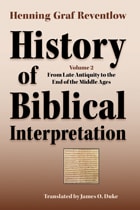
Volume 2 of History of Biblical Interpretation deals with the most extensive period under examination in this four-volume set. It begins in Asia Minor in the late fourth century with Bishop Theodore of Mopsuestia, the founder of a school of interpretation that sought to accentuate the literal meaning of the Bible and thereby stood out from the tradition of antiquity. It ends with another outsider, a thousand years later in England, who by the presuppositions of his thought stood at the end of an era: John Wyclif. In between these two interpreters, this volume presents the history of biblical interpretation from late antiquity until the end of the Middle Ages by examining the lives, works, and interpretive practices of Didymus the Blind, Jerome, Ambrose, Augustine, Gregory the Great, Isidore of Seville, the Venerable Bede, Alcuin, John Scotus Eriugena, Abelard, Rupert of Deutz, Hugo of St. Victor, Joachim of Fiore, Thomas Aquinas, Bonaventure, Rashi, Abraham ibn Ezra, and Nicolas of Lyra.
[more]
cover of History of Biblical Interpretation, Volume 3: Rennaissance, Reformation, Humanism

History of Biblical Interpretation, Volume 3

Rennaissance, Reformation, Humanism

Henning Graf Reventlow

SBL Press, 2009

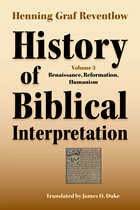
Volume 3 of History of Biblical Interpretation deals with an era—Renaissance, Reformation, and humanism—characterized by major changes, such as the rediscovery of the writings of antiquity and the newly invented art of printing. These developments created the context for one of the most important periods in the history of biblical interpretation, one that combined both philological insights made possible by the now-accessible ancient texts with new theological impulses and movements. As representative of this period, this volume examines the lives and teaching of Johann Reuchlin, Erasmus, Martin Luther, Philipp Melanchthon, John Calvin, Thomas Müntzer, Hugo Grotius, and a host of other influential exegetes.
[more]
cover of History of Biblical Interpretation, Volume 4: From the Englightenment to the Twentieth Century

History of Biblical Interpretation, Volume 4

From the Englightenment to the Twentieth Century

Henning Graf Reventlow

SBL Press, 2010

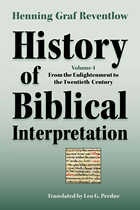
As in the first three volumes of History of Biblical Interpretation, From the Enlightenment to the Twentieth Century surveys the lives and works of significant theologians and lay people, politicians and philosophers, in order to portray the characteristic attitudes of the era. It discusses the philosophers and politicians Hobbes, Locke, and Spinoza and the writers Lessing and Herder. Biblical criticism per se begins with the controversy over the original Hebrew text of the Old Testament and extends into Enlightenment ethics, myth, and miracle stories. Early representatives include Richard Simon and Hermann Samuel Reimarus, followed by Johann Salomo Semler, Johann Jakob Griesbach, Johann Gottfried Eichhorn, and Philipp Jacob Spener. Biblical scholars such as Wilhelm Martin Leberecht de Wette, Ferdinand Christian Baur, Heinrich Julius Holtzmann, Julius Wellhausen, Hermann Gunkel, Wilhelm Bousset, Karl Barth, and Rudolf Bultmann round out the volume and bring readers to the twentieth century.
[more]
cover of History of Paradise: THE GARDEN OF EDEN IN MYTH AND TRADITION

History of Paradise

THE GARDEN OF EDEN IN MYTH AND TRADITION

Jean Delumeau

University of Illinois Press, 1995


With erudition and wit, Jean Delumeau explores the medieval conviction that paradise existed in a precise although unreachable earthly location. Delving into the writings of dozens of medieval and Renaissance thinkers, from Augustine to Dante, Delumeau presents a luminous study of the meaning of Original Sin and the human yearning for paradise.
The finest minds of the Middle Ages wrote about where paradise was to be found, what it was like, and who dwelt in it. Explorers sailed into the unknown in search of paradisal gardens of wealth and delight that were thought to be near the original Garden. Cartographers drew Eden into their maps, often indicating the wilderness into which Adam and Eve were cast, along with the magical kingdom of Prester John, Jerusalem, Babel, the Happy Isles, Ophir, and other places described in biblical narrative or borrowed from other cultures. Later, Renaissance thinkers and writers meticulously reconstructed the details of the original Eden, even providing schedules of the Creation and physical descriptions of Adam and Eve.
Even when the Enlightenment, with its discovery of fossils and pre-Darwinian theories of evolution, gradually banished the dream of paradise on earth, a nostalgia for Eden shaped elements of culture from literature to gardening. In our own time, Eden's hold on the Western imagination continues to fuel questions such as whether land should be conserved or exploited and whether a return to innocence is possible.
 
[more]
cover of History of Political Ideas, Volume 5 (CW23): Religion and the Rise of Modernity

History of Political Ideas, Volume 5 (CW23)

Religion and the Rise of Modernity

Eric Voegelin, Edited by James L. Wiser

University of Missouri Press, 1998

Examining the emergence of modernity within the philosophical and political debates of the sixteenth century, Religion and the Rise of Modernity resumes the analysis of the "great confusion" introduced in Volume IV of History of Political Ideas. Encompassing a vast range of events ignited by Luther's Ninety-Five Theses, this period is one of controversy, revolution, and partiality.

Despite the era's fragmentation and complexity, Voegelin's insightful analysis clarifies its significance and suggests the lines of change converging at a point in the future: the medieval Christian understanding of a divinely created closed cosmos was being replaced by a distinctly modern form of human consciousness that posits man as the proper origin of meaning in the universe.

Analyzing the most significant features of the great confusion, Voegelin examines a vast range of thought and issues of the age. From the more obvious thinkers to those less frequently studied, this volume features such figures as Calvin, Althusius, Hooker, Bracciolini, Savonarola, Copernicus, Tycho de Brahe, and Giordano Bruno. Devoting a considerable amount of attention to Jean Bodin, Voegelin presents him as a prophet of a new, true religion amid the civilizational disorder of the post-Christian era. Focusing on such traditional themes as monarchy, just war theory, and the philosophy of law, this volume also investigates issues within astrology, cosmology, and mathematics.

Religion and the Rise of Modernity is a valuable work of scholarship not only because of its treatment of individual thinkers and doctrines influential in the sixteenth century and beyond but also because of its close examination of those experiences that formed the modern outlook.
[more]
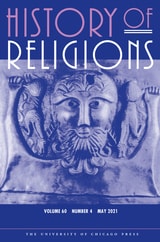
cover of History of Religions, volume 60 number 4 (May 2021)

History of Religions, volume 60 number 4 (May 2021)

The University of Chicago Press

University of Chicago Press Journals, 2021
This is volume 60 issue 4 of History of Religions. The first academic journal devoted exclusively to comparative religious history, History of Religions has set the standard for the study of religious phenomena from prehistory to modern times. HR publishes fresh and insightful scholarship that is engaged both with particular traditions, places, and times and also speaks to broader methodological and/or theoretical issues in the study of religion. It encourages critical conversations in the field with review articles and comprehensive book reviews by distinguished scholars.
[more]
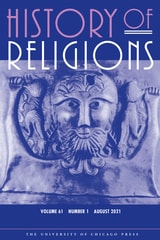
cover of History of Religions, volume 61 number 1 (August 2021)

History of Religions, volume 61 number 1 (August 2021)

The University of Chicago Press

University of Chicago Press Journals, 2021
This is volume 61 issue 1 of History of Religions. The first academic journal devoted exclusively to comparative religious history, History of Religions has set the standard for the study of religious phenomena from prehistory to modern times. HR publishes fresh and insightful scholarship that is engaged both with particular traditions, places, and times and also speaks to broader methodological and/or theoretical issues in the study of religion. It encourages critical conversations in the field with review articles and comprehensive book reviews by distinguished scholars.
[more]
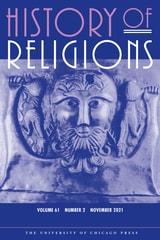
cover of History of Religions, volume 61 number 2 (November 2021)

History of Religions, volume 61 number 2 (November 2021)

The University of Chicago Press

University of Chicago Press Journals, 2021
This is volume 61 issue 2 of History of Religions. The first academic journal devoted exclusively to comparative religious history, History of Religions has set the standard for the study of religious phenomena from prehistory to modern times. HR publishes fresh and insightful scholarship that is engaged both with particular traditions, places, and times and also speaks to broader methodological and/or theoretical issues in the study of religion. It encourages critical conversations in the field with review articles and comprehensive book reviews by distinguished scholars.
[more]
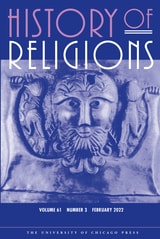
cover of History of Religions, volume 61 number 3 (February 2022)

History of Religions, volume 61 number 3 (February 2022)

The University of Chicago Press

University of Chicago Press Journals, 2022
This is volume 61 issue 3 of History of Religions. The first academic journal devoted exclusively to comparative religious history, History of Religions has set the standard for the study of religious phenomena from prehistory to modern times. HR publishes fresh and insightful scholarship that is engaged both with particular traditions, places, and times and also speaks to broader methodological and/or theoretical issues in the study of religion. It encourages critical conversations in the field with review articles and comprehensive book reviews by distinguished scholars.
[more]
cover of History of Religions, volume 61 number 4 (May 2022)

History of Religions, volume 61 number 4 (May 2022)

The University of Chicago Press

University of Chicago Press Journals, 2022
This is volume 61 issue 4 of History of Religions. The first academic journal devoted exclusively to comparative religious history, History of Religions has set the standard for the study of religious phenomena from prehistory to modern times. HR publishes fresh and insightful scholarship that is engaged both with particular traditions, places, and times and also speaks to broader methodological and/or theoretical issues in the study of religion. It encourages critical conversations in the field with review articles and comprehensive book reviews by distinguished scholars.
[more]
cover of History of Religions, volume 62 number 1 (August 2022)

History of Religions, volume 62 number 1 (August 2022)

The University of Chicago Press

University of Chicago Press Journals, 2022
This is volume 62 issue 1 of History of Religions. The first academic journal devoted exclusively to comparative religious history, History of Religions has set the standard for the study of religious phenomena from prehistory to modern times. HR publishes fresh and insightful scholarship that is engaged both with particular traditions, places, and times and also speaks to broader methodological and/or theoretical issues in the study of religion. It encourages critical conversations in the field with review articles and comprehensive book reviews by distinguished scholars.
[more]
cover of History of Religions, volume 62 number 2 (November 2022)

History of Religions, volume 62 number 2 (November 2022)

The University of Chicago Press

University of Chicago Press Journals, 2022
This is volume 62 issue 2 of History of Religions. The first academic journal devoted exclusively to comparative religious history, History of Religions has set the standard for the study of religious phenomena from prehistory to modern times. HR publishes fresh and insightful scholarship that is engaged both with particular traditions, places, and times and also speaks to broader methodological and/or theoretical issues in the study of religion. It encourages critical conversations in the field with review articles and comprehensive book reviews by distinguished scholars.
[more]
cover of History of Religions, volume 62 number 3 (February 2023)

History of Religions, volume 62 number 3 (February 2023)

The University of Chicago Press

University of Chicago Press Journals, 2023
This is volume 62 issue 3 of History of Religions. The first academic journal devoted exclusively to comparative religious history, History of Religions has set the standard for the study of religious phenomena from prehistory to modern times. HR publishes fresh and insightful scholarship that is engaged both with particular traditions, places, and times and also speaks to broader methodological and/or theoretical issues in the study of religion. It encourages critical conversations in the field with review articles and comprehensive book reviews by distinguished scholars.
[more]
cover of History of Religions, volume 62 number 4 (May 2023)

History of Religions, volume 62 number 4 (May 2023)

The University of Chicago Press

University of Chicago Press Journals, 2023
This is volume 62 issue 4 of History of Religions. The first academic journal devoted exclusively to comparative religious history, History of Religions has set the standard for the study of religious phenomena from prehistory to modern times. HR publishes fresh and insightful scholarship that is engaged both with particular traditions, places, and times and also speaks to broader methodological and/or theoretical issues in the study of religion. It encourages critical conversations in the field with review articles and comprehensive book reviews by distinguished scholars.
[more]
cover of History of Religions, volume 63 number 1 (August 2023)

History of Religions, volume 63 number 1 (August 2023)

The University of Chicago Press

University of Chicago Press Journals, 2023
This is volume 63 issue 1 of History of Religions. The first academic journal devoted exclusively to comparative religious history, History of Religions has set the standard for the study of religious phenomena from prehistory to modern times. HR publishes fresh and insightful scholarship that is engaged both with particular traditions, places, and times and also speaks to broader methodological and/or theoretical issues in the study of religion. It encourages critical conversations in the field with review articles and comprehensive book reviews by distinguished scholars.
[more]
cover of History of Religions, volume 63 number 2 (November 2023)

History of Religions, volume 63 number 2 (November 2023)

The University of Chicago Press

University of Chicago Press Journals, 2023
This is volume 63 issue 2 of History of Religions. The first academic journal devoted exclusively to comparative religious history, History of Religions has set the standard for the study of religious phenomena from prehistory to modern times. HR publishes fresh and insightful scholarship that is engaged both with particular traditions, places, and times and also speaks to broader methodological and/or theoretical issues in the study of religion. It encourages critical conversations in the field with review articles and comprehensive book reviews by distinguished scholars.
[more]
cover of History of Religions, volume 63 number 3 (February 2024)

History of Religions, volume 63 number 3 (February 2024)

The University of Chicago Press

University of Chicago Press Journals, 2024
This is volume 63 issue 3 of History of Religions. The first academic journal devoted exclusively to comparative religious history, History of Religions has set the standard for the study of religious phenomena from prehistory to modern times. HR publishes fresh and insightful scholarship that is engaged both with particular traditions, places, and times and also speaks to broader methodological and/or theoretical issues in the study of religion. It encourages critical conversations in the field with review articles and comprehensive book reviews by distinguished scholars.
[more]
cover of History of Religions, volume 63 number 4 (May 2024)

History of Religions, volume 63 number 4 (May 2024)

The University of Chicago Press

University of Chicago Press Journals, 2024
This is volume 63 issue 4 of History of Religions. The first academic journal devoted exclusively to comparative religious history, History of Religions has set the standard for the study of religious phenomena from prehistory to modern times. HR publishes fresh and insightful scholarship that is engaged both with particular traditions, places, and times and also speaks to broader methodological and/or theoretical issues in the study of religion. It encourages critical conversations in the field with review articles and comprehensive book reviews by distinguished scholars.
[more]
cover of History of Religions, volume 64 number 1 (August 2024)

History of Religions, volume 64 number 1 (August 2024)

The University of Chicago Press

University of Chicago Press Journals, 2024
This is volume 64 issue 1 of History of Religions. The first academic journal devoted exclusively to comparative religious history, History of Religions has set the standard for the study of religious phenomena from prehistory to modern times. HR publishes fresh and insightful scholarship that is engaged both with particular traditions, places, and times and also speaks to broader methodological and/or theoretical issues in the study of religion. It encourages critical conversations in the field with review articles and comprehensive book reviews by distinguished scholars.
[more]
cover of History of Religions, volume 64 number 2 (November 2024)

History of Religions, volume 64 number 2 (November 2024)

The University of Chicago Press

University of Chicago Press Journals, 2024
This is volume 64 issue 2 of History of Religions. The first academic journal devoted exclusively to comparative religious history, History of Religions has set the standard for the study of religious phenomena from prehistory to modern times. HR publishes fresh and insightful scholarship that is engaged both with particular traditions, places, and times and also speaks to broader methodological and/or theoretical issues in the study of religion. It encourages critical conversations in the field with review articles and comprehensive book reviews by distinguished scholars.
[more]
cover of History of Religions, volume 64 number 3 (February 2025)

History of Religions, volume 64 number 3 (February 2025)

The University of Chicago Press

University of Chicago Press Journals, 2025
This is volume 64 issue 3 of History of Religions. The first academic journal devoted exclusively to comparative religious history, History of Religions has set the standard for the study of religious phenomena from prehistory to modern times. HR publishes fresh and insightful scholarship that is engaged both with particular traditions, places, and times and also speaks to broader methodological and/or theoretical issues in the study of religion. It encourages critical conversations in the field with review articles and comprehensive book reviews by distinguished scholars.
[more]
cover of History of Religions, volume 64 number 4 (May 2025)

History of Religions, volume 64 number 4 (May 2025)

The University of Chicago Press

University of Chicago Press Journals, 2025
This is volume 64 issue 4 of History of Religions. The first academic journal devoted exclusively to comparative religious history, History of Religions has set the standard for the study of religious phenomena from prehistory to modern times. HR publishes fresh and insightful scholarship that is engaged both with particular traditions, places, and times and also speaks to broader methodological and/or theoretical issues in the study of religion. It encourages critical conversations in the field with review articles and comprehensive book reviews by distinguished scholars.
[more]
cover of History of Religions, volume 65 number 1 (August 2025)

History of Religions, volume 65 number 1 (August 2025)

The University of Chicago Press

University of Chicago Press Journals, 2025
This is volume 65 issue 1 of History of Religions. The first academic journal devoted exclusively to comparative religious history, History of Religions has set the standard for the study of religious phenomena from prehistory to modern times. HR publishes fresh and insightful scholarship that is engaged both with particular traditions, places, and times and also speaks to broader methodological and/or theoretical issues in the study of religion. It encourages critical conversations in the field with review articles and comprehensive book reviews by distinguished scholars.
[more]
cover of History of Religions, volume 65 number 2 (November 2025)

History of Religions, volume 65 number 2 (November 2025)

The University of Chicago Press

University of Chicago Press Journals, 2025
This is volume 65 issue 2 of History of Religions. The first academic journal devoted exclusively to comparative religious history, History of Religions has set the standard for the study of religious phenomena from prehistory to modern times. HR publishes fresh and insightful scholarship that is engaged both with particular traditions, places, and times and also speaks to broader methodological and/or theoretical issues in the study of religion. It encourages critical conversations in the field with review articles and comprehensive book reviews by distinguished scholars.
[more]
cover of History of Religions, volume 65 number 3 (February 2026)

History of Religions, volume 65 number 3 (February 2026)

The University of Chicago Press

University of Chicago Press Journals, 2026
This is volume 65 issue 3 of History of Religions. The first academic journal devoted exclusively to comparative religious history, History of Religions has set the standard for the study of religious phenomena from prehistory to modern times. HR publishes fresh and insightful scholarship that is engaged both with particular traditions, places, and times and also speaks to broader methodological and/or theoretical issues in the study of religion. It encourages critical conversations in the field with review articles and comprehensive book reviews by distinguished scholars.
[more]
cover of History of Religions, volume 65 number 4 (May 2026)

History of Religions, volume 65 number 4 (May 2026)

The University of Chicago Press

University of Chicago Press Journals, 2026
This is volume 65 issue 4 of History of Religions. The first academic journal devoted exclusively to comparative religious history, History of Religions has set the standard for the study of religious phenomena from prehistory to modern times. HR publishes fresh and insightful scholarship that is engaged both with particular traditions, places, and times and also speaks to broader methodological and/or theoretical issues in the study of religion. It encourages critical conversations in the field with review articles and comprehensive book reviews by distinguished scholars.
[more]
cover of History of Religions, volume 66 number 1 (August 2026)

History of Religions, volume 66 number 1 (August 2026)

The University of Chicago Press

University of Chicago Press Journals, 2026

This is volume 66 issue 1 of History of Religions. The first academic journal devoted exclusively to comparative religious history, History of Religions has set the standard for the study of religious phenomena from prehistory to modern times. HR publishes fresh and insightful scholarship that is engaged both with particular traditions, places, and times and also speaks to broader methodological and/or theoretical issues in the study of religion. It encourages critical conversations in the field with review articles and comprehensive book reviews by distinguished scholars.
[more]