Results by title
3703 books match the query '19th Century' and 102 start with h
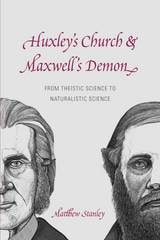
Huxley's Church and Maxwell's Demon
From Theistic Science to Naturalistic ScienceMatthew Stanley
University of Chicago Press, 2014
During the Victorian period, the practice of science shifted from a religious context to a naturalistic one. It is generally assumed that this shift occurred because naturalistic science was distinct from and superior to theistic science. Yet as Huxley’s Church and Maxwell’s Demon reveals, most of the methodological values underlying scientific practice were virtually identical for the theists and the naturalists: each agreed on the importance of the uniformity of natural laws, the use of hypothesis and theory, the moral value of science, and intellectual freedom. But if scientific naturalism did not rise to dominance because of its methodological superiority, then how did it triumph?
Matthew Stanley explores the overlap and shift between theistic and naturalistic science through a parallel study of two major scientific figures: James Clerk Maxwell, a devout Christian physicist, and Thomas Henry Huxley, the iconoclast biologist who coined the word agnostic. Both were deeply engaged in the methodological, institutional, and political issues that were crucial to the theistic-naturalistic transformation. What Stanley’s analysis of these figures reveals is that the scientific naturalists executed a number of strategies over a generation to gain control of the institutions of scientific education and to reimagine the history of their discipline. Rather than a sudden revolution, the similarity between theistic and naturalistic science allowed for a relatively smooth transition in practice from the old guard to the new.
Matthew Stanley explores the overlap and shift between theistic and naturalistic science through a parallel study of two major scientific figures: James Clerk Maxwell, a devout Christian physicist, and Thomas Henry Huxley, the iconoclast biologist who coined the word agnostic. Both were deeply engaged in the methodological, institutional, and political issues that were crucial to the theistic-naturalistic transformation. What Stanley’s analysis of these figures reveals is that the scientific naturalists executed a number of strategies over a generation to gain control of the institutions of scientific education and to reimagine the history of their discipline. Rather than a sudden revolution, the similarity between theistic and naturalistic science allowed for a relatively smooth transition in practice from the old guard to the new.
[more]
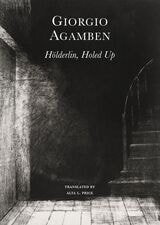
Hölderlin’s Madness
Chronicle of a Dwelling Life, 1806–1843Giorgio Agamben
Seagull Books, 2023
One of Europe’s greatest living philosophers, Giorgio Agamben, analyzes the life and work of one of Europe’s greatest poets, Friedrich Hölderlin.
What does it mean to inhabit a place or a self? What is a habit? And, for human beings, doesn’t living mean—first and foremost—inhabiting? Pairing a detailed chronology of German poet Friedrich Hölderlin’s years of purported madness with a new examination of texts often considered unreadable, Giorgio Agamben's new book aims to describe and comprehend a life that the poet himself called habitual and inhabited.
Hölderlin’s life was split neatly in two: his first 36 years, from 1770 to 1806; and the 36 years from 1807 to 1843, which he spent as a madman holed up in the home of Ernst Zimmer, a carpenter. The poet lived the first half of his existence out and about in the broader world, relatively engaged with current events, only to then spend the second half entirely cut off from the outside world. Despite occasional visitors, it was as if a wall separated him from all external events and relationships. For reasons that may well eventually become clear, Hölderlin chose to expunge all character—historical, social, or otherwise—from the actions and gestures of his daily life. According to his earliest biographer, he often stubbornly repeated, “nothing happens to me.” Such a life can only be the subject of a chronology—not a biography, much less a clinical or psychological analysis. Nevertheless, this book suggests that this is precisely how Hölderlin offers humanity an entirely other notion of what it means to live. Although we have yet to grasp the political significance of his unprecedented way of life, it now clearly speaks directly to our own.
[more]