Results by title
4127 books match the query 'Science' and 129 start with h
How To Identify Plants
H. D. Harrington
Ohio University Press, 1957
First issued in 1957 by Swallow Press, this classic guide to the art of plant identification is now familiar to an entire generation of students. Harrington who was Professor of Botany and Curator of the Herbarium at Colorado State University, gives step-by-step instructions and definitions to help readers recognize and classify plants. The new printing has been reset and reformatted, and L.W. Durrell’s drawings and glossary—more than 500 images—have been digitally enhanced for clarity.
How Trees Die
The Past, Present, and Future of our ForestsJeff Gillman
Westholme Publishing, 2009
Trees have been essential to the success of human beings, providing food, shelter, warmth, transportation, and products (consider the paper you are holding). Trees are also necessary for a healthy atmosphere, literally connecting the earth with the sky. Once in wild abundance— the entire eastern North America was a gigantic forest—they have receded as we have clearcut the landscape in favor of building cities and farms, using up and abusing our forests in the process. Over the centuries, we have trained food trees, such as peach and apple trees, to produce more and better fruit at the expense of their lives. As Jeff Gillman, a specialist in the production and care of trees, explains in his acclaimed work, How Trees Die: The Past, Present, and Future of Our Forests, the death of a tree is as important to understanding our environment as how it lives. While not as readily apparent as other forms of domestication, our ancient and intimate relationship with trees has caused their lives to be inseparably entwined with ours. The environment we have created—what we put into the air and into the water, and how we change the land through farming, construction, irrigation, and highways—affects the world’s entire population of trees, while the lives of the trees under our direct care in farms, orchards, or along a city boulevard depend almost entirely on our actions. Taking the reader on a fascinating journey through time and place, the author explains how we kill trees, often for profit, but also unintentionally with kindness through overwatering or overmulching, and sometimes simply by our movements around the globe, carrying foreign insects or disease. No matter how a tree’s life ends, though, understanding the reason is essential to understanding the future of our environment.
How We Became Human
Mimetic Theory and the Science of Evolutionary OriginsPierpaolo Antonello
Michigan State University Press, 2015
How We Became Our Data
A Genealogy of the Informational PersonColin Koopman
University of Chicago Press, 2019
In How We Became Our Data, Colin Koopman excavates early moments of our rapidly accelerating data-tracking technologies and their consequences for how we think of and express our selfhood today. Koopman explores the emergence of mass-scale record keeping systems like birth certificates and social security numbers, as well as new data techniques for categorizing personality traits, measuring intelligence, and even racializing subjects. This all culminates in what Koopman calls the “informational person” and the “informational power” we are now subject to. The recent explosion of digital technologies that are turning us into a series of algorithmic data points is shown to have a deeper and more turbulent past than we commonly think. Blending philosophy, history, political theory, and media theory in conversation with thinkers like Michel Foucault, Jürgen Habermas, and Friedrich Kittler, Koopman presents an illuminating perspective on how we have come to think of our personhood—and how we can resist its erosion.
How We Became Posthuman
Virtual Bodies in Cybernetics, Literature, and InformaticsN. Katherine Hayles
University of Chicago Press, 1999
Hayles relates three interwoven stories: how information lost its body, that is, how it came to be conceptualized as an entity separate from the material forms that carry it; the cultural and technological construction of the cyborg; and the dismantling of the liberal humanist "subject" in cybernetic discourse, along with the emergence of the "posthuman."
Ranging widely across the history of technology, cultural studies, and literary criticism, Hayles shows what had to be erased, forgotten, and elided to conceive of information as a disembodied entity. Thus she moves from the post-World War II Macy Conferences on cybernetics to the 1952 novel Limbo by cybernetics aficionado Bernard Wolfe; from the concept of self-making to Philip K. Dick's literary explorations of hallucination and reality; and from artificial life to postmodern novels exploring the implications of seeing humans as cybernetic systems.
Although becoming posthuman can be nightmarish, Hayles shows how it can also be liberating. From the birth of cybernetics to artificial life, How We Became Posthuman provides an indispensable account of how we arrived in our virtual age, and of where we might go from here.
How We Became Sensorimotor
Movement, Measurement, SensationMark Paterson
University of Minnesota Press, 2021
An engrossing history of the century that transformed our knowledge of the body’s inner senses
The years between 1833 and 1945 fundamentally transformed science’s understanding of the body’s inner senses, revolutionizing fields like philosophy, the social sciences, and cognitive science. In How We Became Sensorimotor, Mark Paterson provides a systematic account of this transformative period, while also demonstrating its substantial implications for current explorations into phenomenology, embodied consciousness, the extended mind, and theories of the sensorimotor, the body, and embodiment.
Each chapter of How We Became Sensorimotor takes a particular sense and historicizes its formation by means of recent scientific studies, case studies, or coverage in the media. Ranging among a diverse array of sensations, including balance, fatigue, pain, the “muscle sense,” and what Maurice Merleau-Ponty termed “motricity,” Paterson’s analysis moves outward from the familiar confines of the laboratory to those of the industrial world and even to wild animals and their habitats. He uncovers important stories, such as how forgotten pain-measurement schemes transformed criminology, or how Penfield’s outmoded concepts of the sensory and motor homunculi of the brain still mar psychology textbooks.
Complete with original archival research featuring illustrations and correspondence, How We Became Sensorimotor shows how the shifting and sometimes contested historical background to our understandings of the senses are being extended even today.
How We See the Sky
A Naked-Eye Tour of Day and NightThomas Hockey
University of Chicago Press, 2002
Gazing up at the heavens from our backyards or a nearby field, most of us see an undifferentiated mess of stars—if, that is, we can see anything at all through the glow of light pollution. Today’s casual observer knows far less about the sky than did our ancestors, who depended on the sun and the moon to tell them the time and on the stars to guide them through the seas. Nowadays, we don’t need the sky, which is good, because we’ve made it far less accessible, hiding it behind the skyscrapers and the excessive artificial light of our cities.
How We See the Sky gives us back our knowledge of the sky, offering a fascinating overview of what can be seen there without the aid of a telescope. Thomas Hockey begins by scanning the horizon, explaining how the visible universe rotates through this horizon as night turns to day and season to season. Subsequent chapters explore the sun’s and moon’s respective motions through the celestial globe, as well as the appearance of solstices, eclipses, and planets, and how these are accounted for in different kinds of calendars. In every chapter, Hockey introduces the common vocabulary of today’s astronomers, uses examples past and present to explain them, and provides conceptual tools to help newcomers understand the topics he discusses.
Packed with illustrations and enlivened by historical anecdotes and literary references, How We See the Sky reacquaints us with the wonders to be found in our own backyards.
How the Earth Turned Green
A Brief 3.8-Billion-Year History of PlantsJoseph E. Armstrong
University of Chicago Press, 2014
Using an evolutionary framework, How the Earth Turned Green addresses questions such as: Should all green organisms be considered plants? Why do these organisms look the way they do? How are they related to one another and to other chlorophyll-free organisms? How do they reproduce? How have they changed and diversified over time? And how has the presence of green organisms changed the Earth’s ecosystems? More engaging than a traditional textbook and displaying an astonishing breadth, How the Earth Turned Green will both delight and enlighten embryonic botanists and any student interested in the evolutionary history of plants.
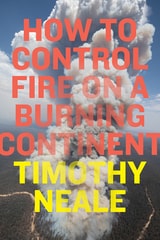
How to Control Fire on a Burning Continent
Timothy Neale
Duke University Press, 2026
Each year, Australia faces increasingly unprecedented wildfires, marked both by their scale and by the intense public disagreements about their political, cultural, and ecological causes. How to Control Fire on a Burning Continent is a critical and ethnographic exploration of wildfire management in Australia and the technoscientific systems of control that shape its current and future possibilities. Timothy Neale observes how two seemingly opposing forces—an entrenched sense of crisis and widespread normalization—combine to form an apparatus of institutional fire management that increasingly centers technical control and militarization. While sympathetic to the double binds many fire management professionals find themselves in, Neale ties contemporary wildfire problems to ongoing colonization and Indigenous dispossession, exploring Indigenous-led land management and cultural burning as a practical assertion of sovereignty. Through dialogue and collaboration with professional fire managers and Indigenous environmental stewards, Neale calls for a collective movement beyond control thinking by fostering new alliances and modes of coping with, rather than commanding, our flammable world.
How to Do Things with Sensors
Jennifer Gabrys
University of Minnesota Press, 2019
An investigation of how-to guides for sensor technologies
Sensors are increasingly common within citizen-sensing and DIY projects, but these devices often require the use of a how-to guide. From online instructional videos for troubleshooting sensor installations to handbooks for using and abusing the Internet of Things, the how-to genres and formats of digital instruction continue to expand and develop. As the how-to proliferates, and instructions unfold through multiple aspects of technoscientific practices, Jennifer Gabrys asks why the how-to has become one of the prevailing genres of the digital. How to Do Things with Sensors explores the ways in which things are made do-able with and through sensors and further considers how worlds are made sense-able and actionable through the instructional mode of citizen-sensing projects.
Forerunners: Ideas First
Short books of thought-in-process scholarship, where intense analysis, questioning, and speculation take the lead

How to Find a Martian
A Fossil Hunter’s Guide to the Red PlanetSean McMahon
University of Chicago Press, 2027
Join today’s search for signs of alien life in fossil remains from prehistoric Mars, an Earth-like world that glittered with rivers, lakes, and deep blue seas.
Billions of years ago, there was another Earth in our solar system: the temperate and blue-streaked world of ancient Mars. Today, the rocky ruins of that lost world offer our best hope of finding signs of alien life. In How to Find a Martian, astrobiologist and paleontologist Sean McMahon argues that we may soon find fossils on Mars—perhaps even in our lifetime.
There are now thousands of astrobiologists around the world, using the tools of modern science to answer some of the most profound, intellectually exciting questions that have ever been asked: What is life? How does it evolve and proliferate across vast spans of space and time, and what forms might it take on alien worlds? The search for life on Mars is a mainstay of this research program, and it has never been more advanced, more sophisticated, or better funded than it is today. Although scientists have not yet found fossils on Mars, astrobiologist Sean McMahon says, we have at least learned how to find them. We now know which regions and landscapes on Mars could once have supported life and preserved its remains in rocks and minerals. We know how the remains of living organisms can end up woven into the texture of ancient rocks, transmuted into minerals or transcribed into the subtle language of fossil carbon molecules. But we have also learned to be cautious—and not to be fooled when non-living nature imitates the patterns of life.
Accessibly explaining trailblazing ideas and findings in astronomy, geology, microbiology, and paleontology, McMahon makes a persuasive and alluring case that we have the tools, ideas, methods, and missions to find past life on Mars.
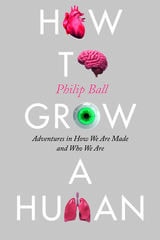
How to Grow a Human
Adventures in How We Are Made and Who We ArePhilip Ball
University of Chicago Press, 2019
In his most mind-bending book yet, Ball makes that disconcerting question the focus of a tour through what scientists can now do in cell biology and tissue culture. He shows how these technologies could lead to tailor-made replacement organs for when ours fail, to new medical advances for repairing damage and assisting conception, and to new ways of “growing a human.” For example, it might prove possible to turn skin cells not into neurons but into eggs and sperm, or even to turn oneself into the constituent cells of embryos. Such methods would also create new options for gene editing, with all the attendant moral dilemmas. Ball argues that such advances can therefore never be about “just the science,” because they come already surrounded by a host of social narratives, preconceptions, and prejudices. But beyond even that, these developments raise questions about identity and self, birth and death, and force us to ask how mutable the human body really is—and what forms it might take in years to come.

How to Identify Grasses and Grasslike Plants
Sedges and RushesH. D. Harrington
Ohio University Press, 1977
There is no easy way to identify grasses. And no one understands this better than H.D. Harrington, who observed thousands of students struggle and learn. His clear, concise, and well-organized guide will continue to be a basic and essential text for use in the classroom or in the field. The book contains over 500 drawings and an illustrated glossary.
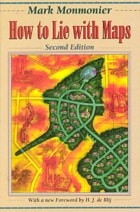
How to Lie with Maps
Mark Monmonier
University of Chicago Press, 1996
The second edition is updated with the addition of two new chapters, 10 color plates, and a new foreword by renowned geographer H. J. de Blij. One new chapter examines the role of national interest and cultural values in national mapping organizations, including the United States Geological Survey, while the other explores the new breed of multimedia, computer-based maps.
To show how maps distort, Monmonier introduces basic principles of mapmaking, gives entertaining examples of the misuse of maps in situations from zoning disputes to census reports, and covers all the typical kinds of distortions from deliberate oversimplifications to the misleading use of color.
"Professor Monmonier himself knows how to gain our attention; it is not in fact the lies in maps but their truth, if always approximate and incomplete, that he wants us to admire and use, even to draw for ourselves on the facile screen. His is an artful and funny book, which like any good map, packs plenty in little space."—Scientific American
"A useful guide to a subject most people probably take too much for granted. It shows how map makers translate abstract data into eye-catching cartograms, as they are called. It combats cartographic illiteracy. It fights cartophobia. It may even teach you to find your way. For that alone, it seems worthwhile."—Christopher Lehmann-Haupt, The New York Times
". . . witty examination of how and why maps lie. [The book] conveys an important message about how statistics of any kind can be manipulated. But it also communicates much of the challenge, aesthetic appeal, and sheer fun of maps. Even those who hated geography in grammar school might well find a new enthusiasm for the subject after reading Monmonier's lively and surprising book."—Wilson Library Bulletin
"A reading of this book will leave you much better defended against cheap atlases, shoddy journalism, unscrupulous advertisers, predatory special-interest groups, and others who may use or abuse maps at your expense."—John Van Pelt, Christian Science Monitor
"Monmonier meets his goal admirably. . . . [His] book should be put on every map user's 'must read' list. It is informative and readable . . . a big step forward in helping us to understand how maps can mislead their readers."—Jeffrey S. Murray, Canadian Geographic
How to Lie with Maps, Third Edition
Mark Monmonier
University of Chicago Press, 2018
Fully updated for the digital age, this new edition of How to Lie with Maps examines the myriad ways that technology offers new opportunities for cartographic mischief, deception, and propaganda. While retaining the same brevity, range, and humor as its predecessors, this third edition includes significant updates throughout as well as new chapters on image maps, prohibitive cartography, and online maps. It also includes an expanded section of color images and an updated list of sources for further reading.
How to Make a Vaccine
An Essential Guide for COVID-19 and BeyondJohn Rhodes
University of Chicago Press, 2021
As the COVID-19 pandemic has affected every corner of the world, changing our relationship to our communities, to our jobs, and to each other, the most pressing question has been—when will it end? Researchers around the globe are urgently trying to answer this question by racing to test and distribute a vaccine that could end the greatest public health threat of our time. In How to Make a Vaccine, an expert who has firsthand experience developing vaccines tells an optimistic story of how three hundred years of vaccine discovery and a century and a half of immunology research have come together at this powerful moment—and will lead to multiple COVID-19 vaccines.
Dr. John Rhodes draws on his experience as an immunologist, including working alongside a young Anthony Fauci, to unravel the mystery of how vaccines are designed, tested, and produced at scale for global deployment. Concise and accessible, this book describes in everyday language how the immune system evolved to combat infection, how viruses responded by evolving ways to evade our defenses, and how vaccines do their work. That history, and the pace of current research developments, make Rhodes hopeful that multiple vaccines will protect us. Today the complex workings of the immune system are well understood. The tools needed by biomedical scientists stand ready to be used, and more than 160 vaccine candidates have already been produced. But defeating COVID-19 won’t be the end of the story: Rhodes describes how discoveries today are also empowering scientists to combat future threats to global health, including a recent breakthrough in the development of genetic vaccines, which have never before been used in humans.
As the world prepares for a vaccine, Rhodes offers a current and informative look at the science and strategies that deliver solutions to the crisis.
How to Tame a Fox (and Build a Dog)
Visionary Scientists and a Siberian Tale of Jump-Started EvolutionLee Alan Dugatkin and Lyudmila Trut
University of Chicago Press, 2017
Most accounts of the natural evolution of wolves place it over a span of about 15,000 years, but within a decade, Belyaev and Trut’s fox breeding experiments had resulted in puppy-like foxes with floppy ears, piebald spots, and curly tails. Along with these physical changes came genetic and behavioral changes, as well. The foxes were bred using selection criteria for tameness, and with each generation, they became increasingly interested in human companionship. Trut has been there the whole time, and has been the lead scientist on this work since Belyaev’s death in 1985, and with Lee Dugatkin, biologist and science writer, she tells the story of the adventure, science, politics, and love behind it all. In How to Tame a Fox, Dugatkin and Trut take us inside this path-breaking experiment in the midst of the brutal winters of Siberia to reveal how scientific history is made and continues to be made today.
To date, fifty-six generations of foxes have been domesticated, and we continue to learn significant lessons from them about the genetic and behavioral evolution of domesticated animals. How to Tame a Fox offers an incredible tale of scientists at work, while also celebrating the deep attachments that have brought humans and animals together throughout time.
How to Think Impossibly
About Souls, UFOs, Time, Belief, and Everything ElseJeffrey J. Kripal
University of Chicago Press, 2024
Now in paperback, a mind-bending invitation to experience the impossible as fundamentally human.
From precognitive dreams and telepathic visions to near-death experiences, UFO encounters, and beyond, so-called impossible phenomena are not supposed to happen. But they do happen—all the time. Jeffrey J. Kripal asserts that the impossible is a function not of reality but of our everchanging assumptions about what is real. How to Think Impossibly invites us to think about these fantastic (yet commonplace) experiences as an essential part of being human, expressive of a deeply shared reality that is neither mental nor material but gives rise to both. Thinking with specific individuals and their extraordinary experiences in vulnerable, open, and often humorous ways, Kripal interweaves humanistic and scientific inquiry to foster an awareness that the fantastic is real, the supernatural is super natural, and the impossible is possible.
Human Cloning
Science, Ethics, and Public PolicyEdited by Barbara MacKinnon
University of Illinois Press, 2000
In this concise volume, experts on all sides of the debate make arguments for why we should either pursue, regulate, or ban the cloning of human beings. From this collection, readers will gain a clearer picture of the history of cloning in agriculture and animal science, the various biological procedures that are encompassed by the term "cloning," the philosophical arguments in support of and opposed to cloning humans, and the considerations that should inform discussions about public policy matters related both the cloning research and to human cloning itself.
Balancing scientific detail with philosophical argument, Human Cloning succinctly outlines what cloning is and is not (e.g., cloning does not produce identical individuals), what has led to recent scientific developments, what is now possible, and what ethical dilemmas cloning presents. Opponents claim that cloning subverts human dignity, makes a mockery of spousal love, and poses serious safety hazards. Proponents cite a range of potential benefits, such as producing transplant tissue that is less likely to be rejected, extending current techniques of artificial insemination, and controlling genetic abnormalities to prevent birth defects.
Cloning itself is not new, but as the science of cloning continues to advance--and as human cloning thus inches closer to reality--we are compelled to consider its implications for society. Human Cloning is a lucid, substantive guide to this contentious and potentially revolutionary issue.
Human Evolution and Development
Nico M. van Straalen Dick Roelofs
Amsterdam University Press, 2019
The authors discuss questions like: - What do we know about ancient humans? - What happens in the development of an embryo? - How did we manage to walk upright and why did we lose our hair? - What is the relationship between language, migration and evolution? - How does our body respond to the challenges of modern society?
In addition to being a core text for the study of the life sciences, Human Evolution and Development is an easy-to-read overview for the interested layperson.
Human Programming
Brainwashing, Automatons, and American UnfreedomScott Selisker
University of Minnesota Press, 2016
Do our ways of talking about contemporary terrorism have a history in the science, technology, and culture of the Cold War? Human Programming explores this history in a groundbreaking work that draws connections across decades and throughout American culture, high and low. Scott Selisker argues that literary, cinematic, and scientific representations of the programmed mind have long shaped conversations in U.S. political culture about freedom and unfreedom, and about democracy and its enemies.
Selisker demonstrates how American conceptions of freedom and of humanity have changed in tandem with developments in science and technology, including media technology, cybernetics, behaviorist psychology, and sociology. Since World War II, propagandists, scientists, and creative artists have adapted visions of human programmability as they sought to imagine the psychological manipulation and institutional controls that could produce the inscrutable subjects of totalitarian states, cults, and terrorist cells. At the same time, writers across the political spectrum reimagined ideals of American freedom, democracy, and diversity by way of contrast with these posthuman specters of mental unfreedom. Images of such “human automatons” circulated in popular films, trials, travelogues, and the news media, giving form to the nebulous enemies of the postwar and contemporary United States: totalitarianism, communism, total institutions, cult extremism, and fundamentalist terrorism.
Ranging from discussions of The Manchurian Candidate and cyberpunk science fiction to the cases of Patty Hearst and the “American Taliban” John Walker Lindh, Human Programming opens new ways of understanding the intertwined roles of literature, film, science, and technology in American culture.
Human Spaceflight
From Mars to the StarsLouis Friedman
University of Arizona Press, 2015
Far from diminishing our future in space, Human Spaceflight lays out a provocative future for human space travel. The noted aerospace engineer and scientist says that human space exploration will continue well into the future, but space travel by humans will stop at Mars. Instead, nanotechnology, space sails, robotics, biomolecular engineering, and artificial intelligence will provide the vehicles of the future for an exciting evolution not just of space travel but of humankind.
Friedman has worked with agencies around the globe on space exploration projects to extend human presence beyond Mars and beyond the solar system. He writes that once we accept Mars as the only viable destination for humans, our space program on planet Earth can become more exciting and more relevant. Mars, he writes, will take hundreds, even thousands, of years to settle. During that time, humans and all our supporting technologies will evolve, allowing our minds to be present throughout the universe while our bodies stay home on Earth and Mars.
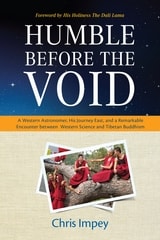
Humble before the Void
A Western Astronomer, his Journey East, and a Remarkable Encounter Between Western Science and Tibetan BuddhismChris Impey
Templeton Press, 2014
“This book will provide readers with a greater awareness of the spirit of curiosity and inquiry that lies at the heart of the Buddhist tradition, as well as the fruitfulness of maintaining active communication between the Buddhist and scientific communities.” —from the Foreword by His Holiness the Dalai Lama
In Humble before the Void, Impey, a noted astronomer, educator, and author gives us a thoroughly absorbing and engaging account of his journey to Northern India to teach in the first-ever “Science for Monks” leadership program. The program was initiated by His Holiness the Dalai Lama to introduce science into the Tibetan Buddhist monastic tradition.
In a vivid and compelling narrative, Impey introduces us to a group of exiled Tibetan monks whose charm, tenacity and unbridled enthusiasm for learning is infectious. Impey marvels not only at their enthusiasm, but at their tireless diligence that allows the monks to painstakingly build intricate sand mandalas—that can be swept away in an instant. He observes them as they meticulously count galaxies and notes how their enthusiasm and diligence stands in contrast to many American students who are frequently turned off by science’s inability to deliver easy, immediate payoffs. Because the Buddhist monks have had a limited science education, Impey must devise creative pedagogy. His new students immediately take to his inspired teaching methods, whether it’s the use of balloons to demonstrate the Hubble expansion or donning an Einstein mask to explain the theory of relativity.
Humble before the Void also recounts Impey’s experiences outside the classroom, from the monks’ eagerness to engage in pick-up basketball games and stream episodes of hip American sitcoms to the effects on his relationship with the teenage son who makes the trip with him. Moments of profound serenity and beauty in the Himalayas are contrasted with the sorrow of learning that other monks have set themselves on fire to protest the Chinese oppression in Tibet.
At the end of the three week program, both the monks and Impey have gained a valuable education. While the monks have a greater understanding and appreciation of science, Impey has acquired greater self- knowledge and a deeper understanding of the nature of learning and teaching in the East and West. This understanding leads to a renewed enthusiasm for making his topic come alive for others.
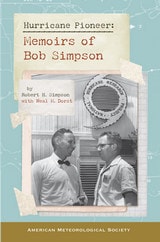
Hurricane Pioneer
Memoirs of Bob SimpsonRobert H. Simpson with Neal M. Dorst
American Meteorological Society, 2014
For Simpson this was just one of his many pioneering explorations of hurricanes and extreme storms. Over his decades-long career his research led to great leaps in our understanding of tropical meteorology and our approach to hurricane safety. He was the first director of the National Hurricane Research Project and the second director of the National Hurricane Center, though he may be best known as co-creator of the widely used Saffir-Simpson Hurricane Scale, familiar to anyone who has heard a reporter use the words “category five.”
Simpson’s memoirs take readers from his experience with the Corpus Christi hurricane of 1919 to his travels to study weather across the globe. Along the way he crosses paths with other weather greats, including his trailblazing wife, meteorologist Joanne Simpson. Hurricane Pioneer is a riveting first-hand account at a revolutionary time in meteorology.
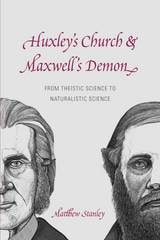
Huxley's Church and Maxwell's Demon
From Theistic Science to Naturalistic ScienceMatthew Stanley
University of Chicago Press, 2014
Matthew Stanley explores the overlap and shift between theistic and naturalistic science through a parallel study of two major scientific figures: James Clerk Maxwell, a devout Christian physicist, and Thomas Henry Huxley, the iconoclast biologist who coined the word agnostic. Both were deeply engaged in the methodological, institutional, and political issues that were crucial to the theistic-naturalistic transformation. What Stanley’s analysis of these figures reveals is that the scientific naturalists executed a number of strategies over a generation to gain control of the institutions of scientific education and to reimagine the history of their discipline. Rather than a sudden revolution, the similarity between theistic and naturalistic science allowed for a relatively smooth transition in practice from the old guard to the new.
Hybrid Ecologies
Edited by Susanne Witzgall, Marietta Kesting, Maria Muhle, and Jenny Nachtigall
Diaphanes, 2021
The notion of ecology not only figures centrally in current debates around climate change, but also traverses contemporary discourses in the arts, the humanities, and the social and techno sciences. In this present form, ecology refers to the multilayered and multidimensional nexus of living processes and technological and media practices—that is, to the complex relations of human and nonhuman agents. Hybrid Ecologies understands ecology as an ambivalent notion, whose very broadness simultaneously opens up new fields of action and raises provocative questions, not least concerning its genealogy. This interdisciplinary volume explores the political and social effects of rethinking community in ecological terms, with a particular emphasis on what the contemporary notion of ecology might mean for artistic and design practices. The result of the fifth annual program of the cx centre for interdisciplinary studies, which was conceived in cooperation with the Chair of Philosophy | Aesthetic Theory at the Academy of Fine Arts in Munich, Hybrid Ecologies is a timely and thought-provoking study of one of the most important themes of our time.
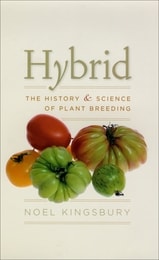
Hybrid
The History and Science of Plant BreedingNoel Kingsbury
University of Chicago Press, 2009
Disheartened by the shrink-wrapped, Styrofoam-packed state of contemporary supermarket fruits and vegetables, many shoppers hark back to a more innocent time, to visions of succulent red tomatoes plucked straight from the vine, gleaming orange carrots pulled from loamy brown soil, swirling heads of green lettuce basking in the sun.
With Hybrid, Noel Kingsbury reveals that even those imaginary perfect foods are themselves far from anything that could properly be called natural; rather, they represent the end of a millennia-long history of selective breeding and hybridization. Starting his story at the birth of agriculture, Kingsbury traces the history of human attempts to make plants more reliable, productive, and nutritious—a story that owes as much to accident and error as to innovation and experiment. Drawing on historical and scientific accounts, as well as a rich trove of anecdotes, Kingsbury shows how scientists, amateur breeders, and countless anonymous farmers and gardeners slowly caused the evolutionary pressures of nature to be supplanted by those of human needs—and thus led us from sparse wild grasses to succulent corn cobs, and from mealy, white wild carrots to the juicy vegetables we enjoy today. At the same time, Kingsbury reminds us that contemporary controversies over the Green Revolution and genetically modified crops are not new; plant breeding has always had a political dimension.
A powerful reminder of the complicated and ever-evolving relationship between humans and the natural world, Hybrid will give readers a thoughtful new perspective on—and a renewed appreciation of—the cereal crops, vegetables, fruits, and flowers that are central to our way of life.

Hydro-criticism
Laura Winkiel, special issue editor
Duke University Press, 0
Contributors. Hester Blum, Brandi Bushman, Jeremy Chow, Margaret Cohen, Elizabeth DeLoughrey, Harris Feinsod, Isabel Hofmeyr, Charne Lavery, Nicole Rizzuto, Meg Samuelson, Allison Shelton, Teresa Shewry, Maxwell Uphaus
Hyman's Comparative Vertebrate Anatomy
Edited by Marvalee H. Wake
University of Chicago Press, 1992