Results by title
8113 books match the query 'Literary Criticism' and 211 start with h
Hope And Dread In Montana Literature
Ken Egan
University of Nevada Press, 2003
This literary survey from a third-generation Montanan includes a thoughtful discussion on the now infamous events of the mid- to late-nineties. The rich literary tradition of Montana, contends author Ken Egan Jr., reflects a catastrophic vision of the West that shows the "horrors of domination" and "the foolish and destructive habits of the imperial heart." Since the 1860s, Montana’s writers have depicted struggles for survival in the state’s dramatic landscape, and for decency in a region characterized by the headlong exploitation of both natural and human resources.
Hope Draped in Black
Race, Melancholy, and the Agony of ProgressJoseph R. Winters
Duke University Press, 2016
Hope Isn't Stupid
Utopian Affects in Contemporary American LiteratureSean Austin Grattan
University of Iowa Press, 2017
Novelists William S. Burroughs, Dennis Cooper, John Darnielle, Toni Morrison, Thomas Pynchon, and Colson Whitehead are deeply invested in the creation of utopian possibilities. A return to reading the utopian wager in literature from the postmodern to the contemporary period reinvigorates critical forms that imagine reading as an act of communication, friendship, solace, and succor. These forms also model richer modes of belonging than the diluted and impoverished ones on display in the neoliberal present. Simultaneously, by linking utopian studies and affect studies, Grattan’s work resists the tendency for affect studies to codify around the negative, instead reorienting the field around the messy, rich, vibrant, and ambivalent affective possibilities of the world. Hope Isn’t Stupid insists on the centrality of utopia not only in American literature, but in American life as well.
Hope Leslie
Or, Early Times in the MassachusettsSedgwick, Catherine M
Rutgers University Press, 1987
Hope Leslie (1827), set in the seventeenth-century New England, is a novel that forced readers to confront the consequences of the Puritans’ subjugation and displacement of the indigenous Indian population at a time when contemporaries were demanding still more land from the Cherokees, the Chickasaws, and the Choctaws.
"This handsome reprint ... makes available after many decades the New Englander's tale of seventeeth-century Puritans, and their relations with the indigenous Indian population." -- Nineteeth-Century Literature
" A splendidly conceived edition of Sedwick's historical romance. Highly recommended." --Choice
"Develop(s) the connections between patriarchal authority within the Puritan state and its policy of dispossessing and exterminating Indians. The different heritage it envisions explicitly link white women and Indians and elaborates a communal concept of liberty at odds with the individualistic concept which predominated in American culture." -- Legacy
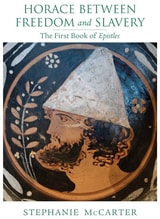
Horace between Freedom and Slavery
The First Book of <i>Epistles</i>Stephanie McCarter
University of Wisconsin Press, 2015
She argues that, although Horace commences the Epistles with an uncompromising insistence on freedom, he ultimately adopts a middle course. She shows how Horace explores in the poems the application of moderate freedom first to philosophy, then to friendship, poetry, and place. Rather than rejecting philosophical masters, Horace draws freely on them without swearing permanent allegiance to any—a model for compromise that allows him to enjoy poetic
renown and friendships with the city's elite while maintaining a private sphere of freedom. This moderation and adaptability, McCarter contends, become the chief ethical lessons that Horace learns for himself and teaches to others. She reads Horace's reconfiguration of freedom as a political response to the transformations of the new imperial age.
Horizon, Sea, Sound
Caribbean and African Women's Cultural Critiques of NationAndrea A. Davis
Northwestern University Press, 2022
In Horizon, Sea, Sound: Caribbean and African Women’s Cultural Critiques of Nation, Andrea Davis imagines new reciprocal relationships beyond the competitive forms of belonging suggested by the nation-state. The book employs the tropes of horizon, sea, and sound as a critique of nation-state discourses and formations, including multicultural citizenship, racial capitalism, settler colonialism, and the hierarchical nuclear family.
Drawing on Tina Campt’s discussion of Black feminist futurity, Davis offers the concept future now, which is both central to Black freedom and a joint social justice project that rejects existing structures of white supremacy. Calling for new affiliations of community among Black, Indigenous, and other racialized women, and offering new reflections on the relationship between the Caribbean and Canada, she articulates a diaspora poetics that privileges our shared humanity. In advancing these claims, Davis turns to the expressive cultures (novels, poetry, theater, and music) of Caribbean and African women artists in Canada, including work by Dionne Brand, M. NourbeSe Philip, Esi Edugyan, Ramabai Espinet, Nalo Hopkinson, Amai Kuda, and Djanet Sears. Davis considers the ways in which the diasporic characters these artists create redraw the boundaries of their horizons, invoke the fluid histories of the Caribbean Sea to overcome the brutalization of plantation histories, use sound to enter and reenter archives, and shapeshift to survive in the face of conquest. The book will interest readers of literary and cultural studies, critical race theories, and Black diasporic studies.
Horizons of Enchantment
Essays in the American ImaginaryLene M. Johannessen
Dartmouth College Press, 2011
Horizontal Comparison
Africa, the Caribbean, and the Making of Black World LiteratureCajetan Iheka
University of Chicago Press, 2026
By analyzing African and Caribbean texts on their own terms, Horizontal Comparison articulates new forms of transoceanic solidarity.
The fields of comparative literature and Black Atlantic studies have an Africa problem: despite sustained attempts to decenter Western paradigms, they still privilege the United States and Europe as the primary loci of reference. So argues Cajetan Iheka in Horizontal Comparison, which aims to redirect both fields toward a non-hierarchical, South-South orientation focusing on the links between Africa and the Caribbean.
By analyzing the literary work and real-life trajectories of writers such as Peter Abrahams, Chimamanda Adichie, Maryse Condé, Buchi Emecheta, Jamaica Kincaid, Claude McKay, Dinaw Mengestu, Ferdinand Oyono, Taiye Selasi, and Sam Selvon, Iheka draws our attention to the ways in which African and Caribbean texts inform and mutually constitute each other, bypassing the usual comparisons to Western literary canons. The book challenges not only Western cultural hegemony in the study of global Black writing but also the very methodologies of comparative literary studies, offering fresh insights into reading, trauma, character, and the “worlding” of literature.
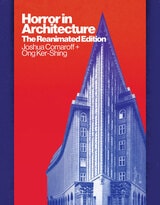
Horror in Architecture
The Reanimated EditionJoshua Comaroff
University of Minnesota Press, 2024
A new edition of this extensive visual analysis of horror tropes and their architectural analogues
Horror in Architecture presents an unflinching look at how horror genre tropes manifest in the built environment. Spanning the realms of art, design, literature, and film, this newly revised and expanded edition compiles examples from all areas of popular culture to form a visual anthology of the architectural uncanny.
Rooted in the Romantic and Gothic treatment of horror as a serious aesthetic category, Horror in Architecture establishes incisive links between contemporary horror media and its parallel traits found in various architectural designs. Through chapters dedicated to distorted and monstrous buildings, abandoned spaces, extremes of scale, and other structural peculiarities, and featuring new essays on insurgent natures, blobs, and architectural puppets, this volume brings together diverse architectural anomalies and shows how their unsettling effects deepen our fascination with the unreal.
Intended for both horror fans and students of visual culture, Horror in Architecture turns a unique lens on the relationship between the human body and the artificial landscapes it inhabits. Extensively illustrated with photographs, film stills, and diagrams, this book retrieves horror from the cultural fringes and demonstrates how its attributes permeate the modern condition and the material world.
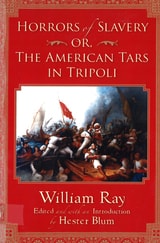
Horrors of Slavery
Or, The American Tars in TripoliBlum, Hester
Rutgers University Press, 2008
Hester Blum's introduction situates Horrors of Slavery in its literary, historical, and political contexts, bringing to light a crucial episode in the early history of our country's relations with Islamic states.
A volume in the Subterranean Lives series, edited by Bradford Verter
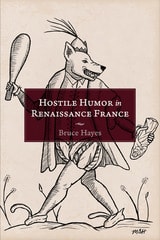
Hostile Humor in Renaissance France
Bruce Hayes
University of Delaware Press, 2020
This book is also freely available online as an open access digital edition here: https://bibliopen.org/9781644531792. The open access edition is funded by the National Endowment for the Humanities.
In sixteenth-century France, the level of jokes, irony, and ridicule found in pamphlets and plays became aggressively hostile. In Hostile Humor in Renaissance France, Bruce Hayes investigates this period leading up to the French Wars of Religion, when a deliberately harmful and destructive form of satire appeared.
This study examines both pamphlets and plays to show how this new form of humor emerged that attacked religious practices and people in ways that forever changed the nature of satire and religious debate in France. Hayes explores this phenomenon in the context of the Catholic and Protestant conflict to reveal new insights about the society that both exploited and vilified this kind of satire.

Hosts, Hospitals and Hospitalities
Narratives of (in)hospitality in literature, culture and the artsEdited by Susana Araújo, Catarina Nunes de Almeida, and Santiago Pérez Isasi
University College London, 2026
This book analyzes narratives of hospitality (and inhospitality) through recent crises like climate change and mass displacement.
Current historical and political issues, such as the refugee crisis and climate emergency, are deeply intertwined with notions, images, and narratives of (in)hospitality. Departing from seminal works, such as those by Kant and Derrida, on this topic, the chapters in this volume examine how new postcolonial, gender, environmental, and medical perspectives reshape current approaches to hospitality in literature, culture, and the arts.
Through a comparison of case studies in multiple national settings, Hosts, Hospitals and Hospitalities shows how the concept of hospitality shapes the way in which we relate with “the Other” in diverse—and ever-evolving—cultural, political, social, and environmental contexts. By examining the issue of hospitality from a post-pandemic standpoint, which revised the roles of our private and public spaces in the aftermath of COVID-19, by dwelling on novel issues of climate emergency, and by focusing on current developments in terms of migration and displacement, this book adds new light and significant theoretical and methodological perspectives to previous debates about hospitality.
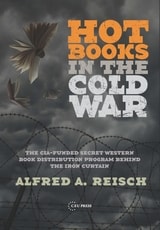
Hot Books in the Cold War
The CIA-Funded Secret Western Book Distribution Program Behind the Iron CurtainAlfred A. Reisch
Central European University Press, 2013
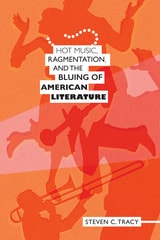
Hot Music, Ragmentation, and the Bluing of American Literature
Steven C. Tracy
University of Alabama Press, 2015
Exploring the deep and enduring relationship between music and literature, Hot Music, Ragmentation, and the Bluing of American Literature examines the diverse ways in which African American “hot” music influenced American culture—particularly literature—in early twentieth century America. Steven C. Tracy provides a history of the fusion of African and European elements that formed African American “hot” music, and considers how terms like ragtime, jazz, and blues developed their own particular meanings for American music and society. He draws from the fields of literature, literary criticism, cultural anthropology, American studies, and folklore to demonstrate how blues as a musical and poetic form has been a critical influence on American literature.
Hot Music, Ragmentation, and the Bluing of American Literature begins by highlighting instances in which American writers, including Herman Melville, Stephen Crane, and Gertrude Stein, use African American culture and music in their work, and then characterizes the social context of the Jazz Age, discussing how African American music reflected the wild abandon of the time. Tracy focuses on how a variety of schools of early twentieth century writers, from modernists to members of the Harlem Renaissance to dramatists and more, used their connections with “hot” music to give their own work meaning.
Tracy’s extensive and detailed understanding of how African American “hot” music operates has produced a fresh and original perspective on its influence on mainstream American literature and culture. An experienced blues musician himself, Tracy draws on his performance background to offer an added dimension to his analysis. Where another blues scholar might only analyze blues language, Tracy shows how the language is actually performed.
Hot Music, Ragmentation, and the Bluing of American Literature is the first book to offer such a refreshingly broad interdisciplinary vision of the influence of African American “hot” music on American literature. It is an essential addition to the library of serious scholars of American and African American literature and culture and blues aficionados alike.
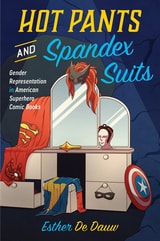
Hot Pants and Spandex Suits
Gender Representation in American Superhero Comic BooksEsther De Dauw
Rutgers University Press, 2021
Hot Pants and Spandex Suits offers a far-reaching look at how masculinity and femininity have been represented in American superhero comics, from the Golden and Silver Ages to the Modern Age. Scholar Esther De Dauw contrasts the bulletproof and musclebound phallic bodies of classic male heroes like Superman, Captain America, and Iron Man with the figures of female counterparts like Wonder Woman and Supergirl, who are drawn as superhumanly flexible and plastic. It also examines the genre’s ambivalent treatment of LGBTQ representation, from the presentation of gay male heroes Wiccan and Hulkling as a model minority couple to the troubling association of Batwoman’s lesbianism with monstrosity. Finally, it explores the intersection between gender and race through case studies of heroes like Luke Cage, Storm, and Ms. Marvel.
Hot Pants and Spandex Suits is a fascinating and thought-provoking consideration of what superhero comics teach us about identity, embodiment, and sexuality.

Hot Property
The Stakes and Claims of Literary OriginalityFrançoise Meltzer
University of Chicago Press, 1994
Freud, inventor of "dream work," turns a blind eye upon the dreams that were the starting point of his predecessor Descartes's famous methode, the one man's obsession with originality mirroring the other's fear of plagiarism. The Holocaust poet Paul Celan, whose sense of identity and place resided in his work, is devastated by a charge of plagiarism. Colette's husband Willy outdoes himself, and his "lazy" wife as well, with his enactment of literary seriousness. Walter Benjamin's early interpreters, notably Hannah Arendt and Theodor Adorno, insidiously undermine the originality of his project . In each of these cases, Meltzer shows how a threat to a writer's status as creator betrays the larger fraud of the originality myth itself.
Fascinating for its insights into the ways originality is both at risk and at work in Western literary culture, Hot Property will engage all those who have an interest in questions of authorship, textual soveriegnty, and the legitimacy of the critical establishment.
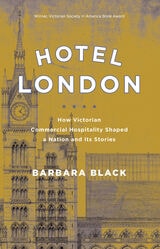
Hotel London
How Victorian Commercial Hospitality Shaped a Nation and Its StoriesBarbara Black
The Ohio State University Press, 2019
Incorporating the works of Oscar Wilde, Henry James, Wilkie Collins, Arnold Bennett, Florence Marryat, and Marie Belloc Lowndes, as well as contemporary depictions of the hotels in Mad Men,American Horror Story, and The Grand Budapest Hotel, Black examines how the hotel supported a corporate identity that would ultimately assist in the rise of modern capitalist structures and the middle class. In this way, Hotel London exposes the aggravations of class stratifications through the operations of status inside hotel life, giving a unique perspective on Victorian London that could only come from the stories of a hotel.
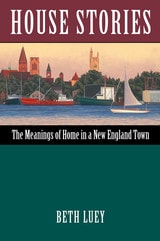
House Stories
The Meanings of Home in a New England TownBeth Luey
University of Massachusetts Press, 2017
Historic houses adorned with plaques populate New England like nowhere else in the country. These plaques note the construction year and original owner of the house, but they tell nothing about the rich lives of the people who lived there. In House Stories, Beth Luey takes readers on a virtual walking tour of several historic houses in Fairhaven, Massachusetts, a small New England coastal town, inviting us in to learn each house's secrets.
Through letters and diaries, church and business records, newspaper accounts, legal documents, and the recollections of neighbors who knew them, Luey introduces the diverse cast of historical characters who lived in these houses at various times from 1800 to the 2000s, including a Japanese castaway and his rescuer, a self-made millionaire, a seagoing adventurer, a religious pioneer, and an entrepreneurial immigrant. All of the houses are still standing and all but a lighthouse are still called home. In House Stories, Luey asks readers to join her as she considers the multiple meanings of “home” for these people and their families.
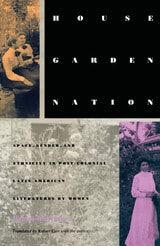
House/Garden/Nation
Space, Gender, and Ethnicity in Post-Colonial Latin American Literatures by WomenIleana Yamileth Rodriguez
Duke University Press, 1994
In House/Garden/Nation the narratives of five Centro-Caribbean writers illustrate these times of transition: Dulce María Loynáz, from colonial rule to independence in Cuba; Jean Rhys, from colony to commonwealth in Dominica; Simone Schwarz-Bart, from slave to free labor in Guadeloupe; Gioconda Belli, from oligarchic capitalism to social democratic socialism in Nicaragua; and Teresa de la Parra, from independence to modernity in Venezuela. Focusing on the nation as garden, hacienda, or plantation, Rodríguez shows us these writers debating the predicament of women under nation formation from within the confines of marriage and home.
In reading these post-colonial literatures by women facing the crisis of transition, this study highlights urgent questions of destitution, migration, exile, and inexperience, but also networks of value allotted to women: beauty, clothing, love. As a counterpoint on issues of legality, policy, and marriage, Rodriguez includes a chapter on male writers: José Eustacio Rivera, Omar Cabezas, and Romulo Gallegos. Her work presents a sobering picture of women at a crossroads, continually circumscribed by history and culture, writing their way.
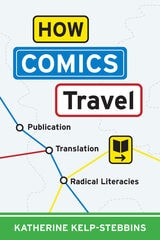
How Comics Travel
Publication, Translation, Radical LiteraciesKatherine Kelp-Stebbins
The Ohio State University Press, 2022
Honorable Mention, 2023 CSS Charles Hatfield Book Prize
In How Comics Travel: Publication, Translation, Radical Literacies, Katherine Kelp-Stebbins challenges the clichéd understanding of comics as a “universal” language, circulating without regard for cultures or borders. Instead, she develops a new methodology of reading for difference. Kelp-Stebbins’s anticolonial, feminist, and antiracist analytical framework engages with comics as sites of struggle over representation in a diverse world. Through comparative case studies of Metro, Tintin, Persepolis, and more, she explores the ways in which graphic narratives locate and dislocate readers in every phase of a transnational comic’s life cycle according to distinct visual, linguistic, and print cultures. How Comics Travel disengages from the constrictive pressures of nationalism and imperialism, both in comics studies and world literature studies more broadly, to offer a new vision of how comics depict and enact the world as a transcultural space.
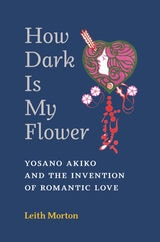
How Dark Is My Flower
Yosano Akiko and the Invention of Romantic LoveLeith Morton
University of Michigan Press, 2023
How Dark Is My Flower emphasizes the astonishing innovations in diction and style, not to mention content, in Akiko’s work that transformed the tanka genre from a hidebound and conservative mode of verse to something much more daring and modern. This book pays particular attention to poetry, particularly the tanka genre, in the evolution of modernism in Japanese literature and breaks new ground in the study of modern Japanese literature by examining the invention and evolution of the concept of romantic love.
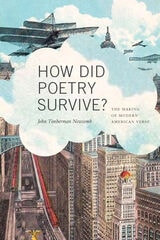
How Did Poetry Survive?
The Making of Modern American VerseJohn Timberman Newcomb
University of Illinois Press, 2013
This book traces the emergence of modern American poetry at the turn of the nineteenth century. With a particular focus on four "little magazines"--Poetry, The Masses, Others, and The Seven Arts--John Timberman Newcomb shows how each advanced ambitious agendas combining urban subjects, stylistic experimentation, and progressive social ideals. While subsequent literary history has favored the poets whose work made them distinct--individuals singled out usually on the basis of a novel technique--Newcomb provides a denser, richer view of the history that hundreds of poets made.
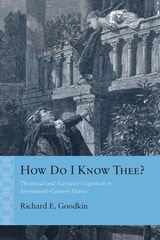
How Do I Know Thee?
Theatrical and Narrative Cognition in Seventeenth-Century FranceRichard E. Goodkin
Northwestern University Press, 2015
The classical period in France presents a particularly lively battleground for the transition between oral-visual culture, on the one hand, and print culture on the other. The former depended on learning from sources of knowledge directly, in their presence, in a manner analogous to theatrical experience. The latter became characterized by the distance and abstraction of reading. How Do I Know Thee? explores the ways in which literature, philosophy, and psychology approach social cognition, or how we come to know others. Richard E. Goodkin describes a central opposition between what he calls “theatrical cognition” and “narrative cognition,” drawing both on scholarship on literary genre and mode, and also on the work of a number of philosophers and psychologists, in particular Descartes’s theory of cognition, Freudian psychoanalysis, mid‑twentieth‑century behaviorism, and the field of cognitive science. The result is a study that will be of interest not only to students of the classical period but also to those in the corresponding disciplines.
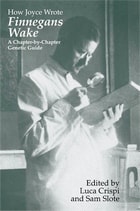
How Joyce Wrote Finnegans Wake
A Chapter-by-Chapter Genetic GuideEdited by Luca Crispi and Sarn Slote
University of Wisconsin Press, 2008
The introduction by Luca Crispi, Sam Slote, and Dirk Van Hulle offers a chronology of the composition of Finnegans Wake, an archival survey of the manuscripts, and an introduction to genetic criticism. Then, the volume provides a chapter-by-chapter interpretation of Finnegans Wake from a variety of perspectives, probing the book as a work in progress. The fruit of more than two decades’ worth of Wakean genetic studies, this book is the essential starting point for all future studies of Joyce’s most complex and fascinating work.
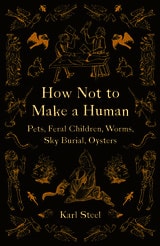
How Not to Make a Human
Pets, Feral Children, Worms, Sky Burial, OystersKarl Steel
University of Minnesota Press, 2019
From pet keeping to sky burials, a posthuman and ecocritical interrogation of and challenge to human particularity in medieval texts
Mainstream medieval thought, like much of mainstream modern thought, habitually argued that because humans alone had language, reason, and immortal souls, all other life was simply theirs for the taking. But outside this scholarly consensus teemed a host of other ways to imagine the shared worlds of humans and nonhumans. How Not to Make a Human engages with these nonsystematic practices and thought to challenge both human particularity and the notion that agency, free will, and rationality are the defining characteristics of being human.
Recuperating the Middle Ages as a lost opportunity for decentering humanity, Karl Steel provides a posthuman and ecocritical interrogation of a wide range of medieval texts. Exploring such diverse topics as medieval pet keeping, stories of feral and isolated children, the ecological implications of funeral practices, and the “bare life” of oysters from a variety of disanthropic perspectives, Steel furnishes contemporary posthumanists with overlooked cultural models to challenge human and other supremacies at their roots.
By collecting beliefs and practices outside the mainstream of medieval thought, How Not to Make a Human connects contemporary concerns with ecology, animal life, and rethinkings of what it means to be human to uncanny materials that emphasize matters of death, violence, edibility, and vulnerability.
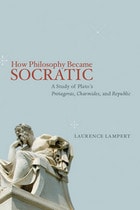
How Philosophy Became Socratic
A Study of Plato's "Protagoras," "Charmides," and "Republic"Laurence Lampert
University of Chicago Press, 2010
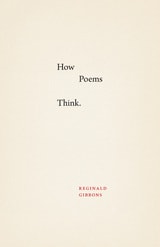
How Poems Think
Reginald Gibbons
University of Chicago Press, 2015
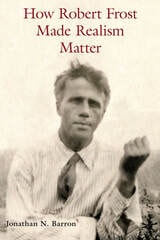
How Robert Frost Made Realism Matter
Jonathan N. Barron
University of Missouri Press, 2015
Robert Frost stood at the intersection of nineteenth-century romanticism and twentieth-century modernism and made both his own. Frost adapted the genteel values and techniques of nineteenth-century poetry, but Barron argues that it was his commitment to realism that gave him popular as well as scholarly appeal and created his enduring legacy. This highly researched consideration of Frost investigates early innovative poetry that was published in popular magazines from 1894 to 1915 and reveals a voice of dissent that anticipated “The New Poetry” – a voice that would come to dominate American poetry as few others have.
How Russia Learned to Write
Literature and the Imperial Table of RanksIrina Reyfman
University of Wisconsin Press, 2021
Irina Reyfman illuminates the surprisingly diverse effects of the Table of Ranks on writers, their work, and literary culture in Russia. From Sumarokov and Derzhavin in the eighteenth century through Pushkin, Gogol, Dostoevsky, and poets serving in the military in the nineteenth, state service affected the self-images of writers and the themes of their creative output. Reyfman also notes its effects on Russia’s atypical course in the professionalization and social status of literary work.
How Soon Is Now?
Medieval Texts, Amateur Readers, and the Queerness of TimeCarolyn Dinshaw
Duke University Press, 2012
Whether discussing Victorian men of letters who parodied the Book of John Mandeville, a fictionalized fourteenth-century travel narrative, or Hope Emily Allen, modern coeditor of the early-fifteenth-century Book of Margery Kempe, Dinshaw argues that these and other medievalists outside the academy inhabit different temporalities than modern professionals operating according to the clock. How Soon Is Now? clears space for amateurs, hobbyists, and dabblers who approach medieval worlds from positions of affect and attachment, from desires to build other kinds of worlds. Unruly, untimely, they urge us toward a disorderly and asynchronous collective.
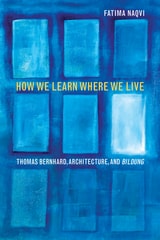
How We Learn Where We Live
Thomas Bernhard, Architecture, and BildungFatima Naqvi
Northwestern University Press, 2015
How We Learn Where We Live opens new avenues into thinking about one of the most provocative writers of the twentieth century, Thomas Bernhard. In one of the first English studies of his work, Fatima Naqvi focuses on the Austrian author’s critique of education (Bildung) through the edifices in which it takes place. She demonstrates that both literature and architecture are implicated in the concept of Bildung. His writings insist that learning has always been a life-long process that is helped—or hindered—by the particular buildings in which Bildung occurs. Naqvi offers close readings of Bernhard’s major prose works, from Amras (1964) to Old Masters (1985) and brings them into dialogue with major architectural debates of the times. She examines Bernard’s interrogation of the theoretical foundations underpinning the educational system and its actual sites.
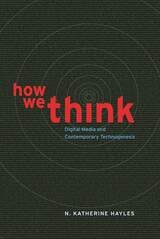
How We Think
Digital Media and Contemporary TechnogenesisN. Katherine Hayles
University of Chicago Press, 2012
“How do we think?” N. Katherine Hayles poses this question at the beginning of this bracing exploration of the idea that we think through, with, and alongside media. As the age of print passes and new technologies appear every day, this proposition has become far more complicated, particularly for the traditionally print-based disciplines in the humanities and qualitative social sciences. With a rift growing between digital scholarship and its print-based counterpart, Hayles argues for contemporary technogenesis—the belief that humans and technics are coevolving—and advocates for what she calls comparative media studies, a new approach to locating digital work within print traditions and vice versa.
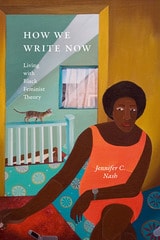
How We Write Now
Living with Black Feminist TheoryJennifer C. Nash
Duke University Press, 2024
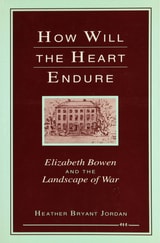
How Will the Heart Endure
Elizabeth Bowen and the Landscape of WarHeather Bryant Jordan
University of Michigan Press, 1992
How Women Must Write
Inventing the Russian Woman PoetOlga Peters Hasty
Northwestern University Press, 2019
In How Women Must Write, Olga Peters Hasty takes us from an emphatically male Romantic age to a modernist period preoccupied with women’s creativity but also with its containment. In late nineteenth and early twentieth-century Russia, the woman poet was invented: by women poets themselves, by readers who projected gender biases into their poems, and by male poets who wrote posing as women. Examining Karolina Pavlova and Evdokiia Rostopchina, who inspired those writing after them, as well as two women invented by men, Cherubina de Gabriak and Briusov’s Nelli, and challenges to male authority by Marina Tsvetaeva and Anna Akhmatova, this book shows women as purposeful actors realizing themselves creatively and advancing the woman poet’s cause. It will appeal to the general reader and to specialists in Russian literature, women’s studies, and cultural history.
How the News Feels
The Empathic Power of Literary JournalistsJonathan D. Fitzgerald
University of Massachusetts Press, 2023
Literary journalism’s origins can be traced to the nineteenth century, when it developed alongside the era’s sentimental literature. Combining fact-based reporting with the sentimentality of popular fiction, literary journalism encouraged readers to empathize with subjects by presenting more nuanced and engaging stories than typical news coverage. While women writers were central to the formation and ongoing significance of the genre, literary journalism scholarship has largely ignored their contributions.
How the News Feels re-centers the work of a range of writers who were active from the nineteenth century until today, including Catharine Williams, Margaret Fuller, Nellie Bly, Winifred Black, Zora Neale Hurston, Joan Didion, Adrian Nicole LeBlanc, and Alexis Okeowo. Offering intimate access to their subjects’ thoughts, motivations, and yearnings, these journalists encouraged readers to empathize with society’s outcasts, from asylum inmates and murder suspects to “fallen women” and the working poor. As this carefully researched study shows, these writers succeeded in defining and developing the genre of literary journalism, with stories that inspire action, engender empathy, and narrow the gap between writer, subject, and audience.
How the Russians Read the French
Lermontov, Dostoevsky, TolstoyPriscilla Meyer
University of Wisconsin Press, 2008
How to Be South Asian in America
Narratives of Ambivalence and BelongingAuthored by anupama jain
Temple University Press, 2011
Providing a useful analysis of and framework for understanding immigration and assimilation narratives, anupama jain's How to Be South Asian in America considers the myth of the American Dream in fiction (Meena Alexander's Manhattan Music), film (American Desi, American Chai), and personal testimonies. By interrogating familiar American stories in the context of more supposedly exotic narratives, jain illuminates complexities of belonging that also reveal South Asians' anxieties about belonging, (trans)nationalism, and processes of cultural interpenetration.
jain argues that these stories transform as well as reflect cultural processes, and she shows just how aspects of identity—gender, sexual, class, ethnic, national—are shaped by South Asians' accommodation of and resistance to mainstream American culture.
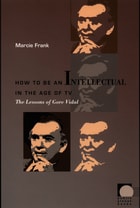
How to Be an Intellectual in the Age of TV
The Lessons of Gore VidalMarcie Frank
Duke University Press, 2005
Frank highlights the connections between Vidal’s attitudes toward TV, sex, and American politics as they have informed his literary and political writings and screen appearances. She deftly situates his public persona in relation to those of Andy Warhol, Jacqueline Susann, Mary McCarthy, Susan Sontag, and others. By describing Vidal’s shrewd maneuvering between different media, Frank suggests that his career offers a model to aspiring public intellectuals and a refutation to those who argue that electronic media have eviscerated public discourse.
How to Draw a Circle
On Reading and WritingDan Beachy-Quick
University of Michigan Press, 2024
How to Go Mad without Losing Your Mind
Madness and Black Radical CreativityLa Marr Jurelle Bruce
Duke University Press, 2020
How to Live, What to Do
Thirteen Ways of Looking at Wallace StevensJoan Richardson
University of Iowa Press, 2018
How to Live, What to Do is an indispensable introduction to and guide through the work of a poet equal in power and sensibility to Shakespeare and Milton. Like them, Stevens shaped a new language, fashioning an instrument adequate to describing a completely changed environment of fact, extending perception through his poems to align what Emerson called our “axis of vision” with the universe as it came to be understood during his lifetime, 1879–1955, a span shared with Albert Einstein. Projecting his own imagination into spacetime as “a priest of the invisible,” persistently cultivating his cosmic consciousness through reading, keeping abreast of the latest discoveries of Einstein, Max Planck, Niels Bohr, Louis de Broglie, and others, Stevens pushed the boundaries of language into the exotic territories of relativity and quantum mechanics while at the same time honoring the continuing human need for belief in some larger order. His work records how to live, what to do in this strange new world of experience, seeing what was always seen but never seen before.
Joan Richardson, author of the standard two-volume critical biography of Stevens and coeditor with Frank Kermode of the Library of America edition of the Collected Poetry and Prose, offers concise, lucid captures of Stevens’s development and achievement. Over the ten years of researching her Stevens biography, Richardson read all that he read, as well as his complete correspondence, journals, and notebooks. She weaves the details drawn from this deep involvement into the background of American cultural history of the period. This fabric is further enlivened by her preparation in philosophy and the sciences, creating in these thirteen panels a contemporary version of a medieval tapestry sequence, with Stevens in the place of the unicorn, as it were, holding our attention and eliciting, as necessary angel, individual solutions to the riddles of our existence on this planet spinning and hissing around its cooling star at 18.5 miles per second.
How to Live/What to Do
H.D.'s Cultural PoeticsAdalaide Morris
University of Illinois Press, 2002
Ever since the publication of her first H.D. essay in 1985 (included here in an expanded version), Morris has eschewed prevailing literary trends in favor of new approaches that both challenge and overpass dominant critical constructs. As she argues in this volume, the writing and, crucially, the reading of poetry is a process in which meaning is produced by the interplay of words on a page and in the ear of the reader. This quality of being not heard but overheard, composed within the body, is crucial to an appreciation of H.D.
Morris shows H.D. to be a playful linguistic innovator whose writings bear on debates in science, technology, and cinema as well as on poetry. Foremost, however, H.D. was a profound reshaper of the boundaries and possibilities of poetry, a generative form that, as this book shows, can indeed serve the cultural work of survival and resistance against the violence of modern culture.
How to Make It as a Woman
Collective Biographical History from Victoria to the PresentAlison Booth
University of Chicago Press, 2004
Beginning in the fifteenth century with Christine de Pizan, Alison Booth traces the long tradition of this genre, investigating the varied types and stories most often grouped together in illustrated books designed for entertainment and instruction. She claims that these group biographies have been instrumental in constructing modern subjectivities as well as relations among classes, races, and nations.
From Joan of Arc to Virginia Woolf, Booth examines a host of models of womanhood—both bad and good. Incorporating a bibliography that includes more than 900 all-female collections published in English between 1830 and 1940, Booth uses collective biographies to decode the varied advice on how to make it as a woman.
How to Make a Soul
The Wisdom of John KeatsEric G. Wilson
Northwestern University Press, 2015
In this innovative hybrid of biography, memoir, and criticism, Eric G. Wilson describes how John Keats gave him solace during a bout of mental illness in spring 2012. While on a tour of the principal sites in Keats’s life—ranging from his London medical school to the small room in Rome where he died—Wilson discovered analogies between the poet’s troubles and his own. He was most struck by Keats’s enlivening vision of the soul.
For Keats, we don’t possess but rather make a soul. We do this by imaginatively transforming our suffering into empathy toward humans and nature alike. Tracking this idea in Keats’s tumultuous yet exhilarating life and work, Wilson struggles to envision his depression anew, desperate to overcome the apathy alienating him from his family.
How to Make a Soul offers fresh perspectives on Keats’s pragmatism, irony, comedy, ethics, and aesthetics, but is above all a lyrical celebration of those galvanizing instances when life springs into art.

How to Read Barthes' Image-Music-Text
Ed White
Pluto Press, 2012
Roland Barthes remains one of the most influential cultural theorists of the postwar period and Image-Music-Text collects his most influential essays. Ed White provides students with a clear guide to this essential but difficult text.
As students are increasingly expected to write across a range of media, Barthes' work can be understood as an early mapping of what we now call interdisciplinary or multidisciplinary study. The book's detailed section-by-section readings makes Barthes' most important writings accessible to undergraduate readers.
This book is a perfect companion for teaching and learning Barthes' ideas in cultural studies and literary theory.
How to Read a Moment
The American Novel and the Crisis of the PresentMathias Nilges
Northwestern University Press, 2021
“Time is a thing that grows scarcer every day,” observes one of Don DeLillo’s characters. “The future is gone,” The Baffler argues. “Where’s my hoverboard!?” a meme demands. Contemporary capitalism, a system that insists that everything happen at once, creates problems for social thought and narrative alike. After all, how does one tell the time of instantaneity? In this moment of on-demand service and instant trading, it has become difficult to imagine the future.
The novel emerged as the art form of a rapidly changing modern world, a way of telling time in its progress. Nilges argues that this historical mission is renewed today through works that understand contemporaneity as a form of time shaping that props up our material world and cultural imagination. But the contemporary American novel does not simply associate our present with a crisis of futurity. Through analyses of works by authors such as DeLillo, Jennifer Egan, Charles Yu, and Colson Whitehead, Nilges illustrates that the novel presents ways to make sense of the temporality that controls our purportedly fully contemporary world. In so doing, the novel recovers a sense of possibility and hope, forwarding a dazzling argument for its own importance today.
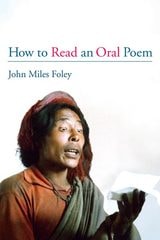
How to Read an Oral Poem
John Miles Foley
University of Illinois Press, 2002
Using dozens of examples, including a North American slam poet, a Tibetan paper-singer, a South African praise-poet, and an ancient Greek bard, John Miles Foley shows that although oral poetry long predates the invention of writing, it continues to be a vital culture-making and communications tool in societies all over the world. Based on fieldwork and archival research on epics, folktales, lyrics, laments, charms, and other oral traditions, How to Read an Oral Poem answers the questions, What is oral poetry? How does it work? What is reading, literally and figuratively?
This accessible and engaging work is enhanced by audio and video examples of oral poetry, which are available at http://www.oraltradition.org. The book can also be used as companion volume to Foley's Teaching Oral Traditions.
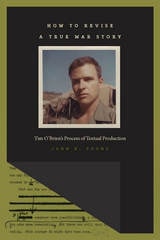
How to Revise a True War Story
Tim O'Brien's Process of Textual ProductionJohn K. Young
University of Iowa Press, 2017
How to Revise a True War Story is the first book-length study of O’Brien’s archival papers at the University of Texas’s Harry Ransom Center. Drawing on extensive study of drafts and other prepublication materials, as well as the multiple published versions of O’Brien’s works, John K. Young tells the untold stories behind the production of such key texts as Going After Cacciato, The Things They Carried, and In the Lake of the Woods. By reading not just the texts that have been published, but also the versions they could have been, Young demonstrates the important choices O’Brien and his editors have made about how to represent the traumas of the war in Viet Nam. The result is a series of texts that refuse to settle into a finished or stable form, just as the stories they present insist on being told and retold in new and changing ways. In their lack of textual stability, these variants across different versions enact for O’Brien’s readers the kinds of narrative volatility that is key to the American literature emerging from the war in Viet Nam. Perhaps in this case, you can tell a true war story if you just keep on revising it.
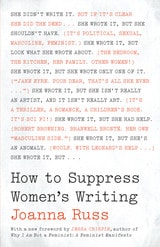
How to Suppress Women's Writing
By Joanna Russ; foreword by Jessa Crispin
University of Texas Press, 2018
Are women able to achieve anything they set their minds to? In How to Suppress Women’s Writing, award-winning novelist and scholar Joanna Russ lays bare the subtle—and not so subtle—strategies that society uses to ignore, condemn, or belittle women who produce literature. As relevant today as when it was first published in 1983, this book has motivated generations of readers with its powerful feminist critique.
“What is it going to take to break apart these rigidities? Russ’s book is a formidable attempt. It is angry without being self-righteous, it is thorough without being exhausting, and it is serious without being devoid of a sense of humor. But it was published over thirty years ago, in 1983, and there’s not an enormous difference between the world she describes and the world we inhabit.”
—Jessa Crispin, from the foreword
“A book of the most profound and original clarity. Like all clear-sighted people who look and see what has been much mystified and much lied about, Russ is quite excitingly subversive. The study of literature should never be the same again.”
—Marge Piercy
“Joanna Russ is a brilliant writer, a writer of real moral passion and high wit.”
—Adrienne Rich