Results by title
8812 books match the query 'Political Science' and 217 start with h
How Green Were the Nazis?
Nature, Environment, and Nation in the Third ReichFranz-Josef Brüggemeier
Ohio University Press, 2005
How Holocausts Happen
The United States in Central AmericaDouglas V. Porpora
Temple University Press, 1992
"History repeats itself, but it never repeats itself exactly," observes Douglas Porpora in this powerful indictment of U.S. intervention in Central America. Comparing the general public’s reaction to the Holocaust in Nazi Germany with American public opinion of U.S. participation in the genocidal policies of Nicaraguan counter-revolutionary forces, and the governments of Guatemala and El Salvador among others, Porpora demonstrates that moral indifference to the suffering of others was the common response. With reference to Hannah Arendt’s thesis of the banality of evil, he develops the concept of a "Holocaust-like event" and examines how even a democratic society can be capable of something on the order of a Holocaust.
Unlike other accounts of the Holocaust and genocide, this book focuses on the citizenry served or ruled by genocidal governments rather than on the governments themselves. Porpora argues that moral indifference and lack of interest in critical reflection are key factors that enable Holocaust-like events to happen And he characterizes American society as being typically indifferent to the fate of other people, uninformed, and anti-intellectual.
Porpora cites numerous horrifying examples of U.S.-backed Latin American government actions against their own peasants, Indians, and dissident factions. He offers finally a theory of public moral indifference and argues that although such indifference is socially created by government, the media, churches, and other institutions, we, the public, must ultimately take responsibility for it. How Holocausts Happen is at once a scholarly examination of the nature of genocide and a stinging indictment of American society.
How Human Rights Can Build Haiti
Activists, Lawyers, and the Grassroots CampaignFran Quigley
Vanderbilt University Press, 2014
The only way to transform Haiti's dismal human rights legacy is through a bottom-up social movement, supported by local and international challenges to the status quo. That recipe for reform mirrors the strategy followed by Mario Joseph, Brian Concannon, and their clients and colleagues profiled in this book. Together, Joseph, Concannon, and their allies represent Haiti's best hope to escape the cycle of disaster, corruption, and violence that has characterized the country's two-hundred-year history. At the same time, their efforts are creating a template for a new and more effective human rights-focused strategy to turn around failed states and end global poverty.

How Informal Institutions Matter
Evidence from Turkish Social and Political SpheresZeki Sarigil
University of Michigan Press, 2023
In How Informal Institutions Matter, Zeki Sarigil examines the role of informal institutions in sociopolitical life and addresses the following questions: Why and how do informal institutions emerge? To ask this differently, why do agents still create or resort to informal institutions despite the presence of formal institutional rules and regulations? How do informal institutions matter? What roles do they play in sociopolitical life? How can we classify informal institutions? What novel types of informal institutions can we identify and explain? How do informal institutions interact with formal institutions? How do they shape formal institutional rules, mechanisms, and outcomes? Finally, how do existing informal institutions change? What factors might trigger informal institutional change? In order to answer these questions, Sarigil examines several empirical cases of informal institution as derived from various issue areas in the Turkish sociopolitical context (i.e., civil law, conflict resolution, minority rights, and local governance) and from multiple levels (i.e., national and local).
How It Works
Recovering Citizens in Post-Welfare PhiladelphiaRobert P. Fairbanks II
University of Chicago Press, 2009
Of the some sixty thousand vacant properties in Philadelphia, half of them are abandoned row houses. Taken as a whole, these derelict homes symbolize the city’s plight in the wake of industrial decline. But a closer look reveals a remarkable new phenomenon—street-level entrepreneurs repurposing hundreds of these empty houses as facilities for recovering addicts and alcoholics. How It Works is a compelling study of this recovery house movement and its place in the new urban order wrought by welfare reform.
To find out what life is like in these recovery houses, Robert P. Fairbanks II goes inside one particular home in the Kensington neighborhood. Operating without a license and unregulated by any government office, the recovery house provides food, shelter, company, and a bracing self-help philosophy to addicts in an area saturated with drugs and devastated by poverty. From this starkly vivid close-up, Fairbanks widens his lens to reveal the intricate relationships the recovery houses have forged with public welfare, the formal drug treatment sector, criminal justice institutions, and the local government.

How Many Exceptionalisms?
Explorations in Comparative MacroanalysisAristide R. Zolberg
Temple University Press, 2008
The essays in How Many Exceptionalisms? span the long history of the intellectual output of Aristide Zolberg, one of the most distinguished social scientists of our time. In this collection, Zolberg shows his originality, insights, and breadth of thought as he addresses subjects ranging from theories of immigration policy, the making of Belgium, and the origins of the modern world system.
Written over three decades, and featuring many essays that have not been in wide circulation, Zolberg here draws from political science, cultural anthropology, sociology, and history to provide a configurative analysis of and long-term approach to the cultural diversity in Africa, Europe, and the United States.
How Many Is Too Many?
The Progressive Argument for Reducing Immigration into the United StatesPhilip Cafaro
University of Chicago Press, 2015
Cafaro roots his argument in human rights, equality, economic security, and environmental sustainability—hallmark progressive values. He shows us the undeniable realities of mass migration to which we have turned a blind eye: how flooded labor markets in sectors such as meatpacking and construction have driven down workers’ wages and driven up inequality; how excessive immigration has fostered unsafe working conditions and political disempowerment; how it has stalled our economic maturity by keeping us ever-focused on increasing consumption and growth; and how it has caused our cities and suburbs to sprawl far and wide, destroying natural habitats, driving other species from the landscape, and cutting us off from nature.
In response to these hard-hitting truths, Cafaro lays out a comprehensive plan for immigration reform that is squarely in line with progressive political goals. He suggests that we shift enforcement efforts away from border control and toward the employers who knowingly hire illegal workers. He proposes aid and foreign policies that will help people create better lives where they are. And indeed he supports amnesty for those who have, at tremendous risk, already built their lives here. Above all, Cafaro attacks our obsession with endless material growth, offering in its place a mature vision of America, not brimming but balanced, where all the different people who constitute this great nation of immigrants can live sustainably and well, sheltered by a prudence currently in short supply in American politics.
How Parties Win
Shaping the Irish Political ArenaSean D. McGraw
University of Michigan Press, 2015
How Partisan Media Polarize America
Matthew Levendusky
University of Chicago Press, 2013
In How Partisan Media Polarize America, Matthew Levendusky confirms—but also qualifies—both of these claims. Drawing on experiments and survey data, he shows that Americans who watch partisan programming do become more certain of their beliefs and less willing to weigh the merits of opposing views or to compromise. And while only a small segment of the American population watches partisan media programs, those who do tend to be more politically engaged, and their effects on national politics are therefore far-reaching.
In a time when politics seem doomed to partisan discord, How Partisan Media Polarize America offers a much-needed clarification of the role partisan media might play.
How Philosophy Became Socratic
A Study of Plato's "Protagoras," "Charmides," and "Republic"Laurence Lampert
University of Chicago Press, 2010
How Policies Make Interest Groups
Governments, Unions, and American EducationMichael T. Hartney
University of Chicago Press, 2022
As most American labor organizations struggle for survival and relevance in the twenty-first century, teachers unions appear to be an exception. Despite being all but nonexistent until the 1960s, these unions are maintaining members, assets—and political influence. As the COVID-19 epidemic has illustrated, today’s teachers unions are something greater than mere labor organizations: they are primary influencers of American education policy. How Policies Make Interest Groups examines the rise of these unions to their current place of influence in American politics.
Michael Hartney details how state and local governments adopted a new system of labor relations that subsidized—and in turn, strengthened—the power of teachers unions as interest groups in American politics. In doing so, governments created a force in American politics: an entrenched, subsidized machine for membership recruitment, political fundraising, and electoral mobilization efforts that have informed elections and policymaking ever since. Backed by original quantitative research from across the American educational landscape, Hartney shows how American education policymaking and labor relations have combined to create some of the very voter blocs to which it currently answers. How Policies Make Interest Groups is trenchant, essential reading for anyone seeking to understand why some voices in American politics mean more than others.
How Political Parties Mobilize Religion
Lessons from Mexico and TurkeyLuis Felipe Mantilla
Temple University Press, 2021
Political mobilization tends to take different forms in contemporary Catholic- and Sunni-majority countries. Luis Felipe Mantilla attributes this dynamic to changes taking place in religious communities and the political institutions that govern religious political engagement.
In How Political Parties Mobilize Religion, Mantillaevenhandedly traces the emergence and success of religious parties in Mexico and Turkey, two countries shaped by assertive secular regimes. In doing so, he demonstrates that religious parties are highly responsive to political institutions, such as electoral laws, as well as to the structure of broader religious communities.
Whereas in both countries, the electoral success of religious mobilizers was initially a boon for democracy, in Mexico it was marred by political mismanagement and became entangled with persistent corruption and escalating violence. In Turkey, the democratic credentials of religious mobilizers were profoundly eroded as the government became increasingly autocratic, concentrating power in very few hands and rolling back basic liberal rights.
Mantilla investigates the role religious mobilization plays in the evolution of electoral politics and democratic institutions, and to what extent their trajectories reflect broader trends in political Catholicism and Islam.
How Politicians Polarize
Political Representation in an Age of Negative PartisanshipMia Costa
University of Chicago Press, 2025
A fresh examination of political representation in an era of negative partisanship.
What does representation look like when politicians focus on "othering" the opposing party rather than the policy interests of their constituents? How do voters react to negative partisan rhetoric? And is policy responsiveness still the cornerstone of American representative democracy?
In How Politicians Polarize, Mia Costa draws on survey experiments, analysis of congressional newsletters and tweets, and data on fundraising and media coverage to examine how and why politicians rely so often on negative partisan attacks. Costa shows that most Americans do not like negative rhetoric, and politicians know this. Nonetheless, these kinds of attacks can reap powerful rewards from national media, donors, and party elites. Costa’s findings challenge the popular notion that Americans are motivated more by their partisan identities than by policy representation. Her research illuminates how the political ecosystem rewards negative representation and how this affects the quality of American democracy.
How Presidents Test Reality
Decisions on Vietnam, 1954 and 1965John P. Burke, Fred L. Greenstein, Larry Berman, and Richard Immerman
Russell Sage Foundation, 1991
Just as famines and plagues can provide opportunities for medical research, the unhappy course of United States relations with Vietnam is a prime source of evidence for students of American political institutions. How Presidents Test Reality draws on the record of American decision making about Vietnam to explore the capacity of top government executives and their advisers to engage in effective reality testing.
Authors Burke and Greenstein compare the Vietnam decisions of two presidents whose leadership styles and advisory systems diverged as sharply as any in the modern presidency. Faced with a common challenge—an incipient Communist take-over of Vietnam—presidents Eisenhower and Johnson engaged in intense debates with their aides and associates, some of whom favored intervention and some of whom opposed it. In the Dien Bien Phu Crisis of 1954, Eisenhower decided not to enter the conflict; in 1965, when it became evident that the regime in South Vietnam could not hold out much longer, Johnson intervened.
How Presidents Test Reality uses declassified records and interviews with participants to assess the adequacy of each president’s use of advice and information. This important book advances our historical understanding of the American involvement in Vietnam and illuminates the preconditions of effective presidential leadership in the modern world.
"An exceptionally thoughtful exercise in what ‘contemporary history’ ought to be. Illuminates the past in a way that suggests how we might deal with the present and the future." —John Lewis Gaddis
"Burke and Greenstein have written what amounts to an owner's manual for operating the National Security Council....This is a book Reagan's people could have used and George Bush ought to read." —Bob Schieffer, The Washington Monthly

How Revolutions Happen
Konstantin Sonin
University of Chicago Press, 0
From the Russian intellectual-in-exile Konstantin Sonin, a grand theory of when and how rapid political change happens—or doesn’t.
In 2015, economist Konstantin Sonin solidified his status as an enemy of the Russian state when he published an article predicting that Vladimir Putin’s presidency would produce the country’s third revolution by the middle of this century. Forced to flee the country, Sonin settled in Chicago. In the decade that followed, the Russian government continued to pursue him—placing him on their state wanted list, tracking his movements, and sentencing him in absentia to eight years in prison. Sonin’s research and political advocacy continued unabated. So did his writing.
Now, Sonin has completed his masterpiece: a revelatory and sweeping investigation of a timeless question—what makes a revolution? How Revolutions Happen pinpoints why they arise, why they don’t, and where they’re likely to occur next. Tracing examples of successful and failed examples from history—in China, France, Haiti, Ukraine—Sonin shows that revolutions don’t grow out of mere popular unrest; they happen when states cease to evolve. This argument extends well beyond why nations fail, considering also why nations almost fail and why other nations fail repeatedly. Drawing on both empirical evidence and his firsthand experience, he also argues that although revolutions are an important part of human societies, they are not inherently good or bad—or quick to end.
Wry, sweeping, and erudite, How Revolutions Happen recasts everything we think about political change. From one of the world’s foremost political economists, this book is a momentous cumulation of knowledge that allows us to fully understand what a revolution is, why they occurred in the past—and how to measure where they might be coming.
How States Shaped Postwar America
State Government and Urban PowerNicholas Dagen Bloom
University of Chicago Press, 2019
How States Shaped Postwar America
State Government and Urban PowerNicholas Dagen Bloom
University of Chicago Press, 2019
The history of public policy in postwar America tends to fixate on developments at the national level, overlooking the crucial work done by individual states in the 1960s and ’70s. In this book, Nicholas Dagen Bloom demonstrates the significant and enduring impact of activist states in five areas: urban planning and redevelopment, mass transit and highways, higher education, subsidized housing, and the environment. Bloom centers his story on the example set by New York governor Nelson Rockefeller, whose aggressive initiatives on the pressing issues in that period inspired others and led to the establishment of long-lived state polices in an age of decreasing federal power. Metropolitan areas, for both better and worse, changed and operated differently because of sustained state action—How States Shaped Postwar America uncovers the scope of this largely untold story.
How The Rural Poor Got Power
Narrative Of A Grass-Roots OrganizerPaul Wellstone
University of Minnesota Press, 2003
The gripping story behind Paul Wellstone’s progressive legacy
Before he was a senator, before he was a nationally known advocate for the disenfranchised and a tireless supporter of public policies to alleviate poverty, Paul Wellstone devoted his time and legendary energy to grassroots organizing. How the Rural Poor Got Power describes Wellstone’s experiences as a political activist in rural Minnesota. Working with senior citizens, struggling farmers, and single mothers, Wellstone created a coalition to address transportation, access to health care, and welfare benefits issues. This narrative features interviews with citizens and shows Wellstone observing and participating in the ideals to which he devoted his life: helping poor people gain a political voice.
How Women Win Presidential Elections in Latin America
Catherine Reyes-Housholder
Temple University Press, 2026
Between 1990 and 2020, women candidates won only 6% of the world’s presidential races. How Women Win Presidential Elections in Latin America explains the factors, strategies, and perceptions that help (or hinder) women to democratically access their country’s highest political office. Catherine Reyes-Housholder introduces a theory of gendered incentives and perceived potential to reveal why a political party would break with tradition and nominate a woman. She also shows how citizens respond when women candidates are running in incumbent parties or competing to displace those in power.
Drawing on comparative research on the presidency and gender, How Women Win Presidential Elections in Latin America examines the successful campaigns of Michelle Bachelet in Chile and Dilma Rousseff in Brazil, as well as why Blanca Ovelar lost her presidential race in Paraguay. Reyes-Housholder’s findings indicate that voter sexism is not a major factor; however, women do not triumph in these elections in the same ways that men do. Rather, the central unknown factor behind women’s victories is how they become candidates of major parties—and gender profoundly influences who parties nominate.
How Women Win Presidential Elections in Latin America is a valuable investigation of women and executive politics.
How World Politics Is Made
France and the Reunification of GermanyTilo Schabert
University of Missouri Press, 2009
How the Dismal Science Got Its Name
Classical Economics and the Ur-Text of Racial PoliticsDavid M. Levy
University of Michigan Press, 2002
Economists of the time argued, on the other hand, that people of color were to be protected by the rule of law--hence the moniker "the dismal science."
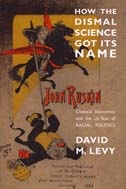
A startling image from 1893, which is reproduced in full color on this book's jacket, shows Ruskin killing someone who appears to be nonwhite. A close look reveals that the victim is reading "The Dismal Science."
Levy discusses this image at length and also includes in his text weblinks to Carlyle's "Occasional Discourse on the Negro Question" and to Mill's response, demonstrating that these are central documents in British classical economics. He explains Adam Smith's egalitarian foundations, contrasting Smith's approach to the hierarchical alternative proposed by Carlyle. Levy also examines various visual representations of this debate and provides an illuminating discussion of Smith's "katallactics," the science of exchange, comparing it with the foundations of modern neoclassical economics.
How the Dismal Science Got Its Name also introduces the notion of "rational choice scholarship" to explain how attacks on market economics from a context in which racial slavery was idealized have been interpreted as attacks on market economics from a humanistic or egalitarian context. Thus it will greatly appeal to economists, political scientists, philosophers, students of Victorian literature, and historians.
David M. Levy is Associate Professor of Economics and Research Associate, Center for Study of Public Choice, George Mason University.
How the Military Remembers
Human Rights and Countermemories in Latin AmericaEdited by Cynthia E. Milton and Michael J. Lazzara
University of Wisconsin Press, 2025
With attention to the distinct cultural, political, and historical contexts across Latin America, the essays reveal how military figures and institutions appropriate mechanisms of truth-telling and accountability to reframe the past, blur the lines between perpetrator and victim, and weaponize memory itself.
Contributors: Mariana Achugar, Gabriela Fried Amilivia, Rebecca Atencio, Jo-Marie Burt, Rachel Hatcher, Nicolás Rodríguez Idárraga, Michael J. Lazzara, Cynthia E. Milton, Carla Granados Moya, María Emma Wills Obregón, Leith Passmore, Valentina Salvi, Gladys Vásquez Zevallos
How the New Deal Was Run
Edited by Sarah E. Igo and Ganesh Sitaraman
University of Chicago Press, 2027
Notable historians delve into the brass tacks of launching and sustaining federal agencies.
Critics today complain that the United States government can’t do big things, can’t do them quickly, and certainly can’t do many of them at once. The New Deal offers a striking contrast. During the 1930s, the United States created a wealth of new agencies, departments, offices, and programs—all at once and in very short order—that enabled a stunning expansion of state capacity. The question is: how?
In this illuminating collection, leading American historians explore the nuts and bolts of New Deal implementation to offer answers. From the Civilian Conservation Corps to the Rural Electrification Administration to the Securities and Exchange Commission, they uncover exactly how the New Dealers did so much so quickly. They detail the choices before state builders who, operating under the pressure and immediacy of the era, made decisions that had momentous consequences in the longer term.
At a time when federal agencies are under stress as never before, the contributors suggest what future administrations can learn from the New Deal’s extraordinary achievements—and how they can build state capacity and deliver for Americans once again.
Features contributions by W. Tanner Allread, Mary Bridges, Brent Cebul, Sarah E. Igo, Meg Jacobs, Richard R. John, Neil M. Maher, Sharon Ann Musher, Sarah T. Phillips, Kathryn Olmsted and Eric Rauchway, Alex Platt, Jason Scott Smith, Ganesh Sitaraman, Abby Spinak, Chloe Thurston, and Mason B. Williams.
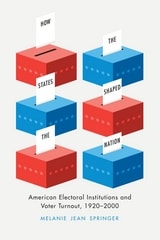
How the States Shaped the Nation
American Electoral Institutions and Voter Turnout, 1920-2000Melanie Jean Springer
University of Chicago Press, 2014
With How the States Shaped the Nation, Melanie Jean Springer places contemporary reforms in historical context and systematically explores how state electoral institutions have been instrumental in shaping voting behavior throughout the twentieth century. Although reformers often assume that more convenient voting procedures will produce equivalent effects wherever they are implemented, Springer reveals that this is not the case. In fact, convenience-voting methods have had almost no effect in the southern states where turnout rates are lowest. In contrast, the adverse effects associated with restrictive institutions like poll taxes and literacy tests have been persistent and dramatic. Ultimately, Springer argues, no single institutional fix will uniformly resolve problems of low or unequal participation. If we want to reliably increase national voter turnout rates, we must explore how states’ voting histories differ and better understand the role of political and geographical context in shaping institutional effects.
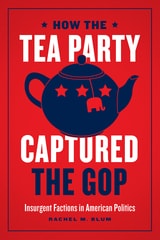
How the Tea Party Captured the GOP
Insurgent Factions in American PoliticsRachel M. Blum
University of Chicago Press, 2020
In How the Tea Party Captured the GOP, Rachel Marie Blum approaches the Tea Party from the angle of party politics, explaining the Tea Party’s insurgent strategies as those of a party faction. Blum offers a novel theory of factions as miniature parties within parties, discussing how fringe groups can use factions to increase their political influence in the US two-party system. In this richly researched book, the author uncovers how the electoral losses of 2008 sparked disgruntled Republicans to form the Tea Party faction, and the strategies the Tea Party used to wage a systematic takeover of the Republican Party. This book not only illuminates how the Tea Party achieved its influence, but also provides a framework for identifying other factional insurgencies.

How the West Came to Rule
The Geopolitical Origins of CapitalismAlex Anievas and Kerem Nisancioglu
Pluto Press, 2015
***Winner, British International Studies Association International Political Economy Working Group Book Prize 2016***
Mainstream historical accounts of the development of capitalism describe a profess which is fundamentally European—a system that was born in the mills and factories of English and under the guillotines of the French Revolution. This groundbreaking book tells a very difference story.
How the West Came to Rule offers a unique interdisciplinary and international historical account of the origins of capitalism. It argues that, contrary to dominant wisdom, capitalism’s origins should not be understood as a development confined to the geographically and culturally sealed borders of Europe, but the outcome of a wider array of global processes in which non-European societies played a decisive role.
Here is a provocative, incisive explanation of how capitalism emerged in England and Europe through a dialectical intersocietal and geopolitical process. The authors’ aim to undermine a Eurocentric bias that has been prominent in the debate about capitalisms rise to supremacy, and their case is remarkably convincing. They provide a fundamental rethinking. Anievas and Nisancioglu contend that often cited assumptions are neither theoretically nor empirically tenable and deny the agency of non-Western societies to the emergence of capitalism. Topics covered include:
*The Problem of Eurocentrism
*The Problem of Historical Specificity
*The Brenner Thesis: Explanation and Critique
*The Geopolitical in the Making of Capitalism
*The Political Marxist Conception of Capitalism
*Rethinking the Origins of Capitalism
*And much more!
Through an outline of the uneven histories of Mongolian expansion, New World discoveries, Ottoman-Habsburg rivalry, the development of the colonies, and bourgeois revolutions, Alex Anievas and Kerem Nisancioglu offer an account of capitalism’s origins that convincingly argues against the prevailing Eurocentric narratives. It will change minds and open the eyes of historians, economists, and political thinkers.
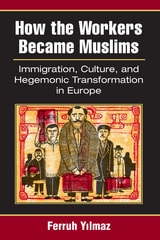
How the Workers Became Muslims
Immigration, Culture, and Hegemonic Transformation in EuropeFerruh Yilmaz
University of Michigan Press, 2016
Yilmaz’s primary case study is Danish immigration discourse, but his argument contextualizes his study in terms of questions of current concern across Europe, where right-wing groups that were long on the fringes of “legitimate” politics have managed to make significant gains with populations traditionally aligned with the Left. Specifically, Yilmaz argues that sociopolitical space has been transformed in the last three decades such that group classification has been destabilized to emphasize cultural rather than economic attributes.
According to this point-of-view, traditional European social and political splits are jettisoned for new “cultural” alliances pulling the political spectrum to the right, against the “corrosive” presence of Muslim immigrants, whose own social and political variety is flattened into an illusion of alien sameness.
How to House the Homeless
Ingrid Gould Ellen
Russell Sage Foundation, 2010
How to Humble a Wingnut and Other Lessons from Behavioral Economics
Cass R. Sunstein
University of Chicago Press, 2013
How to Look Good in a War
Justifying and Challenging State ViolenceBrian Rappert
Pluto Press, 2012
How to Look Good in A War examines the methods used to depict, defend and justify the use of state violence. Many books have shown how 'truth is the first casualty of war' but this is the first to analyse exactly how pro-war narratives are constructed and normalised.
Brian Rappert details the 'upside-down' world of war in which revelation conceals, knowledge fosters uncertainty, and transparency obscures. He looks at government spin during recent wars in Iraq, Afghanistan and Libya where officials manoeuvre between circulating and withholding information.
Examining how organised violence is justified, How to Look Good in A War draws on experiences from recent controversy to consider how ignorance about the operation of war is produced and how concerned individuals and groups can intervene to make a difference.
How to Make a Revolution
Raymond Postgate
Westholme Publishing, 2018
The first third of the twentieth century saw a seismic upheaval in global politics and society that still reverberates today. Communism and fascism toppled both traditional monarchies and representative democracies, while trade unions and other factions effectively challenged existing governments to adopt reforms or face crippling economic or social upheaval. Given these extraordinary events, Raymond Postgate set forth in How to Make a Revolution to objectively discuss revolutionary methods, and which tactics or strategies are the most effective. Drawing on his own idealistic experience as a young labor agitator and editor of a communist newspaper and more than fifteen years of close study of past revolutionary history and theories, the author dispassionately discusses Marxism, fascism, anarchism, and Blanquism (a doctrine within socialism), as well as syndicalism and industrial unionism. He then reviews revolutionary practice, including general strikes, financial pressure, armed revolution, and communist tactics, and ends with a prescient and frightening conclusion: without general consensus and determination, a peaceful revolution is impossible, and “if no action is taken, action of another kind will be taken for us. . . . The continuance of uncertainty will mean that the disillusioned will drift steadily across to a Fascist organization. Fascism means war; the character of a Fascist State is fairly well known. Once it is established, those who read, who write, who publish or who print, books like this are likely to be dead or in concentration camps.” Originally published in 1934, Postgate’s book was heralded for its clarity and scholarship.

How to Protest
Lessons on Nonviolent ActionMegan Hershey, Illustrations by Matthew Cahill
University of Wisconsin Press, 2026
Many people around the world are frustrated with their governments yet do not know what actions to take. Protest may feel out of reach, like something only seasoned activists can do. This accessible guide explores the creativity, joy, and accessibility of peaceful protest. Megan Hershey introduces readers to twenty-five specific and inspiring nonviolent protest methods through real-life examples from the past fifty years. Each chapter includes a short, vivid description of a bold nonviolent action taken by everyday people who demanded that their leaders listen to them. From patriotic choir concerts in Estonia to live painted pigs at the Ugandan parliament, these unique protest strategies will inspire those looking to effect change and offer encouragement from past successes.
How to Read Barthes' Image-Music-Text
Ed White
Pluto Press, 2012
Roland Barthes remains one of the most influential cultural theorists of the postwar period and Image-Music-Text collects his most influential essays. Ed White provides students with a clear guide to this essential but difficult text.
As students are increasingly expected to write across a range of media, Barthes' work can be understood as an early mapping of what we now call interdisciplinary or multidisciplinary study. The book's detailed section-by-section readings makes Barthes' most important writings accessible to undergraduate readers.
This book is a perfect companion for teaching and learning Barthes' ideas in cultural studies and literary theory.
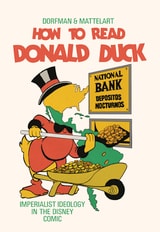
How to Read Donald Duck
Imperialist Ideology in the Disney ComicAriel Dorfman
Pluto Press, 2020
First published in 1971, How to Read Donald Duck shocked readers by revealing how capitalist ideology operates in our most beloved cartoons. Having survived bonfires, impounding and being dumped into the ocean by the Chilean army, this controversial book is once again back on our shelves.
Written and published during the blossoming of Salvador Allende's revolutionary socialism in Chile, the book examines how Disney products reflect capitalist ideology, and are active agents working in this ideology’s favor. Focusing on the hapless mice and ducks of Disney, curiously parentless, marginalized and always short of cash, Ariel Dorfman and Armand Mattelart expose how these characters established hegemonic ideas about capital, race, gender and the relationship between developed countries and the Third World.
A devastating indictment of a media giant, a document of twentieth-century political upheaval, and a reminder of the dark undercurrent of pop culture, How to Read Donald Duck is once again available, together with a new introduction by Ariel Dorfman in which he writes.
"It is that joy in liberation, that alegria, that spirit of resistance, that I wish to share with America, as the book that Pinochet’s soldiers could not liquidate or Disney’s lawyers stop from entering the United States finally finds its way to its new home, deep into the land that invented Donald Duck and Donald Trump. Is the same country that gave me such a warm welcome as a child, and perhaps may now equally greet with open arms this critique of oppression and it certainty that we don’t have to leave the world as it was when we first encountered it."
How to Respond Better to the Next Pandemic
Remedying Institutional FailuresAllen Buchanan, with contributions by Cécile Fabre and Sir Paul Tucker
University of Utah Press, 2024
In How to Respond Better to the Next Pandemic Allen Buchanan argues that, contrary to widespread opinion, the primary cause of flawed COVID-19 policy was not defective leadership, but rather institutional failure. Decisions were made through processes that lacked the most basic safeguards against the large-institution “yes-man” and group-think phenomena and included virtually no provisions for holding decision makers accountable. More fundamentally, policy makers did not fulfill the crucial duty to provide plausible public justifications for their decisions. They disguised the fact that scientific opinion was divided on the appropriateness of the policies they endorsed and labeled those who disagreed with them as anti-scientific. In some cases, they responded to criticism, not by engaging it on the issues, but by branding their critics as quacks.
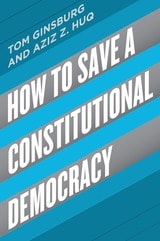
How to Save a Constitutional Democracy
Tom Ginsburg and Aziz Z. Huq
University of Chicago Press, 2018
How to Save a Constitutional Democracy mounts an urgent argument that we can no longer afford to be complacent. Drawing on a rich array of other countries’ experiences with democratic backsliding, Tom Ginsburg and Aziz Z. Huq show how constitutional rules can both hinder and hasten the decline of democratic institutions. The checks and balances of the federal government, a robust civil society and media, and individual rights—such as those enshrined in the First Amendment—often fail as bulwarks against democratic decline. The sobering reality for the United States, Ginsburg and Huq contend, is that the Constitution’s design makes democratic erosion more, not less, likely. Its structural rigidity has had unforeseen consequence—leaving the presidency weakly regulated and empowering the Supreme Court conjure up doctrines that ultimately facilitate rather than inhibit rights violations. Even the bright spots in the Constitution—the First Amendment, for example—may have perverse consequences in the hands of a deft communicator who can degrade the public sphere by wielding hateful language banned in many other democracies. We—and the rest of the world—can do better. The authors conclude by laying out practical steps for how laws and constitutional design can play a more positive role in managing the risk of democratic decline.
How to Save a Constitutional Democracy
Tom Ginsburg and Aziz Z. Huq
University of Chicago Press, 2018
Democracies are in danger. Around the world, a rising wave of populist leaders threatens to erode the core structures of democratic self-rule. In the United States, the tenure of Donald Trump has seemed decisive turning point for many. What kind of president intimidates jurors, calls the news media the “enemy of the American people,” and seeks foreign assistance investigating domestic political rivals? Whatever one thinks of President Trump, many think the Constitution will safeguard us from lasting damage. But is that assumption justified?
How to Save a Constitutional Democracy mounts an urgent argument that we can no longer afford to be complacent. Drawing on a rich array of other countries’ experiences with democratic backsliding, Tom Ginsburg and Aziz Z. Huq show how constitutional rules can both hinder and hasten the decline of democratic institutions. The checks and balances of the federal government, a robust civil society and media, and individual rights—such as those enshrined in the First Amendment—often fail as bulwarks against democratic decline. The sobering reality for the United States, Ginsburg and Huq contend, is that the Constitution’s design makes democratic erosion more, not less, likely. Its structural rigidity has had unforeseen consequence—leaving the presidency weakly regulated and empowering the Supreme Court conjure up doctrines that ultimately facilitate rather than inhibit rights violations. Even the bright spots in the Constitution—the First Amendment, for example—may have perverse consequences in the hands of a deft communicator who can degrade the public sphere by wielding hateful language banned in many other democracies. We—and the rest of the world—can do better. The authors conclude by laying out practical steps for how laws and constitutional design can play a more positive role in managing the risk of democratic decline.
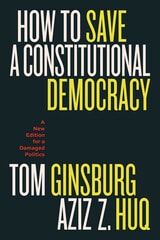
How to Save a Constitutional Democracy
A New Edition for a Damaged PoliticsTom Ginsburg and Aziz Z. Huq
University of Chicago Press, 2026
Updated to take stock of recent developments, Tom Ginsburg and Aziz Z. Huq’s prescient and insightful book shows how constitutional rules both hinder and hasten democratic decline.
Around the world, autocratic leaders threaten the core structures of democratic self-rule. But democratic constitutions are not fail-proof safeguards. By looking at how such leaders exploit legal mechanisms to advance their aims, we can see how democratic constitutions can sometimes abet—and even accelerate—democratic decline. In this new edition of How to Save a Constitutional Democracy, constitutional law experts Tom Ginsburg and Aziz Z. Huq offer a powerful analysis of today’s challenges while arguing that the time has come for meaningful, actionable change.
This new edition takes up the torch of its predecessor, canvasing developments in the United States and other countries that have transpired since 2018. Drawing lessons from countries around the world and reflecting on the prospects for American democracy, the authors show how constitutional design can, in fact, either undermine or support democratic institutions. The sobering reality for the United States is that the Constitution’s design makes democratic erosion eminently feasible. But Ginsburg and Huq do not stop there. They suggest practical ways that law and constitutional design can better manage these mounting threats, analyzing constitutional and legal questions that are consequential yet poorly understood, all while cautioning against an overreliance on technocratic fixes.
Even more urgent and salient in its new edition, How to Save a Constitutional Democracy reflects on why autocrats tend to pose even greater danger the second time they come to power and asks how we can begin to repair a democracy that has failed.
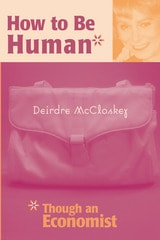
How to be Human*
*Though an EconomistDeirdre N. McCloskey
University of Michigan Press, 2000
Anyone can learn about the field of economics from How to Be Human. She can learn how economics works as a discipline and as a piece of sociology, who the heroes are and the villains, how a career in economics relates to matters of ethics and epistemology. She can learn what it is like to be a new woman in a boys' subject, a subject that avoids at all costs the word "love."
During the 1990s Deirdre McCloskey established herself as the main internal critic of the economic mainstream. Her quarterly columns in the Eastern Economic Journal, many of which are collected here, have become a handbook for reform. Trained in economics herself, she knows the normal science of the field from the inside: she has done it as a distinguished economic historian; and has watched it work from the faculties of Chicago (for twelve years) and Iowa (for nineteen), and now at the University of Illinois at Chicago.
Her criticism from the inside is that the two methods on which economics has depended since the 1940s--existence-theorem mathematics and significance-testing statistics--are nonsense. They have, she claims, nothing to do with economic science, and have massively diverted economists from finding out how the economy works.
McCloskey's book is written for anyone interested in economics, whether trained in it or not--anyone who cares about the economy but is not taken in by the boys' game.
Deirdre McCloskey is University Professor of the Human Sciences, University of Illinois at Chicago.
Hugo Chavez
Socialist for the Twenty-first CenturyMike Gonzalez
Pluto Press, 2014
When Hugo Chavez, then President of Venezuela, died in 2013, millions across the globe mourned. In an age where most politicians inspire only apathy and cynicism, Chavez's popularity, radicalism and vibrant personality were truly unique.
Released one year after Chavez's unexpected death, this dramatic and intimate biography traces Chavez's life from an impoverished rural family to the Miraflores Presidential Palace in Caracas. Mike Gonzalez shows how Chavez's 'Bolivarian revolution' aimed to complete Simon Bolivar’s promise of a Latin America free from imperialism.
Gonzalez details Chavez's close connection to the masses and how he enraged wealthy elites by declaring his support for 21st century socialism. He concludes that the struggle for social justice inspired by Chavez can and must continue. This is an ideal guide to Chavez's inspiring life and legacy.
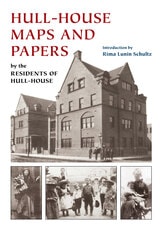
Hull-House Maps and Papers
A Presentation of Nationalities and Wages in a Congested District of Chicago, Together with Comments and Essays on Problems Growing Out of the Social ConditionsBy the Residents of Hull-House
University of Illinois Press, 2007
Inspired by their Progressive Era faith in social science solutions to society’s problems, the residents of Hull-House collaborated on this work of sociology based on their experiences as residents of Chicago’s Near West Side. The contributors to this book believed that an enlightened citizenry could be mobilized for reform, and that by publishing maps with explicit information about the wages and conditions of the working poor in Chicago’s Nineteenth Ward they would educate the public and inspire reforms.
In addition to Jane Addams’s own prefatory note and paper on the role of social settlements in the labor movement, contributors provided detailed, real-world analyses of the Chicago Jewish ghetto, garment workers and the sweatshops, child labor, immigrant neighborhoods in the vicinity of Hull-House, and local charities. This edition also contains eight color reproductions of the original Hull-House neighborhood maps. The year 2006 marks the one hundred and eleventh anniversary of the publication of Hull-House Maps and Papers, and the volume remains a dramatic statement about the residents’ shared values as well as a major influence on subsequent social surveys.

Human Capital versus Basic Income
Ideology and Models for Anti-Poverty Programs in Latin AmericaFabián A. Borges
University of Michigan Press, 2022
There were two distinct models of CCTs: a “human capital” model based on means-tested targeting and strict enforcement of program conditions, exemplified by the program launched by Mexico’s right, and a more universalistic “basic income” model with more permissive enforcement of conditionality, exemplified by Brazil’s program under Lula. These two models then spread across the region. Whereas right and center governments, with assistance from international financial institutions, enacted CCTs based on the human capital model, the left, with assistance from Brazil, enacted CCTs based on the basic income model.
The existence of two distinct types of CCTs and their relation to ideology is supported by quantitative analyses covering the entire region and in-depth case studies based on field research in three countries. Left-wing governments operate CCTs that cover more people and spend more on those programs than their center or right-wing counterparts. Beyond coverage, a subsequent analysis of the 10 national programs adopted after Lula’s embrace of CCTs confirms that program design—evaluated in terms of scope of the target population, strictness of conditionality enforcement, and stipend structure—is shaped by government ideology. This finding is then fleshed out through case studies of the political processes that culminated in the adoption of basic income CCTs by left-wing governments in Argentina and Bolivia and a human capital CCT by a centrist president in Costa Rica.
Human Nature and History
A Study of the Development of Liberal Political ThoughtRobert Denoon Cumming
University of Chicago Press, 1969
Human Nature and History, a monumental work in two volumes, is an attempt to analyze these relations. It is a work in meta-theory or the theory of political theory.
At the most general level, Cumming is concerned with the question of what is involved in the enterprise of political theory or political philosophy and how different conceptions of that enterprise have developed historically. More specifically, he is concerned with the format imposed on the historical development of political thought by Anglo-American liberalism, especially as represented by John Stuart Mill.
Since Cumming traces the development of political theory by reference to the relation between its subject-matter and other subject-matters, his study should be of interest to historians of thought and culture, as well as to political theorists and philosophers.
Human Rights Counterpublics in Perú
Sylvanna M. Falcón
University of Illinois Press, 2024
Engaging and intimate, Human Rights Counterpublics in Perú illuminates the power of human rights and memory work.
Human Rights and Oppressed Peoples
Collected Essays and SpeechesGeorg Brandes
University of Wisconsin Press, 2020
Human Rights and Oppressed Peoples includes thirty-five essays and published speeches from the early twenty-first century on subjects as diverse as the Boxer Rebellion, displaced peoples from World War I, Finland's Jewish population, and imperialism. This collection will interest interdisciplinary scholars of human rights as well as those who study Scandinavian intellectual and literary history.
Human Rights and Social Movements
Neil Stammers, Robert Jupe, and Jane Andrew
Pluto Press, 2009
This book champions social movements as one of the most influential agents that shape our conceptions of human rights.
Stammers argues that human rights cannot be properly understood outside of the context of social movement struggles. He explains how much of the literature on human rights has systematically obscured this link, consequently distorting our understandings of human rights.
Stammers identifies the contours of a new framework through which human rights can be understood. He suggests that what he calls the 'paradox of institutionalisation' can only be addressed through a recognition of the importance of human rights arising out of grassroots activism, and through processes of institutional democratisation.
Human Rights and Transnational Solidarity in Cold War Latin America
Edited by Jessica Stites Mor
University of Wisconsin Press, 2013
Edited by Jessica Stites Mor, this book offers fine-grained case studies that show how Latin America’s re-emerging Left transformed the struggles against dictatorship and repression of the Cold War into the language of anti-colonialism, socioeconomic rights, and identity.
Human Rights and the Care of the Self
Alexandre Lefebvre
Duke University Press, 2018
Human Rights at Risk
Global Governance, American Power, and the Future of DignitySalvador Santino F. Regilme Jr. and Irene Hadiprayitno
Rutgers University Press, 2022
Human Rights on the Move
Edited by Wendy S. Hesford, Momar K. Ndiaye, and Amy Shuman
The Ohio State University Press, 2024
Contributing artists, activists, and scholars expose the fundamental paradox of human rights (namely that nation-states are violators and guarantors of rights) while also showing how people facing violence and persecution move with the hope of more livable and equitable futures. The assembled scholarly essays, interviews, and creative pieces demonstrate the importance of a more relational and contextual understanding of human rights—one that can destabilize current definitions and open space for new formulations.