Results by title
8113 books match the query 'Literary Criticism' and 211 start with h
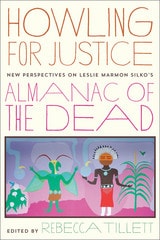
Howling for Justice
New Perspectives on Leslie Marmon Silko’s Almanac of the DeadEdited by Rebecca Tillett
University of Arizona Press, 2014
Howling for Justice actively engages with both the literary achievements and the politics of Silko’s text. It brings together essays by international scholars reacting to the novel while keeping in mind its larger concern with issues of social justice, both local and transnational. Aiming both to refocus critical attention and open the book to a broader array of readers, this collection offers fresh perspectives on its transnational vision, on its sociocultural, historical, and political ambitions, and on its continued relevance in the twenty-first century. The essays examine and explain some of the key points that readers and critics have identified as confusing, problematic, and divisive. Together, they offer new ways to approach and appreciate the text.
The book concludes with a new, never-before-published interview in which Silko reflects on the twenty years since the novel’s publication and relates the concerns of Almanac to her current work.

Huckleberry Finn as Idol and Target
The Functions of Criticism in Our TimeJonathan Arac
University of Wisconsin Press, 1997
If racially offensive epithets are banned on CNN air time and in the pages of USA Today, Jonathan Arac asks, shouldn’t a fair hearing be given to those who protest their use in an eighth-grade classroom? Placing Mark Twain’s comic masterpiece, Huckleberry Finn, in the context of long-standing American debates about race and culture, Jonathan Arac has written a work of scholarship in the service of citizenship.
Huckleberry Finn, Arac points out, is America’s most beloved book, assigned in schools more than any other work because it is considered both the “quintessential American novel” and “an important weapon against racism.” But when some parents, students, and teachers have condemned the book’s repeated use of the word “nigger,” their protests have been vehemently and often snidely countered by cultural authorities, whether in the universities or in the New York Times and the Washington Post. The paradoxical result, Arac contends, is to reinforce racist structures in our society and to make a sacred text of an important book that deserves thoughtful reading and criticism. Arac does not want to ban Huckleberry Finn, but to provide a context for fairer, fuller, and better-informed debates.
Arac shows how, as the Cold War began and the Civil Rights movement took hold, the American critics Lionel Trilling, Henry Nash Smith, and Leo Marx transformed the public image of Twain’s novel from a popular “boy’s book” to a central document of American culture. Huck’s feelings of brotherhood with the slave Jim, it was implied, represented all that was right and good in American culture and democracy. Drawing on writings by novelists, literary scholars, journalists, and historians, Arac revisits the era of the novel’s setting in the 1840s, the period in the 1880s when Twain wrote and published the book, and the post–World War II era, to refute many deeply entrenched assumptions about Huckleberry Finn and its place in cultural history, both nationally and globally. Encompassing discussion of Harriet Beecher Stowe, Frederick Douglass, Ralph Ellison, Archie Bunker, James Baldwin, Shelley Fisher Fishkin, and Mark Fuhrman, Arac’s book is trenchant, lucid, and timely.

Hugo von Hofmannsthal and His Time
The European Imagination, 1860-1920Hermann Broch
University of Chicago Press, 1984
Through an analysis of the changing thought and career of the Austrian poet, librettist, and essaist Hugo von Hofmannsthal (1874-1929), Broch attempts to define and analyze the major intellectual issues of the European fin de siècle, a period that he characterizes according to the Nietzschean concepts of the breakdown of rationality and the loss of a central value system. The result is a major examination of European thought as well as a comparative study of political systems and artistic styles.
Human Nature in Utopia
Zamyatin's WeBrett Cooke
Northwestern University Press, 2002
Human
Babylonian Reflections on LaborSophus Helle
University of Chicago Press, 2026
The Babylonian poem Atra-hasis is a forgotten masterpiece of political thought. Written in Akkadian in what is now southern Iraq during the early second millennium BCE, Atra-hasis gives us a glimpse of how ancient poets understood the society growing around them. This radical history of the world told from the perspective of the mother goddess conveys the complexity and contradictions that lie at the heart of the human experience. Atra-hasis tells how humanity was created as part of a bargain to resolve the world’s first labor strike, in which the lower gods rebelled against the excessive work imposed on them by the higher gods. It depicts humans as workers endowed with defiant intelligence. They multiply and become too loud, so the gods decide to quiet them with a cataclysmic flood.
Looking to Atra-hasis, Sophus Helle reveals an ancient story with reflections on power and history that invite comparison to topics of contemporary relevance, including labor, inequality, climate change, artificial intelligence, threats to democracy, disability, care work, sexual consent, and more. Helle considers Atra-hasis as a foundational document of “pasthumanism,” a term he uses to describe the study of how cultural conceptions of humanity have changed across centuries. He argues that ancient and non-Western texts remind us that cultural assumptions we now take for granted are neither natural nor necessary.
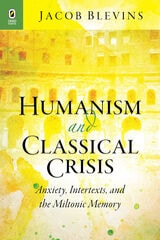
Humanism and Classical Crisis
Anxiety, Intertexts, and the Miltonic MemoryJacob Blevins
The Ohio State University Press, 2014
Blevins grounds his approach in the theories of Jacques Lacan, whose work challenges the very notions of what identity is and, as a result, exposes the complexities of identity formation. Areas and authors covered include imitations and translations of classical works of the sixteenth and seventeenth centuries in England and France by Andrew Marvell, Edmund Spencer, Pierre Ronsard, Joachim Du Bellay, Ben Jonson, Sir Thomas Wyatt, and John Milton.
This book not only provides a new perspective on early modern poetic imitation, but also offers a foundational methodology for examining the classical presence within the modern self.
Humanist Poetics
Thought, Rhetoric, and Fiction in Sixteenth-Century EnglandArthur F. Kinney
University of Massachusetts Press, 1986
By tracing classical resources and the intertextuality of major English works from More's Utopia to Lodge's Rosalynde and Nashe's Unfortunate Traveller, Kinney not only locates basic Elizabethan habits of mind but also shows where the roots of the English novel may ultimately lie.
Humanistic Letters
The Irving Babbitt-Paul Elmer More CorrespondenceEric Adler
University of Missouri Press, 2023
Humoring the Body
Emotions and the Shakespearean StageGail Kern Paster
University of Chicago Press, 2004
Using notions drawn from humoral medical theory to untangle passages from important moral treatises, medical texts, natural histories, and major plays of Shakespeare and his contemporaries, Paster identifies a historical phenomenology in the language of affect by reconciling the significance of the four humors as the language of embodied emotion. She urges modern readers to resist the influence of post-Cartesian abstraction and the disembodiment of human psychology lest they miss the body-mind connection that still existed for Shakespeare and his contemporaries and constrained them to think differently about how their emotions were embodied in a premodern world.
Hungry Subjects
Mapping Appetites in the African Cultural LandscapeNjeri Githire
University of Michigan Press, 2026
Against the backdrop of media representations of Africa through persistent and pervasive images of emaciated, starving Africans and the critical need to marshall food aid in response, Hungry Subjects places Africa’s food anxiety within a broader historical context and expands ongoing food scholarship beyond its current confines in the social sciences. Njeri Githire weaves together coming-of-age texts across the African and African diasporic literary landscape in English, French, and Portuguese expression to ask how African writers incorporate food into their storylines to transmit cultural information, question norms, and propose alternatives. Eating is an intimately personal yet inherently social experience codified by public rituals and commerce, invariably linked to a larger tapestry of historical, cultural, economic, and political dynamics. Delving into the political dynamics of food as a tool of power and control alongside subversive potentialities, Hungry Subjects appraises the narrative and political thrust of (not-)eating and exposes the ways in which postcolonial manifestations of colonial-era power relations are symbolized in food’s many functions and meanings.
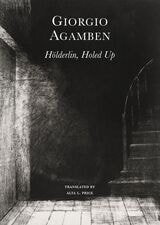
Hölderlin’s Madness
Chronicle of a Dwelling Life, 1806–1843Giorgio Agamben
Seagull Books, 2023
What does it mean to inhabit a place or a self? What is a habit? And, for human beings, doesn’t living mean—first and foremost—inhabiting? Pairing a detailed chronology of German poet Friedrich Hölderlin’s years of purported madness with a new examination of texts often considered unreadable, Giorgio Agamben's new book aims to describe and comprehend a life that the poet himself called habitual and inhabited.
Hölderlin’s life was split neatly in two: his first 36 years, from 1770 to 1806; and the 36 years from 1807 to 1843, which he spent as a madman holed up in the home of Ernst Zimmer, a carpenter. The poet lived the first half of his existence out and about in the broader world, relatively engaged with current events, only to then spend the second half entirely cut off from the outside world. Despite occasional visitors, it was as if a wall separated him from all external events and relationships. For reasons that may well eventually become clear, Hölderlin chose to expunge all character—historical, social, or otherwise—from the actions and gestures of his daily life. According to his earliest biographer, he often stubbornly repeated, “nothing happens to me.” Such a life can only be the subject of a chronology—not a biography, much less a clinical or psychological analysis. Nevertheless, this book suggests that this is precisely how Hölderlin offers humanity an entirely other notion of what it means to live. Although we have yet to grasp the political significance of his unprecedented way of life, it now clearly speaks directly to our own.