Results by title
8812 books match the query 'Political Science' and 217 start with h

Human Rights, Sexual Orientation and Gender Identity in The Commonwealth
Edited by Corinne Lennox and Matthew Waites
University of London Press, 2013
Human Rights
Concepts, Contests, ContingenciesAustin Sarat and Thomas R. Kearns, Editors
University of Michigan Press, 2002
Human Values and Beliefs
A Cross-Cultural SourcebookRonald Inglehart, Miguel Basanez, and Alejandro Moreno
University of Michigan Press, 1998
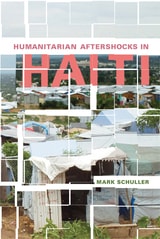
Humanitarian Aftershocks in Haiti
Schuller, Mark
Rutgers University Press, 2016
The 2010 earthquake in Haiti was one of the deadliest disasters in modern history, sparking an international aid response—with pledges and donations of $16 billion—that was exceedingly generous. But now, five years later, that generous aid has clearly failed. In Humanitarian Aftershocks in Haiti, anthropologist Mark Schuller captures the voices of those involved in the earthquake aid response, and they paint a sharp, unflattering view of the humanitarian enterprise.
Schuller led an independent study of eight displaced-persons camps in Haiti, compiling more than 150 interviews ranging from Haitian front-line workers and camp directors to foreign humanitarians and many displaced Haitian people. The result is an insightful account of why the multi-billion-dollar aid response not only did little to help but also did much harm, triggering a range of unintended consequences, rupturing Haitian social and cultural institutions, and actually increasing violence, especially against women. The book shows how Haitian people were removed from any real decision-making, replaced by a top-down, NGO-dominated system of humanitarian aid, led by an army of often young, inexperienced foreign workers. Ignorant of Haitian culture, these aid workers unwittingly enacted policies that triggered a range of negative results. Haitian interviewees also note that the NGOs “planted the flag,” and often tended to “just do something,” always with an eye to the “photo op” (in no small part due to the competition over funding). Worse yet, they blindly supported the eviction of displaced people from the camps, forcing earthquake victims to relocate in vast shantytowns that were hotbeds of violence.
Humanitarian Aftershocks in Haiti concludes with suggestions to help improve humanitarian aid in the future, perhaps most notably, that aid workers listen to—and respect the culture of—the victims of catastrophe.
Humanitarian Performance
From Disaster Tragedies to Spectacles of WarJames Thompson
Seagull Books, 2026
A groundbreaking lens on humanitarianism, which reframes global humanitarian responses to war and disaster through performance studies, revealing how aid, media, and public attention transform crisis into spectacle on a world stage.
As the world is challenged by a state of constant conflict and by disasters, both natural and manmade, support communities endeavour through humanitarianism to overcome human suffering and help to build more peaceful and safe futures. Humanitarian Performance argues that the humanitarian project—from its history and rationale to its contemporary practice—can be productively explored through the critical lens of performance studies. Using the outpouring of international support for projects to benefit survivors of the Asian tsunami, the War in Kosovo, and the crisis in Darfur as case studies, this timely volume explores humanitarian attention to these narratives and the stories of tragedy and survival that emerge. With the peculiar focus and international audiences that the media brings to local tragedies, these contemporary disasters—and the humanitarianism that they elicit—become a performance on the world stage.
Humanitarian Violence
The U.S. Deployment of DiversityNeda Atanasoski
University of Minnesota Press, 2013
When is a war not a war? When it is undertaken in the name of democracy, against the forces of racism, sexism, and religious and political persecution? This is the new world of warfare that Neda Atanasoski observes in Humanitarian Violence, different in name from the old imperialism but not so different in kind. In particular, she considers U.S. militarism—humanitarian militarism—during the Vietnam War, the Soviet-Afghan War, and the 1990s wars of secession in the former Yugoslavia.
What this book brings to light—through novels, travel narratives, photojournalism, films, news media, and political rhetoric—is in fact a system of postsocialist imperialism based on humanitarian ethics. In the fiction of the United States as a multicultural haven, which morally underwrites the nation’s equally brutal waging of war and making of peace, parts of the world are subject to the violence of U.S. power because they are portrayed to be homogeneous and racially, religiously, and sexually intolerant—and thus permanently in need of reform. The entangled notions of humanity and atrocity that follow from such mediations of war and crisis have refigured conceptions of racial and religious freedom in the post–Cold War era. The resulting cultural narratives, Atanasoski suggests, tend to racialize ideological differences—whereas previous forms of imperialism racialized bodies. In place of the European racial imperialism, U.S. settler colonialism, and pre–civil rights racial constructions that associated racial difference with a devaluing of nonwhite bodies, Humanitarian Violence identifies an emerging discourse of race that focuses on ideological and cultural differences and makes postsocialist and Islamic nations the potential targets of U.S. disciplining violence.
Humanitarianism from Below?
Universalism and the Politics of InhumanityEdited by Till Mostowlansky and Elmira Muratova
University College London, 2026
The first global comparative analysis of the role of humanitarianism from below in political and social change.
Drawing on original ethnographic and historical research, Humanitarianism from Below? addresses a wide audience of scholars and students in humanitarian and development studies, anthropology, and political science. Drawing from timely case studies on the war in Ukraine, the Ebola pandemic in West Africa, the 2023 Turkey-Syria earthquakes, and the global flows of aid from Arab states to the Persian Gulf, the book considers humanitarianism’s multiple histories and offers a profound reassessment of humanitarian pluralism today. It critically discusses humanitarianism as a historically, politically, and culturally contingent phenomenon that entails unequal relations of power and multiple forms of universalism, as well as issues of dehumanization and inhumanity.
Humanity's Last Stand
Confronting Global CatastropheMark Schuller
Rutgers University Press, 2021
Humanity’s Last Stand dares to ask these big questions, exploring the interconnections between climate change, global capitalism, xenophobia, and white supremacy. As it unearths how capitalism was born from plantation slavery and the slaughter of Indigenous people, it also invites us to imagine life after capitalism. The book teaches its readers how to cultivate an anthropological imagination, a mindset that remains attentive to local differences even as it identifies global patterns of inequality and racism.
Surveying the struggles of disenfranchised peoples around the globe from frontline communities affected by climate change, to #BlackLivesMatter activists, to Indigenous water protectors, to migrant communities facing increasing hostility, anthropologist Mark Schuller argues that we must develop radical empathy in order to move beyond simply identifying as “allies” and start acting as “accomplices.” Bringing together the insights of anthropologists and activists from many cultures, this timely study shows us how to stand together and work toward a more inclusive vision of humanity before it’s too late.
More information and instructor resources (https://humanityslaststand.org)
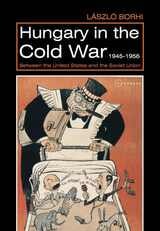
Hungary in the Cold War, 1945-1956
Between the United States and the Soviet UnionLászló Borhi
Central European University Press, 2004
Hunt the Devil
A Demonology of US War CultureRobert L. Ivie and Oscar Giner
University of Alabama Press, 2015
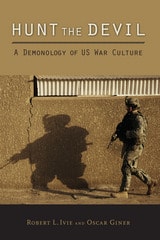
Meticulously researched, documented, and argued, Hunt the Devil opens with contemporary images of the US’s global war on terror in the aftermath of 9/11. In five chapters devoted to the demonization of evildoers, witches, Indians, dictators, and Reds by American writers, in presidential rhetoric, and in popular culture, Ivie and Giner show how the use of demonization in the war on terror is only the most recent manifestation of a process that has recurred throughout American history.
In a sixth chapter, the authors introduce the archetype of the Trickster. Though not opposed to the Devil per se, the Trickster’s democratic impulses have often provided a corrective antidote to the corrosive and distorting effects of demonization. Invoking the framework of Carl Jung’s shadow aspect, Hunt the Devil offers the Trickster as a figure who can break the cycle of demonization and war.
The role of the mythic Devil in the American psyche has profound implications, not just for American diplomacy and the use of American arms in the world, but for the possibility of domestic peace within an increasingly diverse society. Hunt the Devil provides much of interest to readers and scholars in the fields of war, rhetorical studies, American Studies, US political culture, Jungian psychology, and mythography.

Husserl and the Idea of Europe
Timo Miettinen
Northwestern University Press, 2020
Husserl and the Idea of Europe argues that Edmund Husserl’s late reflections on Europe should not be read either as departures from his early transcendental phenomenology or as simple exercises of cultural criticism but rather as systematic phenomenological reflections on generativity and historicity. Timo Miettinen shows that Husserl’s deliberations on Europe contain his most compelling and radical interpretation of the intersubjective, communal, and historical dimensions of phenomenology.
Husserl and his generation worked in the aftermath of World War I, as Europe struggled to redefine itself, and he penned his late writings as the clouds of World War II gathered. Decades later, the fall of the Soviet Union again altered the continent’s identity and its political and economic divisions. Miettinen writes as a European involved in the question of Europe, and many of the recent authors and critics he addresses in this work—such as Michel Foucault, Jacques Derrida, and Giorgio Agamben—likewise deeply engaged with this new problem of European identity. The book illuminates the multifaceted problem of the idea of European rationality, and it defends novel conceptions of universalism and teleology as necessary components of radical philosophical reflection.
Hybrid Constitutions
Challenging Legacies of Law, Privilege, and Culture in Colonial AmericaVicki Hsueh
Duke University Press, 2010
Hsueh traces the historical development and theoretical implications of proprietary constitutionalism by examining the founding of the colonies of Maryland, Carolina, and Pennsylvania. She provides close readings of colonial proclamations, executive orders, and assembly statutes, as well as the charter granting Cecilius Calvert the colony of Maryland in 1632; the Fundamental Constitutions of Carolina, adopted in 1669; and the treaties brokered by William Penn and various Lenni Lenape and Susquehannock tribes during the 1680s and 1690s. These founding documents were shaped by ambition, contingency, and limited resources; they reflected an ambiguous and unwieldy colonialism rather than a purposeful, uniform march to modernity. Hsueh concludes by reflecting on hybridity as a rubric for analyzing the historical origins of colonialism and reconsidering contemporary indigenous claims in former settler colonies such as Australia, New Zealand, and the United States.
Hybrid Justice
The Extraordinary Chambers in the Courts of CambodiaJohn D. Ciorciari and Anne Heindel
University of Michigan Press, 2014
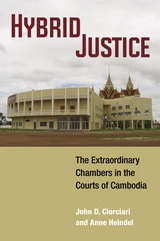
Since 2006, the United Nations and Cambodian Government have participated in the Extraordinary Chambers in the Courts of Cambodia, a hybrid tribunal created to try key Khmer Rouge officials for crimes of the Pol Pot era. In Hybrid Justice, John D. Ciorciari and Anne Heindel examine the contentious politics behind the tribunal’s creation, its flawed legal and institutional design, and the frequent politicized impasses that have undermined its ability to deliver credible and efficient justice and leave a positive legacy. They also draw lessons and principles for future hybrid and international courts and proceedings.

Hybrid Justice
The Extraordinary Chambers in the Courts of CambodiaJohn D. Ciorciari and Anne Heindel
University of Michigan Press, 2023
Since 2006, the United Nations and Cambodian Government have participated in the Extraordinary Chambers in the Courts of Cambodia, a hybrid tribunal created to try key Khmer Rouge officials for crimes of the Pol Pot era. In Hybrid Justice, John D. Ciorciari and Anne Heindel examine the contentious politics behind the tribunal’s creation, its flawed legal and institutional design, and the frequent politicized impasses that have undermined its ability to deliver credible and efficient justice and leave a positive legacy. They also draw lessons and principles for future hybrid and international courts and proceedings.

Hydra Rising
The Enduring Struggle for Freedom, Mobility, and the CommonsBridget Anderson, Nandita Sharma, and Cynthia Wright, editors
Duke University Press, 2027
Hyperpolitics
An Interactive Dictionary of Political Science ConceptsMauro Calise and Theodore J. Lowi
University of Chicago Press, 2010
Fifteen years in the making, Hyperpolitics is an interactive dictionary offering a wholly original approach for understanding and working with the most central concepts in political science. Designed and authored by two of the discipline’s most distinguished scholars, its purpose is to provide its readers with fresh critical insights about what informs these political concepts, as well as a method by which readers—and especially students—can unpack and reconstruct them on their own.
International in scope, Hyperpolitics draws upon a global vocabulary in order to turn complex ideas into an innovative teaching aid. Its companion open access website (www.hyperpolitics.net) has already been widely acknowledged in the fields of education and political science and will continue to serve as a formidable hub for the book’s audience. Much more than a dictionary and enhanced by dynamic graphics, Hyperpolitics introduces an ingenious means of understanding complicated concepts that will be an invaluable tool for scholars and students alike.
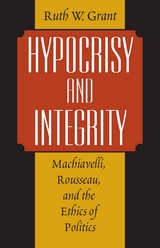
Hypocrisy and Integrity
Machiavelli, Rousseau, and the Ethics of PoliticsRuth W. Grant
University of Chicago Press, 1997