Results by title
87 books match the query 'AIDS (Disease)' and 5 start with i

If Memory Serves
Gay Men, AIDS, and the Promise of the Queer PastChristopher Castiglia
University of Minnesota Press, 2011
The AIDS epidemic soured the memory of the sexual revolution and gay liberation of the 1970s, and prominent politicians, commentators, and academics instructed gay men to forget the sexual cultures of the 1970s in order to ensure a healthy future. But without memory there can be no future, argue Christopher Castiglia and Christopher Reed in this exploration of the struggle over gay memory that marked the decades following the onset of AIDS.
Challenging many of the assumptions behind first-wave queer theory, If Memory Serves offers a new perspective on the emergence of contemporary queer culture from the suppression and repression of gay memory. Drawing on a rich archive of videos, films, television shows, novels, monuments, paintings, and sculptures created in the wake of the epidemic, the authors reveal a resistance among critics to valuing—even recognizing—the inscription of gay memory in art, literature, popular culture, and the built environment. Castiglia and Reed explore such topics as the unacknowledged ways in which the popular sitcom Will and Grace circulated gay subcultural references to awaken a desire for belonging among young viewers; the post-traumatic (un)rememberings of queer theory; and the generation of “ideality politics” in the art of Félix González-Torres, the film Chuck & Buck, and the independent video Video Remains.
Inspired by Alasdair MacIntyre’s insight that “the possession of a historical identity and the possession of a social identity coincide,” Castiglia and Reed demonstrate that memory is crafted in response to inadequacies in the present—and therefore a constructive relation to the past is essential to the imagining of a new future.

In Changing Times
Gay Men and Lesbians Encounter HIV/AIDSEdited by Martin P. Levine, Peter M. Nardi, and John H. Gagnon
University of Chicago Press, 1997
The distinguished contributors to this volume discuss the ways HIV/AIDS has changed collective and individual identities, as well as lives, of gay men and lesbians, and how these alterations have changed our perceptions of the epidemic. They cover such topics as the impact of the epidemic on small towns, cultural barriers to AIDS prevention, gay youth and intergenerational relations, and the roles of lesbians in AIDS organizations. This collection provides compelling insights into the new communities among gay men and lesbians and the new kinds of identities and relationships that are emerging from the social and cultural ferment engendered by HIV/AIDS.
Contributors include Barry D. Adam, Lourdes Arguelles, Rafael Miguel Diaz, John H. Gagnon, Gilbert Herdt, Gregory M. Herek, Nan D. Hunter, Peter M. Nardi, John L. Peterson, Anne Rivero, Gayle S. Rubin, Beth E. Schneider, and Nancy E. Stoller.
In the Shadow of the Epidemic
Being HIV-Negative in the Age of AIDSWalt Odets
Duke University Press, 1995
Odets calls attention to the dire need to address issues that are affecting HIV-negative individuals—from concerns about sexuality and relations with those who are HIV-positive to universal questions about the nature and meaning of survival in the midst of disease. He argues that such action, while explicitly not directing attention away from the needs of those with AIDS, is essential to the human and biological well-being of gay communities. In the immensely powerful firsthand words of gay men living in a semiprivate holocaust, the need for a broader, compassionate approach to all of the AIDS epidemic’s victims becomes clear. In the Shadow of the Epidemic is a pathbreaking first step toward meeting that need.
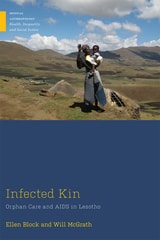
Infected Kin
Orphan Care and AIDS in LesothoEllen Block
Rutgers University Press, 2019
Supplementary instructor resources (https://www.csbsju.edu/sociology/faculty/anthropology-teaching-resources/infected-kin-teaching-resources)
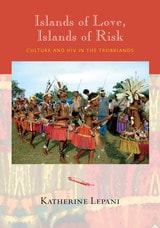
Islands of Love, Islands of Risk
Culture and HIV in the TrobriandsKatherine Lepani
Vanderbilt University Press, 2012
Written by an anthropologist who has direct ties to the Trobriands through marriage and who has been involved in Papua New Guinea's national response to the HIV epidemic since the mid-1990s, Islands of Love, Islands of Risk is an unusual insider ethnography. Katherine Lepani describes in vivid detail the cultural practices of regeneration, from the traditional dance called Wosimwaya to the elaborate exchanges that are part of the mortuary feasts called sagali. Focusing on the sexual freedom of young people, the author reveals the social value of sexual practice. By bringing cultural context and lived experience to the fore, the book addresses the failure of standardized public health programs to bridge the persistent gap between HIV awareness and prevention. The book offers insights on the interplay between global and local understandings of gender, sexuality, and disease and suggests the possibility of viewing sexuality in terms other than risk.
Islands of Love, Islands of Risk illustrates the contribution of ethnographic research methodology in facilitating dialogue between different ways of knowing. As a contemporary perspective on Malinowski's classic accounts of Trobriand sexuality, the book reaffirms the Trobriands' central place in the study of anthropology.
This book is the recipient of the annual Norman L. and Roselea J. Goldberg Prize for the best project in the area of medicine.