Results by title
64 books match the query 'African Diaspora' and 3 start with i
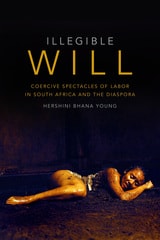
Illegible Will
Coercive Spectacles of Labor in South Africa and the DiasporaHershini Bhana Young
Duke University Press, 2017
In Illegible Will Hershini Bhana Young engages with the archive of South African and black diasporic performance to examine the absence of black women's will from that archive. Young argues for that will's illegibility, given the paucity of materials outlining the agency of black historical subjects. Drawing on court documents, novels, photographs, historical records, websites, and descriptions of music and dance, Young shows how black will can be conjured through critical imaginings done in concert with historical research. She critically imagines the will of familiar subjects such as Sarah Baartman and that of obscure figures such as the eighteenth-century slave Tryntjie of Madagascar, who was executed in 1713 for attempting to poison her mistress. She also investigates the presence of will in contemporary expressive culture, such as the Miss Landmine Angola beauty pageant, placing it in the long genealogy of the freak show. In these capacious case studies Young situates South African performance within African diasporic circuits of meaning throughout Africa, North America, and South Asia, demonstrating how performative engagement with archival absence can locate that which was never recorded.
[more]
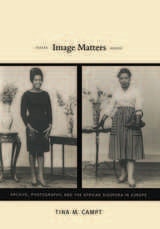
Image Matters
Archive, Photography, and the African Diaspora in EuropeTina M. Campt
Duke University Press, 2012
In Image Matters, Tina M. Campt traces the emergence of a black European subject by examining how specific black European communities used family photography to create forms of identification and community. At the heart of Campt's study are two photographic archives, one composed primarily of snapshots of black German families taken between 1900 and 1945, and the other assembled from studio portraits of West Indian migrants to Birmingham, England, taken between 1948 and 1960. Campt shows how these photographs conveyed profound aspirations to forms of national and cultural belonging. In the process, she engages a host of contemporary issues, including the recoverability of non-stereotypical life stories of black people, especially in Europe, and their impact on our understanding of difference within diaspora; the relevance and theoretical approachability of domestic, vernacular photography; and the relationship between affect and photography. Campt places special emphasis on the tactile and sonic registers of family photographs, and she uses them to read the complexity of "race" in visual signs and to highlight the inseparability of gender and sexuality from any analysis of race and class. Image Matters is an extraordinary reflection on what vernacular photography enabled black Europeans to say about themselves and their communities.
[more]
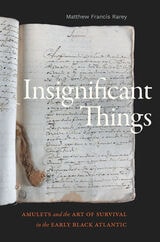
Insignificant Things
Amulets and the Art of Survival in the Early Black AtlanticMatthew Francis Rarey
Duke University Press, 2023
In Insignificant Things Matthew Francis Rarey traces the history of the African-associated amulets that enslaved and other marginalized people carried as tools of survival in the Black Atlantic world from the seventeenth to the nineteenth centuries. Often considered visually benign by white Europeans, these amulet pouches, commonly known as “mandingas,” were used across Africa, Brazil, and Portugal and contained myriad objects, from herbs and Islamic prayers to shells and coins. Drawing on Arabic-language narratives from the West African Sahel, the archives of the Portuguese Inquisition, sixteenth- and seventeenth-century European travel and merchant accounts of the West African Coast, and early nineteenth-century Brazilian police records, Rarey shows how mandingas functioned as portable archives of their makers’ experiences of enslavement, displacement, and diaspora. He presents them as examples of the visual culture of enslavement and critical to conceptualizing Black Atlantic art history. Ultimately, Rarey looks to the archives of transatlantic slavery, which were meant to erase Black life, for objects like the mandingas that were created to protect it.
[more]