Results by title
3576 books match the query 'American' and 115 start with i
I Always Carry My Bones
Felicia Zamora
University of Iowa Press, 2021

I Contain Multitudes
A New Life of Walt WhitmanEric G. Wilson
University of Chicago Press, 2027
Lively and entertaining, this is the first comprehensive biography of Walt Whitman in more than twenty-five years, drawing on significant new discoveries and scholarship.
Walt Whitman is not only one of the most influential and popular poets in American history but also a symbol of American character and independence, as important to our nation’s identity as Abraham Lincoln, Harriet Beecher Stowe, or Louis Armstrong. While his poetry and exuberant style still inspire writers today, our understanding of his life is due for an update. It has been over a quarter of a century since the last full-length biography of Whitman, and in that time several works by Whitman have been rediscovered—including a novel and a men’s health manual—that put Whitman in a new light. In I Contain Multitudes, Eric G. Wilson draws on these discoveries to give us a fresh life of Whitman, one that reveals him to be more playful, flexible, and pragmatic than we had known.
Whitman emerges here as an artist adept in almost every literary genre. Across these varied writings, he fashioned a comedic vision based on the multifariousness of the cosmos. In his life as well, he created a wide range of personae. Like an experienced actor, Whitman had many roles and selves at the ready: the urban dandy, the Broadway bohemian, the humble Civil War nurse. Wilson’s portrait casts well-studied Whitman traits in a new light: his radical egalitarianism, he shows, was suffused with humor—to be a good citizen meant not taking yourself too seriously—and his famous powers of empathy resulted in darkly funny challenges to oppressive hierarchies.
Wilson tells Whitman’s life in dozens of brief, vivid segments, an innovative approach that reflects Whitman’s own existential and literary brio. Presenting the multitudinous Whitman with both stylistic gusto and scholarly rigor, I Contain Multitudes reads as much like a novel as the authoritative biography it is.
I Follow in the Dust She Raises
Linda Martin
University of Alaska Press, 2015
I Live in the Country & other dirty poems
Arielle Greenberg
Four Way Books, 2020
I Love You But I Don't Speak Your Language
PoemsJason Bredle
University of Massachusetts Press, 2026
Poems that question the world with tenderness and restless introspection
In I Love You But I Don’t Speak Your Language, brushes with the profound may lead to brushes with the mundane, or vice versa. Cause and effect become unreasoned and transcendent, at times lifting the arbitrary into the sublime or the sublime into happenstance. Intuitive leaps pull us through oscillations between humor, introspection, and the surreal. These poems don’t follow a straight path; instead, they capture the way thoughts shift, contradict, and collide.
Inspired by the poet’s dreams, as well as travels throughout central Europe, the West Indies, and Central and South America, the poems are alive in voice and detail, yet the speaker’s connections, and more so, disconnections, turn toward isolationism, solitude, and loneliness. At times, the collection leans into restless emotion: “I want to cry / when I think of how / I’ll look back at this moment someday / and cry.” Other moments pull the reader to “a far away place / of limitless palm trees and sunsets.” This is poetry that doesn’t try to fit into a traditional form. It questions, observes, and rethinks the world around it. Some moments might seem absurd, others deeply reflective, but all of them work together to create a book that is both thought-provoking and unpredictable.
I Swallow Turquoise for Courage
Hershman R. John
University of Arizona Press, 2007
With their recurring images of sheep, coyotes, and crows—and an ever-present Navajo grandmother—these poems carry echoes of an ancient time that seems to exist in parallel with our own. The people who live in them bear, as if woven strand by strand into their souls, the culture and traditions of the Glittering World. Although these poems are lush with imagery of sunbaked lands, they are never sentimental. Throughout this collection, the poet’s voice is confident, assured, and engaged with life in a messy world. It is a world in which animated spirits dwell comfortably with modern machinery, where the spiritual resides with the all-too-human. This is a welcoming universe. It invites us to enter, to linger, to savor, and to learn.
I Think Again of Those Ancient Chinese Poets
Tom Sexton
University of Alaska Press, 2010
I Was Waiting to See What You Would Do First
PoemsAngie Mazakis
University of Arkansas Press, 2020
Like nesting dolls, the poems in I Was Waiting to See What You Would Do First contain scenes within scenes, inviting the reader over and over again to sharpen focus on minute details that, though small, reveal much about human perception and imagination.
Angie Mazakis handles these layers of revelation with great tenderness. Her poems wander in the way that a curious mind wanders, so that even though they often end very far from where they started, they are anchored in the familiar, referring to experiences we all share: a moment of distraction in a coffee shop imagining a conversation with someone across the room, or a narrative built around the expressions of the cartoon people on the airplane seatback safety guide.
I Was Waiting to See What You Would Do First is a testament to the notion that whether through a cosmic or microscopic lens, “You just see one moment; you just see now.”
I Will Say Beauty
Carol Frost
Northwestern University Press, 2003
"I will say beauty," Carol Frost boldly says in one of her new lyrical poems, beauty being for her and all of us elusive-in and out of nature. The phrase is meant as a cri de coeur, and the poems are arranged to offer a fresh way to look at--and exist within--nature. For Frost, beauty is a far cry from the decorous and social.
Frost sets many of these poems in Florida's Cedar Keys, amidst the nesting areas of birds, cottonmouth snakes, wetlands, and tidal rhythms. The reader undertakes a journey through a tropical summer, where strange scents and sounds are signs of the transient beauties the imagination may possess for a moment. Drawing brilliantly from nature and from art, from the rhythms of life and the furies of emotion, Frost rejects standard responses and dares to ask: how do we perceive the world? When is beauty not enough? Can we imagine Paradise? And, when nature ordains that death must come, and we weaken, how do we die?
I Write This to You
SonnetsRoger Armbrust
Parkhurst Brothers, Inc., 2022

I'm Black When I'm Singing, I'm Blue When I Ain't and Other Plays
Sonia Sanchez
Duke University Press, 2010

Ice Floe II
International Poetry of the Far NorthEdited by Shannon Gramse and Sarah Kirk
University of Alaska Press, 2011
The long-awaited second volume of the newly revived Ice Floe series, Ice Floe II features new and exciting works of poetry from a vibrant and diverse group of writers from Alaska, Canada, Russia, Sweden, Iceland, and beyond. All work is presented here in both its original language and in English translation. With contributors that include former Alaska poet laureate Tom Sexton, Riina Katajavuori, Yuri Vaella, Gunnar Randversson, and dozens of other established and emerging poets, this wonderful collection of voices from the northern latitudes will be a great read for all lovers of poetry and international literature.
Identifying the Pathogen
Jennifer Militello
Tupelo Press, 2026
Composed as a lab notebook recording various surgeries, autopsies, and experiments, Identifying the Pathogen tells the story of a scientist on an obsessive quest to document an ailment that resists classification. The book considers the body in response to the COVID-19 pandemic, woven through with the story of Anna Morandi Manzolini—an eighteenth-century Italian anatomist and artist who struggled to support a husband suffering from depression—as well as several essays detailing accounts of a ruptured appendix, a splintered cello, and an ill-fated rock climbing excursion.

Identity and the Failure of America
From Thomas Jefferson to the War on TerrorJohn Michael
University of Minnesota Press, 2008
From Thomas Jefferson to John Rawls, justice has been at the center of America’s self-image and national creed. At the same time, for many of its peoples-from African slaves and European immigrants to women and the poor-the American experience has been defined by injustice: oppression, disenfranchisement, violence, and prejudice.
In Identity and the Failure of America, John Michael explores the contradictions between a mythic national identity promising justice to all and the realities of a divided, hierarchical, and frequently iniquitous history and social order. Through a series of insightful readings, Michael analyzes such cultural moments as the epic dramatization of the tension between individual ambition and communal complicity in Moby-Dick, attempts to effect social change through sympathy in the novels of Lydia Marie Child and Harriet Beecher Stowe, Ralph Waldo Emerson’s antislavery activism and Frederick Douglass’s long fight for racial equity, and the divisive figures of John Brown and Nat Turner in American letters and memory.
Focusing on exemplary instances when the nature of the United States as an essentially conflicted nation turned to force, Michael ultimately posits the development of a more cosmopolitan American identity, one that is more fully and justly imagined in response to the nation’s ethical failings at home and abroad.
John Michael is professor of English and of visual and cultural studies at the University of Rochester. He is the author of Anxious Intellects: Academic Professionals, Public Intellectuals, and Enlightenment Values and Emerson and Skepticism: The Cipher of the World.
If No Moon
Moira Linehan
Southern Illinois University Press, 2007
If Some God Shakes Your House
Jennifer Franklin
Four Way Books, 2023
Jennifer Franklin reimagines an Antigone for our times in her third collection, If Some God Shakes Your House, where filial devotion and ossified roles of gendered labor become the engine of her defiance. Franklin’s Antigone is ferocious, feeling, and unafraid of the consequences of speaking the truth to power about the political atrocities she has witnessed and personal traumas she has withstood. With a sensitivity that equally elevates the quotidian and the classical, and an attention that moves from the ancient ruins of Pompeii to the right of bodily autonomy and agency stripped away by our own Supreme Court, Franklin reveals the high stakes of our moment where “the one who does the judging judges things all wrong.” Franklin’s Antigone has embraced the sacrifice of self for something greater—a dual devotion to her disabled daughter and to her art. “For twenty years, I have been disappearing,” she writes in the book’s final poem, yet she continues to sing.
If the House
Molly Spencer
University of Wisconsin Press, 2019

Igniting Wonder
Plays for PreschoolersChildren’s Theatre Children’s Theatre Company
University of Minnesota Press, 2013
Young children love to explore their world through drama—characters, dialogue, story arcs, and props are all standard elements of a child’s play. It is no surprise then that professional theatre has long been regarded as a way to support children’s social-emotional, cognitive, and creative development. Increasingly, there is an international interest in theatre for very young audiences, and the Wall Street Journal reported on a “baby boom” in American theatre, with a marked upswing in the number of stage plays being written and produced for toddlers and preschoolers.
Fueled by ongoing research into developmental psychology and theatre arts, the Children’s Theatre Company (CTC) of Minneapolis presents in this book four of its newly commissioned plays for preschoolers. CTC is widely recognized as the leading theatre for young people and families in North America; it received the 2003 Tony award for regional theatre, and Time magazine rated it the number one children’s theatre in the United States. These four plays encompass a broad range of styles and subjects: Bert and Ernie, Goodnight! is a musical about Bert and Ernie’s unlikely but true friendship, written by Barry Kornhauser and based on the original songs and scripts from Sesame Street. The Biggest Little House in the Forest is a toy-theatre play about a group of diverse animals trying to share a very tiny home, adapted by Rosanna Staffa from the book by Djemma Bider. The Cat’s Journey is a dazzling shadow-puppet play with a little girl who rides on a friendly cat, written by Fabrizio Montecchi. And Victoria Stewart’s Mercy Watson to the Rescue!, adapted from the Kate DiCamillo Mercy Watson series, is a comic romp featuring the inadvertent heroics of everyone’s favorite porcine wonder.
While these plays are as different as they could be, they all help young children to develop a moral compass and critical-thinking skills—while also showing them the power of the theatre to amaze, delight, and inspire.
Illiterate Heart
PoemsMeena Alexander
Northwestern University Press, 2002
Recipient, 2008 Guggenheim Fellowship
Meena Alexander's poetry emerges as a consciousness moving between the worlds of memory and the present, enhanced by multiple languages. Her experience of exile is translated into the intimate exploration of her connections to both India and America. In one poem the thirteenth-century Persian poet Rumi visits with her while she speaks on the phone in her New York apartment, and in another she evokes fellow-poet Allen Ginsberg in the India she herself has left behind. Drawing on the fascinating images and languages of her dual life, Alexander deftly weaves together contradictory geographies, thoughts, and feelings.
Illuminating Letters
Typography and Literary InterpretationPaul C. Gutjahr
University of Massachusetts Press, 2001
What do we read when we read a text? The author's words, of course, but is that all? The prevailing publishing ethic has insisted that typography—the selection and arrangement of type and other visual elements on a page—should be an invisible, silent, and deferential servant to the text it conveys.
This book contests that conventional point of view. Looking at texts ranging from the King James Bible to contemporary comic strips, the contributors to Illuminating Letters examine the seldom considered but richly revealing relationships between a text's typography and its literary interpretation. The essays assume no previous typographic knowledge or expertise; instead they invite readers primarily concerned with literary and cultural meanings to turn a more curious eye to the visual and physical forms of a specific text or genre. As the contributors show, closer inspection of those forms can yield fresh insights into the significance of a text's material presentation, leading readers to appreciate better how presentation shapes understandings of the text's meanings and values.
The case studies included in the volume amplify its two overarching themes: one set explores the roles of printers and publishers in manipulating, willingly or not, the meaning and reception of texts through typographic choices; the other group examines the efforts of authors to circumvent or subvert such mediation by directly controlling the typographic presentation of their texts. Together these essays demonstrate that choices about type selection and arrangement do indeed help to orchestrate textual meaning.
In addition to the editors, contributors include Sarah A. Kelen, Beth McCoy, Steven R. Price, Leon Jackson, and Gene Kannenberg Jr.

Illuminative Moments in Pacific Northwest Prose
1800 to the PresentRichard W. Etulain
University of Nevada Press, 2024
Etulain provides extensive coverage of the writings of notable authors, including novelists Frederic Homer Balch and Mary Hallock Foote, offering an understanding of frontier romantic and Local Color Writers. He also explores the works of H. G. Merriam and novelist H. L. Davis, illustrating regional prose writings. Finally, Etulain includes a panoply of writers who exemplify an emphasis on gender, race and ethnicity, and environmental texts from the post-WWII period.
Illuminative Moments in Pacific Northwest Prose delivers a first-time overview of the region’s literary contributions that will interest both scholars and general readers alike.
Illusion Is More Precise than Precision
The Poetry of Marianne MooreDarlene Williams Erickson
University of Alabama Press, 1992
Erickson examines the work of Marianne Moore in order to provide some consistently successful strategies for understanding her poetry
In 1935, T.S. Eliot wrote that Marianne Moore’s poems “form part of the small body of durable poetry written in our time.” In this comprehensive critical study of the American poet Marianne Moore (1887-1972) and her work, Erickson amply justifies Eliot’s praise, demonstrating the poet’s ability to combine close observation with a worldview presentation that is at once intuitive, kaleidoscopic, and optimistic. Unfortunately, over the years the excellence and originality of Moore’s work has been overshadowed by its apparent inscrutability. Erickson examines the work of Marianne Moore in order to provide some consistently successful strategies for understanding her poetry.
The thesis is centered in a line from Moore’s poem, “Armor’s Undermining Modesty”:” What is more precise than precision? Illusion.” Erickson argues that Moore came to see herself humorously as “Imagnifico, a Wizard in Words,” a magician who used her conjuries to express a truth beyond reason, a truth described by the philosopher Henri Bergson as intuition, the highest stage of the evolution of human understanding. Is Erickson’s contention that Moore’s sense of magic is inextricably bound up in her own uniquely feminine epistemology, the tendency to place great value on intuition, and to find one’s own voice among collections of many voices.
This study demonstrates that Moore’s voice is arguably the strongest female voice in twentieth century American literature and her poetic voice could hold its own in the company of the best of the other modernists. Unlike many current scholars, Erickson examines closely the texts of Moore’s poems themselves, allowing the poet’s own voice to speak clearly. The study also explores Moore’s obsession with time, her preoccupation with the visual, her interest in the forms of Hebrew verse and her “susceptibility to happiness,” an outlook at some odds with the twentieth century’s fascination with the “romance of failure.”
While the book is scholarly in its intent and carefully documented, it is eminently readable and will be of interest of anyone fascinated by the mind of a brilliant twentieth century woman.
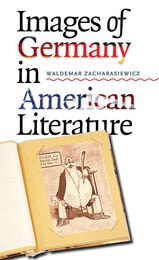
Images of Germany in American Literature
Waldemar Zacharasiewicz
University of Iowa Press, 2007
Starting with the notion of Germany as the ideal site for academic study and travel in the nineteenth century and concluding with the twentieth-century image of Germany as an aggressive country, this innovative work examines the ever-changing image of Germans and Germany in the writings of Louisa May Alcott, Samuel Clemens, Henry James, William James, George Santayana, W. E. B. Du Bois, John Dewey, H. L. Mencken, Katherine Anne Porter, Kay Boyle, Thomas Wolfe, Upton Sinclair, Gertrude Stein, Kurt Vonnegut, Thomas Pynchon, William Styron, Walker Percy, and John Hawkes, among others.
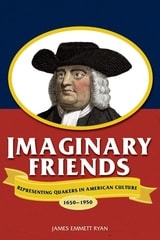
Imaginary Friends
Representing Quakers in American Culture, 1650–1950James Emmett Ryan
University of Wisconsin Press, 2009
Portrayals of Quakers—from dangerous and anarchic figures in seventeenth-century theological debates to moral exemplars in twentieth-century theater and film (Grace Kelly in High Noon, for example)—reflected attempts by writers, speechmakers, and dramatists to grapple with the troubling social issues of the day. As foils to more widely held religious, political, and moral values, members of the Society of Friends became touchstones in national discussions about pacifism, abolition, gender equality, consumer culture, and modernity.
Spanning four centuries, Imaginary Friends takes readers through the shifting representations of Quaker life in a wide range of literary and visual genres, from theological debates, missionary work records, political theory, and biography to fiction, poetry, theater, and film. It illustrates the ways that, during the long history of Quakerism in the United States, these “imaginary” Friends have offered a radical model of morality, piety, and anti-modernity against which the evolving culture has measured itself.
Winner, CHOICE Outstanding Academic Book Award

Imagined Dialogues
Eastern European Literature in Conversation with American and English LiteratureGordana Crnkovic
Northwestern University Press, 1999
Imagining Adoption
Essays on Literature and CultureMarianne Novy, Editor
University of Michigan Press, 2003
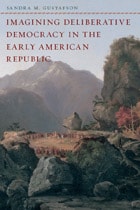
Imagining Deliberative Democracy in the Early American Republic
Sandra M. Gustafson
University of Chicago Press, 2011
Deliberation, in recent years, has emerged as a form of civic engagement worth reclaiming. In this persuasive book, Sandra M. Gustafson combines historical literary analysis and political theory in order to demonstrate that current democratic practices of deliberation are rooted in the civic rhetoric that flourished in the early American republic.
Though the U.S. Constitution made deliberation central to republican self-governance, the ethical emphasis on group deliberation often conflicted with the rhetorical focus on persuasive speech. From Alexis de Tocqueville’s ideas about the deliberative basis of American democracy through the works of Walt Whitman, John Dewey, John F. Kennedy, and Martin Luther King Jr., Gustafson shows how writers and speakers have made the aesthetic and political possibilities of deliberation central to their autobiographies, manifestos, novels, and orations. Examining seven key writers from the early American republic—including James Fenimore Cooper, David Crockett, and Daniel Webster—whose works of deliberative imagination explored the intersections of style and democratic substance, Gustafson offers a mode of historical and textual analysis that displays the wide range of resources imaginative language can contribute to political life.

Imagining Health
Medicine, Social Protest, and Modern American LiteratureIra Halpern
University of Massachusetts Press, 2026
In the United States, a deep suspicion of professional medical expertise is becoming increasingly prominent. Meanwhile, many arguments for health justice take a highly critical view of medical authority, even rejecting it entirely. In the early to mid-twentieth century, alternatively, as medicine rapidly professionalized, Americans came to hold the medical establishment in a particularly high regard, while many saw how it could play a crucial role in progressive politics. In this period, technologies developed, specializations grew, and medical education became standardized. With this process came inequities, as marginalized populations struggled to access the highest levels of care. Literary writers confronting social ills through their work included critiques of this new system in their writing, Ira Halpern argues. Without abandoning professional medicine, they called for alternative systems of care that could better serve diverse populations.
Halpern examines the work of several writers—including Robert Herrick, Wallace Thurman, Frank Slaughter, Charles Chesnutt, Walter White, Ralph Ellison, Charlotte Perkins Gilman, Upton Sinclair, Stephen Crane, and Edith Wharton—to demonstrate how American writing from this period embedded a critical look at healthcare within other elements of progressive politics, from racial protest and women’s rights to disability justice and counter-capitalist viewpoints. Placing this writing into historical context, in terms of medical and scientific developments as well as traditions of social protest, Halpern reveals the efforts of these writers to envision better alternative trajectories for a quickly evolving medical establishment that left too many Americans without reliable care.
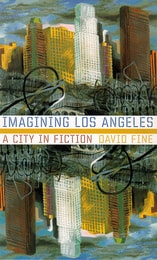
Imagining Los Angeles
A City In FictionDavid Fine
University of Nevada Press, 2004
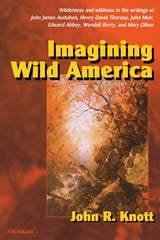
Imagining Wild America
John Knott
University of Michigan Press, 2002

Imagining the Forest
Narratives of Michigan and the Upper MidwestJohn Knott
University of Michigan Press, 2011
Forests have always been more than just their trees. The forests in Michigan (and similar forests in other Great Lakes states such as Wisconsin and Minnesota) played a role in the American cultural imagination from the beginnings of European settlement in the early nineteenth century to the present. Our relationships with those forests have been shaped by the cultural attitudes of the times, and people have invested in them both moral and spiritual meanings.
Author John Knott draws upon such works as Simon Schama's Landscape and Memory and Robert Pogue Harrison's Forests: The Shadow of Civilization in exploring ways in which our
relationships with forests have been shaped, using Michigan---its history of settlement, popular literature, and forest management controversies---as an exemplary case. Knott looks at such well-known figures as William Bradford, James Fenimore Cooper, John Muir, John Burroughs, and Teddy Roosevelt; Ojibwa conceptions of the forest and natural world (including how Longfellow mythologized them); early explorer accounts; and contemporary literature set in the Upper Peninsula, including Jim Harrison's True North and Philip Caputo's Indian Country.
Two competing metaphors evolved over time, Knott shows: the forest as howling wilderness, impeding the progress of civilization and in need of subjugation, and the forest as temple or cathedral, worthy of reverence and protection. Imagining the Forestshows the origin and development of both.
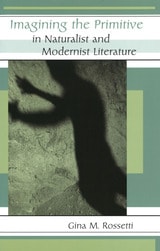
Imagining the Primitive in Naturalist and Modernist Literature
Gina M. Rossetti
University of Missouri Press, 2006
Imitations of Life
Fannie Hurst’s Gaslight SonatasAbe C. Ravitz
Southern Illinois University Press, 2009
In the early 1920s, Fannie Hurst’s enormous popularity made her the highest-paid writer in America. She conquered the literary scene at the same time the silent movie industry began to emerge as a tremendously profitable and popular form of entertainment. Abe C. Ravitz parallels Hurst’s growing acclaim with the evolution of silent films, from which she borrowed ideas and techniques that furthered her career. Ravitz notes that Hurst was amazingly adept at anticipating what the public wanted. Sensing that the national interest was shifting from rural to urban subjects, Hurst set her immigrant tales and her "woiking goil" tales in urban America. In her early stories, she tried to bridge the gap between Old World and New World citizens, each somewhat fearful and suspicious of the other. She wrote of love and ethnicity—bringing the Jewish Mother to prominence—of race relations and prejudice, of the woman alone in her quest for selfhood. Ravitz argues, in fact, that her socially oriented tales and her portraits of women in the city clearly identify her as a forerunner of contemporary feminism.
Ravitz brings to life the popular culture from 1910 through the 1920s, tracing the meteoric rise of Hurst and depicting the colorful cast of characters surrounding her. He reproduces for the first time the Hurst correspondence with Theodore Dreiser, Charles and Kathleen Norris, and Gertrude Atherton. Fellow writers Rex Beach and Vachel Lindsay also play important roles in Ravitz’s portrait of Hurst, as does Zora Neale Hurston, who awakened Hurst’s interest in the Harlem Renaissance and in race relations, as shown in Hurst’s novel Imitation of Life.
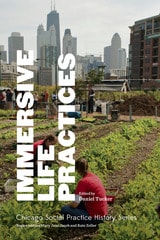
Immersive Life Practices
Edited by Daniel Tucker
School of the Art Institute of Chicago, 2014
Immersive Life Practices talks to Chicago-based artists and authors about life as an art practice and art as a life practice. The contributors explore a range of concerns, from how to be holistic, ethical, or practical; to how to balance life and work; to formal questions of how to represent a never-ending project. Some speak fondly of long-term collaborative relationships that sustain their work, while others place emphasis on the physical space in and outside the city as necessary to keep them grounded. Engaging and honest, the essays and interviews in this collection will resonate with anyone working to create a life—and an art—worth living.
Immersive Life Practices is part of the new Chicago Social Practice History series, edited by Mary Jane Jacob and Kate Zeller in the Department of Exhibitions and Exhibition Studies at the School of the Art Institute of Chicago (SAIC).
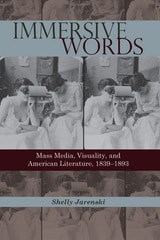
Immersive Words
Mass Media, Visuality, and American Literature, 1839–1893Shelly Jarenski
University of Alabama Press, 2015
The middle of the nineteenth century witnessed the emergence of numerous visual technologies and techniques: the daguerreotype, immersive exhibition spaces such as cycloramas and panoramas, mechanized tourism, and large-scale exhibitions and spectacles such as the World’s Fair. In closely argued chapters devoted to these four visual forms, Jarenski demonstrates that the popularity of these novelties catalyzed a shift by authors of the period beyond narratives that merely described images to ones that invoked aesthetic experiences.
Jarenski describes how Herman Melville adapts the aesthetic of the daguerreotype through his use of dramatic point-of-view and unexpected shifts that disorient readers. Frederick Douglass is shown to appropriate a panoramic aesthetic that severs spatial and temporal narratives from standard expectations. Jarenski traces how Nathaniel Hawthorne’s The Marble Faun found success as a travel guide to Rome, though intended as a work of serious fiction. Finally, Sarah Orne Jewett is shown to simulate the interactivity of the World Columbian Exposition to promote racialized and gendered forms of aesthetic communication. These techniques and strategies drawn from visual forms blur the just-so boundary critics and theorists have traditionally drawn between text and image.
In the mid-nineteenth century, the national identity of the United States remained fluid and hinged upon matters of gender, sexuality, and, crucially, race. Authors both reflected that evolving identity and contributed to its ongoing evolution. In demonstrating how the aesthetic and visual technologies of the nineteenth century changed the fundamental aesthetics of American literature, the importance of Immersive Words goes far beyond literary criticism.

Immortal Sofa
Maura Stanton
University of Illinois Press, 2008
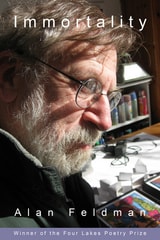
Immortality
Alan Feldman
University of Wisconsin Press, 2015
In a collection where the dead do speak, Feldman’s poems in his first segment, “Self-Portraits,” are more likely to be about others than about himself. The segment “Partners” reflects on marriage and divorce, the latter an “uncontested victor over marriage, / the way the flood is champion over the flood plain.” In the section “Offshore” Feldman writes about travel to Uruguay, his impractical love of sailing, and his wonder at Walter Cronkite’s obtuseness about Vietnam. In his final segment, “What Now?,” he asks about meaning itself. Babysitting his tiny granddaughter, he thinks of sailing—hours of boredom punctuated by moments of terror—and wonders if even this suggests something world-encompassing he’s “still hoping to find a name for. / If it isn’t joy.”
Winner of the Mass Book Award for Poetry, Massachusetts Center for the Book
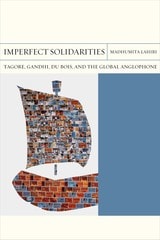
Imperfect Solidarities
Tagore, Gandhi, Du Bois, and the Global AnglophoneMadhumita Lahiri
Northwestern University Press, 2021
A century ago, activists confronting racism and colonialism—in India, South Africa, and Black America—used print media to connect with one another. Then, as now, the most effective medium for their undertakings was the English language. Imperfect Solidarities: Tagore, Gandhi, Du Bois, and the Global Anglophone tells the story of this interconnected Anglophone world. Through Rabindranath Tagore’s writings on China, Mahatma Gandhi’s recollections of South Africa, and W. E. B. Du Bois’s invocations of India, Madhumita Lahiri theorizes print internationalism. This methodology requires new terms within the worldwide hegemony of the English language (“the global Anglophone”) in order to encourage alternate geographies (such as the Global South) and new collectivities (such as people of color).
The women of print internationalism feature prominently in this account. Sonja Schlesin, born in Moscow, worked with Indians in South Africa. Sister Nivedita, an Irish woman in India, collaborated with a Japanese historian. Jessie Redmon Fauset, an African American, brought the world home to young readers through her work as an author and editor.
Reading across races and regions, genres and genders, Imperfect Solidarities demonstrates the utility of the neologism for postcolonial literary studies.
Impersonality
Seven EssaysSharon Cameron
University of Chicago Press, 2007
In American Waters
The Sea in American PaintingDaniel Finamore
University of Arkansas Press, 2021
In American Waters is the catalog of an exhibition co-organized by Crystal Bridges Museum of American Art in Bentonville, Arkansas, and Peabody Essex Museum in Salem, Massachusetts.
The exhibition and this associated catalog invite visitors to discover the sea as an expansive way to reflect on American culture and environment, learn how coastal and maritime symbols moved inland across the United States, and question what it means to be “in American waters.” Work by Georgia O’Keeffe, Amy Sherald, Kay WalkingStick, Norman Rockwell, Hale Woodruff, Paul Cadmus, Thomas Hart Benton, Jacob Lawrence, Valerie Hegarty, Stuart Davis, and many others is included, along with essays from scholars, critics, and the curators.
In Broken Latin
PoemsAnnette Spaulding-Convy
University of Arkansas Press, 2012
In Contagion's Wake
Black Writers and the Development of Modern Outbreak NarrativesKelly L. Bezio
University of Massachusetts Press, 2026
An examination of early American literature that highlights how racial divides exacerbated—and were exacerbated by—the spread of infection
In April of 1721, the HMS Seahorse arrived in Boston from the West Indies, causing a smallpox epidemic that would plague the city for the next year. Of its 12,000 inhabitants, nearly fifty percent were infected, and 900 people died. Like the coronavirus pandemic that began in 2020, the outbreak also brought to the surface deep divides in the social fabric of colonial New England and laid the groundwork for racialized political inequities that we continue to grapple with today.
In Contagion’s Wake examines a range of American outbreak narratives, both historical and fictional, written between the early 1700s and the early 1900s—from the rise of inoculation through the advent of germ theory. Author Kelly L. Bezio argues that during this period, literature about communicable disease was dominated by white authors, such as Cotton Mather and Edgar Allen Poe, who tended to privilege white suffering and survival while obscuring Black suffering and vulnerability. Black authors, however, such as Olaudah Equiano and Frances E.W. Harper, developed variations on plot structures, metaphors, and imagery that drew upon contagion to represent racial injustice and further the cause of Black liberation.
The diverse texts Bezio analyzes vary extensively in genre and geographical location, and in the illnesses that feature in their pages. Significant disorders from the era, including yellow fever, smallpox, consumption, and cholera, make frequent appearances, as do less culturally dominant diseases such as St. Anthony’s Fire. In Contagion’s Wake contends that representations of communicable disease should not be understood only as within their own historical moment; rather, they function more like a DNA code for our present time.

In Defense of Reason
Three Classics of Contemporary CriticismYvor Winters
Ohio University Press, 1947
Yvor Winters has here collected, with an introduction, the major critical works—Primitivism and Decadence, Maule’s Curse, and The Anatomy of Nonsense—of the period in which he worked out his famous and influential critical position. The works together show an integrated position which illuminates the force and importance of the individual essays. With The Function of Criticism, a subsequent collection, In Defense of Reason provides an incomparable body of critical writing.
The noted critic bases his analysis upon a belief in the existence of absolute truths and values, in the ethical judgment of literature, and in an insistence that it is the duty of the writer—as it is of very man—to approximate these truths insofar as human fallibility permits. His argument is by theory, but also by definite example—the technique of the “whole critic” who effectively combines close study of specific literary works and a penetrating investigation of aesthetic philosophies.
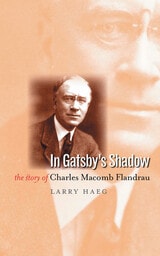
In Gatsby's Shadow
The Story of Charles Macomb FlandrauLarry Haeg
University of Iowa Press, 2004
Flandrau, a model of style and worldly sophistication and destined, almost everyone agreed, for greatness, was among the most talented young writers of his generation. His short stories about Harvard in the 1890s were called “the first realistic description of undergraduate life in American colleges” and sold out of the first printing in a few weeks. From 1899 to 1902 Flandrau was among the most popular contributors to the Saturday Evening Post. Alexander Woollcott rated him the best essayist in America. And Viva Mexico!, Flandrau’s account of life on a Mexican coffee plantation, is a classic, perhaps the best travel book ever written by an American. Yet Flandrau turned his back on it all. Financially independent, he chose a solitary, epicurean life in St. Paul, Mexico, Majorca, Paris, and Normandy. In later years, he confined his writing to local newspaper pieces and letters to his small circle of family and friends.
Using excerpts from these newspaper columns and unpublished letters, Larry Haeg has painstakingly recreated the story of this urbane, talented, witty, lazy, enigmatic, supremely private man who never reached the peak of literary success to which his talent might have taken him.
This very readable biography provides a detailed and honest portrayal of Flandrau and his times. It will fascinate readers interested in writers’ life stories and scholars of American literature as well as general readers interested in midwestern literary history.
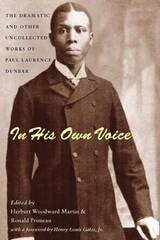
In His Own Voice
The Dramatic and Other Uncollected Works of Paul Laurence DunbarPaul Laurence Dunbar
Ohio University Press, 2002
In Kind
Maggie Queeney
University of Iowa Press, 2023

In Light of Stars
Bruce Willard
Four Way Books, 2021
Willard’s love of music combines with his love and respect for the natural world. Often rooted in, or coming out of, domestic encounters, the poems of this collection rise up (much like the clouds over his oft-traversed Rockies), as the speaker throws his attention to earth and sky, better to understand his own dynamic and shifting inner weather.
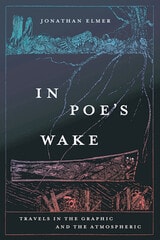
In Poe's Wake
Travels in the Graphic and the AtmosphericJonathan Elmer
University of Chicago Press, 2024
You’ll find his face everywhere, from coffee mugs, bobbleheads, and T-shirts to the cover of the Beatles’ Sergeant Pepper’s Lonely Hearts Club Band. Edgar Allan Poe is one of American culture’s most recognizable literary figures, his life and works inspiring countless derivations beyond the literary realm. Poe’s likeness and influence have been found in commercial illustration and kitsch, art installations, films, radio plays, children’s cartoons, and video games. What makes Poe so hugely influential in media other than his own? What do filmmakers, composers, and other artists find in Poe that suits their purposes so often and so variously?
In Poe’s Wake locates the source of the writer’s enduring legacy in two vernacular aesthetic categories: the graphic and the atmospheric. Jonathan Elmer uses Poe to explore these two terms and track some deep patterns in their use, not through theoretical labor but through close encounters with a wide sampling of aesthetic objects that avail themselves of Poe’s work. Poe’s writings are violent and macabre, memorable both for certain grisly images and for certain prevailing moods or atmospheres—dread, creepiness, and mournfulness. Furthermore, a bundle of Poe traits—his thematic emphasis on extreme sensation, his flexible sense of form, his experimental and modular method, and his iconic visage—amount to what could be called a Poe “brand,” one as likely to be found in music videos or comics as in novels and stories. Encompassing René Magritte, Claude Debussy, Lou Reed, Roger Corman, Spongebob Squarepants, and many others, Elmer’s book shows how the Poe brand opens trunk lines to aesthetic experiences fundamental to a multi-media world.
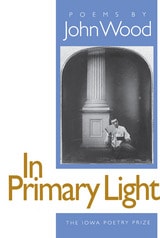
In Primary Light
John Wood
University of Iowa Press, 1994
John Wood is well known for his brilliant writing on the history of photography, but for many years he has also centered on his work as a poet, publishing in some of the very best magazines and gaining the deep admiration of many writers and poets. This book is testimony of his devotion to his craft – a fully realized, mature, and carefully constructed collection.
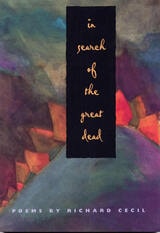
In Search of the Great Dead
Richard Cecil
Southern Illinois University Press, 1999
With grim humor and humorous grimness, In Search of the Great Dead engages the great themes of poetry: death and fame.
The title poem of this collection records Richard Cecil's quest for the tombs of the famous dead. At first the search leads him on a tour of famous European tombstones—the grave of Chateaubriand in St. Malo, the shared tomb of Gertrude Stein and Alice B. Toklas in Pere-Lachaise cemetery in Paris, Yeats's old Celtic cross in Sligo—but gradually it expands into areas where all the tombs have been erased by time or vandalism—the tombs of Seneca and Lucan, and all of the great dead poets whose names have been lost. These once famous, now unknown poets lead Cecil to consider those graveyards full of anonymous dead—the civil war soldiers buried under tiny stones with numbers instead of names inscribed on them. Are they more anonymous than the once famous, now forgotten "great" dead?
Though Cecil is wryly aware of his own obscurity, his poems are strangely optimistic and life-affirming. His reply to Emily Dickinson's question: "I'm Nobody—are you / Nobody, too?" is an enthusiastic yes! In Search of the Great Dead conveys the joy of being Nobody and the shy, almost buried hope that someday (after death), he might become Somebody.