Results by title
402 books match the query 'American poetry' and 16 start with i
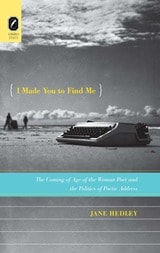
I Made You to Find Me
The Coming of Age of the Woman Poet and the Politics of Poetic AddressJane Hedley
The Ohio State University Press, 2009
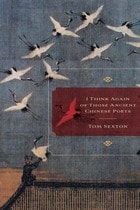
I Think Again of Those Ancient Chinese Poets
Tom Sexton
University of Alaska Press, 2010
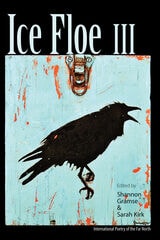
Ice Floe III
Edited by Shannon Gramse and Sarah Kirk
University of Alaska Press, 2012
The third volume of the revived Ice Floe series, Ice Floe III features new and exciting works of poetry by authors from Alaska, Canada, Iceland, the Faroe Islands, Norway, Sweden, Finland, and Russia. All work is presented in both its original language and in English translation. The contributors—Nancy Lord, Tom Sexton, Eira Stenberg, and Riina Katajavuori, among others—include established and emerging poets. This dynamic and vibrant collection of voices from the northern latitudes will be a great read for all poetry enthusiasts and devoted readers of international literature.

Ideogram
History of a Poetic MethodBy Laszlo K. Géfin
University of Texas Press, 1982
The ideogram changed the course of modern American poetry, and Ideogram is the first history of this important poetic tradition.
In modern poetry the ideogram is an idea presented to the reader by means of the juxtaposition of concrete particulars, usually without connective words or phrases. The poem is therefore presented in precise images, usually very tersely, and free from conventional form and meter. The idea of presenting a concept in this manner derives in part from Ernest Fenollosa's essay "The Chinese Character as a Medium for Poetry," the Chinese written character itself being a juxtaposition of pictographs to form a new meaning.
Ezra Pound's search for an alternative to traditional forms of verse composition resulted in his use of the ideogrammic method which, Laszlo K. Géfin asserts, became the major mode of presentation in twentieth-century American poetry. Two generations of avant-garde, experimental poets since Pound have turned to it for inspiration, evolving their own methods from its principles.
Géfin begins by tracing the development of Pound's poetics from the pre-Imagist stage through Imagism and Vorticism to the formulation of the ideogrammic method. He then examines the Objectivist poetics of Louis Zukofsky, Charles Reznikoff, and George Oppen; the contributions to the ideogrammic tradition of William Carlos Williams; and the Projectivist theories of Charles Olson, Robert Duncan, and Robert Creeley. He concludes with an exploration of Allen Ginsberg's theory of the ellipse and Gary Snyder's "riprap" method. Throughout, Géfin maintains that the ideogrammic mode is the literary representation of the twentieth-century post-logical—even post-humanist—world view.
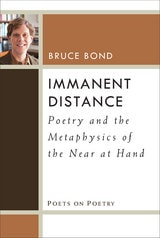
Immanent Distance
Poetry and the Metaphysics of the Near at HandBruce Bond
University of Michigan Press, 2015
In Praise of the Impure
Poetry and the Ethical Imagination: Essays, 1980-1991Alan Shapiro
Northwestern University Press, 1993
In Visible Movement
Nuyorican Poetry from the Sixties to SlamUrayoan Noel
University of Iowa Press, 2014
The first book-length study specifically devoted to Nuyorican poetry, In Visible Movement is unique in its historical and formal breadth, ranging from the foundational poets of the 1960s and 1970s to a variety of contemporary poets emerging in and around the Nuyorican Poets Cafe “slam” scene of the 1990s and early 2000s. It also unearths a largely unknown corpus of poetry performances, reading over forty years of Nuyorican poetry at the intersection of the printed and performed word, underscoring the poetry’s links to vernacular and Afro-Puerto Rican performance cultures, from the island’s oral poets to the New York sounds and rhythms of Latin boogaloo, salsa, and hip-hop. With depth and insight, Urayoán Noel analyzes various canonical Nuyorican poems by poets such as Pedro Pietri, Victor Hernández Cruz, Miguel Algarín, Miguel Piñero, Sandra María Esteves, and Tato Laviera. He discusses historically overlooked poets such as Lorraine Sutton, innovative poets typically read outside the Nuyorican tradition such as Frank Lima and Edwin Torres, and a younger generation of Nuyorican-identified poets including Willie Perdomo, María Teresa Mariposa Fernández, and Emanuel Xavier, whose work has received only limited critical consideration. The result is a stunning reflection of how New York Puerto Rican poets have addressed the complexity of identity amid diaspora for over forty years.
In a Fine Frenzy
Poets Respond to ShakespeareStarkey, David
University of Iowa Press, 2005
Showcasing poems by more than ninety contemporary American poets, In a Fine Frenzyreveals what Shakespeare’s poetic children have made of their inheritance. Particularly interested in Viola, Miranda, Prospero, Desdemona, Iago, Lear, Cordelia, Hamlet, Horatio, and Ophelia, the poets respond to the sonnets, the comedies, the tragedies, the romances, and, to a lesser degree, Shakespeare the man. In so doing they reveal the aspects of his work most currently captivating to modern writers.
Those who cherish Shakespeare’s mercurial wit will delight in the rapid shifts, from grief to hilarity, so characteristic of the bard himself. Comic poems about tragedies follow decidedly somber poems about comedies. Single poems contain multiple emotional twists and turns. Some pay homage; most interact directly with the original Shakespearean text. Collectively, they corroborate Ben Jonson's assertion that Shakespeare is “not of an age, but for all time.”
Inclined to Speak
An Anthology of Contemporary Arab American PoetryHayan Charara
University of Arkansas Press, 2008
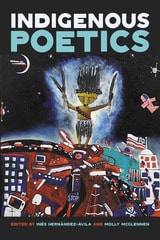
Indigenous Poetics
Inés Hernández-Ávila
Michigan State University Press, 2025
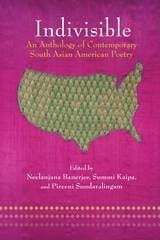
Indivisible
An Anthology of Contemporary South Asian American PoetryNeelanjana Banerjee
University of Arkansas Press, 2010
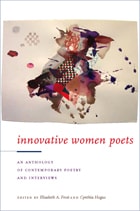
Innovative Women Poets
An Anthology of Contemporary Poetry and InterviewsElisabeth A. Frost
University of Iowa Press, 2007
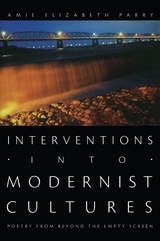
Interventions into Modernist Cultures
Poetry from Beyond the Empty ScreenAmie Elizabeth Parry
Duke University Press, 2007
Reading various works by US expatriates Ezra Pound and Gertrude Stein, Parry compares the cultural politics of U.S. canonical modernism with alternative representations of temporality, hybridity, erasure, and sexuality in the work of the Taiwanese writers Yü Kwang-chung and Hsia Yü and the Asian American immigrant author Theresa Hak Kyung Cha. Juxtaposing poems by Pound and Yü Kwang-chung, Parry shows how Yü’s fragmented, ambivalent modernist form reveals the effects of neocolonialism while Pound denies and obscures U.S. imperialism in Asia, asserting a form of nondevelopmental universalism through both form and theme. Stein appropriates discourses of American modernity and identity to represent nonnormative desire and sexuality, and Parry contrasts this tendency with representations of sexuality in the contemporary experimental poetry of Hsia Yü. Finally, Parry highlights the different uses of modernist forms by Pound in his Cantos—which incorporate a multiplicity of decontextualized and ahistorical voices—and by Cha in her 1982 novel Dictee, a historicized, multilingual work. Parry’s sophisticated readings provide a useful critical framework for apprehending how “minor modernisms” illuminate the histories erased by certain canonical modernist texts.
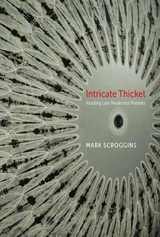
Intricate Thicket
Reading Late Modernist PoetriesMark Scroggins
University of Alabama Press, 2015
In these essays, Scroggins reviews the legacy of Louis Zukofsky, delineates the exceptional influence of the Black Mountain poets, and provides close readings of a wealth of examples of poetic works from poets who have carried the modernist legacy into contemporary poetry. He traces with an insider’s keen observation the careers of many of the most dynamic, innovative, and celebrated poets of the past half-century, among them Ian Hamilton Finlay, Ronald Johnson, Rae Armantrout, Harryette Mullen, and Anne Carson.
In a concluding pair of essays, Scroggins situates his own practice within the broad currents he has described. He reflects on his own aesthetics as a contemporary poet and, drawing on his extensive study and writing about Louis Zukofsky, examines the practical and theoretical challenges of literary biography.
While the core of these essays is the interpretation of poetry, Scroggins also offers clear aesthetic evaluations of the successes and failures of the poetries he examines. Scroggins engages with complex and challenging works, and yet his highly accessible descriptions and criticisms avoid theoretical entanglements and specialized jargon. Intricate Thicket yields subtle and multifaceted insights to experts and newcomers alike.
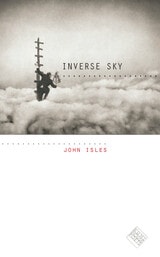
Inverse Sky
John Isles
University of Iowa Press, 2008
Part Baudelairian flâneur, an Arcadian shepherd, the speaker in John Isles’s brave new Inverse Sky encounters a fragmented history. It is nineteenth-century California, and the missions are still burning after the Americans establish the Bear Flag Republic; it is the twenty-first century, and the miners of '49 are relegated to a mural in an arcade. Both a loner and a lover, Isles’s pilgrim-poet takes us on a journey where Native Americans are “missing persons” outside a diorama of their ancestors, then sets us adrift in settings ranging from film noir to the clear-cut hills of modern-day California landscapes, under siege but not defeated.
Inverse Sky evokes the paradigm of a shocked and disbelieving child dealing with a broken promise, yet the poems carry within themselves the knowledge that promises will be kept. The only response to broken promises is “to come undone / to come and go in a single breath.” But this is a beginning as well as an end. Each poem becomes a new world—for if there is anything on earth worth loving, it is something made with the world as it has been handed down to us. Inverse Sky is an insistent effort to "love the things not loving back.”
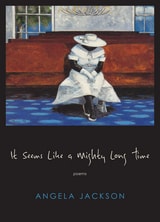
It Seems Like a Mighty Long Time
PoemsAngela Jackson
Northwestern University Press, 2015
2015 PEN Open Book Award Finalist
Angela Jackson’s latest collection of poetry borrows its title from a lyric in Barbara Lewis’s 1963 hit single “Hello Stranger,” recorded at Chess Records in Chicago. Like the song, Jackson’s poems are a melodic ode to the African American experience, informed by both individual lives and community history, from the arrival of the first African slave in Virginia in 1619 to post-Obama America.
It Seems Like a Mighty Long Time reflects the maturity of Jackson’s poetic vision. The Great Migration, the American South, and Chicago all serve as signposts, but it is the complexity of individual lives—both her own and those who have gone before, walk beside, and come after—that invigorate this collection. Upon surveying so vast a landscape, Jackson finds that sorrow meets delight, and joy lifts up anger and despair. And for all this time, love is the agent, the wise and just rule and guide.