Results by title
166 books match the query 'Archives' and 6 start with i
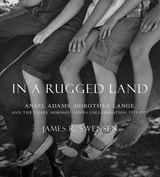
In a Rugged Land
Ansel Adams, Dorothea Lange, and the Three Mormon Towns Collaboration, 1953–1954James Swensen
University of Utah Press, 2018
In a Rugged Land examines the history and content of the two photographers’ forgotten collaboration Three Mormon Towns. Looking at Adams’s and Lange’s photographs, extant letters, and personal memories, the book provides a window into an important moment in their careers and seeks to understand why a project that once held such promise ended in disillusionment and is now little more than a footnote in their illustrative biographies. Swensen’s in-depth research and interpretation help make sense of what they did and place them alongside others who were also exploring the particular qualities of the Mormon village at that time.
Winner of the Joan Paterson Kerr Book Award for best illustrated book on the history of the American West from the Western History Association.
Winner of the Best Book Award from the Utah State Historical Society.
Winner of the 15 Bytes Book Award for Art Book.
Honorable mention for Best Book from the Mormon History Association.
Interview with Tom Williams at Access Utah
In-laws and Outlaws
Lessons in Research and Friendship and a Report from the ArchivesSarah Barringer Gordon
Utah State University Press, 2007
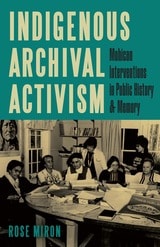
Indigenous Archival Activism
Mohican Interventions in Public History and MemoryRose Miron
University of Minnesota Press, 2024
Who has the right to represent Native history?
The past several decades have seen a massive shift in debates over who owns and has the right to tell Native American history and stories. For centuries, non-Native actors have collected, stolen, sequestered, and gained value from Native stories and documents, human remains, and sacred objects. However, thanks to the work of Native activists, Native history is now increasingly being repatriated back to the control of tribes and communities. Indigenous Archival Activism takes readers into the heart of these debates by tracing one tribe’s fifty-year fight to recover and rewrite their history.
Rose Miron tells the story of the Stockbridge-Munsee Mohican Nation and their Historical Committee, a group of mostly Mohican women who have been collecting and reorganizing historical materials since 1968. She shows how their work is exemplary of how tribal archives can be used strategically to shift how Native history is accessed, represented, written and, most importantly, controlled. Based on a more than decade-long reciprocal relationship with the Stockbridge-Munsee Mohican Nation, Miron’s research and writing is shaped primarily by materials found in the tribal archive and ongoing conversations and input from the Stockbridge-Munsee Historical Committee.
As a non-Mohican, Miron is careful to consider her own positionality and reflects on what it means for non-Native researchers and institutions to build reciprocal relationships with Indigenous nations in the context of academia and public history, offering a model both for tribes undertaking their own reclamation projects and for scholars looking to work with tribes in ethical ways.
Information Activism
A Queer History of Lesbian Media TechnologiesCait McKinney
Duke University Press, 2020
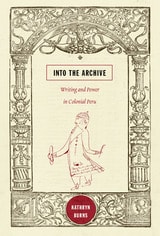
Into the Archive
Writing and Power in Colonial PeruKathryn Burns
Duke University Press, 2010
Kathryn Burns argues that the archive itself must be historicized. Using the case of colonial Cuzco, she examines the practices that shaped document-making. Notaries were businessmen, selling clients a product that conformed to local “custom” as well as Spanish templates. Clients, for their part, were knowledgeable consumers, with strategies of their own for getting what they wanted. In this inside story of the early modern archive, Burns offers a wealth of possibilities for seeing sources in fresh perspective.
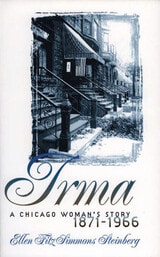
Irma
A Chicago Woman's Story, 1871-1966Ellen Fitzsimmons Steinberg
University of Iowa Press, 2004
Irma’s journals and diaries were private accounts in which she chronicled the rhythm of her days and the shape of her life. She recorded her thoughts and short quotations from her reading, jotted down her own poems and short stories, constructed dinner-party menus, and wrote biographical sketches of her family. Interspersed among the records of what she did when and with whom are a number of lengthy reflections on Chicago history, her early life, religious beliefs, education, her aspirations, disappointments, sorrows, and successes. She documented her family’s activities during the Chicago Fire, the city’s rebuilding, early educational curricula in the city’s schools, what it was like to participate in the suffrage movement and vote for the first time, the effect of the Great Depression on the middle class, and World War II as seen from her perspective.
In each chapter, Ellen Steinberg has set Irma’s contemporary entries and later memoirs against the context of the Chicago history that Irma knew so well. Irma’s story will fascinate those interested in diaries and autobiography, women’s history, and Chicago history. From a plethora of rich source materials—including over half a million words of Irma’s writings alone—Steinberg has created a seamless, fascinating narrative about a Chicago woman who, although “nobody famous” (in her words), lived a vital life in a vibrant city.