Results by title
384 books match the query 'Black Studies (Global)' and 16 start with i
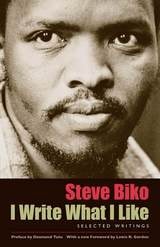
I Write What I Like
Selected WritingsSteve Biko
University of Chicago Press, 2002
I Write What I Like contains a selection of Biko's writings from 1969, when he became the president of the South African Students' Organization, to 1972, when he was prohibited from publishing. The collection also includes a preface by Archbishop Desmond Tutu; an introduction by Malusi and Thoko Mpumlwana, who were both involved with Biko in the Black Consciousness movement; a memoir of Biko by Father Aelred Stubbs, his longtime pastor and friend; and a new foreword by Professor Lewis Gordon.
Biko's writings will inspire and educate anyone concerned with issues of racism, postcolonialism, and black nationalism.
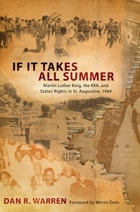
If It Takes All Summer
Martin Luther King, the KKK, and States' Rights in St. Augustine, 1964Dan R. Warren, with foreword by Morris Dees
University of Alabama Press, 2008
An insider’s record of the St. Augustine Civil Rights drama.
This memoir recounts the struggle against segregation in St. Augustine, Florida, in the early and mid-1960s. In the summer of 1964 the nation’s oldest city became the center of the civil rights movement as Martin Luther King Jr., encouraged by President Johnson, a southerner, who made the civil rights bill the center piece of his domestic policy, chose this tourism-driven community as an ideal location to demonstrate the injustice of discrimination and the complicity of southern leaders in its enforcement.
St. Augustine was planning an elaborate celebration of its founding, and expected generous federal and state support. But when the kick-off dinner was announced only whites were invited, and local black leaders protested. The affair alerted the national civil rights leadership to the St. Augustine situation as well as fueling local black resentment.
Ferment in the city grew, convincing King to bring his influence to the leadership of the local struggle. As King and his allies fought for the right to demonstrate, a locally powerful Ku Klux Klan counter-demonstrated. Conflict ensued between civil rights activists, local and from out-of-town, and segregationists, also home-grown and imported. The escalating violence of the Klan led Florida’s Governor to appoint State Attorney Dan Warren as his personal representative in St. Augustine. Warren’s crack down on the Klan and his innovative use of the Grand Jury to appoint a bi-racial committee against the intransigence of the Mayor and other officials, is a fascinating story of moral courage. This is an insider view of a sympathetic middleman in the difficult position of attempting to bring reason and dialog into a volatile situation.
Imagining the Mulatta
Blackness in U.S. and Brazilian MediaJasmine Mitchell
University of Illinois Press, 2020
Jasmine Mitchell investigates the development and exploitation of the mulatta figure in Brazilian and U.S. popular culture. Drawing on a wide range of case studies, she analyzes policy debates and reveals the use of mixed-Black female celebrities as subjects of racial and gendered discussions. Mitchell also unveils the ways the media moralizes about the mulatta figure and uses her as an example of an ”acceptable” version of blackness that at once dreams of erasing undesirable blackness while maintaining the qualities that serve as outlets for interracial desire.
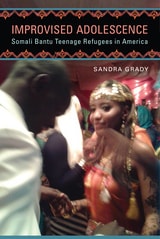
Improvised Adolescence
Somali Bantu Teenage Refugees in AmericaSandra Grady
University of Wisconsin Press, 2015
Improvised Adolescence explores how teenagers from southern Somalia, who spent much of their childhood in East African refugee camps, are adapting to resettlement in the American Midwest. The collapse of the Somali state in 1991, and subsequent chaos in the Horn of Africa, disrupted the lives of these young people educationally, culturally, and developmentally. Folklorist Sandra Grady has intermittently observed the lifeworld of these teens—their homes, their entertainment choices, their interaction with classmates and teachers at school, and their plans for the future—for more than seven years to understand the cultural tools they’ve used in their journey from this disrupted childhood. They negotiate two sets of cultural expectations: in the resettled Somali Bantu community, traditional rites of passage continue to mark the change from child to adult; in the surrounding U.S. culture, an unfamiliar in-between category—“adolescent”—delays adulthood. Offering analysis that is both engaging and theoretically grounded, Grady tracks the emergence in this immigrant community of an improvised adolescence.
Best books for public & secondary school libraries from university presses, American Library Association
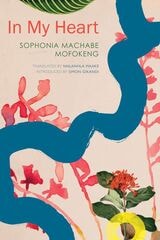
In My Heart
Sofonia Machabe Mofokeng
Seagull Books, 2021
Elsewhere Texts, edited by Gayatri Chakraborty Spivak and Hosam Aboul-Ela, presents radical new engagements with non-European literary cultures. This volume, the latest in this ambitious series, is a brilliant collection of essays originally written in Sesotho by Sophonia Machabe Mofokeng. Often confined to the role of “native informants” in the nineteenth and twentieth centuries, writers working in African languages laid the foundation for the politics and poetics of decolonization and are legendary among their own communities of readers, though their work remains little known elsewhere. In My Heart belongs to this tradition of colonial renegades. Writing in the 1950s during the cataclysmic events of apartheid that were transforming life in South Africa, Mofokeng offers a series of meditations that provide his readers with a Sesotho worldview outside the categories authorized by colonial knowledge. In My Heart, expertly translated by Nhlanhla Maake, introduces a significant African thinker’s influential work to a global readership.
In Plenty and in Time of Need
Popular Culture and the Remapping of Barbadian IdentityLia T. Bascomb
Rutgers University Press, 2020
In a Field of Static
Missed Encounters with Black Feminist TheorizingJames Bliss
Duke University Press, 2026
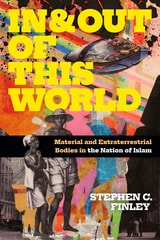
In and Out of This World
Material and Extraterrestrial Bodies in the Nation of IslamStephen C. Finley
Duke University Press, 2022
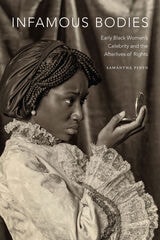
Infamous Bodies
Early Black Women’s Celebrity and the Afterlives of RightsSamantha Pinto
Duke University Press, 2020

Innocent Lens
Race and Visibility on the Swedish ScreenBenjamin Mier-Cruz
University of Wisconsin Press, 2027
Sweden, like other Nordic countries, prides itself on being “colorblind” or immune to the kinds of racism found in, for example, the United States. In the 1960s and 1970s, white Swedish documentarians, in the fashion of early anthropologists, recorded racial tensions amid the US civil rights movement. More recently, in the twenty-first century, short films produced by Swedes of color have tackled racism and bigotry within Sweden.
Benjamin Mier-Cruz offers a comparative study of these two periods of Swedish documentary filmmaking. “Racially innocent” white documentarians of the mid-twentieth century developed an “aesthetics of altruism” predicated on Sweden’s assumed racial equalitarianism—a notion that their documentaries in turn helped create and maintain. In contemporary films, on the other hand, Swedes of color use the same filmic format to challenge not only their predecessors’ reductionist, pseudo-anthropological presentations but also Sweden’s purportedly colorblind ideology. Mier-Cruz’s close readings of films from both eras demonstrate the possibilities and limitations of the documentary form and the ways in which it is motivated by politics and activism.
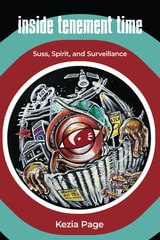
Inside Tenement Time
Suss, Spirit, and SurveillanceKezia Page
Rutgers University Press, 2025
Inside Tenement Time is the first comprehensive treatment of literary and cultural texts on surveillance in the Caribbean. Covering the long historical arc of the twentieth to the twenty-first centuries, Inside Tenement Time uses Jamaica as a case study to examine moments of crisis and particular spaces, especially urban yard enclaves and their environs, in the Caribbean encounter with surveillance. Making the argument that the Caribbean situation reveals flexible hegemonies rather than provinces of exclusive control, the book demonstrates the countervailing force of sussveillance and spiritveillance, Afro-Indigenous variations on surveillance. Sussveillance and spiritveillance are exemplars of vernacular arts and sciences that operate at and within the frangible borders of state power, exposing the unique dynamics of surveillance in the region and marshalling the acts of imagination with which it contends. For example, the Smile Jamaica concert of 1976, headlined by reggae Superstar Bob Marley, and the reputedly US government-backed 2010 Tivoli Gardens incursion in West Kingston, both moments that have dramatic, even mythic residue in Caribbean and global memory, are among the real-life events brought into conversation with literary representations of this history.
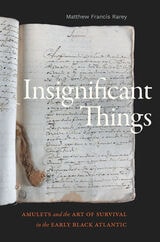
Insignificant Things
Amulets and the Art of Survival in the Early Black AtlanticMatthew Francis Rarey
Duke University Press, 2023
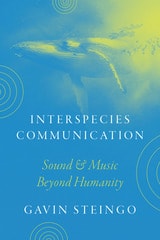
Interspecies Communication
Sound and Music beyond HumanityGavin Steingo
University of Chicago Press, 2024
In Interspecies Communication, music scholar Gavin Steingo examines significant cases of attempted communication beyond the human—cases in which the dualistic relationship of human to non-human is dramatically challenged. From singing whales to Sun Ra to searching for alien life, Steingo charts the many ways we have attempted to think about, and indeed to reach, beings that are very unlike ourselves.
Steingo focuses on the second half of the twentieth century, when scientists developed new ways of listening to oceans and cosmic space—two realms previously inaccessible to the senses and to empirical investigation. As quintessential frontiers of the postwar period, the outer space of the cosmos and the inner space of oceans were conceptualized as parallel realities, laid bare by newly technologized “ears.” Deeply engaging, Interspecies Communication explores our attempts to cross the border between the human and non-human, to connect with non-humans in the depths of the oceans, the far reaches of the universe, or right under our own noses.
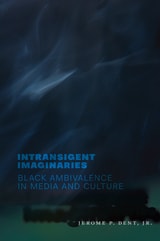
Intransigent Imaginaries
Black Ambivalence in Media and CultureJerome P. Dent, Jr.
Rutgers University Press, 2027
Intransigent Imaginaries: Black Ambivalence in Media and Culture examines why Blackness continues to function as antagonism in fantasy, science fiction, and horror, even in contemporary films and television created by Black artists and celebrated for their progressive politics. Drawing on Afropessimism, psychoanalysis, and genre theory, Jerome P. Dent, Jr. argues that genre itself organizes desire, threat, and narrative closure in ways that consistently position Blackness as danger, excess, or containment. Rather than focusing on whether representations are positive or negative, the book shifts attention to the narrative architectures and visual economies that make those images possible in the first place. Through close readings of works such as Get Out, Us, Nope, Black Panther, A Wrinkle in Time, and major science fiction franchises, Intransigent Imaginaries challenges dominant assumptions about progress, representation, and repair. Refusing the consolations of uplift, the book insists on analytic clarity, asking what criticism looks like when redemption is structurally foreclosed.
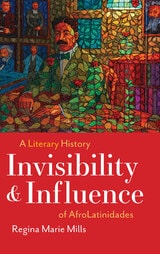
Invisibility and Influence
A Literary History of AfroLatinidadesRegina Marie Mills
University of Texas Press, 2024
2026 Honorable Mention, Latinx Studies Section, Social Sciences Category, Latin American Studies Association (LASA)
A rich literary study of AfroLatinx life writing, this book traces how AfroLatinxs have challenged their erasure in the United States and Latin America over the last century.
Invisibility and Influence demonstrates how a century of AfroLatinx writers in the United States shaped life writing, including memoir, collective autobiography, and other formats, through depictions of a wide range of “Afro-Latinidades.” Using a woman-of-color feminist approach, Regina Marie Mills examines the work of writers and creators often excluded from Latinx literary criticism. She explores the tensions writers experienced in being viewed by others as only either Latinx or Black, rather than as part of their own distinctive communities. Beginning with Arturo (Arthur) Schomburg, who contributed to wider conversations about autobiographical technique, Invisibility and Influence examines a breadth of writers, including Jesús Colón; members of the Young Lords; Piri Thomas; Lukumi santera and scholar Marta Moreno Vega; and Black Mexican American poet Ariana Brown. Mills traces how these writers confront the distorted visions of AfroLatinxs in the United States, Latin America, and the Caribbean, and how they created and expressed AfroLatinx spirituality, politics, and self-identity, often amidst violence. Mapping how AfroLatinx writers create their own literary history, Mills reveals how AfroLatinx life writing shapes and complicates discourses on race and colorism in the Western Hemisphere.
Dialogues in AfroLatinidad Podcast:https://www.youtube.com/watch?v=FIhF-pdeW3A
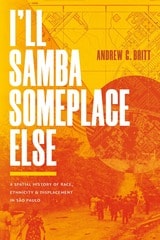
I’ll Samba Someplace Else
A Spatial History of Race, Ethnicity, and Displacement in São PauloAndrew G. Britt
Duke University Press, 2026