Results by title
211 books match the query 'Blacks' and 11 start with i
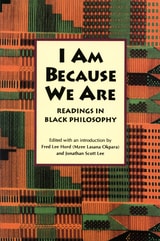
I Am Because We Are
Readings in Africana PhilosophyFred Lee Hord
University of Massachusetts Press, 2016
First published in 1995, I Am Because We Are has been recognized as a major, canon-defining anthology and adopted as a text in a wide variety of college and university courses. Bringing together writings by prominent Black thinkers from Africa, the Caribbean, and North America, Fred Lee Hord and Jonathan Scott Lee made the case for a tradition of “relational humanism” distinct from the philosophical preoccupations of the West.
Over the past twenty years, however, new scholarly research has uncovered other contributions to the discipline now generally known as “Africana philosophy” that were not included in the original volume. In this revised and expanded edition, Hord and Lee build on the strengths of the earlier anthology while enriching the selection of readings to bring the text into the twenty-first century. In a new introduction, the editors reflect on the key arguments of the book's central thesis, refining them in light of more recent philosophical discourse. This edition includes important new readings by Kwame Gyekye, Oyeronke Oy ewumi, Paget Henry, Sylvia Wynter, Toni Morrison, Charles Mills, and Tommy Curry, as well as extensive suggestions for further reading.
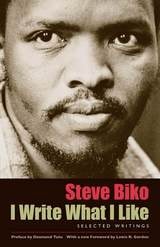
I Write What I Like
Selected WritingsSteve Biko
University of Chicago Press, 2002
I Write What I Like contains a selection of Biko's writings from 1969, when he became the president of the South African Students' Organization, to 1972, when he was prohibited from publishing. The collection also includes a preface by Archbishop Desmond Tutu; an introduction by Malusi and Thoko Mpumlwana, who were both involved with Biko in the Black Consciousness movement; a memoir of Biko by Father Aelred Stubbs, his longtime pastor and friend; and a new foreword by Professor Lewis Gordon.
Biko's writings will inspire and educate anyone concerned with issues of racism, postcolonialism, and black nationalism.
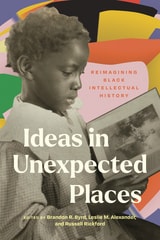
Ideas in Unexpected Places
Reimagining Black Intellectual HistoryEdited by Leslie M. Alexander, Brandon R. Byrd, and Russell Rickford
Northwestern University Press, 2022
The volume centers on the themes of slavery and sexuality; abolitionism; Black internationalism; Black protest, politics, and power; and the intersections of the digital humanities and Black intellectual history. The essays draw from diverse methodologies and fields to examine the ideas and actions of Black thinkers from the eighteenth century to the present, offering fresh insights while creating space for even more creative approaches within the field.
Timely and incisive, Ideas in Unexpected Places encourages scholars to ask new questions through innovative interpretive lenses—and invites students, scholars, and other practitioners to push the boundaries of Black intellectual history even further.
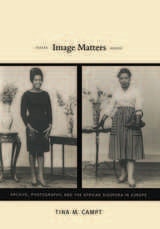
Image Matters
Archive, Photography, and the African Diaspora in EuropeTina M. Campt
Duke University Press, 2012
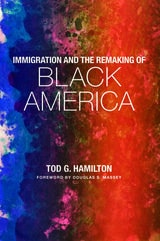
Immigration and the Remaking of Black America
Tod G. Hamilton
Russell Sage Foundation, 2019
Honorable Mention for the 2020 Thomas and Znaniecki Award from the International Migration Section of the American Sociological Association
Over the last four decades, immigration from the Caribbean and sub-Saharan Africa to the U. S. has increased rapidly. In several states, African immigrants are now major drivers of growth in the black population. While social scientists and commentators have noted that these black immigrants’ social and economic outcomes often differ from those of their native-born counterparts, few studies have carefully analyzed the mechanisms that produce these disparities. In Immigration and the Remaking of Black America, sociologist and demographer Tod Hamilton shows how immigration is reshaping black America. He weaves together interdisciplinary scholarship with new data to enhance our understanding of the causes of socioeconomic stratification among both the native-born and newcomers.
Hamilton demonstrates that immigration from the Caribbean and sub-Saharan Africa is driven by selective migration, meaning that newcomers from these countries tend to have higher educational attainment than those who stay behind. As a result, they arrive in the U.S. with some advantages over native-born blacks, and, in some cases, over whites. He also shows the importance of historical context: prior to the Civil Rights Movement, black immigrants’ socioeconomic outcomes resembled native-born blacks’ much more closely, regardless of their educational attainment in their country of origin. Today, however, certain groups of black immigrants have better outcomes than native-born black Americans—such as lower unemployment rates and higher rates of homeownership—in part because they immigrated at a time of expanding opportunities for minorities and women in general. Hamilton further finds that rates of marriage and labor force participation among native-born blacks that move away from their birth states resemble those of many black immigrants, suggesting that some disparities within the black population stem from processes associated with migration, rather than from nativity alone.
Hamilton argues that failing to account for this diversity among the black population can lead to incorrect estimates of the social progress made by black Americans and the persistence of racism and discrimination. He calls for future research on racial inequality to disaggregate different black populations. By richly detailing the changing nature of black America, Immigration and the Remaking of Black America helps scholars and policymakers to better understand the complexity of racial disparities in the twenty-first century.

Impossible Purities
Blackness, Femininity, and Victorian CultureJennifer DeVere Brody
Duke University Press, 1998
Opening with a reading of Daniel Defoe’s “A True-Born Englishman,” which posits the mixed origins of English identity, Brody goes on to analyze mulattas typified by Rhoda Swartz in William Thackeray’s Vanity Fair, whose mixed-race status reveals the “unseemly origins of English imperial power.” Examining Victorian stage productions from blackface minstrel shows to performances of The Octoroon and Uncle Tom’s Cabin, she explains how such productions depended upon feminized, “black” figures in order to reproduce Englishmen as masculine white subjects. She also discusses H.G. Wells’s The Island of Dr. Moreau in the context of debates about the “new woman,” slavery, and fears of the monstrous degeneration of English gentleman. Impossible Purities concludes with a discussion of Bram Stoker’s novella, “The Lair of the White Worm,” which brings together the book’s concerns with changing racial representations on both sides of the Atlantic.
This book will be of interest to scholars in Victorian studies, literary theory, African American studies, and cultural criticism.
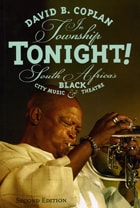
In Township Tonight!
South Africa's Black City Music and Theatre, Second EditionDavid B. Coplan
University of Chicago Press, 2008
In vivid detail, Coplan comprehensively explores more than three centuries of the diverse history of South Africa’s black popular culture, taking readers from indigenous musical traditions into the world of slave orchestras, pennywhistlers, clergyman-composers, the gumboot dances of mineworkers, and touring minstrelsy and vaudeville acts. This up-to-date edition of a landmark work will be welcomed by scholars of ethnomusicology and African studies, world music fans, and anyone concerned with South Africa and its development.
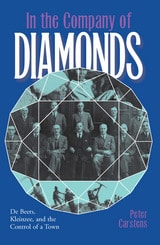
In the Company of Diamonds
De Beers, Kleinzee, and the Control of a TownPeter Carstens
Ohio University Press, 2001
After the 1925 discovery of diamonds in the semi-desert of the northwest coast of South Africa, De Beers Consolidated Mines Ltd. virtually proclaimed its dominion over the whole region. In the town of Kleinzee, the company owns all the real estate and infrastructure, and controls and administers both the town and the industry.
Peter Carstens’s In the Company of Diamonds draws a stark and startling portrait of this closed community, one that analyzes the power and hegemonic techniques used to acquire that power and maintain it.
As a prototypical company town, Kleinzee is subordinated to the industry and will of the owners. Employees and workers are variously differentiated and ordered according to occupation, ethnic variation, and other social criteria, a pattern reflected most markedly in the allocation of housing. Managers live in large, ranch-style houses, while contract workers are lodged in single-sex compounds.
As a community type, company towns like Kleinzee are not entirely unique, and Professor Carstens successfully draws a number of structural parallels with other closed and incomplete social formations such as Indian reservations, military bases, colleges, prisons, and mental hospitals.
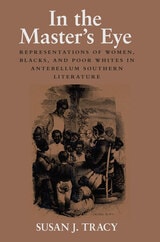
In the Master's Eye
Representations of Women, Blacks, and Poor Whites in Antebellum Southern LiteratureSusan J. Tracy
University of Massachusetts Press, 1995
This book explores the way in which literature can be used to reinforce social power. Through rigorous readings of a series of antebellum plantation novels, Susan J. Tracy shows how the narrative strategies employed by proslavery Southern writers served to justify and perpetuate the oppression of women, blacks, and poor whites.
Tracy focuses on the historical romances of six authors: George Tucker, James Ewell Heath, William Alexander Caruthers, John Pendleton Kennedy, Nathaniel Beverley Tucker, and William Gilmore Simms. Using variations on a recurring plot—in which a young planter/hero rescues a planter's daughter from an “enemy” of her class—each of these novelists reinforced an idealized vision of a Southern civilization based on male superiority, white supremacy, and class inequality. It is a world in which white men are represented as the natural leaders of loyal and dependent women, grateful and docile slaves, and inferior poor whites. According to Tracy, the interweaving of these themes reveals the extent to which the Southern defense of slavery in the years leading up to the Civil War was an argument not only about race relations but about gender and class relations as well.
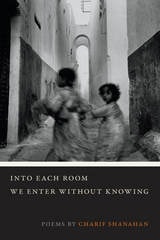
Into Each Room We Enter without Knowing
Charif Shanahan
Southern Illinois University Press, 2017
Finalist, Publishing Triangle's Thom Gunn Award
In this affecting poetry debut, Charif Shanahan explores what it means to be fully human in our wounded and divided world. In poised yet unrelenting lyric poems, Shanahan—queer and mixed-race—confronts the challenges of a complex cultural inheritance, informed by colonialism and his mother’s immigration to the United States from Morocco, navigating racial constructs, sexuality, family, and the globe in search of “who we are to each other . . . who we are to ourselves.”
With poems that weave from Marrakesh to Zürich to London, through history to the present day, this book is, on its surface, an uncompromising exploration of identity in personal and collective terms. Yet the collection is, most deeply, about intimacy and love, the inevitability of human separation and the challenge of human connection. Urging us to reexamine our own place in the broader human tapestry, Into Each Room We Enter without Knowing announces the arrival of a powerful and necessary new voice.
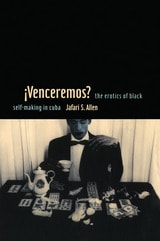
iVenceremos?
The Erotics of Black Self-making in CubaJafari S. Allen
Duke University Press, 2011