282 books match the query 'Caribbean & West Indies' and 14 start with i

cover of I Want to Believe: Posadism, UFOs and Apocalypse Communism

I Want to Believe

Posadism, UFOs and Apocalypse Communism

A.M. Gittlitz

Pluto Press, 2020

"Looks back at the history of Posadism to explore why this largely discredited movement has elicited so much recent interest."—Art in America
 
Advocating nuclear war, attempting communication with dolphins, and taking an interest in the paranormal and UFOs, there is perhaps no greater (or stranger) cautionary tale for the Left than that of Posadism. Named after the Argentine Trotskyist J. Posadas, the movement’s journey through the fractious and sectarian world of mid-20th century revolutionary socialism was unique. This book is a “dumpster dive” into the weird and wonderful world of the Posadists.
 
Although at times significant, Posadas' movement was ultimately a failure. As it disintegrated, it increasingly grew to resemble a bizarre cult, detached from the working class it sought to liberate. The renewed interest in Posadism today, especially for its more outlandish fixations, speaks to both a cynicism towards the past and nostalgia for the earnest belief that a better world is possible. Chapters include:
 
*Revolutionary Youth or Patriotic Youth
*The Death Throes of Capitalism
*The Origins of Posadism
*Flying Saucers, the Process of Matter and Energy, Science, the Revolutionary and Working-Class Stuggle, and the Socialist Future of Mankind
*What Exists Cannot be True
*Why Don’t Extraterrestrials Make Public Contact
*UFOs to the People
 
In the Introduction, A.M. Gittlitz writes, “Insurrection or first contact could come any day, Marxists and ufologists both tell us, but both are far more likely if we desire them, embracing a sentiment enigmatically expressed in a meme come before its time, a poster on the wall of rouge FBI agent Fox Mulder in the ‘90s sci-fi noir The X-Files: hovering alongside a granny image of a comically unconvincingly flying saucer and the words I WANT TO BELIEVE".
 
Drawing on considerable archival research, and numerous interviews with ex- and current Posadists, I Want to Believe tells the fascinating story of this most unusual socialist movement and considers why it continues to capture the imaginations of leftists today.

[more]
cover of Identity and Struggle at the Margins of the Nation-State: The Laboring Peoples of Central America and the Hispanic Caribbean

Identity and Struggle at the Margins of the Nation-State

The Laboring Peoples of Central America and the Hispanic Caribbean

Aviva Chomsky and Aldo Lauria-Santiago, eds.

Duke University Press, 1998

Identity and Struggle at the Margins of the Nation-State brings together new research on the social history of Central America and the Spanish-speaking Caribbean during the late nineteenth and early twentieth centuries. Aviva Chomsky and Aldo A. Lauria Santiago have gathered both well-known and emerging scholars to demonstrate how the actions and ideas of rural workers, peasants, migrants, and women formed an integral part of the growth of the export economies of the era and to examine the underacknowledged impact such groups had on the shaping of national histories.
Responding to the fact that the more common, elite-centered “national” histories distort or erase the importance of gender, race, ethnicity, popular consciousness, and identity, contributors to this volume correct this imbalance by moving these previously overlooked issues to the center of historical research and analysis. In so doing, they describe how these marginalized working peoples of the Hispanic Caribbean Basin managed to remain centered on not only class-based issues but on a sense of community, a desire for dignity, and a struggle for access to resources. Individual essays include discussions of plantation justice in Guatemala, highland Indians in Nicaragua, the effects of foreign corporations in Costa Rica, coffee production in El Salvador, banana workers in Honduras, sexuality and working-class feminism in Puerto Rico, the Cuban sugar industry, agrarian reform in the Dominican Republic, and finally, potential directions for future research and historiography on Central America and the Caribbean.
This collection will have a wide audience among Caribbeanists and Central Americanists, as well as students of gender studies, and labor, social, Latin American, and agrarian history.

Contributors. Patricia Alvarenga, Barry Carr, Julie A. Charlip, Aviva Chomsky, Dario Euraque, Eileen Findlay, Cindy Forster, Jeffrey L. Gould, Lowell Gudmundson, Aldo A. Lauria Santiago, Francisco Scarano, Richard Turits
[more]
cover of Imagining Our Americas: Toward a Transnational Frame

Imagining Our Americas

Toward a Transnational Frame

Sandhya Shukla and Heidi Tinsman, eds.

Duke University Press, 2007

This rich interdisciplinary collection of essays advocates and models a hemispheric approach to the study of the Americas. Taken together, the essays examine North and South America, the Caribbean, and the Pacific as a broad region transcending both national boundaries and the dichotomy between North and South. In the volume’s substantial introduction, the editors, an anthropologist and a historian, explain the need to move beyond the paradigm of U.S. American Studies and Latin American Studies as two distinct fields. They point out the Cold War origins of area studies, and they note how many of the Americas’ most significant social formations have spanned borders if not continents: diverse and complex indigenous societies, European conquest and colonization, African slavery, Enlightenment-based independence movements, mass immigrations, and neoliberal economies.

Scholars of literature, ethnic studies, and regional studies as well as of anthropology and history, the contributors focus on the Americas as a broadly conceived geographic, political, and cultural formation. Among the essays are explorations of the varied histories of African Americans’ presence in Mexican and Chicano communities, the different racial and class meanings that the Colombian musical genre cumbia assumes as it is absorbed across national borders, and the contrasting visions of anticolonial struggle embodied in the writings of two literary giants and national heroes: José Martí of Cuba and José Rizal of the Philippines. One contributor shows how a pidgin-language mixture of Japanese, Hawaiian, and English allowed second-generation Japanese immigrants to critique Hawaii’s plantation labor system as well as Japanese hierarchies of gender, generation, and race. Another examines the troubled history of U.S. gay and lesbian solidarity with the Cuban Revolution. Building on and moving beyond previous scholarship, this collection illuminates the productive intellectual and political lines of inquiry opened by a focus on the Americas.

Contributors. Rachel Adams, Victor Bascara, John D. Blanco, Alyosha Goldstein, Héctor Fernández L’Hoeste, Ian Lekus, Caroline F. Levander, Susan Y. Najita, Rebecca Schreiber, Sandhya Shukla, Harilaos Stecopoulos, Michelle Stephens, Heidi Tinsman, Nick Turse, Rob Wilson
[more]
cover of Imagining the Tropics: Women, Romance, and the Making of Modern Tourism

Imagining the Tropics

Women, Romance, and the Making of Modern Tourism

Elizabeth S. Manley

Rutgers University Press, 2025
Imagining the Tropics is a history of the development of tourism in the Caribbean from the 1910s through the 1970s that focuses on the ways women’s labors of hospitality, writing, and advocacy built the industry and its ubiquitous imagery of tropical island relaxation, escape, and romance. By examining a range of sources, engaging an array of women protagonists, and looking broadly across multiple Caribbean island-states including Jamaica, Cuba, the Bahamas, Barbados, the Dominican Republic, Haiti, Puerto Rico, Trinidad and Tobago, and the U.S. and British Virgin Islands, it seeks to understand how the region came to be sold as a romantic escape from the “troubles” of the modern world. By putting women at the center of Caribbean tourism history—as both its ambassadors and objects of desire—it seeks to explain some of the complicated contradictions that plague the business of pleasure but also to point toward ways of building alternative models to its present and past extractive realities.
[more]
cover of In Plenty and in Time of Need: Popular Culture and the Remapping of Barbadian Identity

In Plenty and in Time of Need

Popular Culture and the Remapping of Barbadian Identity

Lia T. Bascomb

Rutgers University Press, 2020

In Plenty and in Time of Need demonstrates how the unique history of Barbados has contributed to complex relations of national, gendered, and sexual identities, and how these identities are represented and interpreted on a global stage. As the most widespread manifestation of social commentary, the book uses music and performance to analyze the competing ideals and realities of the national culture. It details the histories of prominent musical artists, including the prolific Pan-Africanist calypsonian the Mighty Gabby, the world-renowned Merrymen, Soca Queen Alison Hinds, artist/activist Rupee, and international superstar Rihanna. Using these artists, the project analyzes how femininity, masculinity, and sexuality are put in service of Barbadian nationalism. By examining websites, blogs, and digital products of these artists in conversation with Barbadian tourism, the book re-examines the ways in which commodity, sexuality, gender performance, and diasporic consciousness undergird individual careers and national representations.
[more]
cover of In the Shadow of Powers: Dantes Bellegarde in Haitian Social Thought

In the Shadow of Powers

Dantes Bellegarde in Haitian Social Thought

Patrick Bellegarde-Smith

Vanderbilt University Press, 2019

Out of a slave rebellion, Haiti was forged as an independent nation. This fact, in and of itself, should have been enough to perpetuate an image of Haitians as strong and agentive people. But leaders of countries on both sides of the Atlantic felt threatened by Haiti's beginnings and were intent on sapping it of resources. More than a century of various restrictions on trade, the imposition of crippling fines, and, eventually, a US occupation followed. Yet even as they suffered economically under these penalties, Haitians persisted, some of them becoming influential actors in the world of global politics.

Throughout much of the twentieth century and even to this day, there has been a dearth of scholarship on the intellectual and political contributions of Haitians. In the Shadow of Powers, first published in 1985, was a corrective to this oversight and remains a foundational text. Bellegarde-Smith traces the history of Haiti through the life and career of his grandfather Dantès Bellegarde, one of Haiti's influential diplomats and preeminent thinkers. As Brandon R. Byrd describes in his foreword to this new edition, "Bellegarde was driven by a subversive, racially inclusive vision of civilized progress. He believed in and continued to push for Haiti to establish an existence for itself, black people, and the colonized world independent of the considerable shadow cast by the world's military, economic, and industrial powers." Scholars and students who want to learn about the intellectual and political foundations of Haiti, its influence on other intellectuals worldwide, and its struggles against imperialism continue to find this to be an invaluable classic.
[more]
cover of Infortunios de Alonso Ramirez / The Misfortunes of Alonso Ramirez (1690): Annotated Bilingual Edition

Infortunios de Alonso Ramirez / The Misfortunes of Alonso Ramirez (1690)

Annotated Bilingual Edition

Buscaglia-Salgado, José F

Rutgers University Press, 2018
In 2009, 319 years after its publication, and following over a century of copious scholarly speculation about the work, José F. Buscaglia is the first scholar to furnish direct and irrefutable proof that the story contained in the Infortunios/Misfortunes is based on the life and times of a man certifiably named Alonso Ramírez, who was shipwrecked on Herradura Point in the Coast of Yucatán on Sunday September 18, 1689. This first bilingual edition of the Infortunios/Misfortunes reports the findings of almost two decades of sustained research in pursuit, on land and by sea, of a most elusive historical character who was, as we now can attest with all degree of certainty, the first American known to have circumnavigated the globe. Captured by pirates, shipwrecked, and eventually rescued and sent on his way, this is one man’s story of his unanticipated voyage around the Early Modern world. With transcription, translation, notes, maps, images, and critical essay by Jose F. Buscaglia-Salgado, this Rutgers edition is the most complete and authoritative study on a work that grants us privileged access to the intricacies of early American subjectivity.
[more]
cover of Island Futures: Caribbean Survival in the Anthropocene

Island Futures

Caribbean Survival in the Anthropocene

Mimi Sheller

Duke University Press, 2020
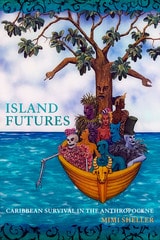
In Island Futures Mimi Sheller delves into the ecological crises and reconstruction challenges affecting the entire Caribbean region during a time of climate catastrophe. Drawing on fieldwork on postearthquake reconstruction in Haiti, flooding on the Haitian-Dominican border, and recent hurricanes, Sheller shows how ecological vulnerability and the quest for a "just recovery" in the Caribbean emerge from specific transnational political, economic, and cultural dynamics. Because foreigners are largely ignorant of Haiti's political, cultural, and economic contexts, especially the historical role of the United States, their efforts to help often exacerbate inequities. Caribbean survival under ever-worsening environmental and political conditions, Sheller contends, demands radical alternatives to the pervasive neocolonialism, racial capitalism, and US military domination that have perpetuated what she calls the "coloniality of climate." Sheller insists that alternative projects for Haitian reconstruction, social justice, and climate resilience—and the sustainability of the entire region—must be grounded in radical Caribbean intellectual traditions that call for deeper transformations of transnational economies, ecologies, and human relations writ large.
[more]
cover of Island Lives: Historical Archaeologies of the Caribbean

Island Lives

Historical Archaeologies of the Caribbean

Edited by Paul Farnsworth

University of Alabama Press, 2001

Historical archaeology and the making of Caribbean cultures and nations.

Long before the founding of Jamestown in 1607, there were Spanish forts, bustling towns, sugar plantations, and sea trade flourishing in the Caribbean. While richer nations, particularly the United States, may view the Caribbean today as merely a place for sun and fun, the island colonies were at one time far more important and lucrative to their European empire countries than their North American counterparts. From the 15th to the 19th centuries, as competing colonial powers vied with each other for military and economic advantage in the Western Hemisphere, events in the Caribbean directly influenced the American mainland. 

This is one rationale for the close study of historical archaeology in the Caribbean. Another is the growing recognition of how archaeological research can support the defining of national identities for the islands, many of them young independent states struggling to establish themselves economically and politically. By looking at cases in the French West Indies, specifically on Guadeloupe, in the Dutch Antilles and Aruba, in the British Bahamas, on Montserrat and St. Eustatius, on Barbados, and the within the U.S. Virgin Islands, the contributors to Island Lives have produced a broad overview of Caribbean historical archaeology. 

Island Lives makes clear that historical archaeology in the Caribbean will continue to grow and diversify due to the interest Caribbean peoples have in recording, preserving, and promoting their culture and heritage; the value it adds to their "heritage tourism"; and the connection it has to African American history and archaeology. In addition, the contributors point to the future by suggesting different trajectories that historical archaeology and its practitioners may take in the Caribbean arena. In so doing, they elucidate the problems and issues faced worldwide by researchers working in colonial and post-colonial societies. 

 

[more]
cover of Island Possessed

Island Possessed

Katherine Dunham

University of Chicago Press, 1994
Just as surely as Haiti is "possessed" by the gods and spirits of vaudun (voodoo), the island "possessed" Katherine Dunham when she first went there in 1936 to study dance and ritual. In this book, Dunham reveals how her anthropological research, her work in dance, and her fascination for the people and cults of Haiti worked their spell, catapulting her into experiences that she was often lucky to survive. Here Dunham tells how the island came to be possessed by the demons of voodoo and other cults imported from various parts of Africa, as well as by the deep class divisions, particularly between blacks and mulattos, and the political hatred still very much in evidence today. Full of the flare and suspense of immersion in a strange and enchanting culture, Island Possessed is also a pioneering work in the anthropology of dance and a fascinating document on Haitian politics and voodoo.
[more]
cover of Island Time: Speed and the Archipelago from St. Kitts and Nevis

Island Time

Speed and the Archipelago from St. Kitts and Nevis

Jessica Swanston Baker

University of Chicago Press, 2024

A close look at how wylers, a popular musical style from the island of St. Kitts and Nevis, expresses a unique mode of relation in the postcolonial Caribbean.
 
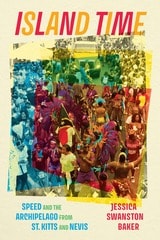
In Island Time, ethnomusicologist Jessica Swanston Baker examines wylers, a musical form from St. Kitts and Nevis that is characterized by speed. Baker argues that this speed becomes a useful and highly subjective metric for measuring the relationship between Caribbean aspirations and the promises of economic modernity; women’s bodily autonomy and the nationalist fantasies that would seek to curb that autonomy; and the material realities of Kittitian-Nevisian youth living in the disillusionment following postcolonial independence. She traces the wider Caribbean musical, cultural, and media-based resonances of wylers, posing an alternative model to scholarship on Caribbean music that has tended to privilege the big islands—Trinidad, Jamaica, and Haiti—thus neglecting not only the unique cultural worlds of smaller nations but also the unbounded nature of musical exchange in the region. The archipelago emerges as a useful model for apprehending the relationality across scales that governs the temporal and spatial logics that undergird Caribbean performance. The archipelago and its speeds ultimately emerge as a meaningful medium for postcolonial, postmodern world-making.
 
[more]
cover of Islands of Sovereignty: Haitian Migration and the Borders of Empire

Islands of Sovereignty

Haitian Migration and the Borders of Empire

Jeffrey S. Kahn

University of Chicago Press, 2018
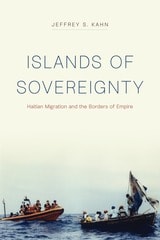
In Islands of Sovereignty, anthropologist and legal scholar Jeffrey S. Kahn offers a new interpretation of the transformation of US borders during the late twentieth century and its implications for our understanding of the nation-state as a legal and political form. Kahn takes us on a voyage into the immigration tribunals of South Florida, the Coast Guard vessels patrolling the northern Caribbean, and the camps of Guantánamo Bay—once the world’s largest US-operated migrant detention facility—to explore how litigation concerning the fate of Haitian asylum seekers gave birth to a novel paradigm of offshore oceanic migration policing. Combining ethnography—in Haiti, at Guantánamo, and alongside US migration patrols in the Caribbean—with in-depth archival research, Kahn expounds a nuanced theory of liberal empire’s dynamic tensions and its racialized geographies of securitization. An innovative historical anthropology of the modern legal imagination, Islands of Sovereignty forces us to reconsider the significance of the rise of the current US immigration border and its relation to broader shifts in the legal infrastructure of contemporary nation-states across the globe.
 
[more]
cover of Isle of Rum: Havana Club, Cultural Mediation, and the Fight for Cuban Authenticity

Isle of Rum

Havana Club, Cultural Mediation, and the Fight for Cuban Authenticity

Christopher Chávez

Rutgers University Press, 2024

Focusing on Havana Club rum as a case study, Isle of Rum examines the ways in which Western cultural producers, working in collaboration with the Cuban state, have assumed responsibility for representing Cuba to the outside world. Christopher Chávez focuses specifically on the role of advertising practitioners, musicians, filmmakers, and visual artists, who stand to benefit economically by selling an image of Cuba to consumers who desperately crave authentic experiences that exist outside of the purview of the marketplace.

Rather than laying claim to authentic Cuban culture, Chávez explores which aspects of Cuban culture are deemed most compelling and, therefore, most profitable by corporate marketers. As a joint venture between the Cuban state and Pernod Ricard, a global spirits marketer based in Paris, Havana Club embodies the larger process of economic reform, which was meant to reintegrate Cuba into global markets during Cuba’s Special Period in a Time of Peace.

[more]
cover of iVenceremos?: The Erotics of Black Self-making in Cuba

iVenceremos?

The Erotics of Black Self-making in Cuba

Jafari S. Allen

Duke University Press, 2011

Promoting the revolutionary socialist project of equality and dignity for all, the slogan ¡Venceremos! (We shall overcome!) appears throughout Cuba, everywhere from newspapers to school murals to nightclubs. Yet the accomplishments of the Cuban state are belied by the marginalization of blacks, the prejudice against sexual minorities, and gender inequities. ¡Venceremos? is a groundbreaking ethnography on race, desire, and belonging among blacks in early-twenty-first-century Cuba, as the nation opens its economy to global capital. Expanding on Audre Lorde’s vision of embodied, even “useful,” desire, Jafari S. Allen shows how black Cubans engage in acts of “erotic self-making,” reinterpreting, transgressing, and potentially transforming racialized and sexualized interpellations of their identities. He illuminates intimate spaces of autonomy created by people whose multiply subaltern identities have rendered them illegible to state functionaries, and to most scholars. In everyday practices in Havana and Santiago de Cuba—including Santeria rituals, gay men’s parties, hip hop concerts, the tourist-oriented sex trade, lesbian organizing, HIV education, and just hanging out—Allen highlights small but significant acts of struggle for autonomy and dignity.
[more]