Results by title
236 books match the query 'Children's Studies' and 9 start with i
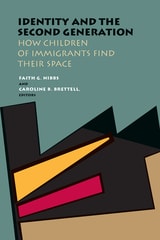
Identity and the Second Generation
How Children of Immigrants Find Their SpaceFaith G. Nibbs
Vanderbilt University Press, 2015
This book explores the social worlds of the children of immigrants. Based on rich ethnographic research, the contributors illustrate how these young people, the so-called second generation, construct and negotiate their lives. Ultimately, the driving question is profoundly important on a universal level: How do these young people construct an identity and a sense of belonging for themselves, and how do they deal with processes of inclusion and exclusion?
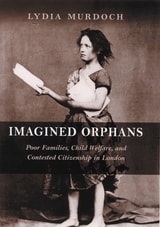
Imagined Orphans
Poor Families, Child Welfare, and Contested Citizenship in LondonMurdoch, Lydia
Rutgers University Press, 2006
With his dirty, tattered clothes and hollowed-out face, Oliver Twist is the enduring symbol of the young indigent spilling out of orphanages and haunting the streets of late-nineteenth-century London. Although poor children were often portrayed as real-life Oliver Twists—either orphaned or abandoned by unworthy parents—they in fact frequently maintained contact and were eventually reunited with their families.
In Imagined Orphans, Lydia Murdoch focuses on this discrepancy between the representation and the reality of children’s experiences within welfare institutions—a discrepancy that she argues stems from conflicts over middle- and working-class notions of citizenship that arose in the 1870s and persisted until the First World War. Reformers’ efforts to depict poor children as either orphaned or endangered by abusive or “no-good” parents fed upon the poor’s increasing exclusion from the Victorian social body. Reformers used the public’s growing distrust and pitiless attitude toward poor adults to increase charity and state aid to the children.
With a critical eye to social issues of the period, Murdoch urges readers to reconsider the complex situations of families living in poverty. While reformers’ motivations seem well intentioned, she shows how their methods solidified the public’s antipoor sentiment and justified a minimalist welfare state that engendered a cycle of poverty. As they worked to fashion model citizens, reformers’ efforts to protect and care for children took on an increasingly imperial cast that would continue into the twentieth century.
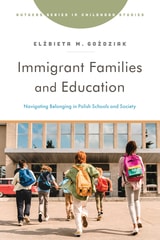
Immigrant Families and Education
Navigating Belonging in Polish Schools and SocietyElzbieta M. Gozdziak
Rutgers University Press, 2026
Immigrant Families and Education is about belonging and unbelonging--or inclusion and exclusion--of migrant children in public and private primary and secondary schools in western Poland. Although migrant children have legally guaranteed access to education in Poland, many struggle to be included and to feel that they belong in Polish schools, and by extension, Polish society. Even children of returned Polish migrants do not always feel welcome in Polish schools. Most publications about migrant children and education present one point of view, typically that of the teachers. In this book, belonging is analyzed from the perspectives of three groups: the children, their parents, and their educators. This book aims to facilitate discussions between and among policy-makers, school administrators and teachers, as well as parents and child activists, and of course the students, on how to best ensure that all children, regardless of their origin, feel welcome in Polish schools.
Imprisoned Minds
Lost Boys, Trapped Men, and Solutions from Within the PrisonErik S. Maloney
Rutgers University Press, 2025
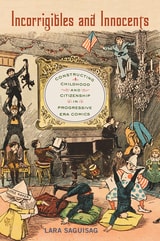
Incorrigibles and Innocents
Constructing Childhood and Citizenship in Progressive Era ComicsSaguisag, Lara
Rutgers University Press, 2019
Histories and criticism of comics note that comic strips published in the Progressive Era were dynamic spaces in which anxieties about race, ethnicity, class, and gender were expressed, perpetuated, and alleviated. The proliferation of comic strip children—white and nonwhite, middle-class and lower class, male and female—suggests that childhood was a subject that fascinated and preoccupied Americans at the turn of the century. Many of these strips, including R.F. Outcault’s Hogan’s Alley and Buster Brown, Rudolph Dirks’s The Katzenjammer Kids and Winsor McCay’s Little Nemo in Slumberland were headlined by child characters. Yet no major study has explored the significance of these verbal-visual representations of childhood. Incorrigibles and Innocents addresses this gap in scholarship, examining the ways childhood was depicted and theorized in late nineteenth- and early twentieth-century comic strips. Drawing from and building on histories and theories of childhood, comics, and Progressive Era conceptualizations of citizenship and nationhood, Lara Saguisag demonstrates that child characters in comic strips expressed and complicated contemporary notions of who had a right to claim membership in a modernizing, expanding nation.
Indicators of Children's Well-Being
Robert M. Hauser
Russell Sage Foundation, 1997
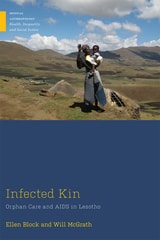
Infected Kin
Orphan Care and AIDS in LesothoEllen Block
Rutgers University Press, 2019
Supplementary instructor resources (https://www.csbsju.edu/sociology/faculty/anthropology-teaching-resources/infected-kin-teaching-resources)
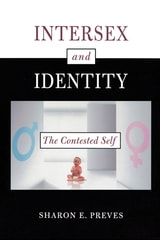
Intersex and Identity
The Contested SelfSharon E. Preves
Rutgers University Press, 2003
Approximately one in every two thousand infants born in America each year is sexually ambiguous in such a way that doctors cannot immediately determine the child’s sex. Some children’s chromosomal sexuality contradicts their sexual characteristics. Others have the physical traits of both sexes, or of neither. Is surgical intervention or sex assignment of intersexed children necessary for their physical and psychological health, as the medical and mental health communities largely assume? Should parents raise sexually ambiguous children as one gender or another and keep them ignorant of their medical history?
Drawing upon life history interviews with adults who were treated for intersexuality as children, Sharon E. Preves explores how such individuals experience and cope with being labeled sexual deviants in a society that demands sexual conformity. Preves frames their stories within a sociological discussion of gender, the history of intersex medicalization, the recent political mobilization of intersexed adults, and the implications of their activism on identity negotiation, medical practice, and cultural norms. By demonstrating how intersexed people manage and create their own identities, often in conflict with their medical diagnosis, Preves argues that medical intervention into intersexuality often creates, rather than mitigates, the stigma these people suffer.

Iron Dads
Managing Family, Work, and Endurance Sport IdentitiesDiana Tracy Cohen
Rutgers University Press, 2016