Results by title
90 books match the query 'Civilization, Modern' and 5 start with i
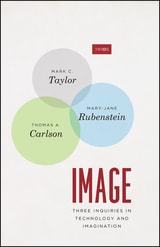
Image
Three Inquiries in Technology and ImaginationMark C. Taylor, Mary-Jane Rubenstein, and Thomas A. Carlson
University of Chicago Press, 2021
Modern life is steeped in images, image-making, and attempts to control the world through vision. Mastery of images has been advanced by technologies that expand and reshape vision and enable us to create, store, transmit, and display images. The three essays in Image, written by leading philosophers of religion Mark C. Taylor, Mary-Jane Rubenstein, and Thomas A. Carlson, explore the power of the visual at the intersection of the human and the technological. Building on Heidegger’s notion that modern humanity aims to master the world by picturing or representing the real, they investigate the contemporary culture of the image in its philosophical, religious, economic, political, imperial, and military dimensions, challenging the abstraction, anonymity, and dangerous disconnection of contemporary images.
Taylor traces a history of capitalism, focusing on its lack of humility, particularly in the face of mortality, and he considers art as a possible way to reconnect us to the earth. Through a genealogy of iconic views from space, Rubenstein exposes the delusions of conquest associated with extraterrestrial travel. Starting with the pressing issues of surveillance capitalism and facial recognition technology, Carlson extends Heidegger’s analysis through a meditation on the telematic elimination of the individual brought about by totalizing technologies. Together, these essays call for a consideration of how we can act responsibly toward the past in a way that preserves the earth for future generations. Attending to the fragility of material things and to our own mortality, they propose new practices of imagination grounded in love and humility.
In Space We Read Time
On the History of Civilization and GeopoliticsKarl Schlögel
Bard Graduate Center, 2016
Here is both a model for thinking about history within physical space and a stimulating history of thought about space, as Schlögel reads historical periods and events within the context of their geographical location. Discussions range from the history of geography in France to what a town directory from 1930s Berlin can say about professional trades that have since disappeared. He takes a special interest in maps, which can serve many purposes—one poignant example being the German Jewish community’s 1938 atlas of emigration, which showed the few remaining possibilities for escape. Other topics include Thomas Jefferson’s map of the United States; the British survey of India; and the multiple cartographers with Woodrow Wilson at the Paris Peace Conference, where the aim was to redraw Europe’s boundaries on the basis of ethnicity. Moving deftly from the Austro-Hungarian Empire to 9/11 and from Vermeer’s paintings to the fall of the Berlin Wall, this intriguing book presents history from a completely new perspective.
Intelligent Guide To Modern Culture
Roger Scruton
St. Augustine's Press, 2000
Invention Of Communication
Armand Mattelart
University of Minnesota Press, 1996
Is Progress Speeding Up
Multiplying Multitudes Of BlessingsJohn Marks Templeton
Templeton Press, 1998
This book is a thought-provoking view of the progress of humankind in the last century. In spite of the pessimism that prevails in the media, people are better fed, better clothed, better housed, and better educated than at any previous time.
The facts within the book provide documentation for a positive outlook toward our nutrition and health, living standards and working conditions, political and economic freedoms, educational facilities, ability to communicate, ease of movement, increasing leisure, and, most important, our ability to get along with one another and with our Creator. The statistics, charts, and photographs that illustrate this book enhance the reassuring and uplifting view of the state of the world and where it is going.
“His analysis gives us a refreshing balance to the negative, sometimes cynical, views in the media that tend to portray the worst rather than the best in human civilization.” —Jimmy Carter
“After reading Sir John Templeton's latest book, I believe more than ever that we are living in the most exciting time in history. Despite the challenges we face, his demonstration of mankind's progress gives all of us great hopes and high expectations for our next century and the new millennium.” —Jack Kemp, former HUD secretary, director of Empower America