Results by title
162 books match the query 'Comparative Politics' and 4 start with i
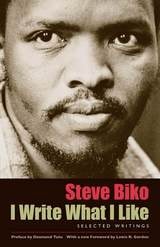
I Write What I Like
Selected WritingsSteve Biko
University of Chicago Press, 2002
I Write What I Like contains a selection of Biko's writings from 1969, when he became the president of the South African Students' Organization, to 1972, when he was prohibited from publishing. The collection also includes a preface by Archbishop Desmond Tutu; an introduction by Malusi and Thoko Mpumlwana, who were both involved with Biko in the Black Consciousness movement; a memoir of Biko by Father Aelred Stubbs, his longtime pastor and friend; and a new foreword by Professor Lewis Gordon.
Biko's writings will inspire and educate anyone concerned with issues of racism, postcolonialism, and black nationalism.
In Pursuit of Prosperity
Industrial Policy and the Politics of Economic UpgradingCharles R. Hankla
University of Michigan Press, 2025
Using a mixed-methods approach, Charles R. Hankla draws upon archival research and interviews from France and India as well as quantitative models of sixteen countries across six decades. He finds that when state and private actors are aligned in their institutional structures, which can happen in both corporatist and pluralist systems, industrial policy tends to be more effective. It is when the state or the private sector independently dominates industrial policy that poor outcomes are most likely. As In Pursuit of Prosperity shows, rather than being fixed characteristics of countries, policymaking styles vary across time and across sectors of the economy, reflecting the changing power dynamics and organizational resources of stakeholders. The book sheds light on how industrial policy—which is experiencing a comeback in the United States and beyond—can best be harnessed for upgrading. It offers a valuable contribution to our understanding of the complex relationship between state politics and economic performance in the modern globalized world.
Intellectuals and Politics in Central Europe
Ivan Bernik
Central European University Press, 1999
Intervention as Indirect Rule
Civil War and Statebuilding in the Democratic Republic of CongoAlex Veit
Campus Verlag, 2010
One of the largest peace-keeping missions currently being undertaken by the United Nations is in the Democratic Republic of Congo, where the UN is attempting to deal with the civil wars and other conflicts that have plagued the country since 1996. In Intervention as Indirect Rule, Alex Veit uses a close study of the district of Ituri, a major battlefield and a laboratory for international intervention, to explore the micropolitics of warfare and statebuilding. Combining detailed firsthand empirical data with a historically informed analysis, Veit shows the effect that contemporary humanitarian interventions have on state-society relations. He also pays particular, and much needed, attention to the question of why the very organizations that should be helping with international statebuilding efforts—local authorities and civil society groups—so often instead turn out to be corrupt or hostile. Ultimately Veit argues that international intervention tends inadvertently to replicate—or even amplify—historical structures of political inequality, rather than establishing a liberal form of statehood.