Results by title
324 books match the query 'Comparative literature' and 17 start with i
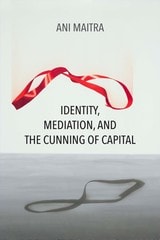
Identity, Mediation, and the Cunning of Capital
Ani Maitra
Northwestern University Press, 2020
Maitra’s archive is transnational and multimodal. Moving from anticolonial polemics to psychoanalysis to diasporic experimental literature to postcolonial feminist and queer media, he lays bare the cunning by which capitalism produces and fragments identity through an intermedial “aesthetic dissonance” with the commodity form. Maitra’s novel contribution to theories of identity and to the concept of mediation will interest a wide range of scholars in media studies, critical race and postcolonial studies, and critical aesthetics.
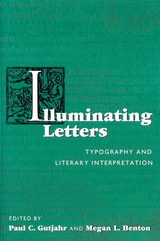
Illuminating Letters
Typography and Literary InterpretationPaul C. Gutjahr
University of Massachusetts Press, 2001
What do we read when we read a text? The author's words, of course, but is that all? The prevailing publishing ethic has insisted that typography—the selection and arrangement of type and other visual elements on a page—should be an invisible, silent, and deferential servant to the text it conveys.
This book contests that conventional point of view. Looking at texts ranging from the King James Bible to contemporary comic strips, the contributors to Illuminating Letters examine the seldom considered but richly revealing relationships between a text's typography and its literary interpretation. The essays assume no previous typographic knowledge or expertise; instead they invite readers primarily concerned with literary and cultural meanings to turn a more curious eye to the visual and physical forms of a specific text or genre. As the contributors show, closer inspection of those forms can yield fresh insights into the significance of a text's material presentation, leading readers to appreciate better how presentation shapes understandings of the text's meanings and values.
The case studies included in the volume amplify its two overarching themes: one set explores the roles of printers and publishers in manipulating, willingly or not, the meaning and reception of texts through typographic choices; the other group examines the efforts of authors to circumvent or subvert such mediation by directly controlling the typographic presentation of their texts. Together these essays demonstrate that choices about type selection and arrangement do indeed help to orchestrate textual meaning.
In addition to the editors, contributors include Sarah A. Kelen, Beth McCoy, Steven R. Price, Leon Jackson, and Gene Kannenberg Jr.

Illuminative Moments in Pacific Northwest Prose
1800 to the PresentRichard W. Etulain
University of Nevada Press, 2024
Etulain provides extensive coverage of the writings of notable authors, including novelists Frederic Homer Balch and Mary Hallock Foote, offering an understanding of frontier romantic and Local Color Writers. He also explores the works of H. G. Merriam and novelist H. L. Davis, illustrating regional prose writings. Finally, Etulain includes a panoply of writers who exemplify an emphasis on gender, race and ethnicity, and environmental texts from the post-WWII period.
Illuminative Moments in Pacific Northwest Prose delivers a first-time overview of the region’s literary contributions that will interest both scholars and general readers alike.

Imagined Dialogues
Eastern European Literature in Conversation with American and English LiteratureGordana Crnkovic
Northwestern University Press, 1999
Immaterial Archives
An African Diaspora Poetics of LossJenny Sharpe
Northwestern University Press, 2020
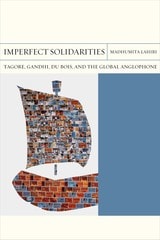
Imperfect Solidarities
Tagore, Gandhi, Du Bois, and the Global AnglophoneMadhumita Lahiri
Northwestern University Press, 2021
A century ago, activists confronting racism and colonialism—in India, South Africa, and Black America—used print media to connect with one another. Then, as now, the most effective medium for their undertakings was the English language. Imperfect Solidarities: Tagore, Gandhi, Du Bois, and the Global Anglophone tells the story of this interconnected Anglophone world. Through Rabindranath Tagore’s writings on China, Mahatma Gandhi’s recollections of South Africa, and W. E. B. Du Bois’s invocations of India, Madhumita Lahiri theorizes print internationalism. This methodology requires new terms within the worldwide hegemony of the English language (“the global Anglophone”) in order to encourage alternate geographies (such as the Global South) and new collectivities (such as people of color).
The women of print internationalism feature prominently in this account. Sonja Schlesin, born in Moscow, worked with Indians in South Africa. Sister Nivedita, an Irish woman in India, collaborated with a Japanese historian. Jessie Redmon Fauset, an African American, brought the world home to young readers through her work as an author and editor.
Reading across races and regions, genres and genders, Imperfect Solidarities demonstrates the utility of the neologism for postcolonial literary studies.
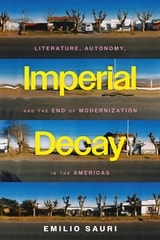
Imperial Decay
Literature, Autonomy, and the End of Modernization in the AmericasEmilio Sauri
Northwestern University Press, 2027
Demonstrating how art and literature remain vital to alternative imaginaries beyond the power of imperialism and modernization
Imperial Decay: Literature, Autonomy, and the End of Modernization in the Americas employs a dynamic, comparative approach to contemporary literature and visual art, showing how fiction, photography, poetry, and film from Latin America and the United States vividly illuminate the present. Focusing on the period from the end of the Cold War to the financial crisis of the late 2000s, Emilio Sauri contends that what brings these media together is not just the history of hemispheric connections but also, and more strikingly, the question of the artwork’s autonomy.
Elaborating on influential accounts that reveal how US hegemony in Latin America and the resistance it inspired throughout the region are bound up with the promise of modernization, Imperial Decay offers unique insights into the hollowing out of this promise at the end of the so-called American Century. Tracing this commitment back to the modernisms of the last century and forward to more recent works, this book casts canonical figures such as Ernest Hemingway, Walker Evans, and Gabriel García Márquez in a new and necessary light while developing a compelling interpretive framework for contemporary writers and artists from across the region, including Roberto Bolaño and Benjamin Kunkel, Alejandro Cartagena and Yvonne Venegas, and Kleber Mendonça Filho. Ultimately, Sauri shows why the work of art remains vital to the task of envisioning alternatives to the immiserations, ecological devastation, and degraded forms of life wrought by imperial decay.
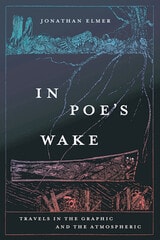
In Poe's Wake
Travels in the Graphic and the AtmosphericJonathan Elmer
University of Chicago Press, 2024
You’ll find his face everywhere, from coffee mugs, bobbleheads, and T-shirts to the cover of the Beatles’ Sergeant Pepper’s Lonely Hearts Club Band. Edgar Allan Poe is one of American culture’s most recognizable literary figures, his life and works inspiring countless derivations beyond the literary realm. Poe’s likeness and influence have been found in commercial illustration and kitsch, art installations, films, radio plays, children’s cartoons, and video games. What makes Poe so hugely influential in media other than his own? What do filmmakers, composers, and other artists find in Poe that suits their purposes so often and so variously?
In Poe’s Wake locates the source of the writer’s enduring legacy in two vernacular aesthetic categories: the graphic and the atmospheric. Jonathan Elmer uses Poe to explore these two terms and track some deep patterns in their use, not through theoretical labor but through close encounters with a wide sampling of aesthetic objects that avail themselves of Poe’s work. Poe’s writings are violent and macabre, memorable both for certain grisly images and for certain prevailing moods or atmospheres—dread, creepiness, and mournfulness. Furthermore, a bundle of Poe traits—his thematic emphasis on extreme sensation, his flexible sense of form, his experimental and modular method, and his iconic visage—amount to what could be called a Poe “brand,” one as likely to be found in music videos or comics as in novels and stories. Encompassing René Magritte, Claude Debussy, Lou Reed, Roger Corman, Spongebob Squarepants, and many others, Elmer’s book shows how the Poe brand opens trunk lines to aesthetic experiences fundamental to a multi-media world.
In the Face of Adversity
Translating Difference and DissentEdited by Thomas Nolden
University College London, 2023
In the Face of Adversity explores the dynamics of translating texts that articulate particular notions of adverse circumstances. The contributors show how literary records of painful experiences and dissenting voices are at risk of being stripped of their authenticity when not carefully handled by the translator, how cultural moments in which the translation of a text that would have otherwise fallen into oblivion instead gave rise to a translator who enabled its preservation while ultimately coming into their own as an author as a result, and how the difficulties the translator faces in intercultural or transnational constellations in which prejudice plays a role endangers projects meant to facilitate mutual understanding. The authors address translation as a project of making available and preserving a corpus of texts that would otherwise be in danger of becoming censored, misperceived, or ignored. They look at translation and adaptation as a project of curating textual models of personal, communal, or collective perseverance, and they offer insights into the dynamics of cultural inclusion and exclusion through a series of theoretical frameworks, as well as through a set of concrete case studies drawn from different cultural and historical contexts.
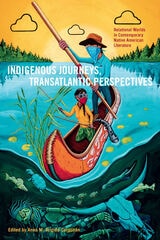
Indigenous Journeys, Transatlantic Perspectives
Relational Worlds in Contemporary Native American LiteratureAnna M Brígido-Corachán
Michigan State University Press, 2023

Indiscreet Fantasies
Iberian Queer CinemaAndrés Lema-Hincapié
Bucknell University Press, 2021
Published by Bucknell University Press. Distributed worldwide by Rutgers University Press.
Inter-imperiality
Vying Empires, Gendered Labor, and the Literary Arts of AllianceLaura Doyle
Duke University Press, 2020
Intersecting Realities and Fictions of Virginia Woolf and Colette
& COLETTEHelen Southworth
The Ohio State University Press, 2004
Intersections of Harm
Narratives of Latina Deviance and DefianceHalperin, Laura
Rutgers University Press, 0
Interventions into Modernist Cultures
Poetry from Beyond the Empty ScreenAmie Elizabeth Parry
Duke University Press, 2007
Reading various works by US expatriates Ezra Pound and Gertrude Stein, Parry compares the cultural politics of U.S. canonical modernism with alternative representations of temporality, hybridity, erasure, and sexuality in the work of the Taiwanese writers Yü Kwang-chung and Hsia Yü and the Asian American immigrant author Theresa Hak Kyung Cha. Juxtaposing poems by Pound and Yü Kwang-chung, Parry shows how Yü’s fragmented, ambivalent modernist form reveals the effects of neocolonialism while Pound denies and obscures U.S. imperialism in Asia, asserting a form of nondevelopmental universalism through both form and theme. Stein appropriates discourses of American modernity and identity to represent nonnormative desire and sexuality, and Parry contrasts this tendency with representations of sexuality in the contemporary experimental poetry of Hsia Yü. Finally, Parry highlights the different uses of modernist forms by Pound in his Cantos—which incorporate a multiplicity of decontextualized and ahistorical voices—and by Cha in her 1982 novel Dictee, a historicized, multilingual work. Parry’s sophisticated readings provide a useful critical framework for apprehending how “minor modernisms” illuminate the histories erased by certain canonical modernist texts.
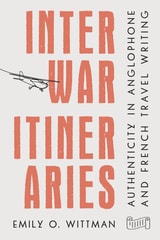
Interwar Itineraries
Authenticity in Anglophone and French Travel WritingEmily O. Wittman
Amherst College Press, 2022
“This book offers a valuable account of literary activity in a genre still inadequately covered in literary-critical history. Emily Witt- man organizes her material through pairings and contextualizing that are instructive and illuminating and often exciting . . . This is comparative literature at its best.” —Vincent Sherry, Washington University
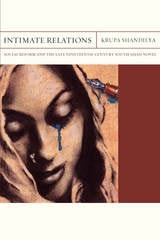
Intimate Relations
Social Reform and the Late Nineteenth-Century South Asian NovelKrupa Shandilya
Northwestern University Press, 2017