100 books match the query 'Criminal justice, Administration of' and 5 start with i
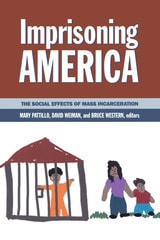
cover of Imprisoning America: The Social Effects of Mass Incarceration

Imprisoning America

The Social Effects of Mass Incarceration

Mary Pattillo

Russell Sage Foundation, 2004

Over the last thirty years, the U.S. penal population increased from around 300,000 to more than two million, with more than half a million prisoners returning to their home communities each year. What are the social costs to the communities from which this vast incarcerated population comes? And what happens to these communities when former prisoners return as free men and women in need of social and economic support? In Imprisoning America, an interdisciplinary group of leading researchers in economics, criminal justice, psychology, sociology, and social work goes beyond a narrow focus on crime to examine the connections between incarceration and family formation, labor markets, political participation, and community well-being. The book opens with a consideration of the impact of incarceration on families. Using a national survey of young parents, Bruce Western and colleagues show the enduring corrosive effects of incarceration on marriage and cohabitation, even after a prison sentence has been served. Kathryn Edin, Timothy Nelson, and Rechelle Parnal use in-depth life histories of low-income men in Philadelphia and Charleston, to study how incarceration not only damages but sometimes strengthens relations between fathers and their children. Imprisoning America then turns to how mass incarceration affects local communities and society at large. Christopher Uggen and Jeff Manza use survey data and interviews with thirty former felons to explore the political ramifications of disenfranchising inmates and former felons. Harry Holzer, Stephen Raphael, and Michael Stoll examine how poor labor market opportunities for former prisoners are shaped by employers' (sometimes unreliable) background checks. Jeremy Travis concludes that corrections policy must extend beyond incarceration to help former prisoners reconnect with their families, communities, and the labor market. He recommends greater collaboration between prison officials and officials in child and family welfare services, educational and job training programs, and mental and public health agencies. Imprisoning America vividly illustrates that the experience of incarceration itself—and not just the criminal involvement of inmates—negatively affects diverse aspects of social membership. By contributing to the social exclusion of an already marginalized population, mass incarceration may actually increase crime rates, and threaten the public safety it was designed to secure. A rigorous portrayal of the pitfalls of getting tough on crime, Imprisoning America highlights the pressing need for new policies to support ex-prisoners and the families and communities to which they return.
[more]
cover of In an Abusive State: How Neoliberalism Appropriated the Feminist Movement against Sexual Violence

In an Abusive State

How Neoliberalism Appropriated the Feminist Movement against Sexual Violence

Kristin Bumiller

Duke University Press, 2008

In an Abusive State puts forth a powerful argument: that the feminist campaign to stop sexual violence has entered into a problematic alliance with the neoliberal state. Kristin Bumiller chronicles the evolution of this alliance by examining the history of the anti-violence campaign, the production of cultural images about sexual violence, professional discourses on intimate violence, and the everyday lives of battered women. She also scrutinizes the rhetoric of high-profile rape trials and the expansion of feminist concerns about sexual violence into the international human-rights arena. In the process, Bumiller reveals how the feminist fight against sexual violence has been shaped over recent decades by dramatic shifts in welfare policies, incarceration rates, and the surveillance role of social-service bureaucracies.

Drawing on archival research, individual case studies, testimonies of rape victims, and interviews with battered women, Bumiller raises fundamental concerns about the construction of sexual violence as a social problem. She describes how placing the issue of sexual violence on the public agenda has polarized gender- and race-based interests. She contends that as the social welfare state has intensified regulation and control, the availability of services for battered women and rape victims has become increasingly linked to their status as victims and their ability to recognize their problems in medical and psychological terms. Bumiller suggests that to counteract these tendencies, sexual violence should primarily be addressed in the context of communities and in terms of its links to social disadvantage. In an Abusive State is an impassioned call for feminists to reflect on how the co-optation of their movement by the neoliberal state creates the potential to inadvertently harm impoverished women and support punitive and racially based crime control efforts.

[more]
cover of Incarceration and Race in Michigan: Grounding the National Debate in State Practice

Incarceration and Race in Michigan

Grounding the National Debate in State Practice

Lynn O. Scott

Michigan State University Press, 2019

State and local policies are key to understanding how to reduce prison populations. This anthology of critical and personal essays about the need to reform criminal justice policies that have led to mass incarceration provides a national perspective while remaining grounded in Michigan. Major components in this volume include a focus on current research on the impact of incarceration on minority groups, youth, and the mentally ill; and a focus on research on Michigan’s leadership in the area of reentry. Changes in policy will require a change in the public’s problematic images of incarcerated people. In this volume, academic research is combined with first-person narratives and paintings from people who have been directly affected by incarceration to allow readers to form more personal connections with those who face incarceration. At a time when much of the push to reduce prison populations is focused on the financial cost to states and cities, this book emphasizes the broader social and human costs of mass incarceration.
[more]
cover of Inventing the Savage: The Social Construction of Native American Criminality

Inventing the Savage

The Social Construction of Native American Criminality

By Luana Ross

University of Texas Press, 1998

Luana Ross writes, "Native Americans disappear into Euro-American institutions of confinement at alarming rates. People from my reservation appeared to simply vanish and magically return. [As a child] I did not realize what a 'real' prison was and did not give it any thought. I imagined this as normal; that all families had relatives who went away and then returned."

In this pathfinding study, Ross draws upon the life histories of imprisoned Native American women to demonstrate how race/ethnicity, gender, and class contribute to the criminalizing of various behaviors and subsequent incarceration rates. Drawing on the Native women's own words, she reveals the violence in their lives prior to incarceration, their respective responses to it, and how those responses affect their eventual criminalization and imprisonment. Comparisons with the experiences of white women in the same prison underline the significant role of race in determining women's experiences within the criminal justice system.

[more]
cover of Invisible Men: Mass Incarceration and the Myth of Black Progress

Invisible Men

Mass Incarceration and the Myth of Black Progress

Becky Pettit

Russell Sage Foundation, 2012

For African American men without a high school diploma, being in prison or jail is more common than being employed—a sobering reality that calls into question post-Civil Rights era social gains. Nearly 70 percent of young black men will be imprisoned at some point in their lives, and poor black men with low levels of education make up a disproportionate share of incarcerated Americans. In Invisible Men, sociologist Becky Pettit demonstrates another vexing fact of mass incarceration: most national surveys do not account for prison inmates, a fact that results in a misrepresentation of U.S. political, economic, and social conditions in general and black progress in particular. Invisible Men provides an eye-opening examination of how mass incarceration has concealed decades of racial inequality. Pettit marshals a wealth of evidence correlating the explosion in prison growth with the disappearance of millions of black men into the American penal system. She shows that, because prison inmates are not included in most survey data, statistics that seemed to indicate a narrowing black-white racial gap—on educational attainment, work force participation, and earnings—instead fail to capture persistent racial, economic, and social disadvantage among African Americans. Federal statistical agencies, including the U.S. Census Bureau, collect surprisingly little information about the incarcerated, and inmates are not included in household samples in national surveys. As a result, these men are invisible to most mainstream social institutions, lawmakers, and nearly all social science research that isn't directly related to crime or criminal justice. Since merely being counted poses such a challenge, inmates' lives—including their family background, the communities they come from, or what happens to them after incarceration—are even more rarely examined. And since correctional budgets provide primarily for housing and monitoring inmates, with little left over for job training or rehabilitation, a large population of young men are not only invisible to society while in prison but also ill-equipped to participate upon release. Invisible Men provides a vital reality check for social researchers, lawmakers, and anyone who cares about racial equality. The book shows that more than a half century after the first civil rights legislation, the dismal fact of mass incarceration inflicts widespread and enduring damage by undermining the fair allocation of public resources and political representation, by depriving the children of inmates of their parents' economic and emotional participation, and, ultimately, by concealing African American disadvantage from public view.
[more]