476 books match the query 'Criticism' and 14 start with i

cover of I Love My Selfie

I Love My Selfie

Essay by Ilan Stavans / Auto-Portraits by ADÁL

Duke University Press, 2017
What explains our current obsession with selfies? In I Love My Selfie noted cultural critic Ilan Stavans explores the selfie's historical and cultural roots by discussing everything from Greek mythology and Shakespeare to Andy Warhol, James Franco, and Pope Francis. He sees selfies as tools people use to disguise or present themselves as spontaneous and casual. This collaboration includes a portfolio of fifty autoportraits by the artist ADÁL; he and Stavans use them as a way to question the notion of the self and to engage with artists, celebrities, technology, identity, and politics. Provocative and engaging, I Love My Selfie will change the way readers think about this unavoidable phenomenon of twenty-first-century life.
[more]
cover of Identifying Consumption: Subjects and Objects in Consumer Society

Identifying Consumption

Subjects and Objects in Consumer Society

Robert G. Dunn

Temple University Press, 2008

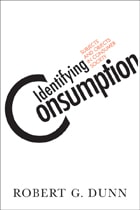
Identifying Consumption illustrates how an individual’s buying habits are shaped by the dynamics of the consumer marketplace—and thus how consumption and identity inform each other. Robert Dunn brings together the various theories of spending and develops a mode of analysis concentrating on the individual subjectivity of consumption. By doing so, he addresses how we spend and its relationship with status and lifestyle.

Dunn provides a comprehensive guide to the study of modern consumer behavior before summarizing and critiquing the major theories of consumption. At this juncture, he proposes a method of analysis that focuses on the significance of status and lifestyle in social relations that can help explain how the consumer marketplace is shaped. He concludes by raising issues about different ways of consuming and the relationship between consumption and identity.

[more]
cover of Identities

Identities

Edited by Kwame Anthony Appiah and Henry Louis Gates Jr.

University of Chicago Press, 1995

The study of identity crosses all disciplinary borders to address such issues as the multiple interactions of race, class, and gender in feminist, lesbian, and gay studies, postcolonialism and globalization, and the interrelation of nationalism and ethnicity in ethnic and area studies. Identities will help disrupt the cliché-ridden discourse of identity by exploring the formation of identities and problem of subjectivity.

Leading scholars in literary criticism, anthropology, sociology, and philosophy explore such topics as "Gypsies" in the Western imagination, the mobilization of the West in Chinese television, the lesbian identity and the woman's gaze in fashion photography, and the regulation of black women's bodies in early 20th-century urban areas. This collection of twenty articles brings together the special issue of Critical Inquiry entitled "Identities" (Summer 1992), two other previously published essays, and five previously published critical responses and rejoinders, all of which is interrogated in two new essays by Michael Gorra and Judith Butler.

Contributors include Elizabeth Abel, Kwame Anthony Appiah, Akeel Bilgrami, Daniel Boyarin, Jonathan Boyarin, Judith Butler, Hazel V. Carby, Xiaomei Chen, Diana Fuss, Henry Louis Gates, Jr., Avery Gordon, Michael Gorra, Cheryl Herr, Saree S. Makdisi, Walter Benn Michaels, Christopher Newfield, Gananath Obeyesekere, Molly Anne Rothenberg, Gayatri Chakravorty Spivak, Sara Suleri, Katie Trumpener, and Joseph Valente.

[more]
cover of Illuminations: Women Writing on Photography From the 1850s to the Present

Illuminations

Women Writing on Photography From the 1850s to the Present

Liz Heron and Val Williams, eds.

Duke University Press, 1996

The first anthology of its kind, Illuminations presents a comprehensive selection of women’s writings on photography. It proposes a new and different history by demonstrating the ways in which women’s perspectives have advanced photographic criticism over the last 150 years.
Extraordinarily wide-ranging in its scope, this collection chronicles the role of women in photography as critics, historians, and practitioners. Readers will find Julia Margaret Cameron’s bold description of her photographic method, Rosalind Krauss’s exploration of what the camera means for Surrealism, Margaret Bourke-White and Carol Squiers with differing perspectives on Life magazine, as well as essays by Eudora Welty, Susan Sontag, Lucy Lippard, Berenice Abbott, Dorthea Lange, and many others. Illuminations begins with a short piece on the daguerreotype by Elizabeth Barrett Browning then moves through the avant-garde influence of Dada, Bauhaus, and surrealism, to fashion and portrait photography, continuing with documentary and reportage, the emergence of feminist analysis, and postmodern and postcolonial criticism. Encompassing many varied points of view, this volume offers pieces on individual photographers such as Diane Arbus, Ansel Adams, Barbara Kruger, Edward Weston, and Cindy Sherman along with theoretical work by contemporary writers including Jane Gallop, Coco Fusco, and Laura Mulvey.
An historic anthology, Illuminations shows that women have been writing about photography from its beginnings and have intervened in the key debates of the past century and a half. It will welcomed by those interested in photography, gender studies, and women and the arts.

Contributors. Berenice Abbott, Dawn Ades, Susan H. Aiken, Jan Avgikos, Elizabeth Barrett Browning, Margaret Bourke-White, Deborah Bright, Susan Butler, Julia Margaret Cameron, Cynthia Chris, Louise Dahl-Wolfe, Gen Doy, Olive Edis, Ute Eskildsen, Andrea Fisher, Gisèle Freund, Coco Fusco, Jane Gallop, Nan Goldin, Jewelle Gomez, Jan Zita Grover, Judith Mara Gutman, Maria Morris Hambourg, Liz Heron, Alice Hughes, Karen Knorr, Rosalind Krauss, Annette Kuhn, Dorothea Lange, Therese Lichtenstein, Lucy Lippard, Catherine Lord, Mary Warner Marien, Elizabeth McCausland, Roberta McGrath, Lee Miller, Tina Modotti, Lucia Moholy, Laura Mulvey, Carole Naggar, Nancy Newhall, Amy Rule, Lauren Sedofsky, Ingrid Sischy, Abigail Solomon-Godeau, Susan Sontag, Jo Spence, Carol Squiers, Varvara Stepanova, Anne Tucker, Eudora Welty, Dorothy Wilding, Val Wiliams, Anne-Marie Willis, Madame Yevonde
[more]
cover of Image Matters: Archive, Photography, and the African Diaspora in Europe

Image Matters

Archive, Photography, and the African Diaspora in Europe

Tina M. Campt

Duke University Press, 2012
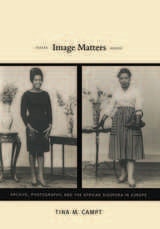
In Image Matters, Tina M. Campt traces the emergence of a black European subject by examining how specific black European communities used family photography to create forms of identification and community. At the heart of Campt's study are two photographic archives, one composed primarily of snapshots of black German families taken between 1900 and 1945, and the other assembled from studio portraits of West Indian migrants to Birmingham, England, taken between 1948 and 1960. Campt shows how these photographs conveyed profound aspirations to forms of national and cultural belonging. In the process, she engages a host of contemporary issues, including the recoverability of non-stereotypical life stories of black people, especially in Europe, and their impact on our understanding of difference within diaspora; the relevance and theoretical approachability of domestic, vernacular photography; and the relationship between affect and photography. Campt places special emphasis on the tactile and sonic registers of family photographs, and she uses them to read the complexity of "race" in visual signs and to highlight the inseparability of gender and sexuality from any analysis of race and class. Image Matters is an extraordinary reflection on what vernacular photography enabled black Europeans to say about themselves and their communities.
[more]
cover of In The Scheme Of Things: Alternative Thinking on the Practice of Architecture

In The Scheme Of Things

Alternative Thinking on the Practice of Architecture

Thomas R. Fisher Fisher

University of Minnesota Press, 2006

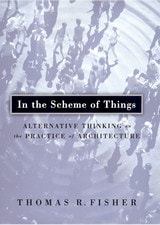
One of the field’s most innovative thinkers reconsiders the purpose and practice of architecture. At the dawn of the twenty-first century, architecture is in a state of crisis. Numbed by an ugly and shoddily constructed built environment and outraged by the cost of high-profile design projects, the public has become disinterested in and contemptuous of architecture as both a profession and an art. At the same time, some of our most creative designers have isolated themselves from the tastes and needs of mainstream society, reflecting a similar malaise found in design and architecture schools around the country. In this troubling climate, Thomas R. Fisher—who challenged architects as editorial director of Progressive Architecture, becoming recognized as one of the field’s most original thinkers—contends that the purpose and prospects of architectural practice must be reconsidered and reenergized. In the Scheme of Things looks at architecture’s need to respond creatively and meaningfully to the extraordinary changes affecting the profession now, changes that include the global economy, the advent of computer-aided design, and the growing disconnection between design schools, architectural practice, and the public.

In each of the twelve essays that comprise this timely volume, Fisher addresses issues of vital concern to architects and students, offering hard-hitting criticism and proposing innovative and practical ideas for reform at the level of both the individual practitioner and the profession as a whole. Through his thoughtful and nuanced consideration of architecture’s ideological foundations and its relationship to ecology, politics, and technology, as well as his subtle understanding of the architect’s interior life, Fisher challenges the demoralized design community to recapture its historical role as steward and visionary of the public realm.

Thomas R. Fisher is dean of the College of Architecture and Landscape Architecture at the University of Minnesota and coeditor of Architectural Research Quarterly. His essays have appeared in Design Quarterly, Architectural Record, and other leading journals.
[more]
cover of Inadvertent Images: A History of Photographic Apparitions

Inadvertent Images

A History of Photographic Apparitions

Peter Geimer

University of Chicago Press, 2018
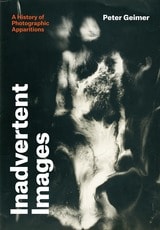
As an artistic medium, photography is uniquely subject to accidents, or disruptions, that can occur in the making of an artwork. Though rarely considered seriously, those accidents can offer fascinating insights about the nature of the medium and how it works. With Inadvertent Images, Peter Geimer explores all kinds of photographic irritation from throughout the history of the medium, as well as accidental images that occur through photo-like means, such as the image of Christ on the Shroud of Turin, brought into high resolution through photography. Geimer’s investigations complement the history of photographic images by cataloging a corresponding history of their symptoms, their precarious visibility, and the disruptions threatened by image noise. Interwoven with the familiar history of photography is a secret history of photographic artifacts, spots, and hazes that historians have typically dismissed as “spurious phenomena,” “parasites,” or “enemies of the photographer.” With such photographs, it is virtually impossible to tell where a “picture” has been disrupted—where the representation ends and the image noise begins. We must, Geimer argues, seek to keep both in sight: the technical making and the necessary unpredictability of what is made, the intentional and the accidental aspects, representation and its potential disruption.
[more]
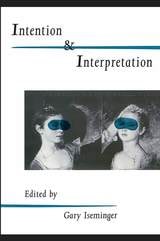
cover of Intention Interpretation

Intention Interpretation

edited by Gary Iseminger

Temple University Press, 1995
"...an excellent and comprehensive discussion of a debate that was initiated in this century in William Wimsatt's and Monroe C. Beardsley's influential article 'The Intentional Fallacy.'...this is a splendidly conceived and very useful collection of essays. Readers will want to take issue with the arguments of individual authors, but this is to be expected in a volume at the cutting edge of a fertile philosophical controversy." --David Novitz, The Philosophical Quarterly "What is the connection, if any, between the author's intentions in (while) writing a work of literature and the truth (acceptability, validity) of interpretive statements about it?" With this question, Gary Isminger introduces a literary debate that has been waged for the past four decades and is addressed by philosophers and literary theorists in Intention and Interpretation. Thirteen essays discuss the role of appeals to the author's intention in interpreting works of literature. A well-known argument by E.D. Hirsch serves as the basic text, in which he defends the appeal to the author's intention against Wimsatt and Beardsley's claim that such an appeal involved "the intentional fallacy." The essays, mostly commissioned by the editor, explore the presuppositions and consequences of arguing for the importance of the author's intentions in the way Hirsch does. Connections emerge between this issue and many fundamental issues in metaphysics and the philosophy of mind as well as in aesthetics. The (old) "New Criticism" and current Post-Structuralism tend to agree in disenfranchising the author, and many people now are disinclined even to consider the alternative. Hirsch demurs, and arguments like his deserve the careful attention, both from critics and sympathizers, that they receive here. Literary scholars and philosophers who are sympathetic to Continental as well as to Anglo-American styles of philosophy are among the contributors. "This is a timely book appearing as it does when postmodernist views of the death of the author are disappearing quickly from the scene. As a collection it exemplifies the best work that is being done on this problem at the moment, and it will no doubt inspire further debate." --The Journal of Aesthetics and Art Criticism "[T]his volume contains important articles illuminating the central debate over the role and relevance of authorial intentions in literary interoperation." --British Journal of Aesthetics
[more]
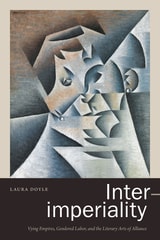
cover of Inter-imperiality: Vying Empires, Gendered Labor, and the Literary Arts of Alliance

Inter-imperiality

Vying Empires, Gendered Labor, and the Literary Arts of Alliance

Laura Doyle

Duke University Press, 2020
In Inter-imperiality Laura Doyle theorizes the co-emergence of empires, institutions, language regimes, stratified economies, and literary cultures over the longue durée. Weaving together feminist, decolonial, and dialectical theory, she shows how inter-imperial competition has generated a systemic stratification of gendered, racialized labor, while literary and other arts have helped both to constitute and to challenge this world order. To study literature is therefore, Doyle argues, to attend to world-historical processes of imaginative and material co-formation as they have unfolded through successive eras of vying empires. It is also to understand oral, performed, and written literatures as power-transforming resources for the present and future. To make this case, Doyle analyzes imperial-economic processes across centuries and continents in tandem with inter-imperially entangled literatures, from A Thousand and One Nights to recent Caribbean fiction. Her trenchant interdisciplinary method reveals the structural centrality of imaginative literature in the politics and possibilities of earthly life.
[more]
cover of Interpreting Environments: Tradition, Deconstruction,  Hermeneutics

Interpreting Environments

Tradition, Deconstruction, Hermeneutics

By Robert Mugerauer

University of Texas Press, 1995

In this pioneering book, Robert Mugerauer seeks to make deconstruction and hermeneutics accessible to people in the environmental disciplines, including architecture, planning, urban studies, environmental studies, and cultural geography.

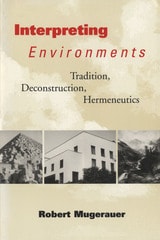
Mugerauer demonstrates each methodology through a case study. The first study uses the traditional approach to recover the meaning of Jung's and Wittgenstein's houses by analyzing their historical, intentional contexts. The second case study utilizes deconstruction to explore Egyptian, French neoclassical, and postmodern attempts to use pyramids to constitute a sense of lasting presence. And the third case study employs hermeneutics to reveal how the American understanding of the natural landscape has evolved from religious to secular to ecological since the nineteenth century.
[more]
cover of Intolerable: Writings from Michel Foucault and the Prisons Information Group (1970–1980)

Intolerable

Writings from Michel Foucault and the Prisons Information Group (1970–1980)

Michel Foucault

University of Minnesota Press, 2020

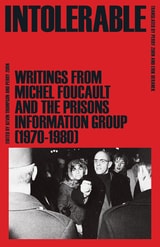
A groundbreaking collection of writings by Michel Foucault and the Prisons Information Group documenting their efforts to expose France’s inhumane treatment of prisoners

Founded by Michel Foucault and others in 1970–71, the Prisons Information Group (GIP) circulated information about the inhumane conditions within the French prison system. Intolerable makes available for the first time in English a fully annotated compilation of materials produced by the GIP during its brief but influential existence, including an exclusive new interview with GIP member Hélène Cixous and writings by Gilles Deleuze and Jean Genet. 

These archival documents—public announcements, manifestos, reports, pamphlets, interventions, press conference statements, interviews, and round table discussions—trace the GIP’s establishment in post-1968 political turmoil, the new models of social activism it pioneered, the prison revolts it supported across France, and the retrospective assessments that followed its denouement. At the same time, Intolerable offers a rich, concrete exploration of Foucault’s concept of resistance, providing a new understanding of the arc of his intellectual development and the genesis of his most influential book, Discipline and Punish.

Presenting the account of France’s most vibrant prison resistance movement in its own words and on its own terms, this significant and relevant collection also connects the approach and activities of the GIP to radical prison resistance movements today.

[more]
cover of Inventing the Critic in Renaissance England

Inventing the Critic in Renaissance England

William Russell

University of Delaware Press, 2011

The turn of the seventeenth century was an important moment in the history of English criticism. In a series of pioneering works of rhetoric and poetics, writers such as Philip Sidney, George Puttenham, and Ben Jonson laid the foundations of critical discourse in English, and the English word “critic” began, for the first time, to suggest expertise in literary judgment. Yet the conspicuously ambivalent attitude of these critics toward criticism—and the persistent fear that they would be misunderstood, marginalized, scapegoated, or otherwise “branded with the dignity of a critic”—suggests that the position of the critic in this period was uncertain. In Inventing the Critic in Renaissance England, William Russell reveals that the critics of the English Renaissance did not passively absorb their practice from Continental and classical sources but actively invented it in response to a confluence of social and intellectual factors.

Published by University of Delaware Press. Distributed worldwide by Rutgers University Press.

 
 
[more]
cover of Inwardness and Existence: Subjectivity in/and Hegel, Heidegger, Marx, and Freud

Inwardness and Existence

Subjectivity in/and Hegel, Heidegger, Marx, and Freud

Walter A. Davis

University of Wisconsin Press, 1989
A profound, challenging, wide-ranging book, back in print for a new generation
 
“Inwardness and Existence accomplishes what no book before or after has even approximated: it demonstrates with great lucidity and insight the shared philosophical project that animates psychoanalysis, Marxism, existentialism, and Hegelian dialectics. Davis roots the reader in the enterprise of questioning what is given and probing beyond what is safe in order to demonstrate that psychoanalytic inquiry, Marxist politics, existential reflection, and dialectical connection all move within the same orbit. No one who reads it will ever think about existence itself in the same way again. Davis’s landmark work will profoundly transform anyone who reads it.”—Todd McGowan, author of The Real Gaze: Film Theory after Lacan
[more]
cover of Islam and Modernity: Transformation of an Intellectual Tradition

Islam and Modernity

Transformation of an Intellectual Tradition

Fazlur Rahman

University of Chicago Press, 1984

"As Professor Fazlur Rahman shows in the latest of a series of important contributions to Islamic intellectual history, the characteristic problems of the Muslim modernists—the adaptation to the needs of the contemporary situation of a holy book which draws its specific examples from the conditions of the seventh century and earlier—are by no means new. . . . In Professor Rahman's view the intellectual and therefore the social development of Islam has been impeded and distorted by two interrelated errors. The first was committed by those who, in reading the Koran, failed to recognize the differences between general principles and specific responses to 'concrete and particular historical situations.' . . . This very rigidity gave rise to the second major error, that of the secularists. By teaching and interpreting the Koran in such a way as to admit of no change or development, the dogmatists had created a situation in which Muslim societies, faced with the imperative need to educate their people for life in the modern world, were forced to make a painful and self-defeating choice—either to abandon Koranic Islam, or to turn their backs on the modern world."—Bernard Lewis, New York Review of Books

"In this work, Professor Fazlur Rahman presents a positively ambitious blueprint for the transformation of the intellectual tradition of Islam: theology, ethics, philosophy and jurisprudence. Over the voices advocating a return to Islam or the reestablishment of the Sharia, the guide for action, he astutely and soberly asks: What and which Islam? More importantly, how does one get to 'normative' Islam? The author counsels, and passionately demonstrates, that for Islam to be actually what Muslims claim it to be—comprehensive in scope and efficacious for every age and place—Muslim scholars and educationists must reevaluate their methodology and hermeneutics. In spelling out the necessary and sound methodology, he is at once courageous, serious and profound."—Wadi Z. Haddad, American-Arab Affairs
[more]