304 books match the query 'Death' and 5 start with i
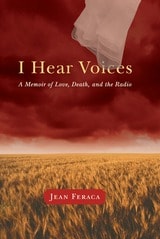
cover of I Hear Voices: A Memoir of Love, Death, and the Radio

I Hear Voices

A Memoir of Love, Death, and the Radio

Jean Feraca

University of Wisconsin Press, 2007

Jean Feraca’s road to self-fulfillment has been as quirky and demanding as the characters in her incredible memoir. A veteran of several decades of public radio broadcasting, Feraca is also a writer and a poet. She is a talk show host beloved for her unique mixture of the humanities, poetry, and journalism, and is the creator of the pioneering international cultural affairs radio program Here on Earth: Radio without Borders.
    In this searing memoir, Feraca traces her own emergence. She pulls back the curtain on her private life, revealing unforgettable portraits of the characters in her brawling Italian-American family: Jenny, the grandmother, the devil woman who threw Casey Stengel down an excavation pit; Dolly, the mother, a cross between Long John Silver and the Wife of Bath, who in battling mental illness becomes the scourge of a Lutheran nursing home; and Stephen, the brilliant but troubled older brother, an anthropologist adopted by a Sioux tribe. In a new chapter that reinforces and ties together the book’s exploration of the multiple forms of love, Jean introduces us to Roger, a Wildman and her husband’s best friend with whom she, too, develops an extraordinary intimacy. A selection of fifteen of Feraca’s poems add counterpoint to her engaging prose.
[more]
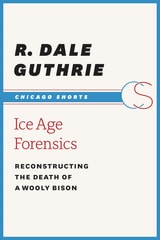
cover of Ice Age Forensics: Reconstructing the Death of a Wooly Bison

Ice Age Forensics

Reconstructing the Death of a Wooly Bison

Dale Guthrie

University of Chicago Press, 2013
Frozen mammals of the Ice Age, preserved for millennia in the tundra, have been a source of fascination and mystery since their first discovery over two centuries ago. The 1979 find of a frozen, extinct steppe bison in an Alaskan gold mine allowed paleontologist Dale Guthrie to undertake the first scientific excavation of an Ice Age mummy in North America and to test theories about these enigmatic frozen fauna. In this brilliant remaking of the death of a wooly bison over 36,000 years ago, we’re given a glimpse of what life was like during the Pleistocene Epoch. From torn fragments and patches of deep-frozen skin and insights gleaned from studies of Montana bison, African lions, and Iberian cave art, Ice Age Forensics presents the story of the huge carcass Guthrie calls “Blue Babe”—and the excitement surrounding its reconstruction.
[more]
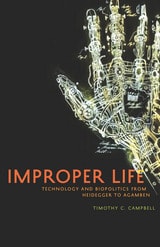
cover of Improper Life: Technology and Biopolitics from Heidegger to Agamben

Improper Life

Technology and Biopolitics from Heidegger to Agamben

Timothy C. Campbell

University of Minnesota Press, 2011

Has biopolitics actually become thanatopolitics, a field of study obsessed with death? Is there something about the nature of biopolitical thought today that makes it impossible to deploy affirmatively? If this is true, what can life-minded thinkers put forward as the merits of biopolitical reflection? These questions drive Improper Life, Timothy C. Campbell’s dexterous inquiry-as-intervention.

Campbell argues that a “crypto-thanatopolitics” can be teased out of Heidegger’s critique of technology and that some of the leading scholars of biopolitics—including Michel Foucault, Giorgio Agamben, and Peter Sloterdijk—have been substantively influenced by Heidegger’s thought, particularly his reading of proper and improper writing. In fact, Campbell shows how all of these philosophers have pointed toward a tragic, thanatopolitical destination as somehow an inevitable result of technology. But in Improper Life he articulates a corrective biopolitics that can begin with rereadings of Foucault (especially his late work regarding the care and technologies of the self), Freud (notably his writings on the drives and negation), and Gilles Deleuze (particularly in the relation of attention to aesthetics).

Throughout Improper Life, Campbell insists that biopolitics can become more positive and productively asserts an affirmative technē not thought through thanatos but rather practiced through bíos.
[more]
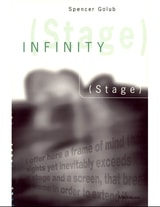
cover of Infinity (Stage)

Infinity (Stage)

Spencer Golub

University of Michigan Press, 2001
Infinity (Stage) is a highly original study and poetic meditation on the themes of death, memory, identity, and representation in theater, film, and literature. Inspired in part by the death of his father, Spencer Golub's scholarly entertainment employs imaginative wordplay, subtle humor, and textual layering to talk about the impossibility of being real. Infinity (Stage) is a masterful piece of performative writing, a quasi-memoir of a mind staging and screening its inner life, embodying a theory of the nature of art and existence. This alternative approach to history uses mostly immaterial evidence, accident, and coincidence to subvert the widespread power and authority of the material world and its logical functions. The list of artists, authors, directors and other celebrities who make appearances includes Alfred Hitchcock, Bernardo Bertolucci, David Lynch, Fred Astaire, Harold Pinter, Herbert Blau, Jean Baudrillard, Jean Cocteau, Maurice Blanchot, Paul Auster, Peter Handke, Robert Wilson, Sam Shepard, Stanley Kubrick, Peter Greenaway, Maya Deren, Jocelyn Moorhouse, Tadeusz Kantor, Tom Stoppard, Vladimir Nabokov, and Rene Magritte, among others. The author's interdisciplinary approach, the scope of his sources and concerns, his blending of critical analysis and creative writing, and his attention to different genres and styles (narrative; dramatic; aphoristic; science, detective, and post-modern fictions) will appeal to readers in theatre, film, performance studies, philosophy, and creative writing. The book will also be of interest to readers who have experienced loss and to those who perceive meaning in things un-remembered, mis-remembered, and unseen. "This book will change the way we think about theatre/film studies and their relation not only to ideology, politics, cultural studies, but to something far more demanding than enunciated and passing power relationships--to life." --Michal Kobialka, University of Minnesota
[more]
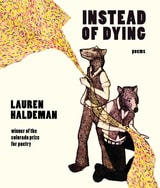
cover of Instead of Dying

Instead of Dying

Lauren Haldeman

University Press of Colorado, 2017

Invoking spiders and senators, physicists and aliens, Lauren Haldeman’s second book, Instead of Dying, decodes the world of death with a powerful mix of humor, epiphany, and agonizing grief. In the spirit of Calvino’s Invisible Cities, these poems compulsively imagine alternate realities for a lost sibling (“Instead of dying, they inject you with sunlight & you live” or “Instead of dying, you join a dog-sledding team in Quebec”), relentlessly recording the unlived possibilities that blossom from the purgative magical thinking of mourning. Whether she is channeling Google Maps Street View to visit a scene of murder (“Because / a picture of this place is / also a picture of you”) or investigating the origins of consciousness (“Yes, alien / life-forms exist / they are your thoughts”), Haldeman wrenches verse into new sublime forms, attempting to both translate the human experience as well as encrypt it, inviting readers into realms where we hover, plunge, rise again, and ascend.
[more]