Results by title
628 books match the query 'Democracy' and 24 start with i
Identity/Difference
Democratic Negotiations of Political ParadoxWilliam E. Connolly
University of Minnesota Press, 2002
A new edition of this classic work on the idea of difference.
In this foundational work in contemporary political theory, William Connolly makes a distinctive contribution to our understanding of the relationship between personal identity and democratic politics, particularly in the domains of religion, ethics, sexuality, and ethnicity. Every identity, Connolly argues, whether individual or social, presents us with a fundamental and troubling paradox: an identity establishes itself in relation to a set of differences, and it operates under powerful pressures to fix, regulate, or exclude some of these differences as otherness. The dignity of a people or political regime, and the quality of democratic culture, depends on the acknowledgment and ethos cultivated in response to these pressures.
In a substantial new essay, Connolly responds to the heated controversy surrounding his ideas when Identity\Difference was first published in 1991, while augmenting his discussion of the virtues of critical responsiveness. The issues of identity and difference cannot be ignored, he contends, and are ubiquitous in modern life.
Imagining Interest in Political Thought
Origins of Economic RationalityStephen G. Engelmann
Duke University Press, 2003
Tracing the development of monistic interest from its origins in Reformation political theory and theology through late-twentieth-century neoliberalism, Engelmann reconceptualizes the history of liberalism as consisting of phases in the history of monistic interest or economic government. He describes how monistic interest, as formulated by Bentham, is made up of the individual’s imagined expectations, which are constructed by the very regime that maximizes them. He asserts that this construction of interests is not the work of a self-serving manipulative state. Rather, the state, which is itself subject to strict economic regulation, is only one cluster of myriad "public" and "private" agencies that produce and coordinate expectations. In place of a liberal vision in which government appears only as a protector of the free pursuit of interest, Engelmann posits that the free pursuit of interest is itself a mode of government, one that deploys individual imagination and choice as its agents.
Imagining Judeo-Christian America
Religion, Secularism, and the Redefinition of DemocracyK. Healan Gaston
University of Chicago Press, 2019
Imperialism and the Corruption of Democracies
Herman Lebovics
Duke University Press, 2006
Some essays explore why modern Western democratic societies needed colonialism. Among these is an examination of the seventeenth-century philosopher John Locke’s prescient conclusion that liberalism could only control democratic forces with the promise of greater wealth enabled by empire. In other essays Lebovics considers the relation between overseas rule and domestic life. Discussing George Orwell’s tale “Shooting an Elephant” and the careers of two colonial officers (one British and one French), he contemplates the ruinous authoritarianism that develops among the administrators of empire. Lebovics considers Pierre Bourdieu’s thinking about how colonialism affected metropolitan French life, and he reflects on the split between sociology and ethnology, which was partly based on a desire among intellectuals to think one way about metropolitan populations and another about colonial subjects. Turning to the arts, Lebovics traces how modernists used the colonial “exotic” to escape the politicized and contested modernity of the urban West. Imperialism and the Corruption of Democracies is a compelling case for cultural history as a key tool for understanding the injurious effects of imperialism and its present-day manifestations within globalization.
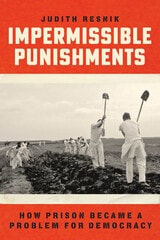
Impermissible Punishments
How Prison Became a Problem for DemocracyJudith Resnik
University of Chicago Press, 2025
An original transatlantic history of the invention of the corrections profession and of ensuing debates about punishment’s purposes and prisoners’ rights.
Impermissible Punishments explores the history of punishment inside prisons and how governments grappled with obligations to justify the punishments they impose. Legal scholar Judith Resnik charts the creation of the corrections profession and weaves together the stories of people who made rules for prisons and the stories of those living under the resulting regimes.
Resnik maps three centuries of shifting ideas, norms, and legal standards aiming to draw lines between permissible and impermissible punishments. Her account documents the impact of World War II, the United Nations, the US Civil Rights movement, and the pioneering prisoners who insisted that law should protect their individual dignity. Taking us to the present, Resnik analyzes the expansion of imprisonment, the inability of public and private prisons to provide safe housing, and the impact of abolition politics.
Exploring the interdependency of people in and out of prisons, Impermissible Punishments examines what governments committed to equality owe to the people they detain and argues that many contemporary forms of punishment need to end.
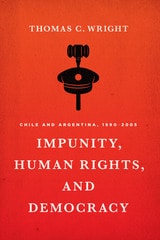
Impunity, Human Rights, and Democracy
Chile and Argentina, 1990-2005By Thomas C. Wright
University of Texas Press, 2014
Universal human rights standards were adopted in 1948, but in the 1970s and 1980s, violent dictatorships in Argentina and Chile flagrantly defied the new protocols. Chilean general Augusto Pinochet and the Argentine military employed state terrorism in their quest to eradicate Marxism and other forms of “subversion.” Pinochet constructed an iron shield of impunity for himself and the military in Chile, while in Argentina, military pressure resulted in laws preventing prosecution for past human rights violations. When democracy was reestablished in both countries by 1990, justice for crimes against humanity seemed beyond reach.
Thomas C. Wright examines how persistent advocacy by domestic and international human rights groups, evolving legal environments, unanticipated events that impacted public opinion, and eventual changes in military leadership led to a situation unique in the world—the stripping of impunity not only from a select number of commanders of the repression but from all those involved in state terrorism in Chile and Argentina. This has resulted in trials conducted by national courts, without United Nations or executive branch direction, in which hundreds of former repressors have been convicted and many more are indicted or undergoing trial.
Impunity, Human Rights, and Democracy draws on extensive research, including interviews, to trace the erosion and collapse of the former repressors’ impunity—a triumph for human rights advocates that has begun to inspire authorities in other Latin American countries, including Peru, Uruguay, Brazil, and Guatemala, to investigate past human rights violations and prosecute their perpetrators.
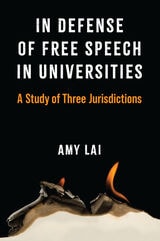
In Defense of Free Speech in Universities
A Study of Three JurisdictionsAmy Lai
University of Michigan Press, 2023
In this book, Amy Lai examines the current free speech crisis in Western universities. She studies the origin, history, and importance of freedom of speech in the university setting, and addresses the relevance and pitfalls of political correctness and microaggressions on campuses, where laws on harassment, discrimination, and hate speech are already in place, along with other concepts that have gained currency in the free speech debate, including deplatforming, trigger warning, and safe space. Looking at numerous free speech disputes in the United Kingdom, the United States, and Canada, the book argues for the equal application of the free speech principle to all expressions to facilitate respectful debates. All in all, it affirms that the right to free expression is a natural right essential to the pursuit of truth, democratic governance, and self-development, and this right is nowhere more important than in the university.
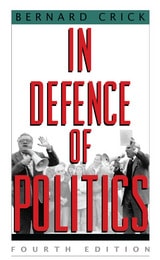
In Defense of Politics
Bernard Crick
University of Chicago Press, 1993
It's hard to get excited about politics these days. Polarization is high, getting things done seems all but impossible, and at times it seems like no one is willing to listen to anyone they disagree with. Surely there's a better way.
In Defense of Politics says, loud and proud: Absolutely not. In this classic but still timely work, which recently drew strong praise from Ezra Klein, Bernard Crick argues that politics, with its compromises and frustrations aand power struggles, remains the only tested alternative to government by coercion, making both freedom and order possible in heterogeneous societies. For Crick, politics is messy and complex, and his book defends it against those who would identify it with (and reduce it to) ideology, democracy, nationalism, or technology. “Politics," Crick explains, "involves genuine relationships with people who are genuinely other people, not tasks set for our redemption or objects for our philanthropy.”
Clear-eyed and frank yet still capable of inspiring, In Defense of Politics is a rousing call to recommit to the hard work of bringing people together and moving society forward.
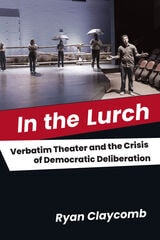
In the Lurch
Verbatim Theater and the Crisis of Democratic DeliberationRyan Claycomb
University of Michigan Press, 2023
But this is not just a disinterested history—Claycomb reflects on his own participation in that political fantasy, including earlier scholarly writing that articulated with breathless hopefulness the potential of verbatim theater, and on his own theatrical attendance, imbued with a belief that witnessing this idealized public sphere was a substitute for actual public participation. In the Lurch also recounts the bumpy path towards its completion, two years marked by presidential impeachments, an insurrection, a national reckoning with racism, and a global pandemic. At the heart of the book is a central question: is verbatim theater any longer an effective cultural response to what can look like the possible end of democracy?
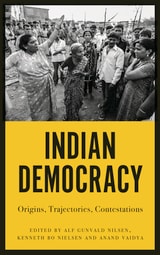
Indian Democracy
Origins, Trajectories, ContestationsEdited by Alf Gunvald Nilsen, Kenneth Bo Nielsen, and Anand Vaidya
Pluto Press, 2019
India’s pluralism has always posed a formidable challenge to its democracy, with many believing that a clash of identities based on region, language, caste, religion, ethnicity, and tribe would bring about its demise. With the meteoric rise to power of the Bharatiya Janata Party, the nation’s solidity is once again called into question: is Modi’s Hindu majoritarianism an anti-democratic attempt to transform India into a monolithic Hindu nation from which minorities and dissidents are forcibly excluded?
With examinations of the way that class and caste power shaped the making of India’s postcolonial democracy, the role of feminism, the media, and the public sphere in sustaining and challenging democracy, this book interrogates the contradictions at the heart of the Indian democratic project, examining its origins, trajectories, and contestations.
India’s New Middle Class
Democratic Politics in an Era of Economic ReformLeela Fernandes
University of Minnesota Press, 2006
Inequality and American Democracy
What We Know and What We Need to LearnLawrence R. Jacobs
Russell Sage Foundation, 2005

Information and Democratic Processes
Edited by John A. Ferejohn and James H. Kuklinski
University of Illinois Press, 1990
The golden democratic tradition of an informed and involved electorate freely and rationally choosing its public officials seems to be at odds with American political reality. Thus the questions: On what basis do people vote and form opinions? How does the lack of information at the individual level affect system performance?
In this collection twenty-six distinguished political scientists discuss, debate, and define the relationship between information and the democracy it supposedly serves. The contributors address both the empirical and normative aspects of governing in the United States, employing psychological, sociological, and economic perspectives.
Information, Participation, and Choice
An Economic Theory of Democracy in PerspectiveBernard Grofman, Editor
University of Michigan Press, 1993
Ingenious Citizenship
Recrafting Democracy for Social ChangeCharles T. Lee
Duke University Press, 2016
Inside Colombia
Drugs, Democracy, and WarLivingstone, Grace
Rutgers University Press, 2004
The South American nation of Colombia has seen more than forty years of unrest, conflict, and civil war. It is a country in which social violence and warfare are intricately intertwined. Colombia is also notorious for its drug trade, being one of the leading producers of cocaine in the world, and for its central role as a staging ground for the U.S. “war on drugs.” Since 9/11 the Bush administration has sought to draw political links between the Colombian drug trade, guerrilla organizations, and terrorism.
Inside Colombia offers a valuable introduction and quick reference guide to this complex nation. With chapters devoted to history, human rights issues, the economy, drugs, the controversial antidrug intervention known as Plan Colombia, and relations with the United States, the book offers an easily accessible and comprehensive overview. Readers will learn about the major players in the conflicts, significant political figures, how Colombia’s economy has fared in the twentieth century, how the country’s geography influences its politics and economy, and how U.S. intervention shapes Colombia’s political scene.
Intellectual Populism
Democracy, Inquiry, and the PeoplePaul Stob
Michigan State University Press, 2020
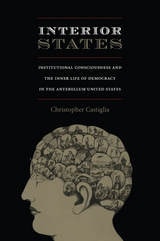
Interior States
Institutional Consciousness and the Inner Life of Democracy in the Antebellum United StatesChristopher Castiglia
Duke University Press, 2008
In the late eighteenth century and early nineteenth, as discourses of interiority gained prominence, so did powerful counter-narratives. Castiglia reveals the flamboyant pages of antebellum popular fiction to be an archive of unruly democratic aspirations. Through close readings of works by Maria Monk and George Lippard, Walt Whitman and Timothy Shay Arthur, Hannah Webster Foster and Hannah Crafts, and Nathaniel Hawthorne and Herman Melville, Castiglia highlights a refusal to be reformed or self-contained. In antebellum authors’ representations of nervousness, desire, appetite, fantasy, and imagination, he finds democratic strivings that refused to disappear. Taking inspiration from those writers and turning to the present, Castiglia advocates a humanism-without-humans that, denied the adjudicative power of interiority, promises to release democracy from its inner life and to return it to the public sphere where U.S. citizens may yet create unprecedented possibilities for social action.
International Perspectives on Contemporary Democracy
Edited by Peter F. Nardulli
University of Illinois Press, 2007
Democracy enjoys unparalleled prestige at the beginning of the twenty-first century as a form of government. Some of the world's most prosperous nations are democracies, and an array of nations in Europe, Africa, and South America have adopted the system. This globalization has also met resistance and provoked concerns about international power exerted by institutions and elites that are beyond the control of existing democratic institutions. In this volume, leading scholars of democracy engage the key questions about how far and how fast democracy can spread, and how international agencies and international cooperation uneasily affect national democracies. At first glance, the efforts of intergovernmental organizations to intervene in a nation's governance seem anything but democratic to that nation. The contributors demonstrate why democracy has been so attractive and so successful, but are also candid about what limits it may reach, and why.
Contributors are Lisa Anderson, Larry Diamond, Zachary Elkins, John R. Freeman, Brian J. Gaines, James H. Kuklinski, Peter F. Nardulli, Melissa A. Orlie, Buddy Peyton, Paul J. Quirk, Wendy Rahn, Bruce Russett, and Beth Simmons.

Interrogating Cultural Studies
Theory, Politics and PracticeEdited by Paul Bowman
Pluto Press, 2003
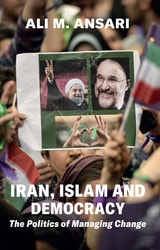
Iran, Islam and Democracy
The Politics of Managing ChangeAli M. Ansari
Gingko, 2019
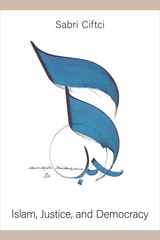
Islam, Justice, and Democracy
Sabri Ciftci
Temple University Press, 2022
Justice (al-‘adl) is one of the principal values of the Islamic faith. In Islam, Justice, and Democracy, Sabri Ciftci explores the historical, philosophical, and empirical foundations of justice to examine how religious values relate to Muslim political preferences and behavior. He focuses on Muslim agency and democracy to explain how ordinary Muslims use the conceptions of divine justice—either servitude to God or exercising free will against oppressors—to make sense of real-world problems.
Using ethnographic research, interviews, and public opinion surveys as well as the works of Islamist ideologues, archives of Islamist journals, and other sources, Ciftci shows that building contemporary incarnations of Islamist justice is, in essence, a highly practical political project that has formative effects on Muslim political attitudes. Islam, Justice, and Democracy compares the recent Arab Spring protests to the constitutionalist movements of the nineteenth and twentieth centuries in the Middle East to demonstrate the continuities and rifts a century apart.
By putting justice at the center of democratic thinking in the Muslim world, Ciftci reconsiders Islam's potential in engendering both democratic ideals and authoritarian preferences.
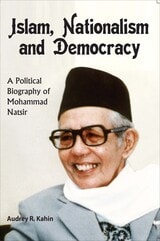
Islam, Nationalism and Democracy
a Political Biography of Mohammad NatsirAudrey R. Kahin
National University of Singapore Press, 2012
Islam, Postmodernism and Other Futures
A Ziauddin Sardar ReaderEdited by Sohail Inayatullah and Gail Boxwell
Pluto Press, 2003
Ziauddin Sardar is a prolific writer and an insightful cultural commentator. His latest book, Why Do People Hate America?, has been a regular feature in bestseller lists in several countries. In the UK, he is known as a leading intellectual and his regular contributions to the Observer, the Independent and the New Statesman have brought his writings to a wide audience. As one of our most high-profile Muslim intellectuals, he has also become an increasingly important voice in the media since the events of September 11th 2001.
This is the first collection of his writings that offers a comprehensive introduction to his thought. Starting with his analysis of his own position as a British Muslim and a writer, it goes on to explore issues of Islam and cultural change, education, identity, post-modernism and the future. Drawn from a broad range of his work in scholarly journals as well as from his many books on aspects of culture and society, it includes his most frequently cited papers and makes an ideal introduction to the immense scope of his work in cultural studies.
Ziaddin Sardar is currently the editor of Third Text and Visiting Professor of Cultural Studies at City University, London. His books for Pluto Press include Postmodernism and the Other and Aliens R Us.