436 books match the query 'Disability' and 9 start with i

cover of If You Would Let Me

If You Would Let Me

Maggie Dietz

Four Way Books, 2026

If You Would Let Me uses the myth of Persephone and Demeter to explore, in an utterly contemporary idiom, the hellish descents and unequivocal love of a mother and an adolescent child. The old story is reimagined in new terms—a present-day Persephone’s cycles of psychic affliction giving rise to botched facial piercings, social media ghostings, and squalls of physical fury—and revoiced in poems that sing Demeter’s rage, the depths of maternal grief, the seasons of erasure and renewal. In an electric transposition of classic lore onto modern descriptive modes, Dietz casts the imperiling pubescence and anxiety of middle school as canonically significant and dangerously chimerical: “Persephone and her friends brought / Waxed paper cups of ice cream / To the meadow by the river,” where “Their laughter made ripples a heron / Mistook for alewives underwater” while “Under some of their shirts” grew “The first hiccups of puffy nipples.” Throughout these teenage transformations and the distances they grow, Dietz remains as constant as a lodestar, offering unwavering light for her child to see by in order to return. “You must know what I mean even if / You do not know you know: Child, // When you called my name I heard you / Though your cries could find no wind.”  Formally meticulous and sonically intricate, these poems hear as much as they make themselves heard, harnessing ancient energies to create a picture of our recycled world—a story for our own times, one not only familiar but perennially, timelessly true.  
[more]
cover of Illness Politics and Hashtag Activism

Illness Politics and Hashtag Activism

Lisa Diedrich

University of Minnesota Press, 2024

How illness on social media reveals the struggle for care and access against ableism and stigma

Illness Politics and Hashtag Activism explores illness and disability in action on social media, analyzing several popular hashtags as examples of how illness figures in recent U.S. politics. Lisa Diedrich shows how illness- and disability-oriented hashtags serve as portals into how and why illness and disability are sites of political struggle and how illness politics is informed by, intersects with, and sometimes stands in for sexual, racial, and class politics. She argues that illness politics is central—and profoundly important—to both mainstream and radical politics, and she investigates the dynamic intersection of media and health and health-activist practices to show the ways their confluence affects our perception and understanding of illness.
[more]
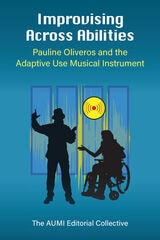
cover of Improvising Across Abilities: Pauline Oliveros and the Adaptive Use Musical Instrument

Improvising Across Abilities

Pauline Oliveros and the Adaptive Use Musical Instrument

The AUMI Editorial Collective

University of Michigan Press, 2024

Improvising Across Abilities: Pauline Oliveros and the Adaptive Use Musical Instrument (AUMI) brings together scholars, musicians, and family members of people with disabilities to  collectively recount years of personal experiences, research, and perspectives on the societal and community impact of inclusive musical improvisation. One of the lesser-known projects of composer, improviser, and humanitarian, Pauline Oliveros (1932–2016), the AUMI was designed as a liberating and affordable alternative to the constraints of instruments created only for normative bodies, thus opening a doorway for people of all ages, genders, abilities, races, and socioeconomic backgrounds to access artistic practice with others. More than a book about AUMI, this book is an invitation to readers to use AUMI in their own communities. 

This book, which contains wisdom from many who have been affected by their work with the instrument and the people who use it, is a representation of how music and extemporized performance have touched the lives and minds of scholars and families alike. Not only has AUMI provided the opportunity to grow in listening to others who may speak differently (or not at all), but it has been used as an avenue for a diverse set of people to build friendships with others whom they may have never otherwise even glanced at in the street. By providing a space for every person who comes across AUMI to perform, listen, improvise, and collaborate, the continuing development of this instrument contributes to a world in which every person is heard, welcomed, and celebrated.

[more]
cover of In the Province of the Gods

In the Province of the Gods

Kenny Fries

University of Wisconsin Press, 2021
Kenny Fries embarks on a journey of profound self-discovery as a disabled foreigner in Japan, a society historically hostile to difference. As he visits gardens, experiences Noh and butoh, and meets artists and scholars, he also discovers disabled gods, one-eyed samurai, blind chanting priests, and A-bomb survivors. When he is diagnosed as HIV positive, all his assumptions about Japan, the body, and mortality are shaken, and he must find a way to reenter life on new terms.
[more]
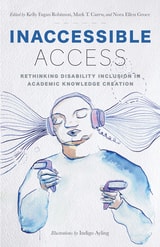
cover of Inaccessible Access: Rethinking Disability Inclusion in Academic Knowledge Creation

Inaccessible Access

Rethinking Disability Inclusion in Academic Knowledge Creation

Kelly Fagan Robinson

Rutgers University Press, 2025
Inaccessible Access ethnographically addresses barriers to inclusion within knowledge-making. It focuses on the social, environmental, communicative, and epistemological barriers that people with disabilities confront and embody throughout the course of their learning and living and in the specific context of their higher education institutions and in research. It is presented by a neurodiverse, disabled, and non-cis cohort of authors, all of whom acknowledge a continuum of (in)access that is available to each contributor contingent on their inherent intersectionalities and alterities. The authors and editors of this book foreground the work that has yet to be done on recognizing the value of nonnormative ways of approaching, being in, and knowing research and higher education, particularly in cases where disablity-centered epistemologies are sidelined in confrontation with institutional norms, even within existing discourses concerning equality and alterity. 
[more]
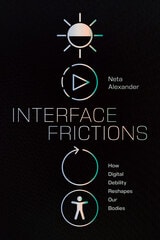
cover of Interface Frictions: How Digital Debility Reshapes Our Bodies

Interface Frictions

How Digital Debility Reshapes Our Bodies

Neta Alexander

Duke University Press, 2025
In Interface Frictions, Neta Alexander explores how ubiquitous design features in digital platforms reshape, condition, and break our bodies. She shows that while features such as refresh, playback speed, autoplay, and night mode are convenient, they can lead to “digital debility”—the slow and often invisible ways that technologies may harm human bodies. These features all assume an able-bodied user and at the same time push users to ignore their bodily limitations like the need for rest, nourishment, or movement. Building on the lived experiences of people with disabilities, Alexander explores alternative design solutions that arise from a multisensorial approach to communication. She demonstrates what can be gained from centering the nonaverage user, such as blind people who pioneered ways to control the playback speed of media, and Netflix subscribers with invisible disabilities like PTSD who successfully pushed the company to redesign its previews autoplay feature. Drawing on artworks, video games, and creative hacking by users with disabilities, Alexander challenges our understanding of media consumption, the attention economy, and the digital interface.
[more]
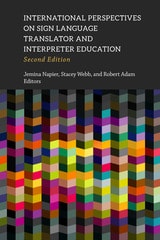
cover of International Perspectives on Sign Language Translator and Interpreter Education

International Perspectives on Sign Language Translator and Interpreter Education

Jemina Napier

Gallaudet University Press, 2024

The field of sign language translator and interpreter (SLTI) education gets a global treatment in this new volume helmed by editors Jemina Napier, Stacey Webb, and Robert Adam. This second edition updates the information from the 2009 volume and adds new contributions that expand the scope of the work to include additional countries and topic areas. SLTI scholars and educators will benefit from these international perspectives and gain an improved understanding of this rapidly evolving discipline.
 
Each chapter, authored collaboratively by deaf and hearing educators, surveys general interpreter education and training, examines the status of the profession for both deaf and hearing practitioners, and addresses specific challenges faced within the different national frameworks. Contributors also discuss ongoing and future trends, including the impact of the Covid-19 pandemic on educational practices.
 
This volume disseminates extensive knowledge on sign language translator and interpreter education, covering established programs as well as ad hoc training, and highlighting effective teaching pedagogies and structured classroom strategies. Contributors emphasize a holistic approach to the field, integrating SLTI education, the current profession, future practitioners, and deaf communities. Although the state of the field varies widely around the world depending on the national context, this volume reveals a shared goal of advancing professional standards and improving the provision of service to deaf people worldwide.

[more]
cover of Intoxicated: Race, Disability, and Chemical Intimacy across Empire

Intoxicated

Race, Disability, and Chemical Intimacy across Empire

Mel Y. Chen

Duke University Press, 2023
In Intoxicated Mel Y. Chen explores the ongoing imperial relationship between race, sexuality, and disability. They focus on nineteenth-century biopolitical archives in England and Australia to show how mutual entanglements of race and disability take form through toxicity. Examining English scientist John Langdon Down’s characterization of white intellectual disability as Asian interiority and Queensland’s racialization and targeting of Aboriginal peoples through its ostensible concern with black opium, Chen explores how the colonial administration of race and disability gives rise to “intoxicated” subjects often shadowed by slowness. Chen charts the ongoing reverberations of these chemical entanglements in art and contemporary moments of political and economic conflict or agitation. Although intoxicated subjects may be affected by ongoing pollution or discredited as agents of failure, Chen affirmatively identifies queer/crip forms of unlearning and worldmaking under imperialism. Exemplifying an undisciplined thinking that resists linear or accretive methods of inquiry, Chen unsettles conventional understandings of slowness and agitation, intellectual method, and the toxic ordinary.
[more]
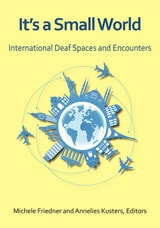
cover of It's a Small World: International Deaf Spaces and Encounters

It's a Small World

International Deaf Spaces and Encounters

Michele Friedner

Gallaudet University Press, 2015

It’s a Small World explores the fascinating and, at times, controversial concept of DEAF-SAME (“I am deaf, you are deaf, and so we are the same”) and its influence on deaf spaces locally and globally. The editors and contributors focus on national and international encounters (e.g., conferences, sporting events, arts festivals, camps) and the role of political/economic power structures on deaf lives and the creation of deaf worlds. They also consider important questions about how deaf people negotiate DEAF-SAME and deaf difference, with particular attention to relations between deaf people in the global South (countries in Africa, Asia, and Latin America, with access to fewer resources than other countries) and the global North (countries in Europe, along with Canada, the US, Australia, and several other nations with access to and often control of resources). 
 
       Editors Michele Friedner and Annelies Kusters and their contributors represent a variety of academic and professional fields, from anthropology and linguistics to cultural and religious studies. Each chapter in this original volume highlights a new perspective on the multiple intersections that occur between nationalities, cultures, languages, religions, races, genders, and identities. The text is organized into five sections—Gatherings, Language, Projects, Networks, and Visions. Taken all together, the 23 chapters in this book provide an understanding of how sameness and difference are powerful yet contested categories in deaf worlds.
[more]