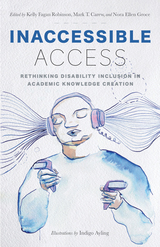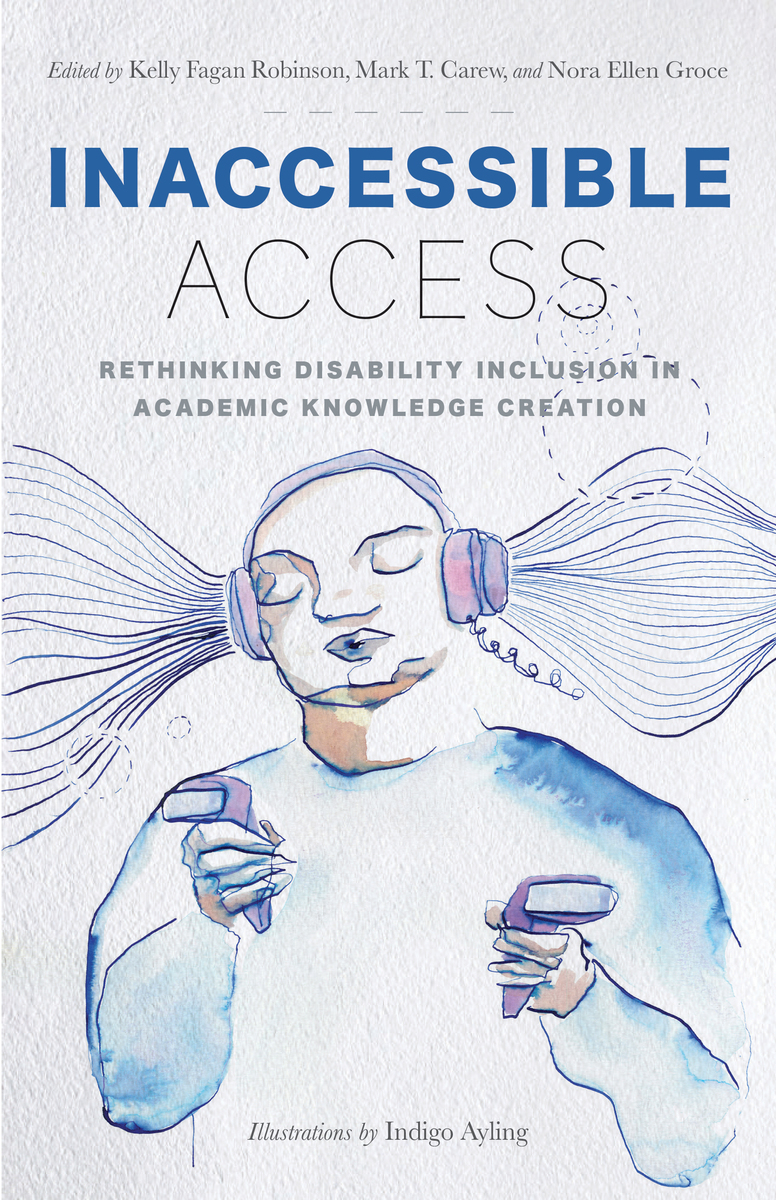
Inaccessible Access: Rethinking Disability Inclusion in Academic Knowledge Creation
Rutgers University Press, 2025
Cloth: 978-1-9788-4146-8 | Paper: 978-1-9788-4145-1 | eISBN: 978-1-9788-4147-5 (ePub) | eISBN: 978-1-9788-4148-2 (PDF)
Library of Congress Classification LC4818.38.I53 2025
Dewey Decimal Classification 371.91
Cloth: 978-1-9788-4146-8 | Paper: 978-1-9788-4145-1 | eISBN: 978-1-9788-4147-5 (ePub) | eISBN: 978-1-9788-4148-2 (PDF)
Library of Congress Classification LC4818.38.I53 2025
Dewey Decimal Classification 371.91
ABOUT THIS BOOK | AUTHOR BIOGRAPHY | REVIEWS | TOC
ABOUT THIS BOOK
Inaccessible Access ethnographically addresses barriers to inclusion within knowledge-making. It focuses on the social, environmental, communicative, and epistemological barriers that people with disabilities confront and embody throughout the course of their learning and living and in the specific context of their higher education institutions and in research. It is presented by a neurodiverse, disabled, and non-cis cohort of authors, all of whom acknowledge a continuum of (in)access that is available to each contributor contingent on their inherent intersectionalities and alterities. The authors and editors of this book foreground the work that has yet to be done on recognizing the value of nonnormative ways of approaching, being in, and knowing research and higher education, particularly in cases where disablity-centered epistemologies are sidelined in confrontation with institutional norms, even within existing discourses concerning equality and alterity.
See other books on: Aims and objectives | Education (Higher) | Knowledge, Sociology of | People with disabilities | Universities and colleges
See other titles from Rutgers University Press