
 A SCHOLARLY BOOK REPOSITORY
24 start with A start with A

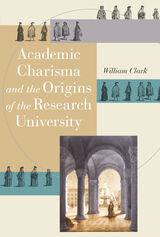
William Clark argues that the research university—which originated in German Protestant lands and spread globally in the nineteenth and twentieth centuries—developed in response to market forces and bureaucracy, producing a new kind of academic whose goal was to establish originality and achieve fame through publication. With an astonishing wealth of research, Academic Charisma and the Origins of the Research University investigates the origins and evolving fixtures of academic life: the lecture catalogue, the library catalog, the grading system, the conduct of oral and written exams, the roles of conversation and the writing of research papers in seminars, the writing and oral defense of the doctoral dissertation, the ethos of "lecturing with applause" and "publish or perish," and the role of reviews and rumor. This is a grand, ambitious book that should be required reading for every academic.

Using as a framework the "theory of careers" developed by John L. Holland, the authors of this volume examine the patterns of student stability and change inherent in the college experience, as well as the variations in professional attitudes and behaviors of college faculty. Their goal is to learn more about what colleges and universities might do to facilitate the retention, satisfaction, and learning of their students.
For example, why should faculties split over student-oriented teaching strategies, one group favoring the formal, structured classroom, the other a freer, more spontaneous environment? Why do some undergraduates become independent thinkers with strong analytical, mathematical, and scientific competencies while others develop powerful interpersonal and group leadership skills?
Holland's theory--at its core a person-environment fit theory--assumes that there are six personality types and six analogous academic environments and that the educational persistence, satisfaction, and achievement of students are a function of the congruence or "fit" between students and their academic environments. The authors also assume that there are circumstances under which the environments of the major field exert more influence on students than do the students' own personality traits. Applying Holland's theory to distinctive clusters of academic disciplines, the authors have found that the answers to such fundamental questions as those asked above emanate from a basic understanding of the influences of academic disciplines and the manner by which they shape the patterns of thought and behavior of both college students and faculty.
Academic Disciplines will benefit researchers and graduate students who study college students and faculty, as well as administrators and policymakers responsible for the performance of colleges and universities.

In this passionately argued overview, a longtime activist-scholar takes readers through the changing landscape of academic freedom. From the aftermath of September 11th to the new frontier of blogging, Robert O'Neil examines the tension between institutional and individual interests. Many cases boil down to a hotly contested question: who has the right to decide what is taught in the classroom?
O'Neil shows how courts increasingly restrict professorial judgment, and how the feeble protection of what is posted on the Internet and written in email makes academics more vulnerable than ever. Even more provocatively, O'Neil argues, the newest threats to academic freedom come not from government, but from the private sector. Corporations increasingly sponsor and control university-based research, while self-appointed watchdogs systematically harass individual teachers on websites and blogs. Most troubling, these threats to academic freedom are nearly immune from legal recourse.
Insisting that new concepts of academic freedom, and new strategies for maintaining it are needed, O'Neil urges academics to work together--and across rigid and simplistic divisions between "left" and "right."

Faculty members, administrators, and professionals with experience at all levels of higher education offer candid, practical advice to help beginning academics understand matters including:
— The different kinds of institutions of higher learning and expectations of faculty at each.
— The advantages and disadvantages of teaching at four-year colleges instead of research universities.
— The ins and outs of the job market.
— Alternatives to tenure-track, research-oriented positions.
— Salary and benefits.
— The tenure system.
— Pedagogy in both large lecture courses and small, discussion-based seminars.
— The difficulties facing women and minorities within academia.
— Corporations, foundations, and the federal government as potential sources of research funds.
— The challenges of faculty mentoring.
— The impact of technology on contemporary teaching and learning.
— Different types of publishers and the publishing process at university presses.
— The modern research library.
— The structure of university governance.
— The role of departments within the university.
With the inclusion of eight new chapters, this edition of The Academic’s Handbook is designed to ease the transition from graduate school to a well-rounded and rewarding career.
Contributors. Judith K. Argon, Louis J. Budd, Ronald R. Butters, Norman L. Christensen, Joel Colton, Paul L. Conway, John G. Cross, Fred E. Crossland, Cathy N. Davidson, A. Leigh DeNeef, Beth A. Eastlick, Matthew W. Finkin, Jerry G. Gaff, Edie N. Goldenberg, Craufurd D. Goodwin, Stanley M. Hauerwas, Deborah L. Jakubs, L. Gregory Jones, Nellie Y. McKay, Patrick M. Murphy, Elizabeth Studley Nathans, A. Kenneth Pye, Zachary B. Robbins, Anne Firor Scott, Sudhir Shetty, Samuel Schuman, Philip Stewart, Boyd R. Strain, Emily Toth, P. Aarne Vesilind, Judith S. White, Henry M. Wilbur, Ken Wissoker
Contributors. Luis Alvarez, Steven Alvarez, Eladio Bobadilla, Genevieve Carpio, Marcia Chatelain, Ernesto Chávez, Miroslava Chávez-García, Nathan D. B. Connolly, Jeremy V. Cruz, Cathy N. Davidson, Sarah Deutsch, Brenda Elsey, Sylvanna M. Falcón, Michelle Falkoff, Kelly Fayard, Matthew W. Finkin, Lori A. Flores, Kathryn J. Fox, Frederico Freitas, Neil Garg, Nanibaa’ A. Garrison, Joy Gaston Gayles, Tiffany Jasmin González, Cynthia R. Greenlee, Romeo Guzmán, Lauren Hall-Lew, David Hansen, Heidi Harley, Laura M. Harrison, Sonia Hernández, Sharon P. Holland, Elizabeth Q. Hutchison, Deborah Jakubs, Bridget Turner Kelly, Karen Kelsky, Stephen Kuusisto, Magdalena Maczynska, Sheila McManus, Cary Nelson, Jocelyn H. Olcott, Rosanna Olsen, Natalia Mehlman Petrzela, Charles Piot, Bryan Pitts, Sarah Portnoy, Laura Portwood-Stacer, Yuridia Ramirez, Meghan K. Roberts, John Elder Robison, David Schultz, Lynn Stephen, James E. Sutton, Antar A. Tichavakunda, Keri Watson, Ken Wissoker, Karin Wulf
Welcome to the life of the mind in the gig economy. Over the past few decades, the job of college professor has been utterly transformed—for the worse. America’s colleges and universities were designed to serve students and create knowledge through the teaching, research, and stability that come with the longevity of tenured faculty, but higher education today is dominated by adjuncts. In 1975, only thirty percent of faculty held temporary or part-time positions. By 2011, as universities faced both a decrease in public support and ballooning administrative costs, that number topped fifty percent. Now, some surveys suggest that as many as seventy percent of American professors are working course-to-course, with few benefits, little to no security, and extremely low pay.
In The Adjunct Underclass, Herb Childress draws on his own firsthand experience and that of other adjuncts to tell the story of how higher education reached this sorry state. Pinpointing numerous forces within and beyond higher ed that have driven this shift, he shows us the damage wrought by contingency, not only on the adjunct faculty themselves, but also on students, the permanent faculty and administration, and the nation. How can we say that we value higher education when we treat educators like desperate day laborers?
Measured but passionate, rooted in facts but sure to shock, The Adjunct Underclass reveals the conflicting values, strangled resources, and competing goals that have fundamentally changed our idea of what college should be. This book is a call to arms for anyone who believes that strong colleges are vital to society.

There have been institutions of higher learning for centuries in Africa, but the phenomenal growth has taken place in the last fifty years, first in the later days of colonialism and then in the heady days of independence and commodity boom. Without them, there would have been no development.
The three highly distinguished authors have written the first comprehensive assessment of universities and higher education in Africa south of the Sahara. As can be seen from their biographies, they draw on experience from both francophone and anglophone Africa and from teaching in both the sciences and the arts.
Agile work strategies are a staple of the software development world, developed out of the need to be flexible and responsive to fast-paced change at times when “business as usual” could not work. These techniques call for breaking projects into phases and short-term goals, managing assignments collectively, and tracking progress openly.
Agile Faculty is a comprehensive roadmap for scholars who want to incorporate Agile practices into all aspects of their academic careers, be it research, service, or teaching. Rebecca Pope-Ruark covers the basic principles of Scrum, one of the most widely used models, and then through individual chapters shows how to apply that framework to everything from individual research to running faculty committees to overseeing student class work. Practical and forward-thinking, Agile Faculty will help readers not only manage their time and projects but also foster productivity, balance, and personal and professional growth.
The enormous changes in twentieth-century Chinese higher education up to the Sino-Japanese War are detailed in this pioneering work. Yeh examines the impact of instruction in English and of the introduction of science and engineering into the curriculum. Such innovations spurred the movement of higher education away from the gentry academies focused on classical studies and propelled it toward modern middle-class colleges with diverse programs.
Yeh provides a typology of Chinese institutions of higher learning in the Republican period and detailed studies of representative universities. She also describes student life and prominent academic personalities in various seats of higher learning. Social changes and the political ferment outside the academy affected students and faculty alike, giving rise, as Yeh contends, to a sense of alienation on the eve of war.
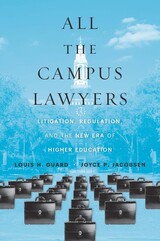
How colleges and universities can respond to legal pressures while remaining true to their educational missions.
Not so long ago, colleges and universities had little interaction with the law. In the 1970s, only a few well-heeled universities even employed in-house legal counsel. But now we live in the age of tenure-denial lawsuits, free speech battles, and campus sexual assault investigations. Even athletics rules violations have become a serious legal matter. The pressures of regulation, litigation, and legislation, Louis Guard and Joyce Jacobsen write, have fostered a new era in higher education, and institutions must know how to respond.
For many higher education observers and participants, including most administrators and faculty, the maze of legal mandates and potential risks can seem bewildering. Guard, a general counsel with years of higher education law experience, and Jacobsen, a former college president, map this unfamiliar terrain. All the Campus Lawyers provides a vital, up-to-date assessment of the impact of legal concerns on higher education and helps readers make sense of the most pressing trends and issues, including civil rights; free speech and expression; student life and wellness; admissions, advancement, and community relations; governance and oversight; the higher education business model; and on-campus crises, from cyberattacks to pandemics.
As well as informing about the latest legal and regulatory developments affecting higher education, Guard and Jacobsen offer practical guidance to those in positions of campus authority. There has never been a more crucial time for college and university boards, presidents, inside and outside counsel, and other higher education leaders to know the law and prepare for legal challenges.
"O'Brien's historical overview of the transition from 19th-century denominational colleges to 20th-century research-driven and largely secular ones is provocative. Cleverly written and well-focused, the book addresses the financial pressures facing higher education and asks vital questions about cutbacks and curricula."—Publishers Weekly
"Lively, engaging, and richly suggestive." —Francis Oakley, Commonweal
"O'Brien employs calm, powerful reason, without sensationalism. His perspective is illuminating. . . . All the Essential Half-Truths About Higher Education is one of the wisest and most useful treatments of American higher education." —John Attarian, Detroit News
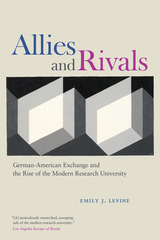
During the nineteenth century, nearly ten thousand Americans traveled to Germany to study in universities renowned for their research and teaching. By the mid-twentieth century, American institutions led the world. How did America become the center of excellence in higher education? And what does that story reveal about who will lead in the twenty-first century?
Allies and Rivals is the first history of the ascent of American higher education seen through the lens of German-American exchange. In a series of compelling portraits of such leaders as Wilhelm von Humboldt, Martha Carey Thomas, and W. E. B. Du Bois, Emily J. Levine shows how academic innovators on both sides of the Atlantic competed and collaborated to shape the research university. Even as nations sought world dominance through scholarship, universities retained values apart from politics and economics. Open borders enabled Americans to unite the English college and German PhD to create the modern research university, a hybrid now replicated the world over.
In a captivating narrative spanning one hundred years, Levine upends notions of the university as a timeless ideal, restoring the contemporary university to its rightful place in history. In so doing she reveals that innovation in the twentieth century was rooted in international cooperation—a crucial lesson that bears remembering today.

Always an Academic Immigrant is a collective memoir that gives voice to eighty-one academics who immigrated from thirty-seven countries for a career in an institution of higher education, in either the United States or one of ten other countries. Through in-depth interviews and observations from her own experiences as an immigrant scholar, Dafna Lemish shares the highs and the lows that academic immigrants feel as they search for both a country and an institution they can call home. She discovers the formative events that led these scholars to pursue careers outside their native lands and details the challenges they faced adapting to unspoken expectations in their new countries and workplaces. Ultimately, this book reveals the strategies that immigrant professors use to bridge their native and adoptive cultures while highlighting the vital contributions they have made to academia as scholars, teachers, and leaders.

At the end of the eighteenth century, just eighteen colleges existed in the United States, with an average enrollment of fewer than seventy. One hundred years later, over 450 American colleges and universities boasted enrollments up more than one hundredfold. The role of educational institutions in the life of the nation had been utterly transformed.
As the bridge between the two eras, the nineteenth-century college has been among the most controversial subjects in the history of American higher education. While earlier historians portrayed the "old-time" college as an impediment to modernization, later scholars affirmed the broad role of the colleges in the education of the American people.
The American College in the Nineteenth Century combines the best recent scholarship with an interpretive introduction to provide a fresh view of the development of American colleges. The contributors consider these institutions within four new contexts: first, the dramatic transformation in the college students' experience from oppressive discipline to relative freedom; second, the regional variations among the developing American colleges (for example, a South dominated by state colleges, a Midwest by denominational schools); third, the revolution in the century's third quarter as colleges became multipurpose institutions; and fourth, universities that became dominant by the end of the century, incorporating rather than displacing the colleges.
Innovative in its examination of the nature and function of these uniquely American institutions, The American College in the Nineteenth Century is a vital addition to the scholarship of the period.
Contributors: David B. Potts, Leon Jackson, Julie Ann Bubolz, Michael Sugrue, James Findlay, Margaret A. Nash, Peter Dobkin Hall, James Turner, Paul Bernard, and Willard J. Pugh.

With funding cuts well under way and many institutions already promising to charge the maximum £9,000 yearly tuition fee, university education for the majority is under threat. This book exposes the true motives behind the government's programme and provides the analytical tools to fight it.
Widespread student protests and occupations, often supported by staff, unions and society at large, show the public's opposition to funding cuts and fee increases. The contributors to this sharp, well-written collection, many of whom are active participants in the anti-cuts movement, outline what's at stake and why it matters. They argue that university education is becoming increasingly skewed towards vocational degrees, which devalues the arts and social sciences – subjects that allow creativity and political inquiry to flourish.
Released at the beginning of the new academic year, this book will be at the heart of debates around the future of higher education in the UK and beyond, inspiring both new and seasoned activists in the fight for the soul of our universities.
READERS
Browse our collection.
PUBLISHERS
See BiblioVault's publisher services.
STUDENT SERVICES
Files for college accessibility offices.
RECENTLY PUBLISHED




UChicago Accessibility Resources
home | accessibility | search | about | contact us
BiblioVault ® 2001 - 2025
The University of Chicago Press