Results by title
74 books match the query 'Discourse analysis' and 5 start with i

Imagining China
Rhetorics of Nationalism in an Age of GlobalizationStephen J. Hartnett
Michigan State University Press, 2017

Imperial Encounters
The Politics of Representation in North-South RelationsRoxanne Doty
University of Minnesota Press, 1996
Offers a fresh perspective on power relationships in global politics.
“Developed/underdeveloped,” “first world/third world,” “modern/traditional”-although there is nothing inevitable, natural, or arguably even useful about such divisions, they are widely accepted as legitimate ways to categorize regions and peoples of the world. In Imperial Encounters, Roxanne Lynn Doty looks at the way these kinds of labels influence North-South relations, reflecting a history of colonialism and shaping the way national identity is constructed today.
Employing a critical, poststructuralist perspective, Doty examines two “imperial encounters” over time: between the United States and the Philippines and between Great Britain and Kenya. The history of these two relationships demonstrates that not only is the more powerful member allowed to construct “reality,” but this construction of reality bears an important relationship to actual practice. Doty is particularly interested in the way in which the South has been represented by policymakers, scholars, and journalists, and how these representations have influenced specific encounters. Doty also uses the insights of Edward Said to argue that the power dynamic that allows the North to define the global identity of nations in the South ultimately tells us more about northern powers than about their southern neighbors. Doty then considers the persistence of representational practices, particularly with regard to Northern views of human rights in the South and contemporary social science discourses on North-South relations. She ends with the argument that the discipline of international relations needs to be reformed by broadening the repertoire of theoretical and analytical tools available to scholars studying global politics. Important and timely, Imperial Encounters brings a fresh perspective to the debate over the past-and the future-of global politics.
Inside the Antisemitic Mind
The Language of Jew-Hatred in Contemporary GermanyMonika Schwarz-Friesel and Jehuda Reinharz
Brandeis University Press, 2017
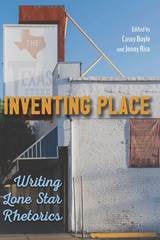
Inventing Place
Writing Lone Star RhetoricsEdited by Casey Boyle and Jenny Rice
Southern Illinois University Press, 2018
Divided into five sections corresponding to Texas regions, essays consider aesthetics, buildings, environment, food and alcohol, private and public memory, and race and class. Among the topics covered by contributors are the Imagine Austin urban planning initiative; the terroir of Texas barbecue; the racist past of Grand Saline, Texas; Denton, Texas, and authenticity as rhetorical; negative views of Texas and how the state (or any place) is subject to reinvention; social, historical, and economic networks of place and their relationship to the food we eat; and Texas gun culture and working-class character.

Inventive Intercourse
From Rhetorical Conflict to the Ethical Creation of Novel TruthStephen R. Yarbrough
Southern Illinois University Press, 2006
Applying interactionist discourse theory to show how we create novel beliefs
Inventive Intercourse: From Rhetorical Conflict to the Ethical Creation of Novel Truth offers a theory of discursive interaction, illustrating how we can understand human communication without resorting to the notion of language. Using the perspective of interactionist discourse theory, author Stephen Yarbrough investigates how we create novel beliefs, beliefs we could not have inferred from our established beliefs.
The volume considers a central dilemma of post-modern thought: If language is a system of conventions and rules that limit what we can say and think, how can we deliberately produce anything truly novel? While postmodernism concludes that linguistic and conceptual change within our incommensurable worlds is driven by contingency and blind mechanical forces, Yarbrough argues that this view is wrong because the notion that language mediates our perception is wrong.
Beginning with philosopher Donald Davidson’s assertion that "there is no such thing as language" in the sense of a system of conventions and rules, Yarbrough develops an interactionist theory of discourse and uses it to revise the major elements of Aristotelian rhetoric to explain how we deliberately invent novel concepts that we come to believe.
Yarbrough suggests that all conceptual change is initiated by a shift in our ethical apperception of elements of a situation and that an ethical change will have emotional consequences. Changes in our emotional responses to things will change the ways we interact with them, he says, and changes in our interaction with things will create new technical relations which we can communicate to others only by altering our habitual shared way of using signs, metaphors, and other tropes.