Results by title
154 books match the query 'East' and 9 start with i
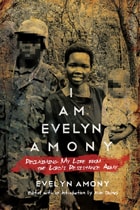
I Am Evelyn Amony
Reclaiming My Life from the Lord's Resistance ArmyEvelyn Amony, Edited with an introduction by Erin Baines
University of Wisconsin Press, 2015
Abducted at the age of eleven, Evelyn Amony spent nearly eleven years inside the Lord’s Resistance Army, becoming a forced wife to Joseph Kony and mother to his children. She takes the reader into the inner circles of LRA commanders and reveals unprecedented personal and domestic details about Joseph Kony. Her account unflinchingly conveys the moral difficulties of choosing survival in a situation fraught with violence, threat, and death.
Amony was freed following her capture by the Ugandan military. Despite the trauma she endured with the LRA, Amony joined a Ugandan peace delegation to the LRA, trying to convince Kony to end the war that had lasted more than two decades. She recounts those experiences, as well as the stigma she and her children faced when she returned home as an adult.
This extraordinary testimony shatters stereotypes of war-affected women, revealing the complex ways that Amony navigated life inside the LRA and her current work as a human rights advocate to make a better life for her children and other women affected by war.
Best books for public & secondary school libraries from university presses, American Library Association
I Will Mix Your Blood with Coal
Snapshots from the East of UkraineOleksandr Mykhed, Tanya Savchynska, and David Mossop
Northwestern University Press, 2025
In 2014, the Russian army, with support from local militants, occupied parts of Ukraine’s two easternmost regions—once the beating industrial heart of the Soviet Union—where coal extraction has since exhausted both the human population and the natural resources. In late 2016, Oleksandr Mykhed set out on a research trip to explore the deep history and contested present of the area from the perspective of a fellow countryman who’d never been there.
Mykhed brings us on a painful yet hopeful journey across the Ukrainian east, sharing conversations with locals, snippets from archival documents, and the complicated perspectives of prominent cultural figures, such as writer Serhiy Zhadan, historian Olena Stiazhkina, and philosopher Ihor Kozlovsky, who was imprisoned and tortured for nearly two years.
I Will Mix Your Blood with Coal invites us to meet generations of coal miners. To learn about the Belgian and British investors who founded the east’s industrial cities. To remember the harrowing events of the First and Second World Wars and the incalculable brutality of Soviet history. To see the activists who are even now working to improve the country. To hear sweet memories of a lost utopia that never existed. Mykhed provides a unique portrait of life in the east during the war, before the full-scale invasion that would change everything.
Imagining Serengeti
A History of Landscape Memory in Tanzania from Earliest Times to the PresentJan Bender Shetler
Ohio University Press, 2007
Many students come to African history with a host of stereotypes that are not always easy to dislodge. One of the most common is that of Africa as safari grounds—as the land of expansive, unpopulated game reserves untouched by civilization and preserved in their original pristine state by the tireless efforts of contemporary conservationists. With prose that is elegant in its simplicity and analysis that is forceful and compelling, Jan Bender Shetler brings the landscape memory of the Serengeti to life. She demonstrates how the social identities of western Serengeti peoples are embedded in specific spaces and in their collective memories of those spaces. Using a new methodology to analyze precolonial oral traditions, Shetler identifies core spatial images and reevaluates them in their historical context through the use of archaeological, linguistic, ethnographic, ecological, and archival evidence. Imagining Serengeti is a lively environmental history that will ensure that we never look at images of the African landscape in quite the same way.
In Search of a Nation
Histories of Authority & Dissidence in TanzaniaGregory H. Maddox
Ohio University Press, 2005

In the Province of the Gods
Kenny Fries
University of Wisconsin Press, 2021
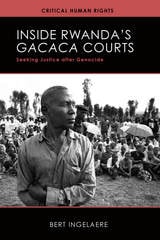
Inside Rwanda's /Gacaca/ Courts
Seeking Justice after GenocideBert Ingelaere
University of Wisconsin Press, 2018
Weaving together vivid firsthand recollections, interviews, and trial testimony with systematic analysis, Ingelaere documents how the gacaca shifted over time from confession to accusation, from restoration to retribution. He precisely articulates the importance of popular conceptions of what is true and just. Marked by methodological sophistication, extraordinary evidence, and deep knowledge of Rwanda, this is an authoritative, nuanced, and bittersweet account of one of the most important experiments in transitional justice after mass violence.
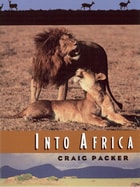
Into Africa
Craig Packer
University of Chicago Press, 1994
As in the works of George Schaller and Cynthia Moss, Packer transports us to life in the field. He is addicted to this land—to the beauty of a male lion striding across the Serengeti plains, to the calls of a baboon troop through the rain forests of Gombe—and to understanding the animals that inhabit it. Through his vivid narration, we feel the dust and the bumps of the Arusha Road, smell the rosemary in the air at lunchtime on a Serengeti verandah, and hear the lyrics of the Grateful Dead playing off bootlegged tapes.
Into Africa also explores the social lives of the animals and the threats to their survival. Packer grapples with questions he has passionately tried to answer for more than two decades. Why do female lions raise their young in crèches? Why do male baboons move from troop to troop while male chimps band together? How can humans and animals continue to coexist in a world of diminishing resources? Immediate demands—logistical nightmares, political upheavals, physical exhaustion—yield to the larger inescapable issues of the interdependence of the land, the animals, and the people who inhabit it.
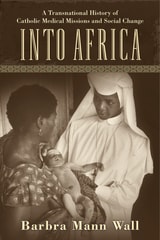
Into Africa
A Transnational History of Catholic Medical Missions and Social ChangeWall, Barbra Mann
Rutgers University Press, 2015
Awarded first place in the 2016 American Journal of Nursing Book of the Year Award in the History and Public Policy category
The most dramatic growth of Christianity in the late twentieth century has occurred in Africa, where Catholic missions have played major roles. But these missions did more than simply convert Africans. Catholic sisters became heavily involved in the Church’s health services and eventually in relief and social justice efforts. In Into Africa, Barbra Mann Wall offers a transnational history that reveals how Catholic medical and nursing sisters established relationships between local and international groups, sparking an exchange of ideas that crossed national, religious, gender, and political boundaries.
Both a nurse and a historian, Wall explores this intersection of religion, medicine, gender, race, and politics in sub-Saharan Africa, focusing on the years following World War II, a period when European colonial rule was ending and Africans were building new governments, health care institutions, and education systems. She focuses specifically on hospitals, clinics, and schools of nursing in Ghana and Uganda run by the Medical Mission Sisters of Philadelphia; in Nigeria and Uganda by the Irish Medical Missionaries of Mary; in Tanzania by the Maryknoll Sisters of New York; and in Nigeria by a local Nigerian congregation. Wall shows how, although initially somewhat ethnocentric, the sisters gradually developed a deeper understanding of the diverse populations they served. In the process, their medical and nursing work intersected with critical social, political, and cultural debates that continue in Africa today: debates about the role of women in their local societies, the relationship of women to the nursing and medical professions and to the Catholic Church, the obligations countries have to provide care for their citizens, and the role of women in human rights.
A groundbreaking contribution to the study of globalization and medicine, Into Africa highlights the importance of transnational partnerships, using the stories of these nuns to enhance the understanding of medical mission work and global change.

Islam and Politics in East Africa
The Sufi Order in TanzaniaAugust H. Nimtz Jr.
University of Minnesota Press, 1980
Islam and Politics in East Africa was first published in 1980. Minnesota Archive Editions uses digital technology to make long-unavailable books once again accessible, and are published unaltered from the original University of Minnesota Press editions.
Focusing on the interplay of religion, society, and politics, August Nimtz examines the role of sufi tariqas (brotherhoods) in Tanzania, where he observed an African Muslim society at first hand. Nimtz opens this book with a historical account of Islam in East Africa, and in subsequent chapters analyzes the role of tariqas in Tanzania and, more specifically, in the coastal city of Bagamoyo. Using a conceptual framework derived from contemporary political theories on social cleavages and individual interests. Nimtz explains why the tariqa is important in the process of political change.
The fundamental cleavage in Muslim East Africa, he notes, is that of "whites" versus blacks. Nimtz contends that the tariqus, in serving the interest of blacks (that is, Africans), became in turn vehicles for the mass mobilization of African Muslims during the anti-colonial struggle. In Bagamoyo he finds a similar process and, in addition, reveals that the tariqas have served African interests in opposition to those of "whites" because of the individual benefits they provide. At the same time, Nimtz concludes, the social structure of East African Muslim society has ensured that Africans would be particularly attracted to these benefits. This work will interest both observers of African political development and specialists in the Islamic studies.