Results by title
2728 books match the query 'Education' and 91 start with i
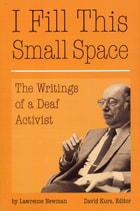
I Fill This Small Space
The Writings of a Deaf ActivistLawrence Newman
Gallaudet University Press, 2009
Lawrence Newman became deaf at the age of five in 1930, and saw his father fight back tears knowing that his son would never hear again. The next time he saw his father cry was in 1978, when Newman received an honorary doctorate from Gallaudet University, his alma mater. Newman was recognized for his achievements as a life-long advocate for deaf education, including receiving California’s Teacher of the Year award in 1968. Perhaps his greatest influence, however, stemmed from his many articles and columns that appeared in various publications, the best of which are featured in I Fill This Small Space: The Writings of a Deaf Activist.
Editor David Kurs has organized Newman’s writings around his passions — deaf education, communication and language, miscellaneous columns and poems on Deaf life, and humorous insights on his activism. His articles excel both as seamless arguments supporting his positions and as windows on the historical conflicts that he fought: against the Least Restrictive Environment in favor of residential deaf schools; for sign language, Total Communication, and bilingual education; and as a deaf teacher addressing parents of deaf children. A gifted writer in all genres, Newman amuses with ease (“On Mini and Midi-Skirts”), and moves readers with his heartfelt verse (“Girl with a Whirligig”). Newman ranges wide in his ability, but he always maintains his focus on equal tights for deaf people, as he demonstrates in his title poem “I Fill This Small Space:”
I fill this small space, this time
Who is to say yours is better
Than mine or mine yours
I Guess This Is Activism?
Youth, Political Education, and Free-Market Common SenseKevin L. Clay
University of Minnesota Press, 2026
How neoliberal capitalism and pedagogical deideologization constrain the radical possibilities of youth activism
In I Guess This Is Activism? Kevin L. Clay presents an eye-opening account of his experience with Youth Participatory Action Research (YPAR) as an Upward Bound educator. Grounded in Paulo Freire’s tradition of critical pedagogy, YPAR has been championed by community-based educators and scholars in the United States as an approach for supporting critical consciousness development and social change with working-class Black and Latino youth. Clay, however, questions whether YPAR can effectively prepare youths to subvert the systems reproducing their material conditions under neoliberal capitalism. Exposing the political and pedagogical limits of YPAR’s progressive education model, he reveals how omnipresent neoliberalism undermines youths’ radical potential when political education is not prioritized in youth activism.
I Guess This Is Activism? engages Black radical thinkers, including Ella Baker and Fred Hampton, to reveal the faulty assumptions implicit in YPAR’s program. Looking deeply into how he and his students navigated questions of community problems and social change at the twilight of the Obama presidency, Clay demonstrates how, in the absence of political education on the structures of race, class, and capitalism, youth activism is always eclipsed by the common sense of the free market.
As working-class Black and Latino youth inherit a society deeply shaped by neoliberal dogma, I Guess This Is Activism? delivers a much-needed reexamination of YPAR and visions for the future of youth activist education.
Retail e-book files for this title are screen-reader friendly with images accompanied by short alt text and/or extended descriptions.
I Was Married to a Horse, and Other Tales of an Accidental Anthropologist
John Borneman
HAU, 2026
How does the youngest of eight children, raised on a family farm in northern Wisconsin by parents with only half a grammar school education, become an Ivy League professor and a witness to some of the most transformative events of the late twentieth and early twenty-first centuries? In this remarkable memoir, John Borneman tells the story of his life as an “accidental anthropologist” with searing honesty, humor, and emotional depth.
Tracing a path from his upbringing as a queer farm boy to a career in anthropology, Borneman’s memoir reflects on social mobility, the decline of the American family farm, and shifting understandings of queerness and masculinity. Meanwhile, as a fourth-generation German American, his journey carried him to divided Berlin, where he captures the moods of East and West, and back again during the arrival of Syrian refugees—culminating in a long-standing friendship and a poignant reunion with a refugee he had first met years earlier.
Through these encounters, Borneman shows how empathy and attention can reveal the hidden textures of history, identity, and belonging. Rich in insight and humanity, this is a story of personal discovery, intercultural encounter, and the search for meaning in a rapidly changing world—one that speaks to scholars and general readers alike.
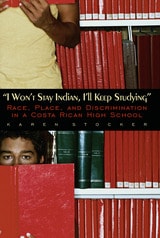
I Won't Stay Indian, I'll Keep Studying
Race, Place, and Discrimination in a Costa Rican High SchoolKaren Stocker
University Press of Colorado, 2005
Stocker reveals how overt and hidden curricula taught ethnic, racial, and gendered identities and how the dominant ideology of the town, present in school, conveyed racist messages to students.
"I Won't Stay Indian, I'll Keep Studying" documents how students from the reservation reacted to, coped with, and resisted discrimination. Considering the students' experiences in the context of the Costa Rican educational system as a whole, Stocker discusses policy shifts that might reduce institutionalized discrimination. Her interpretation of the experiences of these students makes a significant contribution to anthropology, Latin American studies, critical race theory, and educational theory.

ISDN Applications in Education and Training
Robin Mason
The Institution of Engineering and Technology, 1994
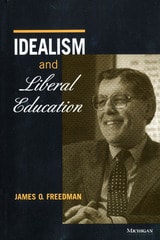
Idealism and Liberal Education
James O. Freedman
University of Michigan Press, 2001
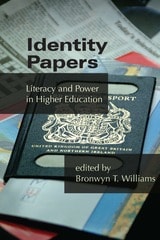
Identity Papers
Literacy and Power in Higher Educationedited by Bronwyn T. Williams
Utah State University Press, 2006
How do definitions of literacy in the academy, and the pedagogies that reinforce such definitions, influence and shape our identities as teachers, scholars, and students? The contributors gathered here reflect on those moments when the dominant cultural and institutional definitions of our identities conflict with our other identities, shaped by class, race, gender, sexual orientation, location, or other cultural factors.
These writers explore the struggle, identify the sources of conflict, and discuss how they respond personally to such tensions in their scholarship, teaching, and administration. They also illustrate how writing helps them and their students compose alternative identities that may allow the connection of professional identities with internal desires and senses of self. They emphasize how identity comes into play in education and literacy and how institutional and cultural power is reinforced in the pedagogies and values of the writing classroom and writing profession.
Ideology, Culture and the Process of Schooling
Henry Giroux
Temple University Press, 1984

If Colors Could be Heard
Narratives About Racial Identity in Music EducationEdited by Christopher Cayari, Jason D. Thompson, and Rekha S. Rajan
Intellect Books, 2025
If Colors Could Be Heard: Narratives About Racial Identity in Music Education is a groundbreaking collection of firsthand accounts by music educators, artists, activists, and students from the Global Majority. These deeply personal narratives explore how race and ethnicity shape experiences in music learning, making, and teaching.
From stories of childhood discovery to reflections on navigating racial identity in the classroom, these voices paint a complex and vivid portrait of music education in the United States. Going beyond a collection of research studies, this book embraces self-reflective storytelling as a legitimate and essential method of inquiry, offering a scholarly mosaic of lived experience.
By centering voices often marginalized in academia, If Colors Could Be Heard challenges dominant narratives and reimagines music education through a lens of equity, identity, and belonging. A must-read for students, educators, and researchers committed to fostering an inclusive and just musical future.
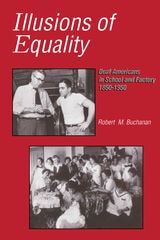
Illusions of Equality
Deaf Americans in School and Factory, 1850-1950Robert M. Buchanan
Gallaudet University Press, 1999
The working lives of Deaf Americans from the mid-1850s to the post-World War II era depended upon strategies created by Deaf community leaders to win and keep jobs through periods of low national employment as well as high. Deaf people typically sought to de-emphasize their identity as sign language users to be better integrated into the workforce. But in his absorbing new book Illusions of Equality, Robert Buchanan shows that events during the next century would thwart these efforts.
The residential schools for deaf students established in the 19th century favored a bilingual approach to education that stressed the use of American Sign Language while also recognizing the value of learning English. But the success of this system was disrupted by the rise of oralism, with its commitment to teaching deaf children speech and its ban of sign language. Buchanan depicts the subsequent ramifications in sobering terms: most deaf students left school with limited educations and abilities that qualified them for only marginal jobs. He also describes the insistence of the male hierarchy in the Deaf community on defending the tactics of individual responsibility through the end of World War II, a policy that continually failed to earn job security for Deaf workers. Illusions of Equality is an original, edifying work that will be appreciated by scholars and students for years to come.

Illustrative Learning Experiences
University High School in ActionEmma Birkmaier
University of Minnesota Press, 1952
Imagination in Teaching and Learning
The Middle School YearsKieran Egan
University of Chicago Press, 1992
stimulated and developed in education. Yet, few teachers
understand what imagination is or how it lends itself to
practical methods and techniques that can be used easily in
classroom instruction. In this book, Kieran Egan—winner of
the prestigious Grawemeyer Award for his work on
imagination—takes up where his Teaching as Story Telling
left off, offering practical help for teachers who want to
engage, stimulate, and develop the imaginative and learning
processes of children between the ages of eight to fifteen.
This book is not about unusually imaginative students and
teachers. Rather, it is about the typical student's
imaginative life and how it can be stimulated in learning,
how the average teacher can plan to achieve this aim, and how
the curriculum can be structured to help achieve this aim.
Slim and determinedly practical, this book contains a wealth
of concrete examples of curriculum design and teaching
techniques structured to appeal specifically to children in
their middle school years.

Imagined World
A Story of Scientific DiscoveryJune Goodfield
University of Michigan Press, 1991
Immigrant Families and Education
Navigating Belonging in Polish Schools and SocietyElzbieta M. Gozdziak
Rutgers University Press, 2026
Immigrant Families and Education is about belonging and unbelonging--or inclusion and exclusion--of migrant children in public and private primary and secondary schools in western Poland. Although migrant children have legally guaranteed access to education in Poland, many struggle to be included and to feel that they belong in Polish schools, and by extension, Polish society. Even children of returned Polish migrants do not always feel welcome in Polish schools. Most publications about migrant children and education present one point of view, typically that of the teachers. In this book, belonging is analyzed from the perspectives of three groups: the children, their parents, and their educators. This book aims to facilitate discussions between and among policy-makers, school administrators and teachers, as well as parents and child activists, and of course the students, on how to best ensure that all children, regardless of their origin, feel welcome in Polish schools.
Implementing Collaborative Writing Tasks in Multilingual Classrooms
Mimi Li and Neomy Storch
University of Michigan Press, 2025
With clear visuals and concrete examples of different types of collaborative writing tasks—including multimodal writing and collaborative reading for writing tasks—the book invites readers to consider the kind of decisions that need to be taken when implementing collaborative writing (e.g., group size, how to allocate students) and when assessing collaborative writing. In connecting frontier pedagogical knowledge to practice, Implementing Collaborative Writing Tasks in Multilingual Classrooms will help educators to implement collaborative writing activities in their various contexts.
Throughout the book, readers will find:
- Research-informed, pedagogy-oriented lessons on why and how to implement and assess collaborative writing in multilingual classrooms.
- Cutting-edge pedagogical knowledge that distinguishes the different modes of implementing collaborative writing (e.g., face-to-face, via computer-mediated communication, and a hybrid approach).
- Key practical suggestions for teachers.
- Tips on how to incorporate artificial intelligence in collaborative writing activities.
- Recommendations for further research that can be helpful for practitioners, teacher educators, or graduate students.

Implicit/Explicit
Stephanie Gioia
A2RU Intervals, 2018
Play reveals which elements of an institution’s reappointment, tenure, and promotion practices are explicitly addressed in policy and which remain tacit, and helps players recognize the cultural biases present in institutional norms, processes, and policies when they are not made explicit. Additionally, the color-coded cards helps participants identify the roles and processes that are most relevant to them.
Improvement by Design
The Promise of Better SchoolsDavid K. Cohen, Donald J. Peurach, Joshua L. Glazer, Karen E. Gates, and Simona Goldin
University of Chicago Press, 2013
The authors identify four critical puzzles that the successful programs were able to solve: design, implementation, improvement, and sustainability. Pinpointing the specific solutions that clearly improved instruction, they identify the key elements that all successful reform programs share. Offering urgently needed guidance for state and local school systems as they attempt to respond to future reform proposals, Improvement by Design gets America one step closer to truly successful education systems.
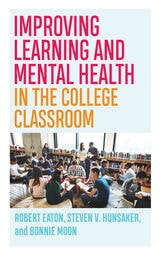
Improving Learning and Mental Health in the College Classroom
Robert Eaton
West Virginia University Press, 2023
How teachers can help combat higher education’s mental health crisis.
Mental health challenges on college campuses were a huge problem before COVID-19, and now they are even more pronounced. But while much has been written about higher education’s mental health crisis, very little research focuses on the role played by those on campus whose influence on student well-being may well be greatest: teachers. Drawing from interviews with students and the scholarship of teaching and learning, this book helps correct the oversight, examining how faculty can—instead of adding to their own significant workloads or duplicating counselors’ efforts—combat student stress through adjustments to the work they already do as teachers.
Improving Learning and Mental Health in the College Classroom provides practical tips that reduce unnecessary discouragement. It demonstrates how small improvements in teaching can have great impacts in the lives of students with mental health challenges, while simultaneously boosting learning for all students.
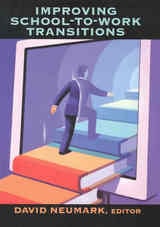
Improving School-to-Work Transitions
David Neumark
Russell Sage Foundation, 2007

Improvisation for the Theater
A Handbook of Teaching and Directing TechniquesViola Spolin
Northwestern University Press, 1999
The thoroughly revised third edition of the bible of improvisational theater.
Viola Spolin's improvisational techniques changed the very nature and practice of modern theater. The first two editions of Improvisation for the Theater sold more than 100,000 copies and inspired actors, directors, teachers, and writers in theater, television, film. These techniques have also influenced the fields of education, mental health, social work, and psychology.
The revised edition features:
- 30 new exercises, including introductions (Slow/Fast/Normal; Extended Sound; Mirror Speech; Unrelated Conversation)
- More than 200 updated classic exercises
- new section of traditional theater games for warm-up use
- “Paul Sills' Sayings of Viola Spolin”
- New glossary of side-coaching phrases, with definitions of their meaning and value
- Alphabetical list of all games and exercises
In Defense of Disciplines
Interdisciplinarity and Specialization in the Research UniversityJerry A. Jacobs
University of Chicago Press, 2014
Drawing on diverse sources of data, Jacobs offers a new theory of liberal arts disciplines such as biology, economics, and history that identifies the organizational sources of their dynamism and breadth. Illustrating his thesis with a wide range of case studies including the diffusion of ideas between fields, the creation of interdisciplinary scholarly journals, and the rise of new fields that spin off from existing ones, Jacobs turns many of the criticisms of disciplines on their heads to mount a powerful defense of the enduring value of liberal arts disciplines. This will become one of the anchors of the case against interdisciplinarity for years to come.
In Defense of Free Speech in Universities
A Study of Three JurisdictionsAmy Lai
University of Michigan Press, 2023
In this book, Amy Lai examines the current free speech crisis in Western universities. She studies the origin, history, and importance of freedom of speech in the university setting, and addresses the relevance and pitfalls of political correctness and microaggressions on campuses, where laws on harassment, discrimination, and hate speech are already in place, along with other concepts that have gained currency in the free speech debate, including deplatforming, trigger warning, and safe space. Looking at numerous free speech disputes in the United Kingdom, the United States, and Canada, the book argues for the equal application of the free speech principle to all expressions to facilitate respectful debates. All in all, it affirms that the right to free expression is a natural right essential to the pursuit of truth, democratic governance, and self-development, and this right is nowhere more important than in the university.
In Search of Identity
The Japanese Overseas Scholar in America and JapanJohn Bennett
University of Minnesota Press, 1958
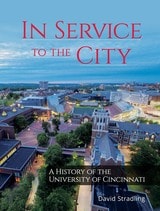
In Service to the City
A History of the University of CincinnatiDavid Stradling
University of Minnesota Press, 2018
In Service to the City: A History of the University of Cincinnati, the first history of the university written in over fifty years, explores the evolving, complex relationship between UC and the city of Cincinnati. In Service to the City casts an unvarnished lens on the details of student demographics, faculty research, curricular changes, and athletic controversy to challenges associated with campus architecture and planning, neighborhood relations, regional and national consequences of urban decline, and the roles of municipal, state, and federal governments within American higher education.
Urban, environmental historian David Stradling traces UC’s story through starts and stops, growth and contraction. In the 1870s the institution began its transformation into a comprehensive, municipal university located in America’s thriving heartland. Expansion continued through mergers with Cincinnati College-Conservatory of Music and Cincinnati Medical College, among others. In 1977, University President Warren Bennis and Governor Jim Rhodes signed papers ending UC’s municipal status while securing its future as part of the state university system of Ohio.
UC maintains its strong relationship with Cincinnati, pioneering countless community and regionally oriented programs, from its expanding co-op education system, the first in the nation, to the Niehoff Urban Studio. Stradling describes the social and political activism of UC students and faculty—front and center in the civil rights and women’s rights movements, as well as the public health and environmental movements. Often they struggled to change the culture within their own institution, which at times appeared conservative or reactionary.
Drawing on archival research, Stradling recounts in lively prose and through dozens of illustrations, two-hundred years of UC history, setting the story in the context of changes within higher education in the United States.
With the cost of higher education on the minds of legislators and the public, questions first posed by Daniel Drake in 1819 upon the founding of Cincinnati College remain relevant. Who should the college serve? What and how should students learn? How can we pay for it? In Service to the City encourages readers to consider how the University of Cincinnati—with a history so entwined with its city—can balance its urban-serving tradition with its aspiration to be a leader global research university.
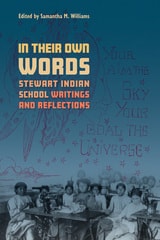
In Their Own Words
Stewart Indian School Writings and ReflectionsSamantha M. Williams
University of Nevada Press, 2027
In Their Own Words: Stewart Indian School Writings and Reflections examines Stewart Indian School through writings produced by its students. Stewart was established in 1890 in Carson City, Nevada, to educate and assimilate Native American children. Students from across the West attended the school, which evolved from a militaristic institution into one that, by the late 1960s and 1970s, emphasized academics and athletics. The U.S. government closed Stewart in 1980, citing financial and structural concerns.
In the book, student writings document daily lessons and activities, thoughts about academic and vocational training, and responses to life within the institution. The school’s publications also gave students a platform for expression, serving as a window into what it meant to be Native in a government-run boarding school system.
The book includes original interviews with Stewart alumni covering the 1950s, 1960s, and 1970s. These firsthand accounts provide new information about student life, including positive and negative perspectives, and offer context for the varied experiences of those who attended.
Together, the writings and interviews offer a fuller understanding of student life at Stewart.
In a Classroom of Their Own
The Intersection of Race and Feminist Politics in All-Black Male SchoolsKeisha Lindsay
University of Illinois Press, 2018
Keisha Lindsay explains the complex politics of ABMSs by situating these schools within broader efforts at neoliberal education reform and within specific conversations about both "endangered” black males and a “boy crisis” in education. Lindsay also demonstrates that intersectionality, long considered feminist, is in fact a politically fluid framework. As such, it represents a potent tool for advancing many political agendas, including those of ABMSs supporters who champion antiracist education for black boys while obscuring black girls’ own race and gender-based oppression in school. Finally, Lindsay theorizes a particular means by which black men and other groups can form antiracist and feminist coalitions even when they make claims about their experiences that threaten bridge building. The way forward, Lindsay shows, allows disadvantaged groups to navigate the racial and gendered politics that divide them in pursuit of productive—and progressive—solutions.
Far-thinking and boldly argued, In a Classroom of Their Own explores the dilemmas faced by professionals and parents in search of equitable schooling for all students—black boys and otherwise.
In a Queer Voice
Journeys of Resilience from Adolescence to AdulthoodMichael Sadowski
Temple University Press, 2013
Educator Michael Sadowski deftly brings the voices of LGBTQ youth out into the open in his poignant and important book, In a Queer Voice. Drawing on two waves of interviews conducted six years apart, Sadowski chronicles how queer youth, who were often “silenced” in school and elsewhere, now can approach adulthood with a strong, queer voice.
In a Queer Voice continues the critical conversation about LGBTQ youth issues—from bullying and suicide to other risks involving drug and alcohol abuse—by focusing on the factors that help young people develop positive, self-affirming identities. Using the participants’ heartfelt, impassioned voices, we hear what schools, families, and communities can do to help LGBTQ youth become resilient, confident adults.
In the Company of Scholars
The Struggle for the Soul of Higher EducationBy Julius G. Getman
University of Texas Press, 1992
"I began this book to articulate my sense of disappointment and alienation from the status I had fought so hard to achieve." A remarkable admission from an alumnus of Harvard Law School who has held tenured professorships in the law schools of Yale and Stanford and has taught in the law schools of Harvard and Chicago.
In this personal reflection on the status of higher education, Julius Getman probes the tensions between status and meaning, elitism and egalitarianism, that challenge the academy and academics today. He shows how higher education creates a shared intellectual community among people of varied races and classes—while simultaneously dividing people on the basis of education and status.
In the course of his explorations, Getman touches on many of the most current issues in higher education today, including the conflict between teaching and research, challenges to academic freedom, the struggle over multiculturalism, and the impact of minority and feminist activism. Getman presents these issues through relevant, often humorous anecdotes, using his own and others' experiences in coping with the constantly changing academic landscape.
Written from a liberal perspective, the book offers another side of the story told in such works as Allan Bloom's The Closing of the American Mind and Roger Kimball's Tenured Radicals.
Inaccessible Access
Rethinking Disability Inclusion in Academic Knowledge CreationKelly Fagan Robinson
Rutgers University Press, 2025

Incidents in an Educational Life
A Memoir (of Sorts)John M. Swales
University of Michigan Press, 2009
Inclusive Musical Theatre
Tools and Curriculum for Rehearsal and PerformanceJamie Cacciola-Price
Intellect Books, 2025
A comprehensive guide to creating inclusive and accessible musical theater at the high school level.
This book is a comprehensive guide that presents a research-backed curriculum and strategies for creating an inclusive and accessible musical theater rehearsal and performance process for high schoolers. It draws on the author's doctoral research and extensive teaching experience to provide practical tools, assessments, and process modifications to support students of all learning needs and backgrounds.
The book begins by exploring the historical context and legal frameworks surrounding special education in public schools, as well as the intersection of drama education and disability studies. It then delves into an in-depth analysis of traditional actor training methods, highlighting their ableist origins and the need for adaptations to foster radical inclusion.
The core of the text outlines a twenty-nine-week rehearsal and performance curriculum, broken into three distinct phases, that is designed to scaffold skill development, promote ensemble collaboration, and empower diverse learners. Accompanying the unit plans are detailed assignments, assessments, and grading rubrics that align with national and state arts standards. Additionally, the author provides a wealth of supporting documents, such as student contracts, production resources, and a sample warm-up guide.
By championing inclusive practices rooted in the principles of Universal Design for Learning and culturally responsive pedagogy, this book equips drama educators with the tools to create transformative theatrical experiences for all students.
Inclusive Teaching
Strategies for Promoting Equity in the College ClassroomKelly A. Hogan
West Virginia University Press, 2022
Award-winning teachers offer practical tips for addressing inequities in the college classroom and for making all students feel welcome and included.
In a book written by and for college teachers, Kelly Hogan and Viji Sathy provide tips and advice on how to make all students feel welcome and included. They begin with a framework describing why explicit attention to structure enhances inclusiveness in both course design and interactions with and between students. Inclusive Teaching then provides practical ways to include more voices in a series of contexts: when giving instructions for group work and class activities, holding office hours, communicating with students, and more. The authors finish with an opportunity for the reader to reflect on what evidence to include in a teaching dossier that demonstrates inclusive practices.
The work of two highly regarded specialists who have delivered over a hundred workshops on inclusive pedagogy and who contribute frequently to public conversations on the topic, Inclusive Teaching distills state-of-the-art guidance on addressing privilege and implicit bias in the college classroom. It seeks to provide a framework for individuals and communities to ask, Who is being left behind and what can teachers do to add more structure?
Indebted Mobilities
Indian Youth, Migration, and the Internationalizing UniversitySusan Thomas
University of Chicago Press, 2024
As states have reduced funding to public universities, many of those institutions have turned to overseas students as a vital, alternative source of revenue. Students from India have especially been seen as among the most desirable populations, as they’re typically fluent in English and overwhelmingly enroll in professional fields deemed critical to the knowledge economy. The large numbers of these youth migrating for their education tend to be viewed as a shining example of the value of the contemporary global university and how it enables ambitious people to secure opportunities not available to them in their home nation.
However, a deeper examination of these young people’s encounters reveals a more complicated story than glossy brochures and paeans to American higher education would suggest. Indebted Mobilities draws on Susan Thomas’s close shadowing of a group of middle-class Indian migrant men who attended a public university in New York just as the institution sought to “internationalize” its campus in the wake of ongoing withdrawal of state funding. Thomas takes the reader along with the young men as they study, work, and socialize, pursuing the successful futures they believed to be promised when they migrated for an American education. All the while, they must face their marginalization as they become enmeshed in the fraught inclusion politics of contemporary university life in the United States. At the heart of these encounters is these students’ relationship to debt—not just material ones that include student loans, but moral and affective debts as well. This indebtedness, which keeps them tied to both India and the United States, is meaningful to how Indian middle-class men make sense of their experiences as student-migrants. These youth long to be modern “men of the world.” Yet Thomas illuminates how the complex realities that arise for them, informed by the logic of US exceptionalism, force a reckoning with their anxieties about successful masculinities and the precarity of being drawn into the global knowledge economy as indebted migrants.
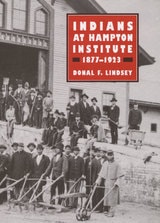
Indians at Hampton Institute, 1877-1923
Donal F. Lindsey
University of Illinois Press, 1995
Founded in 1868, Hampton Institute educated almost 1400 members of sixty-five Native American peoples. Donal F. Lindsey examines the interactions among Indigenous people, Blacks, and whites at the nation’s premier industrial school for racial minorities.
Lindsey's analysis traces the rise and decline of the program for Indigenous Americans while analyzing the program’s impact on the campaign for Native education. Lindsey also examines how the two marginalized races at Hampton viewed each other and white society. Though integration prevailed in much of student life, it resulted in even greater accommodation to a racist society. The weaknesses and strengths attributed to one race were used with “tender violence” to remake the other, in a program in which the powerful and the powerless remained so regardless of segregation or integration.
Indicators of Trends in American Education
Abbott Lamoyne Ferriss
Russell Sage Foundation, 1969

Indigenous Motherhood in the Academy
Robin Zape-tah-hol-ah Minthorn
Rutgers University Press, 2022
Indigenous Textual Cultures
Reading and Writing in the Age of Global EmpireTony Ballantyne, Lachy Paterson, and Angela Wanhalla, editors
Duke University Press, 2020
Contributors. Noelani Arista, Tony Ballantyne, Alban Bensa, Keith Thor Carlson, Evelyn Ellerman, Isabel Hofmeyr, Emma Hunter, Arini Loader, Adrian Muckle, Lachy Paterson, Laura Rademaker, Michael P. J. Reilly, Bruno Saura, Ivy T. Schweitzer, Angela Wanhalla

Individual Differences and the Common Curriculum
Edited by Gary D. Fenstermacher and John I. Goodlad
University of Chicago Press, 1983
Individual Differences in Online Computer-based Learning
Gifted and Other Diverse PopulationsPatrick Suppes
CSLI, 2013
Individual and Social Responsibility
Child Care, Education, Medical Care, and Long-Term Care in AmericaEdited by Victor R. Fuchs
University of Chicago Press, 1995
Four in-depth studies of human-service sectors—child care, education, medical care, and long-term care for the elderly—are followed by six cross-sector studies that stimulate new ways of thinking about human services through the application of economic theory, institutional analysis, and the history of social policy.
The contributors include Kenneth J. Arrow, Martin Feldstein, Victor Fuchs, Alan M. Garber, Eric A. Hanushek, Christopher Jencks, Seymour Martin Lipset, Glenn Loury, Roger G. Noll, Paul M. Romer, Amartya Sen, and Theda Skocpol.
This timely study sheds important light on the tension between individual and social responsibility, and will appeal to economists and other social scientists and policymakers concerned with social policy issues.
Industrial Poetics
Demo Tracks for a Mobile CultureJoe Amato
University of Iowa Press, 2006
Through a dizzying array of references to subjects ranging from engineering to poetry, on-the-job experiences in academia and industry, conflicts between working-class and intellectual labor, the privatization of universities, and the contradictions of the modern environment, Joe Amato’s Industrial Poetics mounts a boisterous call for poetry communities to be less invested in artistic self-absorption and more concerned about social responsibility.
As Amato focuses on the challenges faced by American poets in creating a poetry that speaks to a public engineered into complacency by those industrial technologies, practices, and patterns of thought that we cannot seem to do without, he brings readers face to face with the conflicting realities of U.S. intellectual, academic, and poetic culture.
Formally adventurous and rhetorically lively, Industrial Poetics is best compared with the intellectually exploratory, speculative, risky, polemical work of other contemporary poet-critics including Kathleen Fraser, Joan Retallack, Bruce Andrews, Susan Howe, and Allen Grossman. Amato uses an exhilarating range of structural and rhetorical strategies: conventionally developed argument, abruptly juxtaposed aphorisms, personal narrative, manifesto-like polemic, and documentary reportage. With a critic’s sharply analytical mind, a poet’s verve, and a working-class intellectual’s sense of social justice, Amato addresses the many nonliterary institutions and environments in which poetry is inextricably embedded.
By connecting poetry to industry in a lively demonstration against the platitudes and habitudes of the twentieth century, Amato argues for a reenergized and socially forceful poetics—an industrial poetics, rough edges and all. Jed Rasula writes, “I can't say I pay much attention to talk radio, but this is what I imagine it might be like if the deejay were really smart, enviably well read, yet somehow retained the snarling moxie of the AM format.”
Inequalities of Love
College-Educated Black Women and the Barriers to Romance and FamilyAveril Y. Clarke
Duke University Press, 2011
Information Now, Second Edition
A Graphic Guide to Student Research and Web LiteracyMatt Upson, Holly Luetkenhaus, C. Michael Hall, and Kevin Cannon
University of Chicago Press, 2021
This second edition of the popular guide incorporates critical analysis of information systems, asking students to think about the biases and problems in how databases and search engines are designed and used. It also addresses how different populations of people are disproportionately affected by the algorithmic biases built into information systems. And it includes revised critical thinking exercises in every chapter.
Written and revised by library professionals, Information Now is a fun and insightful tool for high school and college students, writers, and anyone wanting to improve their research skills.

Informed Learning
Christine Bruce
Assoc of College & Research Libraries, 2011
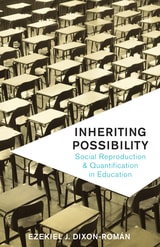
Inheriting Possibility
Social Reproduction and Quantification in EducationEzekiel J. Dixon-Román
University of Minnesota Press, 2017
How has the dominant social scientific paradigm limited our understanding of the impact of inherited economic resources, social privilege, and sociocultural practices on multigenerational inequality? In what ways might multiple forces of social difference haunt quantitative measurements of ability such as the SAT? Building on new materialist philosophy, Inheriting Possibility rethinks methods of quantification and theories of social reproduction in education, demonstrating that test performance results and parenting practices convey the impact of materially and historically contingent patterns of differential possibility.
Ezekiel J. Dixon-Román explores the dualism of nature and culture that has undergirded theories of inheritance, social reproduction, and human learning and development. Research and debate on the reproduction of power relations have rested on a premise that nature is made up of fixed universals on which the creative, intellective, and discursive play of culture are based. Drawing on recent work in the physical and biological sciences, Dixon-Román argues that nature is culture. He contends that by assuming a rigid nature/culture binary, we ultimately limit our understanding of how power relations are reproduced.
Through innovative analyses of empirical data and cultural artifacts, Dixon-Román boldly reconsiders how we conceptualize the processes of inheritance and approach social inquiry in order to profoundly sharpen understanding and address the reproducing forces of inequality.
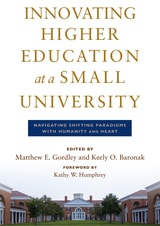
Innovating Higher Education at a Small University
Navigating Shifting Paradigms with Humanity and HeartMatthew E. Gordley
Rutgers University Press, 2027
Higher education is at a moment of real uncertainty. Colleges and universities are being asked to respond to changing student needs, financial pressure, and growing questions about value and purpose. Innovating Higher Education at a Small University offers a grounded and hopeful response to these challenges. Through a series of real, lived case studies, the book shows how one small, mission driven institution is rethinking how it teaches, partners, and serves its community. Spanning interdisciplinary work across teacher preparation, literacy, healthcare, and the arts, the chapters highlight what becomes possible when faculty and leaders are trusted to innovate with intention and care. Each chapter shares not only what was built, but also what was learned along the way, offering clear insights that others can adapt to their own contexts. Not a book about abstract trends or emerging technologies, it is grounded in program design, relationships, and project implementation. It is a book about people doing the work, and a reminder that meaningful change in higher education is already happening in places willing to lead with both humanity and purpose.
Inside Academia
Professors, Politics, and PoliciesCahn, Steven M
Rutgers University Press, 2019
Inside Academia uses real cases to illustrate how faculty members, deans, and provosts often do not serve the best interests of schools or students. Yet the book also highlights efforts of those who have committed themselves and their institutions to the pursuit of academic excellence.
Inside Jewish Day Schools
Leadership, Learning, and CommunityAlex Pomson and Jack Wertheimer
Brandeis University Press, 2021
This book takes readers inside Jewish day schools to observe what happens day to day, as well as what the schools mean to their students, families, and communities. Many different types of Jewish day schools exist, and the variations are not well understood, nor is much information available about how day schools function. Inside Jewish Day Schools proves a vital guide to understanding both these distinctions and the everyday operations of these contemporary schools.
Inside the Eagle's Head
An American Indian CollegeAngelle A. Khachadoorian
University of Alabama Press, 2010
Where tradition meets bureaucracy—Native students redefine education on their own terms.
Inside the Eagle’s Head offers a compelling and deeply human portrait of the Southwestern Indian Polytechnic Institute (SIPI), a federally operated college serving Native American students from across the United States. In it, anthropologist Angelle Khachadoorian draws on years of teaching experience and extensive student interviews to illuminate the challenges and successes of life at SIPI. Far more than an institutional history, this book captures the voices of students navigating a complex educational landscape shaped by federal oversight, tribal identity, and personal ambition.
Through vivid metaphors—SIPI as a family, a prison, a reservation—students articulate their struggles and resilience within a system that is at once empowering and restrictive. Khachadoorian’s analysis reveals how SIPI’s hybrid nature—part community college, part BIA legacy—creates both opportunities and obstacles for its students. With empathy and insight, she explores how young Native Americans forge identity, community, and purpose in a setting few outsiders understand. Inside the Eagle’s Head is essential reading for educators, policymakers, and anyone interested in the intersection of Indigenous education, federal institutions, and student agency. It is a powerful testament to the transformative potential of listening to students’ stories.
Inside the Teaching Machine
Rhetoric and the Globalization of the U.S. Public Research UniversityCatherine Chaput
University of Alabama Press, 2008
An incisive critique of the corporatized university, tracing the entanglement of academic missions with economic, political, and cultural systems.
Advocates of higher education have long contended that universities should operate above the crude material negotiations of economics and politics. Such arguments, ignore the historical reality that the American university system emerged through, and in service to, a capitalist political economy that unevenly combines corporate, state, and civil interests.
As the corporatization of U.S. universities becomes nearly impossible to deny, the common response from many academics has been a superior stand against the contamination of the professional ideal by tainted corporate interests. Inside the Teaching Machine proposes a correction to this view through the lens of historical materialism.
Chaput argues that the U.S. public research university has always been a vital component of the capitalist political economy. While conventional narratives of public higher education emphasize civic preparation and upward mobility, Chaput demonstrates that supposedly egalitarian policies like the Morrill Land-Grant Act and the G.I. Bill served the changing interests of capitalism much as education, creating a professional class that supports the capitalist political economy. Chaput also focuses on the relationship between American universities and globalization, showing how the trend toward professionalization contributes to the production of surplus value, and the ways that the American university model circulates outside the United States. Chaput concludes by advocating rhetorical strategies for the professional who opposes the capitalist logic of the global university system, proposing concrete options for engaging and redirecting globalization within the university system.