Results by title
394 books match the query 'English literature' and 25 start with i

INTERROGATING ORIENTALISM
Contextual Approaches and Pedagogical PracticesEdited by Diane Long Hoeveler and Jeffrey Cass
The Ohio State University Press, 2006
Imagining A Medieval English Nation
Kathy Lavezzo
University of Minnesota Press, 2003
The first comprehensive analysis of English national identity in the late Middle Ages
During the late Middle Ages, the increasing expansion of administrative, legal, and military systems by a central government, together with the greater involvement of the commons in national life, brought England closer than ever to political nationhood. Examining a diverse array of texts—ranging from Latin and vernacular historiography to Lollard tracts, Ricardian poetry, and chivalric treatises—this volume reveals the variety of forms “England” assumed when it was imagined in the medieval West.
These essays disrupt conventional thinking about the relationship between premodernity and modernity, challenge traditional preconceptions regarding the origins of the nation, and complicate theories about the workings of nationalism. Imagining a Medieval English Nation is not only a collection of new readings of major canonical works by leading medievalists, it is among the first book-length analyses on the subject and of critical interest. Contributors: Kathleen Davis, Bucknell U; L. O. Aranye Fradenburg, U of California, Santa Barbara; Andrew Galloway, Cornell U; Jill C. Havens, Baylor U; Peggy A. Knapp, Carnegie Mellon U; Larry Scanlon, Rutgers U; D. Vance Smith, Princeton U; Claire Sponsler, U of Iowa; Lynn Staley, Colgate U; Thorlac Turville-Petre, U of Nottingham.
Imagining Adoption
Essays on Literature and CultureMarianne Novy, Editor
University of Michigan Press, 2003
Imagining Minds
The Neuro-Aesthetics of Austen, Eliot, and HardyKay Young
The Ohio State University Press, 2010
Imagining Monsters
Miscreations of the Self in Eighteenth-Century EnglandDennis Todd
University of Chicago Press, 1995
Mary Toft's outrageous claim was accepted because of a common belief that the imagination of a pregnant woman could deform her fetus, creating a monster within her. Drawing on largely unexamined material from medicine, embryology, philosophy, and popular "monster" exhibitions, Todd shows that such ideas about monstrous births expressed a fear central to scientific, literary, and philosophical thinking: that the imagination could transgress the barrier between mind and body.
In his analysis of the Toft case, Todd exposes deep anxieties about the threat this transgressive imagination posed to the idea of the self as stable, coherent, and autonomous. Major works of Pope and Swift reveal that they, too, were concerned with these issues, and Imagining Monsters provides detailed discussions of Gulliver's Travels and The Dunciad illustrating how these writers used images of monstrosity to explore the problematic nature of human identity. It also includes a provocative analysis of Pope's later work that takes into account his physical deformity and his need to defend himself in a society that linked a deformed body with a deformed character.
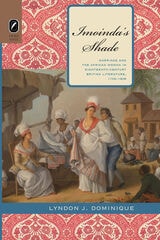
Imoinda’s Shade
Marriage and the African Woman in Eighteenth-Century British Literature, 1759–1808Lyndon J. Dominique
The Ohio State University Press, 2012
As the eighteenth century is entirely bereft of narratives written by African women, one might assume that these women had little to no impact on British literature and the national psyche of the period. Yet these kinds of assumptions are belied by the influence of one prominent African woman featured in the period’s literary texts.
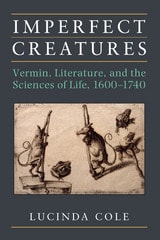
Imperfect Creatures
Vermin, Literature, and the Sciences of Life, 1600-1740Lucinda Cole
University of Michigan Press, 2016
As Cole illustrates, human health and demographic problems—notably those of feeding populations periodically stricken by hunger, disease, and famine—were tied to larger questions about food supplies, property laws, national identity, and the theological imperatives that underwrote humankind’s claim to dominion over the animal kingdom. In this context, Cole’s study indicates, so-called “vermin” occupied liminal spaces between subject and object, nature and animal, animal and the devil, the devil and disease—even reason and madness. This verminous discourse formed a foundational category used to carve out humankind’s relationship to an unpredictable, irrational natural world, but it evolved into a form for thinking about not merely animals but anything that threatened the health of the body politic—humans, animals, and even thoughts.
Imperfect Solidarities
Tagore, Gandhi, Du Bois, and the Global AnglophoneMadhumita Lahiri
Northwestern University Press, 2021
A century ago, activists confronting racism and colonialism—in India, South Africa, and Black America—used print media to connect with one another. Then, as now, the most effective medium for their undertakings was the English language. Imperfect Solidarities: Tagore, Gandhi, Du Bois, and the Global Anglophone tells the story of this interconnected Anglophone world. Through Rabindranath Tagore’s writings on China, Mahatma Gandhi’s recollections of South Africa, and W. E. B. Du Bois’s invocations of India, Madhumita Lahiri theorizes print internationalism. This methodology requires new terms within the worldwide hegemony of the English language (“the global Anglophone”) in order to encourage alternate geographies (such as the Global South) and new collectivities (such as people of color).
The women of print internationalism feature prominently in this account. Sonja Schlesin, born in Moscow, worked with Indians in South Africa. Sister Nivedita, an Irish woman in India, collaborated with a Japanese historian. Jessie Redmon Fauset, an African American, brought the world home to young readers through her work as an author and editor.
Reading across races and regions, genres and genders, Imperfect Solidarities demonstrates the utility of the neologism for postcolonial literary studies.

Imperial Bibles, Domestic Bodies
Women, Sexuality, and Religion in the Victorian MarketMary Wilson Carpenter
Ohio University Press, 2003
Of the many literary phenomena that sprang up in eighteenth-century England and later became a staple of Victorian culture, one that has received little attention until now is the “Family Bible with Notes.” Published in serial parts to make it affordable, the Family Bible was designed to enhance the family’s status and sense of national and imperial identity.
Imperial Bibles, Domestic Bodies reveals in its study of the production and consumption of British commercial Family Bibles startling changes in “family values.” Advertised in the eighteenth century as providing the family with access to “universal knowledge,” these Bibles suddenly shifted in the early nineteenth century to Bibles with bracketed sections marked “to be omitted from family reading” and reserved for reading “in the closet” by the “Master of the family.” These disciplinary Bibles were paralleled by Family Bibles designed to appeal to the newly important female consumer. Illustrations featured saintly women and charming children, and “family registers” with vignettes of family life emphasized the prominent role of the “angel in the house.”
As Mary Wilson Carpenter documents in Imperial Bibles, Domestic Bodies, the elaborate notes and “elegant engravings” in these Bibles bring to light a wealth of detail about the English commonsense view of such taboo subjects as same-sex relations, masturbation, menstruation, and circumcision. Her reading of literary texts by Charlotte Brontë, George Eliot, and Elizabeth Barrett Browning in the context of these commercial representations of the “Authorized Version” or King James translation of the Bible indicates that when the Victorians spoke about religion, they were also frequently speaking about sex.

Imperial Desire
Dissident Sexualities And Colonial LiteraturePhilip Holden
University of Minnesota Press, 2003
Illuminates the intersections between colonial thought and homosexuality
An exploration of the intersection of colonialism and homosexuality in fiction and travel writing from Robinson Crusoe to the present, this volume brings together two dynamic fields of academic inquiry: colonial discourse analysis, which considers literary texts as expressions of colonial power; and queer theory, which interrogates the representation, enforcement, and subversions of sexualities in literature and culture.
These writers reexamine the work of Kipling, Conrad, Forster, Lessing, and others, ranging from male adventure stories to postcolonial novels. This volume will provoke and inform readers concerned with gender and sexuality, colonial history and literature, or with any of the works and authors revisited—and reexperienced—here. Contributors: Anjali Arondekar, U of California, Santa Cruz; John C. Beynon, California State U, Fresno; Joseph A. Boone, USC; Sarah Cole, Columbia U; Lois Cucullu, U of Minnesota; Maria Davidis, Cornell; Dennis Denisoff, Ryerson U; Mark Forrester, U of Maryland; Terry Goldie, York U; Christopher Lane, Northwestern U; Tim Middleton, Bath Spa U College, UK; Hans Turley, U of Connecticut.Imperial Media
Colonial Networks and Information Technologies in the British Literary Imagination, 1857–1918Aaron Worth
The Ohio State University Press, 2014
Imperial Media: Colonial Networks and Information Technologies in the British Literary Imagination, 1857–1918 brings together two of the most dynamic and productive approaches to the study of nineteenth-century literature in recent years—media studies and colonial studies—to illuminate the rich and enduring symbiosis that developed between information technologies and Empire. Over a century before Facebook and the iPhone, Britons relied on the electric media of their day for information about their global empire—but those media, which during Victoria’s reign stretched out its tentacles to form a true “world wide web,” not only delivered information but provided conceptual frames as well, helping to shape the way their users thought.
Ranging in space from the telegraph offices of Kipling’s India to the wireless transmitter on H.G. Wells’s Africanized moon, and in time from the Sepoy Rebellion to the Great War, Imperial Media reveals the extent to which British conceptions of imperial power were inflected by the new media of the nineteenth century: the telegraph, telephone, phonograph, radio, and cinema.
While focusing on the fiction of Kipling, Wells, Marie Corelli, H. Rider Haggard, and John Buchan (“the last Victorian,” in Gertrude Himmelfarb’s phrase), Aaron Worth also argues that the “imperial media” of the Victorians retain much of their imaginative life and power today, informing such popular entertainments of the twenty-first century as Bollywood cinema and the BBC’s science-fiction franchise Torchwood. This is a vital, engaging study that will shape future discussions of both colonial and information systems, as well as the relationship between the two, in Victorian studies and elsewhere.

Impossible Purities
Blackness, Femininity, and Victorian CultureJennifer DeVere Brody
Duke University Press, 1998
Opening with a reading of Daniel Defoe’s “A True-Born Englishman,” which posits the mixed origins of English identity, Brody goes on to analyze mulattas typified by Rhoda Swartz in William Thackeray’s Vanity Fair, whose mixed-race status reveals the “unseemly origins of English imperial power.” Examining Victorian stage productions from blackface minstrel shows to performances of The Octoroon and Uncle Tom’s Cabin, she explains how such productions depended upon feminized, “black” figures in order to reproduce Englishmen as masculine white subjects. She also discusses H.G. Wells’s The Island of Dr. Moreau in the context of debates about the “new woman,” slavery, and fears of the monstrous degeneration of English gentleman. Impossible Purities concludes with a discussion of Bram Stoker’s novella, “The Lair of the White Worm,” which brings together the book’s concerns with changing racial representations on both sides of the Atlantic.
This book will be of interest to scholars in Victorian studies, literary theory, African American studies, and cultural criticism.
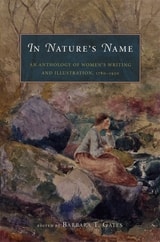
In Nature's Name
An Anthology of Women's Writing and Illustration, 1780-1930Edited by Barbara T. Gates
University of Chicago Press, 2002
The works contained in this volume are as varied as the women who produced them. They include passionate essays on the protection of animals, vivid accounts of travel and adventure from the English seashore to the Indian Alps, poetry and fiction, and marvelous tales of nature for children. Special features of the book include a detailed chronology placing each selection in its historical and literary context; biographical sketches of each author's life and works; a comprehensive bibliography of primary and secondary literature; and over sixty illustrations.
An ideal introduction to women's powerful and diverse responses to the natural world, In Nature's Name will be treasured by anyone interested in natural history, women, or Victorian and Edwardian Britain.
In Quest of the Ordinary
Lines of Skepticism and RomanticismStanley Cavell
University of Chicago Press, 1988
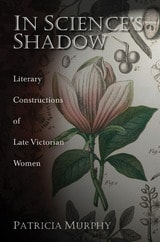
In Science's Shadow
Literary Constructions of Late Victorian WomenPatricia Murphy
University of Missouri Press, 2006
The Victorian era was characterized by great scientific curiosity—as exemplified by the publication of Darwin’s Descent of Man—as well as by new questions regarding the place of women in society. Patricia Murphy now explores the tenuous interplay of gender and science to show how the era’s literature both challenged and reinforced a constrictive role for Victorian women. Focusing on a specific body of literature involving women intensely associated with scientific pursuits, and examining selected noncanonical writings—both fictional and nonfictional representations of scientific women—Murphy demonstrates how these works informed the “Woman Question” by reinforcing or rejecting presumed truths about gender and science.

In the Nineties
John Stokes
University of Chicago Press, 1990
Spurning fixed boundaries, Stokes relates the controversial topics of the day—the status of the "New Journalism," the "degenerative" influence of Impressionist painting, the dubious morality of the music hall, the urgent need for prison reform, and the prevalence of suicide—to primary literary texts, such as The Ballad of Reading Gaol, The Importance of Being Earnest, Jude the Obscure, and Portrait of a Lady. And in the process, he explores crucial areas of sociological and psychological interest: criminality, sexuality, madness, and "morbidity."
Each of the book's six chapters opens with a look at the correspondence columns of daily newspapers and goes on, with a keen eye for the hidden link, to pursue a particular theme. Locations shift from Leicester Square and the Thames embankment to the Normandy coast and the Paris morgue and feature, along with famous names, a lesser known company of acrobats, convicts, aesthetes, "philistines," and mysterious suicides.
Nearly a century later, John Stokes's unrivalled knowledge of how the arts actually functioned in the nineties makes this book a major contribution to modern cultural studies.
Increase And Multiply
Governing Cultural Reproduction In Early Modern EnglandDavid Glimp
University of Minnesota Press, 2003
A wide-ranging study of the ideology of population control in early modern England
Across the sixteenth and seventeenth centuries, a growing notion of the value of a large populace created a sense of urgency about reproduction; accordingly, a wide array of English writers of the time voiced the need not merely to add more people but also to ensure that England had an abundance of the right kinds of people. This need, in turn, called for a variety of institutions to train—and thus make, through a kind of nonbiological procreation—pious, enterprising, and dutiful subjects. In Increase and Multiply, David Glimp examines previously unexplored links between this emergent demographic mentality and Renaissance literature.
Glimp’s analysis centers on humanist pedagogy as a mechanism for creating people capable of governing both themselves and others. Acknowledging the ways in which authors such as Sidney, Shakespeare, and Milton advance their own work by appealing to this vision, Glimp argues that their texts allow us to read the scope and limits of this generative ideal, its capacity to reinforce order and to become excessive and destabilizing. His work provides unprecedented insight into the role of fantasies of nonbiological reproduction in early modern political theory, government practice, and literary production.
Influence and Intertextuality in Literary History
John B. Clayton
University of Wisconsin Press, 1991
This important collection explores and clarifies two of the most contested ideas in literary theory today, influence and intertextuality. The study of influence tends to center on major authors and canonical works, identifying prior documents as “sources” or “contexts” for a given author. Intertextuality, on the other hand, is a concept unconcerned with authors as individuals; it treats all texts as part of a network of discourse that includes culture, history, and social practices as well as other literary works. In thirteen essays drawing on the entire spectrum of English and American literary history, this volume considers the relationship between these two terms—their rivalry, their kinship, their range of uses.
Debates about these two concepts have been crucial to the “new historicism” and the resurgence of interest in literary history. The essays in this volume employ a refreshing array of examples from that history—poetry of the Renaissance and the twentieth century, novels of the eighteenth through twentieth centuries, Old English texts, and postmodernist productions that have served as recurrent “intertexts” for contemporary theory. The contributors treat such currently vital questions as the role of the author, canon formation, gender, causality, and the social dimension of texts. They illuminate old assumptions and new ideas about agency that lie behind notions of influence, and they examine models of an anonymous textual field that lie behind notions of intertextuality.
The volume takes much of its character from its own intertextual origin as a group project of the English faculty at the University of Wisconsin–Madison. Though diverse in their academic interests, concerns, and experience, the contributors particpated in an ongoing intellectual exchange that is a model of how new scholarship can arise from dialogue.
Intelligent Souls?
Feminist Orientalism in Eighteenth-Century English LiteratureSamara Anne Cahill
Bucknell University Press, 2019
Published by Bucknell University Press. Distributed worldwide by Rutgers University Press.
Inventing Paradise
The Greek Journey, 1937-47Edmund Keeley
Northwestern University Press, 2002
Inventing Womanhood
Gender and Language in Later Middle English WritingTara Williams
The Ohio State University Press, 2011
Inventing the Addict
Drugs, Race, and Sexuality in Nineteenth-Century British and American LiteratureSusan Zieger
University of Massachusetts Press, 2008
The notion of addiction has always conjured first-person stories, often beginning with an insidious seduction, followed by compulsion and despair, culminating in recovery and tentative hope for the future. We are all familiar with this form of individual life arrative, Susan Zieger observes, but we know far less about its history. “Addict” was not an available identity until the end of the nineteenth century, when a modernizing medical establishment and burgeoning culture of consumption updated the figure of the sinful drunkard popularized by the temperance movement.
In Inventing the Addict, Zieger tells the story of how the addict, a person uniquely torn between disease and desire, emerged from a variety of earlier figures such as drunkards, opium-eating scholars, vicious slave masters, dissipated New Women, and queer doctors. Drawing on a broad range of literary and cultural material, including canonical novels such as Uncle Tom's Cabin, The Strange Case of Dr. Jekyll and Mr. Hyde, and Dracula, she traces the evolution of the concept of addiction through a series of recurrent metaphors: exile, self-enslavement, disease, and vampirism. She shows how addiction took on multiple meanings beyond its common association with intoxication or specific habit-forming substances—it was an abiding desire akin to both sexual attraction and commodity fetishism, a disease that strangely failed to meet the requirements of pathology, and the citizen's ironic refusal to fulfill the promise of freedom.
Nor was addiction an ideologically neutral idea. As Zieger demonstrates, it took form over time through specific, shifting intersections of gender, race, class, and sexuality, reflecting the role of social power in the construction of meaning.
Inventing the Critic in Renaissance England
William Russell
University of Delaware Press, 2011
Published by University of Delaware Press. Distributed worldwide by Rutgers University Press.
Invention and Authorship in Medieval England
Robert R. Edwards
The Ohio State University Press, 2017
Authorial invention in the Middle Ages is the base of a national tradition that English writers in the Renaissance saw as stable and capable of emulating the canons of classical languages and the Italian and French vernaculars. In Invention and Authorship in Medieval England, Robert R. Edwards brings new interpretive perspectives to Walter Map, Marie de France, John Gower, Geoffrey Chaucer, Thomas Hoccleve, and John Lydgate. He offers a critical reading of key moments that define the emergence of medieval English authorship by showing how writers adapt the commonplaces of authorship to define themselves and their works externally and to construct literary meaning internally.
Irish Writers in the Irish American Press, 1882-1964
Stephen G. Butler
University of Massachusetts Press, 2018
Irish Writers in the Irish American Press spans the period from Oscar Wilde's 1882 American lecture tour to the months following JFK's assassination and covers the century in which Irish American identity was shaped by immigration, religion, politics, and economic advancement. Through a close engagement with Irish American periodicals, Butler offers a more nuanced understanding of the connections between Irish literary studies and Irish American culture during this period.