Results by title
83 books match the query 'Enlightenment' and 2 start with i
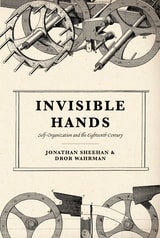
Invisible Hands
Self-Organization and the Eighteenth CenturyJonathan Sheehan and Dror Wahrman
University of Chicago Press, 2015
A synthesis of eighteenth-century intellectual and cultural developments that offers an original explanation of how Enlightenment thought grappled with the problem of divine agency.
Why is the world orderly, and how does this order come to be? Human beings inhabit a multitude of apparently ordered systems—natural, social, political, economic, cognitive, and others—whose origins and purposes are often obscure. In the eighteenth century, older certainties about such orders, rooted in either divine providence or the mechanical operations of nature, began to fall away. In their place arose a new appreciation for the complexity of things, a new recognition of the world’s disorder and randomness, new doubts about simple relations of cause and effect—but with them also a new ability to imagine the world’s orders, whether natural or manmade, as self-organizing. If large systems are left to their own devices, eighteenth-century Europeans increasingly came to believe, order will emerge on its own without any need for external design or direction.
In Invisible Hands, Jonathan Sheehan and Dror Wahrman trace the many appearances of the language of self-organization in the eighteenth-century West. Across an array of domains, including religion, society, philosophy, science, politics, economy, and law, they show how and why this way of thinking came into the public view, then grew in prominence and arrived at the threshold of the nineteenth century in versatile, multifarious, and often surprising forms. Offering a new synthesis of intellectual and cultural developments, Invisible Hands is a landmark contribution to the history of the Enlightenment and eighteenth-century culture.
[more]
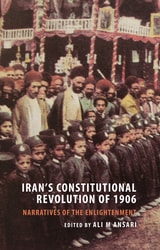
Iran's Constitutional Revolution of 1906 and Narratives of the Enlightenment
Edited by Ali Ansari
Gingko, 2016
The Constitutional Revolution of 1906 opened the way for enormous change in Persia, heralding the modern era and creating a model for later political and cultural movements in the region. Broad in its scope, this multidisciplinary volume brings together essays from leading scholars in Iranian Studies to explore the significance of this revolution, its origins, and the people who made it happen.
As the authors show, this period was one of unprecedented debate within Iran’s burgeoning press. Many different groups fought to shape the course of the Revolution, which opened up seemingly boundless possibilities for the country’s future and affected nearly every segment of its society. Exploring themes such as the role of women, the use of photography, and the uniqueness of the Revolution as an Iranian experience, the authors tell a story of immense transition, as the old order of the Shah subsided and was replaced by new institutions, new forms of expression, and a new social and political order.
As the authors show, this period was one of unprecedented debate within Iran’s burgeoning press. Many different groups fought to shape the course of the Revolution, which opened up seemingly boundless possibilities for the country’s future and affected nearly every segment of its society. Exploring themes such as the role of women, the use of photography, and the uniqueness of the Revolution as an Iranian experience, the authors tell a story of immense transition, as the old order of the Shah subsided and was replaced by new institutions, new forms of expression, and a new social and political order.
[more]