Results by title
329 books match the query 'Folklore & Mythology' and 9 start with i
If Beale Street Could Talk
Music, Community, CultureRobert Cantwell
University of Illinois Press, 2008
Demonstrating the intimate connections among our public, political, and personal lives, these essays by Robert Cantwell explore the vernacular culture of everyday life. A keen and innovative observer of American culture, Cantwell casts a broad and penetrating intelligence over the cultural functioning of popular texts, artifacts, and performers, examining how cultural practices become performances and how performances become artifacts endowed with new meaning through the transformative acts of imagination. Cantwell's points of departure range from the visual and the literary--a photograph of Woody Guthrie, or a poem by John Keats--to major cultural exhibitions such as the World's Columbian Exposition. In all these domains, he unravels the implications for community and cultural life of a continual migration, transformation, and reformulation of cultural content.
[more]

If You Don't Laugh You'll Cry
The Occupational Humor of White Wisconsin Prison WorkersClaire Schmidt
University of Wisconsin Press, 2017
America is fascinated by prisons and prison culture, but few Americans understand what it is like to work in corrections. Claire Schmidt, whose extended family includes three generations of Wisconsin prison workers, introduces readers to penitentiary officers and staff as they share stories, debate the role of corrections in American racial politics and social justice, and talk about the important function of humor in their jobs.
In a state that locks up a disproportionate number of men and women of color, white prison workers occupy a complicated social position as representatives of institutional authority and bearers of social stigma. The job, by turns dangerous, dull, or dehumanizing, is aided by a quick wit, comedic timing, and verbal agility. The men and women who do this work rely on storytelling, practical jokes, and sarcasm to bond with each other, build flexible relationships with inmates, and create personal identities that work in and out of prison. Schmidt shows how this humorous occupational culture both upholds and undermines prisons as social institutions.
Issues of power and race, as well as sex and gender, infuse Schmidt's groundbreaking analysis, and she also engages with current scholarship about identity, occupational folklore, and family narrative. This eye-opening, provocative book reveals the invisible culture, beliefs, and aesthetics embedded in workplace humor.
[more]
Imagined States
Nationalism, Utopia, and Longing in Oral Culturesedited by Luisa Del Giudice & Gerald Porter
Utah State University Press, 2003
An international ensemble of folklore scholars looks at varied ways in which national and ethnic groups have traditionally and creatively used imagined states of existence-some idealizations, some demonizations-in the construction of identities for themselves and for others. Drawing on oral traditions, especially as represented in traditional ballads, broadsides, and tale collections, the contributors consider fertile landscapes of the mind where utopias overflow with bliss and abundance, stereotyped national and ethnic caricatures define the lives of "others," nostalgia glorifies home and occupation, and idealized and mythological animals serve as cultural icons and guideposts to harmonious social life.
[more]
Improvised Adolescence
Somali Bantu Teenage Refugees in AmericaSandra Grady
University of Wisconsin Press, 2015
Changing from child to young adult is difficult everywhere. But to experience childhood in continuous flight from conflict, then move into adolescence as a refugee in a radically different culture, is a more than usually complicated transition for teens and for their parents, communities, teachers, and social workers.
Improvised Adolescence explores how teenagers from southern Somalia, who spent much of their childhood in East African refugee camps, are adapting to resettlement in the American Midwest. The collapse of the Somali state in 1991, and subsequent chaos in the Horn of Africa, disrupted the lives of these young people educationally, culturally, and developmentally. Folklorist Sandra Grady has intermittently observed the lifeworld of these teens—their homes, their entertainment choices, their interaction with classmates and teachers at school, and their plans for the future—for more than seven years to understand the cultural tools they’ve used in their journey from this disrupted childhood. They negotiate two sets of cultural expectations: in the resettled Somali Bantu community, traditional rites of passage continue to mark the change from child to adult; in the surrounding U.S. culture, an unfamiliar in-between category—“adolescent”—delays adulthood. Offering analysis that is both engaging and theoretically grounded, Grady tracks the emergence in this immigrant community of an improvised adolescence.
Best books for public & secondary school libraries from university presses, American Library Association
[more]
In Search of Authenticity
The Formation of Folklore StudiesRegina Bendix
University of Wisconsin Press, 1997
Authenticity is a notion much debated, among discussants as diverse as cultural theorists and art dealers, music critics and tour operators. The desire to find and somehow capture or protect the “authentic” narrative, art object, or ceremonial dance is hardly new. In this masterful examination of German and American folklore studies from the eighteenth century to the present, Regina Bendix demonstrates that the longing for authenticity remains deeply implicated in scholarly approaches to cultural analysis.
Searches for authenticity, Bendix contends, have been a constant companion to the feelings of loss inherent in modernization, forever upholding a belief in a pristine yet endangered cultural essence and fueling cultural nationalism worldwide. Beginning with precursors of Herder and Emerson and the “discovery” of the authentic in expressive culture and literature, she traces the different, albeit intertwined, histories of German Volkskunde and American folklore studies. A Swiss native educated in American folklore programs, Bendix moves effortlessly between the two traditions, demonstrating how the notion of authenticity was used not only to foster national causes, but also to lay the foundations for categories of documentation and analysis within the nascent field of folklore studies.
Bendix shows that, in an increasingly transcultural world, where Zulu singers back up Paul Simon and where indigenous artists seek copyright for their traditional crafts, the politics of authenticity mingles with the forces of the market. Arguing against the dichotomies implied in the very idea of authenticity, she underscores the emptiness of efforts to distinguish between folklore and fakelore, between echt and ersatz.
[more]
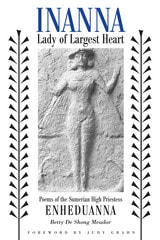
Inanna, Lady of Largest Heart
Poems of the Sumerian High Priestess EnheduannaBy Betty De Shong Meador
University of Texas Press, 2001
That these poems deal immediately with the very popular 'goddess literature' and with an individual woman in a most important historical situation should give this work widespread appeal.-John Maier, SUNY College at Brockport, cotranslator of the Epic of GilgameshThe earliest known author of written literature was a woman named Enheduanna, who lived in ancient Mesopotamia around 2300 BCE. High Priestess to the moon god Nanna, Enheduanna came to venerate the goddess Inanna above all gods in the Sumerian pantheon. The hymns she wrote to Inanna constitute the earliest written portrayal of an ancient goddess. In their celebration of Enheduanna's relationship with Inanna, they also represent the first existing account of an individual's consciousness of her inner life. This book provides the complete texts of Enheduanna's hymns to Inanna, skillfully and beautifully rendered by Betty De Shong Meador, who also discusses how the poems reflect Enheduanna's own spiritual and psychological liberation from being an obedient daughter in the shadow of her ruler father. Meador frames the poems with background information on the religious and cultural systems of ancient Mesopotamia and the known facts of Enheduanna's life. With this information, she explores the role of Inanna as the archetypal feminine, the first goddess who encompasses both the celestial and the earthly and shows forth the full scope of women's potential.
[more]
Inari Sámi Folklore
Stories from AanaarAugust V. Koskimies and Toivo I. Itkonen, revised by Lea Laitinen; Edited and translated by Tim Frandy
University of Wisconsin Press, 2020
A rich multivoiced anthology of folktales, legends, joik songs, proverbs, riddles, and other verbal art, this is the most comprehensive collection of Sámi oral tradition available in English to date. Collected by August V. Koskimies and Toivo I. Itkonen in the 1880s from nearly two dozen storytellers from the arctic Aanaar (Inari) region of northeast Finland, the material reveals a complex web of social relations that existed both inside and far beyond the community.
First published in 1918 only in the Aanaar Sámi language and in Finnish, this anthology is now available in a centennial English-language edition for a global readership. Translator Tim Frandy has added biographies of the storytellers, maps and period photos, annotations, and a glossary. In headnotes that contextualize the stories, he explains such underlying themes as Aanaar conflicts with neighboring Sámi and Finnish communities, the collapse of the wild reindeer populations less than a century before, and the pre-Christian past in Aanaar. He introduces us to the bawdy humor of Antti Kitti, the didacticism of Iisakki Mannermaa, and the feminist leanings of Juho Petteri Lusmaniemi, emphasizing that folktales and proverbs are rooted in the experiences of individuals who are links in a living tradition.
First published in 1918 only in the Aanaar Sámi language and in Finnish, this anthology is now available in a centennial English-language edition for a global readership. Translator Tim Frandy has added biographies of the storytellers, maps and period photos, annotations, and a glossary. In headnotes that contextualize the stories, he explains such underlying themes as Aanaar conflicts with neighboring Sámi and Finnish communities, the collapse of the wild reindeer populations less than a century before, and the pre-Christian past in Aanaar. He introduces us to the bawdy humor of Antti Kitti, the didacticism of Iisakki Mannermaa, and the feminist leanings of Juho Petteri Lusmaniemi, emphasizing that folktales and proverbs are rooted in the experiences of individuals who are links in a living tradition.
[more]
Indian Tales of North America
An Anthology for the Adult ReaderEdited by Tristam P. Coffin
University of Texas Press, 1961
This collection of folktales, originally published in 1961, presents stories from a wide range of North American indigenous peoples. The stories are grouped into three categories: “The Way the World Is,” “What Man Must Know and Learn,” and “The Excitement of Living.”
[more]
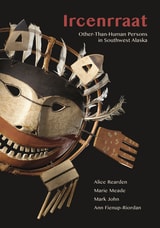
Ircenrraat
Other-Than-Human Persons in Southwest AlaskaAlice Rearden
University of Alaska Press, 2021
At Calista Education and Culture, we have been documenting Yup'ik traditional knowledge in southwest Alaska since 1998. During many of our discussions with elders, the subject of ircenrraat, the little people, would pop up. They are said to be miniature in size, and very crafty, and they exist in a different dimension with the ability to appear and disappear as they please in our world. Those who have encountered them have witnessed them hunting, fishing, and gathering together as our own people do. They have also stated that being invited to their dwellings for a day is like a year in our lifetime. We have been fortunate to have heard many stories, and we are pleased to put them together in this book.
[more]