Results by title
130 books match the query 'Gender identity' and 7 start with i
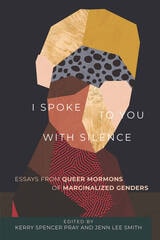
I Spoke to You with Silence
Essays from Queer Mormons of Marginalized GendersEdited by Kerry Spencer Pray and Jenn Lee Smith
University of Utah Press, 2022
This collection of essays gives voice to queer Mormons. The authors who share their stories—many speaking for the first time from the closet—do so here in simple narrative prose. They talk about their identities, their experiences, their relationships, their heartbreaks, their beliefs, and the challenges they face. Some stay in the church, some do not, some are in constant battles with themselves and the people around them as they make agonizing decisions about love and faith and community. Their stories bravely convey what it means to be queer, Mormon, and marginalized—what it means to have no voice and yet to speak anyway.

Identity Complex
Making the Case for MultiplicityMichael Hames-García
University of Minnesota Press, 2011
In seemingly exhaustive arguments about identity as a category of analysis, we have made a critical error—one that Michael Hames-García sets out to correct in this revisionary look at the making and meaning of social identities. We have asked how separate identities—of race, class, ethnicity, gender, and sexuality—come to intersect. Instead, Hames-García proposes, we should begin by understanding such social identities as mutually constituting one another.
Grounded in both theoretical and political practices—in the lived realities of people’s experience—Identity Complex reinvigorates identity as a key concept and as a tool for the pursuit of social justice. Hames-García draws on a wide range of examples to show that social identities are central to how exploitation works, such as debates about the desirability of sexual minority identities in postcolonial contexts, questions about the reality of race, and the nature of the U.S. prison crisis.
Unless we understand precisely how identities take shape in relation to each other and within contexts of oppression, he contends, we will never be able to eradicate discrimination and social inequality. By analyzing the social interdependence of identities, Hames-García seeks to enable the creation of deep connections of solidarity across differences.
Identity, Mediation, and the Cunning of Capital
Ani Maitra
Northwestern University Press, 2020
Maitra’s archive is transnational and multimodal. Moving from anticolonial polemics to psychoanalysis to diasporic experimental literature to postcolonial feminist and queer media, he lays bare the cunning by which capitalism produces and fragments identity through an intermedial “aesthetic dissonance” with the commodity form. Maitra’s novel contribution to theories of identity and to the concept of mediation will interest a wide range of scholars in media studies, critical race and postcolonial studies, and critical aesthetics.
Imagining Transgender
An Ethnography of a CategoryDavid Valentine
Duke University Press, 2007
Valentine argues that “transgender” has been adopted so rapidly in the contemporary United States because it clarifies a model of gender and sexuality that has been gaining traction within feminism, psychiatry, and mainstream gay and lesbian politics since the 1970s: a paradigm in which gender and sexuality are distinct arenas of human experience. This distinction and the identity categories based on it erase the experiences of some gender-variant people—particularly poor persons of color—who conceive of gender and sexuality in other terms. While recognizing the important advances transgender has facilitated, Valentine argues that a broad vision of social justice must include, simultaneously, an attentiveness to the politics of language and a recognition of how social theoretical models and broader political economies are embedded in the day-to-day politics of identity.
Immaterial Archives
An African Diaspora Poetics of LossJenny Sharpe
Northwestern University Press, 2020
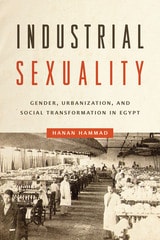
Industrial Sexuality
Gender, Urbanization, and Social Transformation in EgyptBy Hanan Hammad
University of Texas Press, 2016
Sara A. Whaley Book Prize, National Women's Studies Association, 2017
AMEWS Book Award, Journal of Middle Eastern Studies, 2017
Millions of Egyptian men, women, and children first experienced industrial work, urban life, and the transition from peasant-based and handcraft cultures to factory organization and hierarchy in the years between the two world wars. Their struggles to live in new places, inhabit new customs, and establish and abide by new urban norms and moral and gender orders underlie the story of the making of modern urban life—a story that has not been previously told from the perspective of Egypt’s working class.
Reconstructing the ordinary urban experiences of workers in al-Mahalla al-Kubra, home of the largest and most successful Egyptian textile factory, Industrial Sexuality investigates how the industrial urbanization of Egypt transformed masculine and feminine identities, sexualities, and public morality. Basing her account on archival sources that no researcher has previously used, Hanan Hammad describes how coercive industrial organization and hierarchy concentrated thousands of men, women, and children at work and at home under the authority of unfamiliar men, thus intensifying sexual harassment, child molestation, prostitution, and public exposure of private heterosexual and homosexual relationships. By juxtaposing these social experiences of daily life with national modernist discourses, Hammad demonstrates that ordinary industrial workers, handloom weavers, street vendors, lower-class landladies, and prostitutes—no less than the middle and upper classes—played a key role in shaping the Egyptian experience of modernity.
Is the Rectum a Grave?
and Other EssaysLeo Bersani
University of Chicago Press, 2009
Over the course of a distinguished career, critic Leo Bersani has tackled a range of issues in his writing, and this collection gathers together some of his finest work. Beginning with one of the foundations of queer theory—his famous meditation on how sex leads to a shattering of the self, “Is the Rectum a Grave?”—this volume charts the inspired connections Bersani has made between sexuality, psychoanalysis, and aesthetics.
Over the course of these essays, Bersani grapples with thinkers ranging from Plato to Descartes to Georg Simmel. Foucault and Freud recur as key figures, and although Foucault rejected psychoanalysis, Bersani contends that by considering his ideas alongside Freud’s, one gains a clearer understanding of human identity and how we relate to one another. For Bersani, art represents a crucial guide for conceiving new ways of connecting to the world, and so, in many of these essays, he stresses the importance of aesthetics, analyzing works by Genet, Caravaggio, Proust, Almodóvar, and Godard.
Documenting over two decades in the life of one of the best minds working in the humanities today, Is the Rectum a Grave? and Other Essays is a unique opportunity to explore the fruitful career of a formidable intellect.