Results by title
153 books match the query 'Genres' and 6 start with i

I Died a Million Times
Gangster Noir in Midcentury AmericaRobert Miklitsch
University of Illinois Press, 2020
With the Senate's organized crime hearings and the brighter-than-bright myth of the American Dream as a backdrop, Miklitsch examines the style and history, and the production and cultural politics, of classic pictures from The Big Heat and The Asphalt Jungle to lesser-known gems like 711 Ocean Drive and post-Fifties movies like Ocean’s Eleven. Miklitsch pays particular attention to trademark leitmotifs including the individual versus the collective, the family as a locus of dissension and rapport, the real-world roots of the heist picture, and the syndicate as an octopus with its tentacles deep into law enforcement, corporate America, and government. If the memes of gangster noir remain prototypically dark, the look of the films becomes lighter and flatter, reflecting the influence of television and the realization that, under the cover of respectability, crime had moved from the underworld into the mainstream of contemporary everyday life.

I'd Just as Soon Kiss a Wookiee
Uncovering Racialized Desire in the Star Wars GalaxyGreg Carter
University of Texas Press, 2025
How the Star Wars trilogies and their fandoms have engaged with and mirrored American beliefs about race and gender.
2026 Award for Best Single Work, Popular Culture Association (MPCA)
The Star Wars saga takes place in a galaxy far, far away, but its social structures—in particular its racial realities—are thoroughly American. So argues Greg Carter in this thought-provoking analysis, which blends historical and theoretical treatments of science fiction cinema and Star Wars fandom to explore the subtle mirroring between fantasy and the communities that create and consume it.
I’d Just as Soon Kiss a Wookiee draws on insights from prominent scholars to examine fictional relationships between groups perceived to be biologically different. Three areas of commonality between the United States and Star Wars arise: stiff regulation of racial mixture; racialized servitude, with nonhumans placed in positions of bondage; and the presumption of white male supremacy. None of these are functions of the of the Star Wars story; rather, they index the expectations of US society. But expectations have also shifted since Star Wars launched in 1977, and the franchise with it. Carter gauges minority and mainstream fan reactions, finding that, while science fiction enthusiasts have a reputation for progressiveness, the truth turns out to be as complicated as US racism itself.
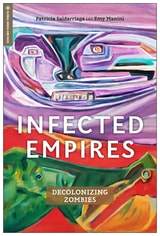
Infected Empires
Decolonizing ZombiesPatricia Saldarriaga
Rutgers University Press, 2022
Studying films from around the world, including Latin America, Asia, Africa, the US, and Europe, Infected Empires presents a vision of a global zombie that points toward a posthuman and feminist future.
Given the current moment—polarized populations, increasing climate fears, and decline of supranational institutions in favor of a rising tide of nationalisms—it is easy to understand the proliferation of apocalyptic and dystopian elements in popular culture. Infected Empires examines one of the most popular figures in contemporary apocalyptic film: the zombie. This harbinger of apocalypse reveals bloody truths about the human condition, the wounds of history, and methods of contending with them.
Infected Empires considers parallels in the zombie genre to historical and current events on different political, theological and philosophical levels, and proposes that the zombie can be read as a figure of decolonization and an allegory of resistance to oppressive structures that racialize, marginalize, disable, and dispose of bodies.

Infrastructure in Dystopian and Post-apocalyptic Film, 1968–2021
Christian Long
Intellect Books, 2024
Dystopian and post-apocalyptic movies from 1968 to 2021 usually conclude with optimism, giving the audience a window into what is possible in the face of social dysfunction. The infrastructure that peeks through at the edges of the frame surfaces some of the concrete ways in which dystopian and post-apocalyptic survivors have made do with their damaged and destroyed worlds. In this book, Christian B. Long argues that if the happy endings so common to mass-audience films do not provide an all-encompassing vision of a better world, the presence of infrastructure, whether old or retrofitted or new, offers a starting point for the continued work of building toward the future.
Film imaginings of energy, transportation, water, waste, and their combination in the food system reveal what might be essential infrastructure on which to build the new post-dystopian and post-apocalyptic communities. We can look to dystopian and post-apocalyptic movies for a sense of where we might begin.

Innocent Lens
Race and Visibility on the Swedish ScreenBenjamin Mier-Cruz
University of Wisconsin Press, 2027
Sweden, like other Nordic countries, prides itself on being “colorblind” or immune to the kinds of racism found in, for example, the United States. In the 1960s and 1970s, white Swedish documentarians, in the fashion of early anthropologists, recorded racial tensions amid the US civil rights movement. More recently, in the twenty-first century, short films produced by Swedes of color have tackled racism and bigotry within Sweden.
Benjamin Mier-Cruz offers a comparative study of these two periods of Swedish documentary filmmaking. “Racially innocent” white documentarians of the mid-twentieth century developed an “aesthetics of altruism” predicated on Sweden’s assumed racial equalitarianism—a notion that their documentaries in turn helped create and maintain. In contemporary films, on the other hand, Swedes of color use the same filmic format to challenge not only their predecessors’ reductionist, pseudo-anthropological presentations but also Sweden’s purportedly colorblind ideology. Mier-Cruz’s close readings of films from both eras demonstrate the possibilities and limitations of the documentary form and the ways in which it is motivated by politics and activism.
Intransigent Imaginaries
Black Ambivalence in Media and CultureJerome P. Dent, Jr.
Rutgers University Press, 2027
Intransigent Imaginaries: Black Ambivalence in Media and Culture examines why Blackness continues to function as antagonism in fantasy, science fiction, and horror, even in contemporary films and television created by Black artists and celebrated for their progressive politics. Drawing on Afropessimism, psychoanalysis, and genre theory, Jerome P. Dent, Jr. argues that genre itself organizes desire, threat, and narrative closure in ways that consistently position Blackness as danger, excess, or containment. Rather than focusing on whether representations are positive or negative, the book shifts attention to the narrative architectures and visual economies that make those images possible in the first place. Through close readings of works such as Get Out, Us, Nope, Black Panther, A Wrinkle in Time, and major science fiction franchises, Intransigent Imaginaries challenges dominant assumptions about progress, representation, and repair. Refusing the consolations of uplift, the book insists on analytic clarity, asking what criticism looks like when redemption is structurally foreclosed.