Results by title
51 books match the query 'Holocaust survivors' and 3 start with i
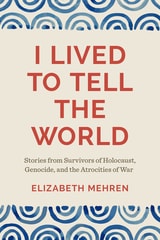
I Lived to Tell the World
Stories from Survivors of Holocaust, Genocide, and the Atrocities of WarElizabeth Mehren
Oregon State University Press, 2024
The 2025 Oregon Center for the Book Adult Readers' Selection
The 2025 NYC BIG BOOK AWARD Distinguished Favorite in the category of Cultural and Social Issues
Foreword INDIES 2024 Book of the Year Award Finalist - Multiculturalism & Regional
As Americans increasingly question how each of us fits into our nation's cultural tapestry, I Lived to Tell the World presents thirteen inspiring profiles of refugees who have settled in Oregon. They come from Rwanda, Myanmar, Bosnia, Syria, and more-different stories, different conflicts, but similar paths through loss and violence to a new, not always easy, life in the United States. The in-depth profiles are drawn from hours of interviews and oral histories; journalist Elizabeth Mehren worked collaboratively with the survivors to honor the complexity of their experiences and to ensure that the stories are told with, and not just about, them. Mehren also weaves in historical, cultural, and political context alongside these personal stories of resilience.
In the face of global cruelty and hatred, the courage and fortitude of these individuals illuminate the darkness. Their stories inspire readers to reflect on their own experiences and to view newcomers to America with renewed respect. As more states adopt Holocaust and genocide education curricula and as issues around refugees, immigration, and racial justice gain attention, I Lived to Tell the World highlights the purposeful lives led by these Oregonians despite their painful pasts. Their experiences not only humanize the atrocities often seen in headlines, but also convey a universal message of hope.
In the Aftermath of Genocide
Armenians and Jews in Twentieth-Century FranceMaud S. Mandel
Duke University Press, 2003
In the Aftermath of Genocide reveals that Armenian and Jewish survivors rarely sought to shed the obvious symbols of their ethnic and religious identities. Mandel shows that following the 1915 genocide and the Holocaust, these communities, if anything, seemed increasingly willing to mobilize in their own self-defense and thereby call attention to their distinctiveness. Most Armenian and Jewish survivors were neither prepared to give up their minority status nor willing to migrate to their national homelands of Armenia and Israel. In the Aftermath of Genocide suggests that the consolidation of the nation-state system in twentieth-century Europe led survivors of genocide to fashion identities for themselves as ethnic minorities despite the dangers implicit in that status.
Invisible Walls and To Remember is to Heal
A German Family under the Nuremberg LawsIngeborg Hecht
Northwestern University Press, 1999
In Invisible Walls, Hecht writes of what it was like to live under these circumstances, sharing heartbreaking details of her personal life, including the loss of her daughter's father on the Russian front; the death of her own father after his deportation in 1944; and her fears of perishing coupled with the shame of faring better than most of her family and friends. This new volume adds the first translation of part of Hecht's second book, To Remember is to Heal, a collection of vignettes of encounters and experiences that resulted from the publication of the first.