Results by title
405 books match the query 'Human Geography' and 16 start with i
Ice Geographies
The Colonial Politics of Race and Indigeneity in the ArcticJen Rose Smith
Duke University Press, 2025
Imagined Olympians
Body Culture And Colonial Representation In RwandaJohn Bale
University of Minnesota Press, 2002
Imperial Texas
An Interpretive Essay in Cultural GeographyBy D. W. Meinig
University of Texas Press, 1969
Imperial Texas examines the development of Texas as a human region, from the simple outline of the Spanish colony to the complex patterns of the modern state. In this study in cultural geography set into a historical framework, D. W. Meinig discusses the "various peoples of Texas, who they are, where they came from, where they settled, and how they are proportioned one to another from place to place." After examining the historical framework, he then presents detailed analyses of the major regions of modem Texas and an over-all characterization of the state and its people. He concludes that, although Texas has never been the empire that it has sometimes been called, "nevertheless... Texas is something more than just one-fourteenth of the American area, one-twentieth of the American people, and one-fiftieth of the American union."

In Place/Out of Place
Geography, Ideology, and TransgressionTim Cresswell
University of Minnesota Press, 1996
In Place/Out of Place was first published in 1996. Minnesota Archive Editions uses digital technology to make long-unavailable books once again accessible, and are published unaltered from the original University of Minnesota Press editions.
What is the relationship between place and behavior? In this fascinating volume, Tim Cresswell examines this question via "transgressive acts" that are judged as inappropriate not only because they are committed by marginalized groups but also because of where they occur.
In Place/Out of Place seeks to illustrate the ways in which the idea of geographical deviance is used as an ideological tool to maintain an established order. Cresswell looks at graffiti in New York City, the attempts by various "hippie" groups to hold a free festival at Stonehenge during the summer solstices of 1984–86, and the Greenham Common Women's Peace Camp in Berkshire, England. In each of the cases described, the groups involved were designated as out of place both by the media and by politicians, whose descriptions included an array of images such as dirt, disease, madness, and foreignness.
Cresswell argues that space and place are key factors in the definition of deviance and, conversely, that space and place are used to construct notions of order and propriety. In addition, whereas ideological concepts being expressed about what is good, just, and appropriate often are delineated geographically, the transgression of these delineations reveals the normally hidden relationships between place and ideology-in other words, the "out-of-place" serves to highlight and define the "in-place." By looking at the transgressions of the marginalized, Cresswell argues, we can gain a novel perspective on the "normal" and "taken-for-granted" expectations of everyday life. The book concludes with a consideration of the possibility of a "politics of transgression," arguing for a link between the challenging of spatial boundaries and the possibility of social transformation.
Tim Cresswell is currently lecturer in geography at the University of Wales.

In The Nature Of Things
Language, Politics, and the EnvironmentJane Bennett
University of Minnesota Press, 1993
Informed by recent developments in literary criticism and social theory, In the Nature of Things addresses the presumption that nature exists independent of culture and, in particular, of language. The theoretical approaches of the contributors represent both modernist and postmodernist positions, including feminist theory, critical theory, Marxism, science fiction, theology, and botany. They demonstrate how the concept of nature is invoked and constituted in a wide range of cultural projects—from the Bible to science fiction movies, from hunting to green consumerism. Ultimately, it weeks to link the work of theorists concerned with nature and the environment to nontheorists who share similar concerns.
Contributors include R. McGreggor Cawley, Romand Coles, William E. Connolly, Jan E. Dizard, Valerie Hartouni, Cheri Lucas Jennings, Bruce H. Jennings, Timothy W. Luke, Shane Phelan, John Rodman, Michael J. Shapiro, and Wade Sikorski.
In the Meantime
Temporality and Cultural PoliticsSarah Sharma
Duke University Press, 2014
In the Space of Theory
Postfoundational Geographies of the Nation-StateMatthew Sparke
University of Minnesota Press, 2005
In the Space of Theory details the territorial implications of the Iraq war, NAFTA, welfare reform, constitutional reform, cross-border regional development, and the legal battles of First Nations. In using antiessentialist arguments to elucidate the complexity of these developments, Sparke seeks to ground and critique postfoundational theory itself. He shows how the postfoundational arguments of Homi Bhabha, Arjun Appadurai, Timothy Mitchell, Ernesto Laclau, Chantal Mouffe, Michael Hardt, and Antonio Negri obscure politically important processes of reterritorialization at the same time they deterritorialize diverse theoretical assumptions about the nation-state. Engaged with theory and grounded in close study of cultural, political, and economic change, In the Space of Theory explores the geographies of struggle that at once underlie and undermine the hyphen in contemporary nation-states.
Matthew Sparke is associate professor of geography and international studies at the University of Washington.
Indian Migration and Empire
A Colonial Genealogy of the Modern StateRadhika Mongia
Duke University Press, 2018
Indigenous Development in the Andes
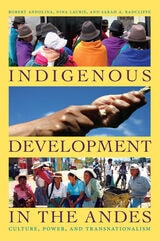
Culture, Power, and TransnationalismRobert Andolina, Nina Laurie, and Sarah A. Radcliffe
Duke University Press, 2009
The authors argue that this reconfiguration of development policy and practice permits Ecuadorian and Bolivian indigenous groups to renegotiate their relationship to development as subjects who contribute and participate. Yet it also recasts indigenous peoples and their cultures as objects of intervention and largely fails to address fundamental concerns of indigenous movements, including racism, national inequalities, and international dependencies. Andean indigenous peoples are less marginalized, but they face ongoing dilemmas of identity and agency as their fields of action cross national boundaries and overlap with powerful institutions. Focusing on the encounters of indigenous peoples with international development as they negotiate issues related to land, water, professionalization, and gender, Indigenous Development in the Andes offers a comprehensive analysis of the diverse consequences of neoliberal development, and it underscores crucial questions about globalization, governance, cultural identity, and social movements.
Informational Peripheries
Rethinking the Urban in a Digital AgeEdited by Ayona Datta and Fenna Imara Hoefsloot
University College London, 2025
Moving beyond current scholarship in urban and regional studies, this volume presents a case for “informational peripheries” as an analytical lens to understand the uneven, fragmented, and disconnected geographies of urban peripheries in the Global South. While this concept is parallel to and overlaps with the urban periphery, the circulation—or restriction—of information has taken on additional significance with the coming of a digital age. The periphery is no longer confined to the slums or suburbia at a city's edge; it now also encompasses uneven and fragmented digital infrastructures.
Providing empirical and theoretical contributions from cities in the Global South, this book advances scholarship in Southern urbanism, smart cities, and peripheral urbanization, conceptualizing the diverse ways in which informational peripheries are resisted, adapted, complied with, and lived in.
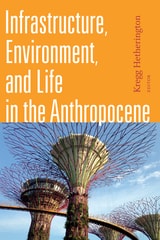
Infrastructure, Environment, and Life in the Anthropocene
Kregg Hetherington, editor
Duke University Press, 2019
Contributors. Nikhil Anand, Andrea Ballestero, Bruce Braun, Ashley Carse, Gastón R. Gordillo, Kregg Hetherington, Casper Bruun Jensen, Joseph Masco, Shaylih Muehlmann, Natasha Myers, Stephanie Wakefield, Austin Zeiderman
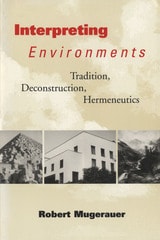
Interpreting Environments
Tradition, Deconstruction, HermeneuticsBy Robert Mugerauer
University of Texas Press, 1995
In this pioneering book, Robert Mugerauer seeks to make deconstruction and hermeneutics accessible to people in the environmental disciplines, including architecture, planning, urban studies, environmental studies, and cultural geography.
Mugerauer demonstrates each methodology through a case study. The first study uses the traditional approach to recover the meaning of Jung's and Wittgenstein's houses by analyzing their historical, intentional contexts. The second case study utilizes deconstruction to explore Egyptian, French neoclassical, and postmodern attempts to use pyramids to constitute a sense of lasting presence. And the third case study employs hermeneutics to reveal how the American understanding of the natural landscape has evolved from religious to secular to ecological since the nineteenth century.
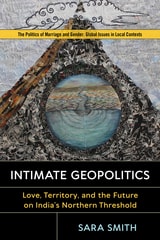
Intimate Geopolitics
Love, Territory, and the Future on India’s Northern ThresholdSara Smith
Rutgers University Press, 2020
2021 Foreword Indies Finalist - Politics and Social Sciences
Intimate Geopolitics begins with a love story set in the Himalayan region of Ladakh, in India’s Jammu and Kashmir State, but this is also a story about territory, and the ways that love, marriage, and young people are caught up in contemporary global processes. In Ladakh, children grow up to adopt a religious identity in part to be counted in the census, and to vote in elections. Religion, population, and voting blocs are implicitly tied to territorial sovereignty and marriage across religious boundaries becomes a geopolitical problem in an area that seeks to define insiders and outsiders in relation to borders and national identity. This book populates territory, a conventionally abstract rendering of space, with the stories of those who live through territorial struggle at marriage and birth ceremonies, in the kitchen and in the bazaar, in heartbreak and in joy. Intimate Geopolitics argues for the incorporation of the role of time–temporality–into our understanding of territory.
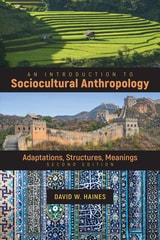
Introduction to Sociocultural Anthropology
Adaptations, Structures, MeaningsDavid Haines
University Press of Colorado, 2017
An Introduction to Sociocultural Anthropology exposes students to the cultural detail and personal experiences that lie in the anthropological record and extends their anthropological understanding to contemporary issues.
The book is divided into three parts that focus on the main themes of the discipline: ecological adaptations, structural arrangements, and interpretive meanings. Each chapter provides an overview of a particular topic and then presents two case examples that illuminate the range of variation in traditional and contemporary societies. New case examples include herders’ climate change adaptations in the Arctic, matrilineal Muslims in Indonesia, Google’s AI winning the Asian game Go, mass migration in China, cross-cultural differences in the use of social media, and the North American response to the Syrian refugee crisis. Instructors will also have digital access to all the book’s illustrations for class review.
Covering the full range of sociocultural anthropology in a compact approach, this revised and updated edition of Cultural Anthropology: Adaptations, Structures, Meanings is a holistic, accessible, and socially relevant guide to the discipline for students at all levels.
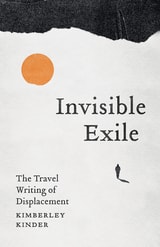
Invisible Exile
The Travel Writing of DisplacementKimberley Kinder
University of Minnesota Press, 2025
Mapping the transformative personal journeys of the displaced
The travel writing genre has long been associated with a certain kind of privileged and autonomous journey, encouraged by society and geared toward individual growth. Presenting an important counterpoint to this tradition, Invisible Exile considers a diverse set of narratives that explore travel undertaken as a result of displacement. In this creative work of cultural geography, Kimberley Kinder sheds light on the transformative accounts of those who must navigate across and within spatial boundaries due to marginalization and violence.
Unfolding as an extended trip, with each chapter marking out the next phase of one imaginatively constructed itinerary, Invisible Exile analyzes forty works in which the authors grapple with themes of loss and alienation. Kinder emphasizes the aspect of travel writing that posits spatial movement as a means of reinventing oneself, showcasing the personal insight and renewal these travelers find on their paths into, through, and partially out of exile.
By foregrounding the experiences of forced and reluctant migrants and refugees, Invisible Exile poses a critical challenge to the existing genre of travel literature, expanding its scope. Examining a vast range of twenty-first-century writings, Kinder crafts a moving, episodic journey that carries readers through displacement, transformation, and redemption.
Retail e-book files for this title are screen-reader friendly.
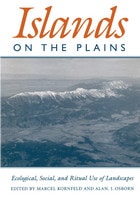
Islands On The Plains
Ecological, Social, and Ritual Use of LandscapesEdited by Marcel Kornfeld and Alan J. Osborn
University of Utah Press, 2003
Scattered throughout the Great Plains are many isolated areas of varying size and ecology, quite distinct from the surrounding grasslands. Such spaces can be uplands like the Black Hills, low hills like the Nebraska Sand Hills, or linear areas such as shallow river valleys and deeply incised canyons. While the notion of “islands” is not a new one among ecologists, its application in Plains archaeology is.
The contributors to this volume seek to illustrate the different ways that the spatial, structural, and temporal nature of islands conditioned the behavior and adaptation of past Plains peoples. This as a first step toward a more detailed analysis of habitat variation and its effects on Plains cultural dynamics and evolution. Although the emphasis is on ecology, several chapters also address social and ideological islands in the form of sacred sites and special hunting grounds.